In 30 seconds
In this September 26, 2025 livestream, investor Mike Maples explains his framework for finding durable startups, OpenAI research lead Ahmed El-Kishky describes a 12-problem ICPC result, and Intelligent Internet founder Emad Mostaque proposes ways to distribute the benefits of AI. Hosts Matthew Berman and Nick Wentz also discuss model releases and conduct a small, subjective image-model comparison. Predictions and company claims are presented in their historical context.
- 1Scarcity in an era of AIMaples asks what becomes valuable if inference becomes much cheaper and seeks products with distinctive, durable advantages.
- 2Industry expertise as a defenseHe argues that integrating AI into complex sectors can require capabilities beyond a general-purpose model.
- 3How the ICPC system workedEl-Kishky describes GPT-5 and an experimental reasoning model generating candidate solutions, selecting submissions and eventually solving twelve problems.
- 4A small blind comparisonThe hosts choose among image outputs before seeing the model labels; preferences differ by prompt.
- 5A proposal for universal AIMostaque suggests open access and public-benefit computing funded by a digital asset, while acknowledging the difficulty of building a wider economic system.
Takeaways
- Maples looks for distinctive insights and industry-specific capabilities that can survive rapid improvements in general AI models.
- The ICPC system generated multiple candidate programs and selected submissions; its contest result does not by itself prove broad software-engineering competence.
- El-Kishky describes longer reasoning and reinforcement learning as research directions, while treating scientific discoveries as a future goal.
- The hosts’ image comparison illustrates different strengths on a handful of prompts, not an overall model ranking.
- Mostaque proposes open AI access and public-benefit computing to address possible economic concentration, but his financing and economic ideas remain unproven.
Read the edited text by chapter
Introductions and news
The hosts introduce their guests and discuss online exchanges and hiring fraud. They distinguish reported events from their own interpretation.
Matthew Berman and co-host Nick Wentz introduce the September 26, 2025 show and its guests: Floodgate investor Mike Maples, OpenAI researcher Ahmed El-Kishky, and Intelligent Internet founder Emad Mostaque.
Berman recounts an exchange with Elon Musk about Musk’s assessment of OpenAI’s prospects against Google. Berman points to 2018 emails, while acknowledging that one statement contained a condition about changes in execution.
Musk replied that he had estimated a 1% chance rather than zero. Berman agrees those probabilities differ, but argues that the wording in the cited email supports his recollection; the hosts treat it as a dispute over what was said and its context.
The hosts discuss an account of remote IT workers using false identities and AI-assisted interview tools. They distinguish reported conduct from speculation about motives or security risks, and note that interview fraud is not confined to one country.
Wentz raises the possibility of a security problem beyond fraudulent hiring. Berman describes long pauses during AI-assisted interviews and says the issue adds to his interest in working in person, although it is not his only reason.
Mike Maples on AI investing
Maples discusses non-consensus ideas, startup differentiation and venture-fund strategy. He considers how industry knowledge may create defensible products.
Mike Maples joins the show. Before discussing AI investing, he returns to the hosts’ exchange about Musk and argues that it is a mistake to expect a person with unconventional opinions to be right all the time.
Maples says a genuinely non-consensus bet must carry a risk of being wrong: an investor who wants to outperform an index also risks underperforming it. He evaluates venture investments by the magnitude of outcomes and expected value, not just the fraction of predictions that prove correct.
Berman agrees with the larger point but says his narrow objection concerned whether Musk had said something at all. The discussion then shifts from personality to how an early-stage investor sees the AI wave.
Maples compares eras of abundant computation and connectivity. When personal computers made computing widely available, valuable software emerged; internet connectivity later enabled networks that aggregated users and attention.
He calls AI an era of potentially abundant cognition and asks what will become scarce and valuable if inference gets much cheaper. This is an investment framework and a hypothetical future, not an assertion that intelligence already costs nothing.
Rather than focus only on autonomous agents, Maples looks for tools that amplify high-agency people. He imagines systems that help a sales leader, marketer or executive understand their own organization and act more effectively.
As an example, a chief legal officer could use an intelligence system to compare contracts, risks and opportunities across jurisdictions. The value would lie in understanding the company’s particular situation rather than simply answering generic questions.
Maples defines a breakthrough startup as a seemingly heretical business idea that turns out to be right. Airbnb and ride-sharing sounded implausible to many people before changes in technology and behavior made the models viable.
He uses mobile location technology as an example of an enabling inflection: once riders and drivers can locate each other in real time, a founder can see a new market structure. The valuable insight is not merely that a technology exists, but what it makes possible.
AI creates many simultaneous opportunities, but Maples warns that an appealing feature can be copied if everyone exploits the same change. A startup needs a distinctive insight or capability to capture value instead of competing away its margins.
Vertical companies may have an advantage when they combine AI with deep industry knowledge. Maples cites Applied Intuition’s automotive work, where delivery depends on simulation, software architecture and relationships with manufacturers.
Asked about the risk that a powerful general model could absorb a startup’s product, Maples says he prefers businesses that can succeed regardless of the next model release. Integrating software into vehicles involves much more than model quality.
He contrasts the complexity of redesigning a car’s software and supply chain with a thin application that merely wraps a model. His point is not that all vertical products are defensible, but that deep integration can create a more durable position.
On founders, Maples distinguishes independent, non-consensus thinking from disagreeing merely for the sake of being contrarian. He looks for people who notice a missing piece of the future while experimenting and create something that solves a real problem.
A founder also needs to persuade early believers to move toward that different future. Maples values focus, determination and the willingness to endure ridicule, while recognizing that a novel idea can still be wrong.
Asked whether disagreeableness can be learned, Maples says it can develop early and need not mean being rude. For him it means being willing to hold a different view and enjoying the challenge of working through difficult problems.
He compares the satisfaction of building with founders to the eventual financial reward of an exit. The adventure, uncertainty and effort of persuading others are part of what he finds meaningful in venture investing.
Maples describes two fund strategies: scaling assets while seeking a good return, and keeping a fund sized for unusually high returns, or alpha. He argues that funds should be clear about which strategy they are pursuing rather than drifting between them.
For a smaller fund, he says success depends on recognizing breakthrough companies before they become obvious and staying disciplined about where the fund has an advantage. Different venture strategies can coexist.
He gives his own rough return targets: about 15% of investments returning 20 times the initial check, and, for an exceptional result, 5% returning 100 times. These are his fund’s heuristics, not a promise or a general investment rule.
Valuation matters because a high entry price makes a given multiple harder to achieve, although it is not the only determinant. Maples compares investing to waiting for a suitable pitch rather than swinging at every opportunity.
On startup geography, Maples sees an advantage in San Francisco because people there can see emerging AI capabilities early. His broader advice is to find places where a plausible future is already visible, wherever they happen to be.
Maples contrasts incumbents, which typically extend existing advantages, with startups that can challenge the rules of a market. He thinks rapid change can favor upstarts, while acknowledging that most unconventional startups fail.
Proactive AI and model releases
The hosts examine ChatGPT Pulse and discuss recent video and image models. Their release impressions and film timelines reflect September 2025.
After Maples leaves, the hosts turn to ChatGPT Pulse, announced that week as a way to deliver personalized updates proactively. Wentz says it could help people who have not yet formed a habit of asking an assistant for information.
Berman connects the idea to “sleeptime compute”: doing work asynchronously before the user asks. He suggests that background computation could use less busy periods and return a more prepared result, though those economics depend on deployment.
The hosts see personalization as central to proactive assistance. Berman says users can refine their interests, such as AI news or local Bay Area updates, rather than relying only on information inferred from past conversations.
They review several video models, including Wan 2.5, which is described as generating short 1080p clips with synchronized sound. The hosts are uncertain during the broadcast about its open-source availability and do not resolve that question.
Kling 2.5 Turbo is presented as another fast video option, and the hosts mention Qwen Image and Luma’s Ray3. Their impressions reflect announced features and selected examples, not a controlled comparison of all capabilities.
Asked when an AI-generated film people enjoy might appear, Wentz guesses six or seven months and Berman estimates 18 to 24 months. Both answers are predictions made in September 2025, not established timelines.
Ahmed El-Kishky on reasoning and ICPC
The OpenAI researcher discusses reinforcement learning, longer reasoning and a coding-contest system. He explains candidate generation, verification and the final accepted solution.
Ahmed El-Kishky, an OpenAI research lead, joins to discuss reasoning, coding and the team’s ICPC result. His team focuses on helping models work through hard problems and use tools, including for software engineering.
El-Kishky says competition problems are useful benchmarks because answers can often be verified. The next challenge is harder to quantify: good software design, effective engineering and eventually the discovery of new scientific knowledge.
Asked about timing, he personally predicts that models could contribute new scientific knowledge by the following year. This was his 2025 forecast; the interview does not establish that such discoveries had already happened.
Berman asks whether longer reasoning time or faster, more efficient reasoning matters more. El-Kishky says both matter: his team works on longer reasoning while training can also make use of each reasoning token more effective.
He describes reinforcement learning in broad terms: offer progressively harder problems, allow the model to try approaches and use feedback to improve. The analogy with human learning is explanatory, not a disclosure of the detailed training recipe.
The research challenge includes finding intermediate problems that are difficult, verifiable and relevant to the skills desired later. An ambitious goal such as a medical breakthrough cannot simply be assumed solved by scaling a competition benchmark.
El-Kishky recalls early programming models failing simple contest problems or exhausting memory with poor solutions. Over successive training runs, their contest ratings improved, giving the team a measurable sign of progress.
OpenAI staff compared model ratings with those of colleagues who were competitive programmers, including Mark Chen. El-Kishky says the contest was a stepping stone toward more general reasoning, not the final research goal.
Asked whether reasoning scaling has hit a ceiling, he says the team has not seen much plateauing and expects the approach to remain useful. He cites a refactoring task that took a Codex model seven hours and an AtCoder heuristic competition that ran for ten.
On background or “sleeptime” computation, El-Kishky sees the same general shift toward longer-running tasks rather than a wholly separate paradigm. A researcher might allow an assistant hours or longer, periodically check progress and receive a result later.
The discussion turns to the International Collegiate Programming Contest world finals. El-Kishky explains that student teams of three share one computer and have five hours to solve twelve difficult problems, which an automated judge checks for correctness and resource limits.
OpenAI used GPT-5 and an experimental reasoning model in its setup. The models generated multiple candidate solutions and the experimental model selected which to submit; the team reported solving all twelve problems. This contest result does not measure every aspect of real-world engineering.
Because submissions can affect tie-breaking, selecting a candidate matters. El-Kishky describes the system as a relatively simple setup assembled shortly before the event, rather than a single model producing one answer in one uninterrupted pass.
One strategy impressed the researchers: the model wrote an easy brute-force solution, compared it with an optimized solution on tests, then submitted the efficient version. El-Kishky says the team did not explicitly prompt that strategy and attributes its emergence to training.
The team expected a strong result but not necessarily twelve out of twelve. El-Kishky says GPT-5 solved the first eleven on its first attempts, while the final problem required repeated submissions and a longer-thinking experimental model.
The final answer was accepted on the ninth attempt with roughly 20 to 30 minutes remaining, according to his account. The result shows what that particular system achieved under contest conditions, including candidate generation and verification.
El-Kishky says coding matters to OpenAI partly because researchers can use coding tools in their own work. In a possible future, models might prepare experiments and help advance AI research; he does not claim that a self-improving research loop is already complete.
Reproducing a research paper is a useful precursor to proposing and testing new ideas, he argues. Software experiments have a comparatively accessible feedback loop: write code, run it with compute and inspect results.
His next hoped-for milestone is not another contest score but contributions to meaningful human knowledge. He imagines models working on mathematics or science for extended periods, while presenting that as an aspiration.
The hosts ask how OpenAI should allocate limited compute among training, products, safety and research. El-Kishky says all matter and argues for more capacity, while emphasizing that increasingly capable models also need safety and alignment work.
Pressed for a number, he says researchers could use as much additional compute as available. He is especially interested in tasks such as assessing real engineering work and new proofs, where defining useful rewards remains difficult.
Image models in a blind comparison
The hosts compare four image models across several prompts. They reveal the labels and explain their subjective choices.
The hosts begin a blind image comparison: four models receive the same prompt, their outputs are shown without labels, and the hosts select favorites before the labels are revealed. The exercise is informal and uses a small set of examples.
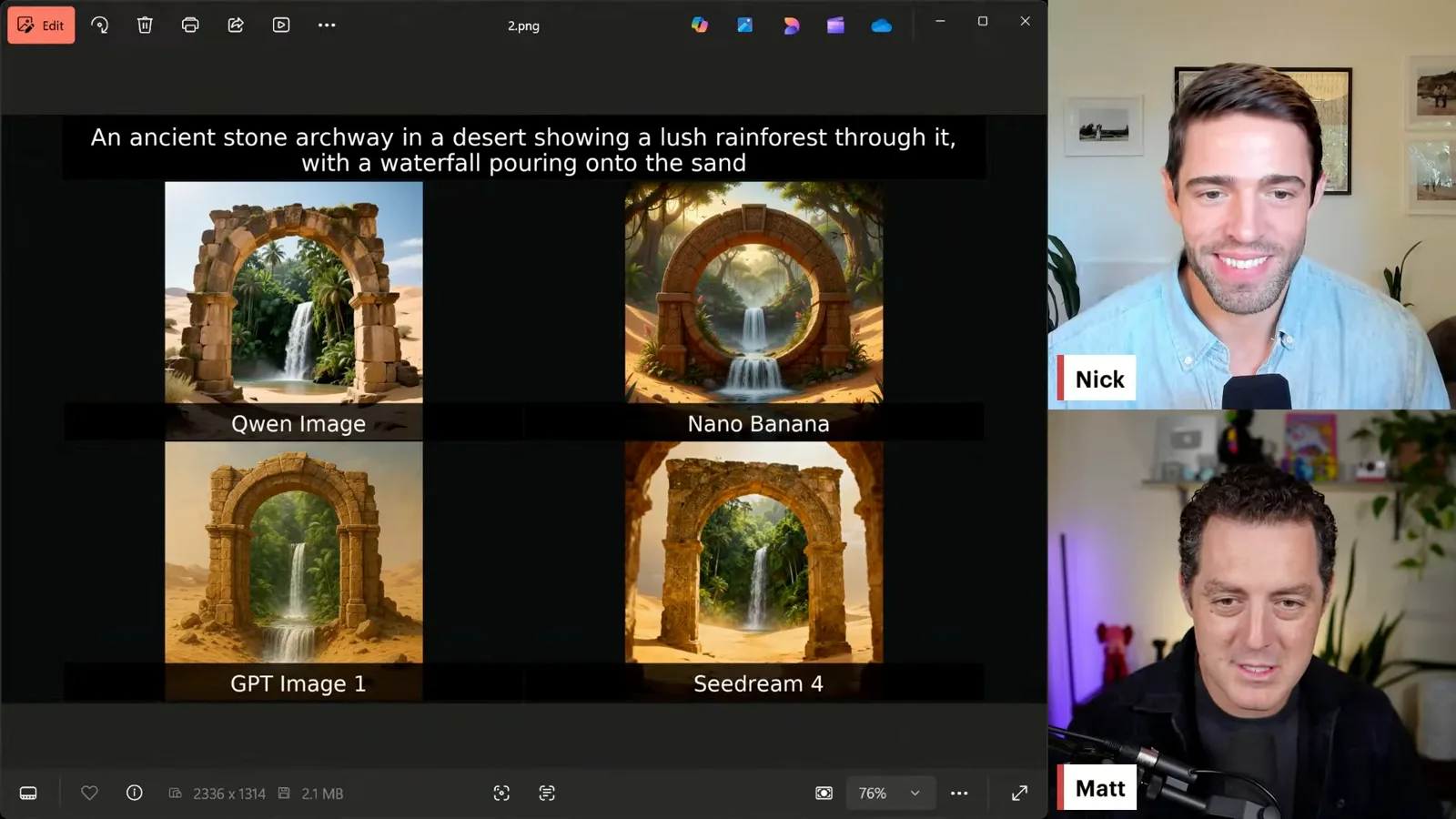
The first prompt asks for a stone arch in a desert opening onto rainforest and a waterfall. Both initially favor the fourth image, later revealed as Seedream 4; Qwen Image is another strong contender in their subjective assessment.
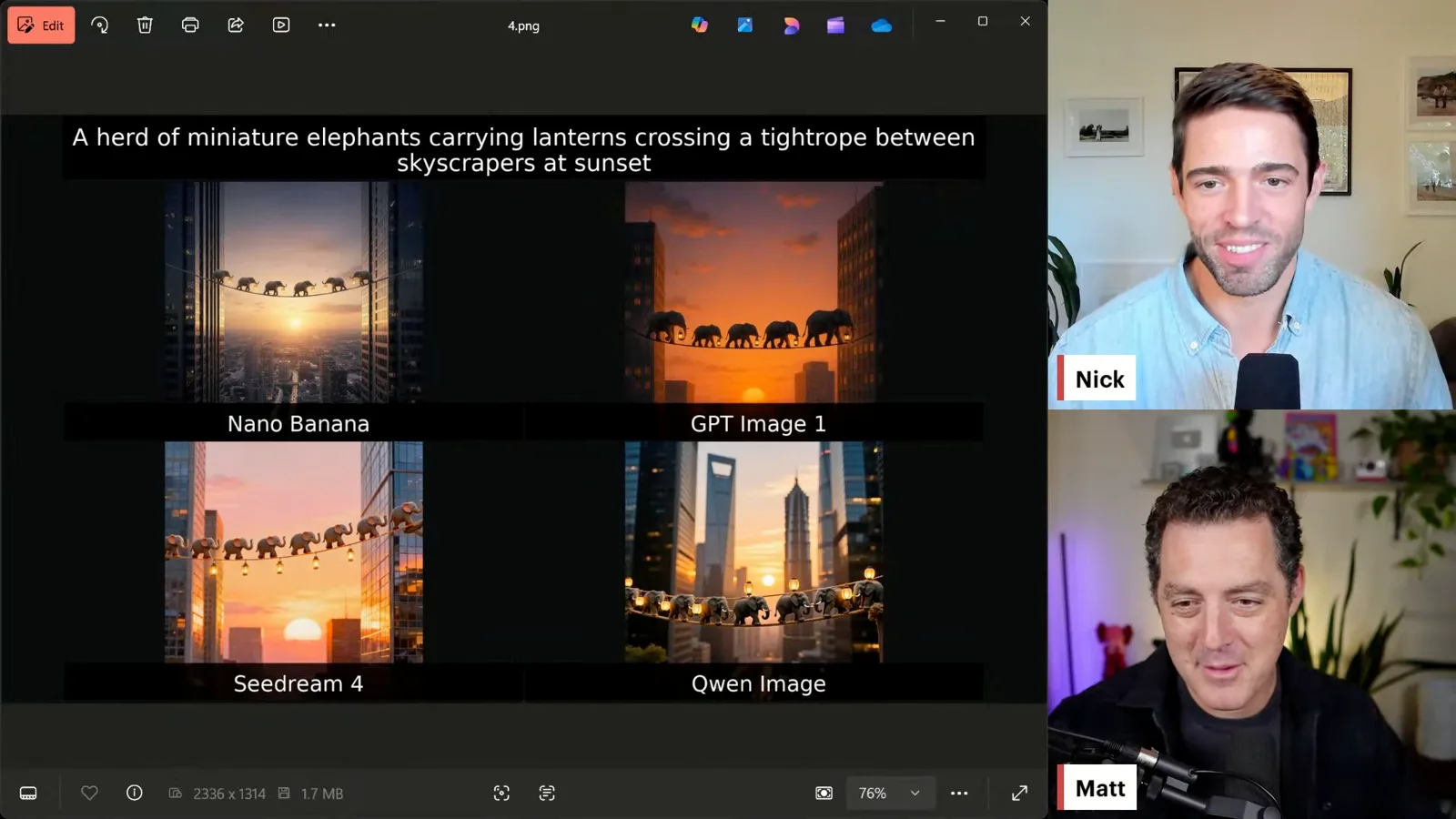
A second prompt asks for miniature elephants carrying lanterns across a tightrope between skyscrapers. Berman prefers the fourth image, Qwen Image, while Wentz chooses the first, Nano Banana; each values different visual details.
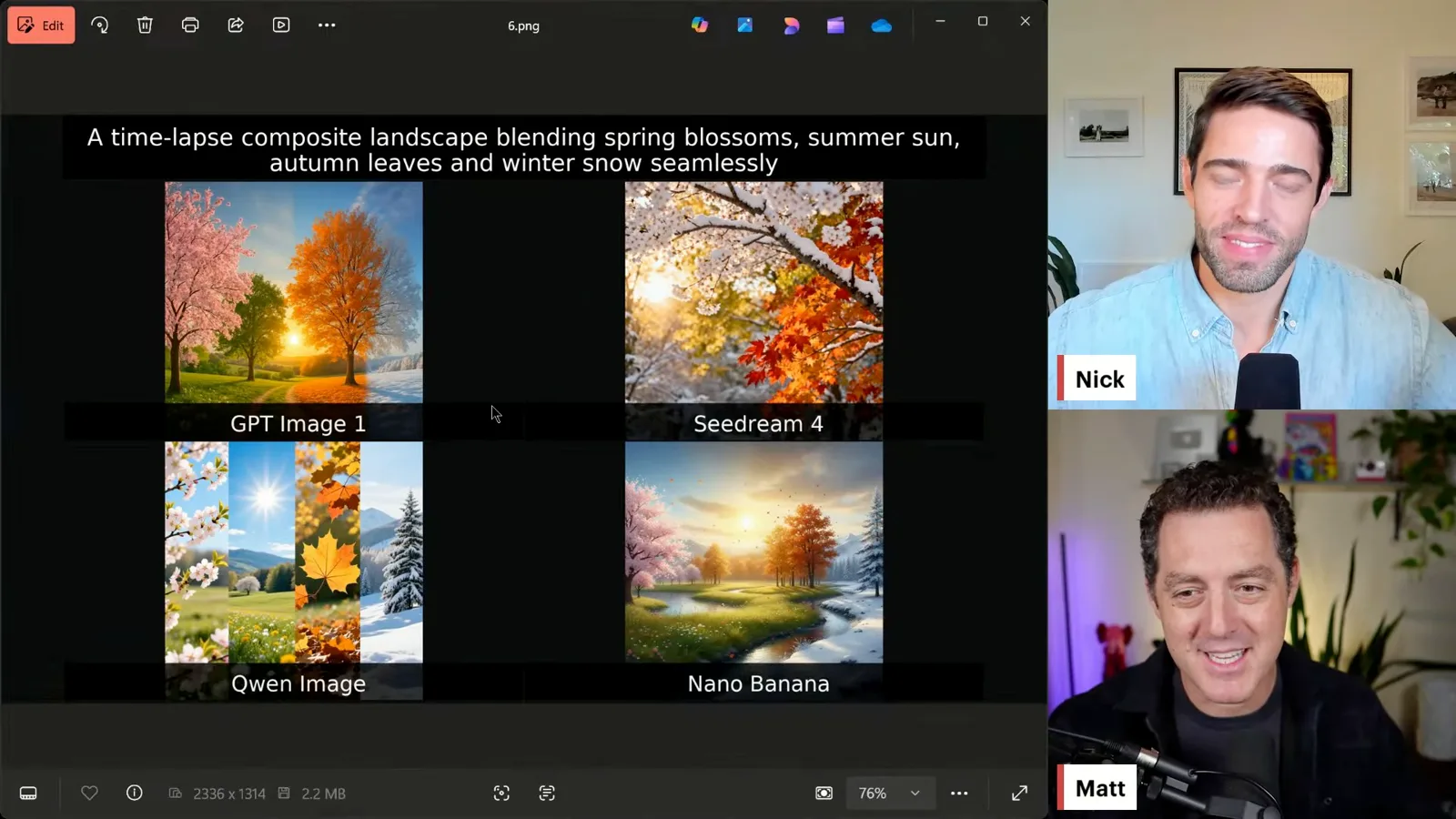
For a landscape combining all four seasons, Berman chooses GPT Image 1 and Wentz prefers Nano Banana. They criticize the Qwen output for separating the seasons into panels rather than blending them as requested.
In an image-editing prompt, the models must turn Berman into a superhero and another participant into a photographer. The hosts compare likeness and instruction following; Wentz chooses Nano Banana while Berman favors a different result.
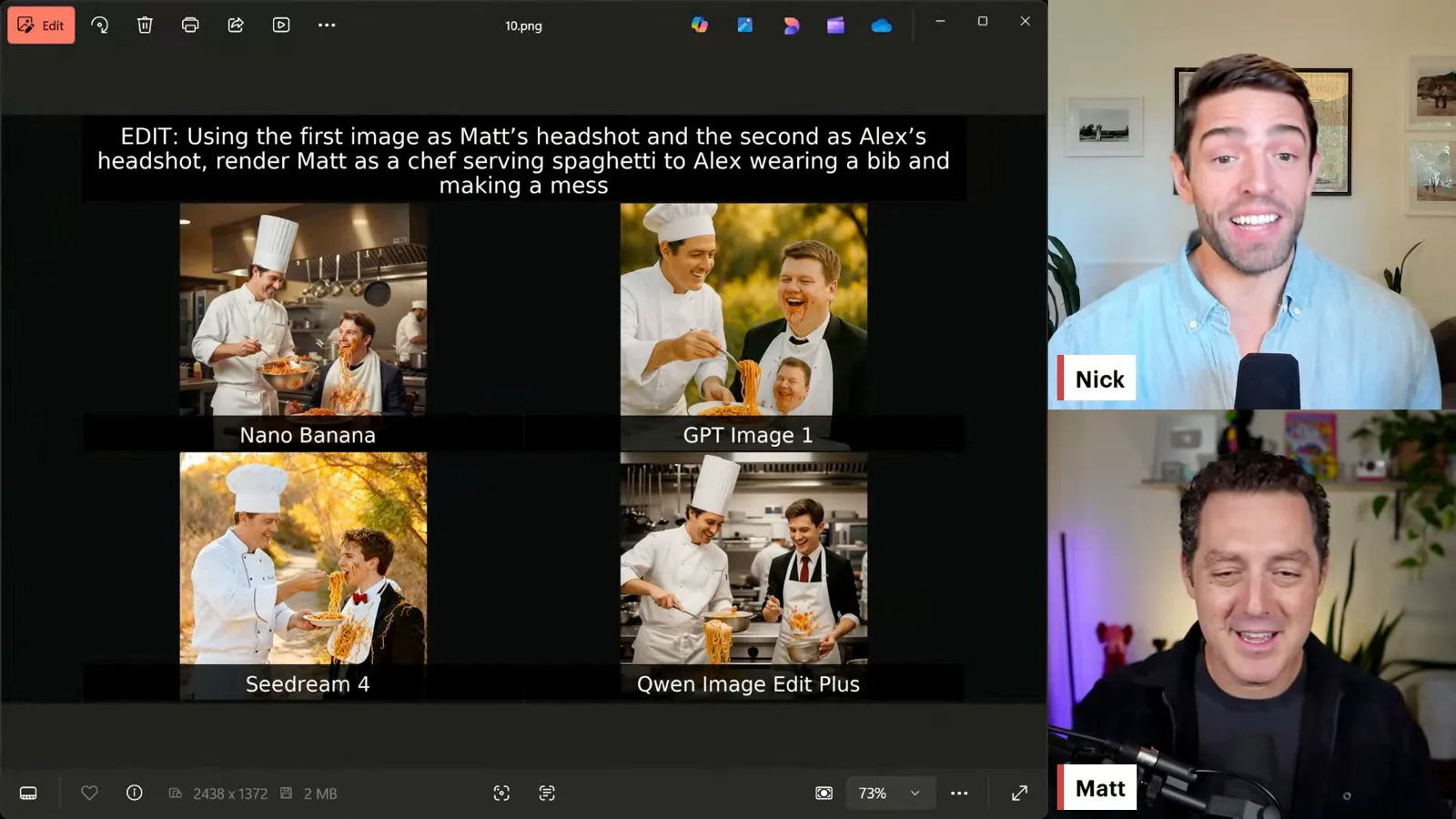
A final editing prompt depicts Berman serving spaghetti to Alex. The hosts favor the GPT Image 1 result for likeness and humor. Across these few prompts, preferences vary; the segment is not a statistically meaningful model ranking.
Emad Mostaque on AI and the economy
Mostaque discusses open AI, economic disruption and a proposed public-benefit computing model. The hosts question his assumptions about automation, access and incentives.
The final guest is Emad Mostaque, founder of Intelligent Internet and formerly of Stability AI. He says his company is exploring open models and agents for areas such as health, education and government, alongside a proposed economic framework.
Mostaque introduces his book The Last Economy. He speculates that increasingly capable AI could change the economic role of human cognitive labor, and argues that society needs to consider how the benefits and power will be distributed.
The hosts ask about his prediction that traditional economic structures could become obsolete within about a thousand days. He suggests AI might perform much screen-based knowledge work, but this is his prediction, not an established outcome.
Mostaque worries that entry-level workers may have fewer opportunities and asks how graduates can navigate a transition. Berman raises the possibility that concentrated ownership of compute could create a persistent underclass.
Mostaque argues that the flow of money may change if owners substitute AI computation for labor. He proposes universal access to AI and a digital-asset system intended to fund public-benefit computing; the proposal has not been demonstrated to solve the distribution problem.
He describes a hypothetical highly automated software company, calling it Macrohard, as an illustration of the competitive power that concentrated compute might enable. Its capabilities are part of his scenario, not proof that such a company can replace the software industry.
Berman asks whether humans will continue to set goals and verify outputs while AI performs the middle of a workflow. Mostaque argues that verifiers and longer-running agents could reduce that need, but comparisons with programming contests and driving do not establish full autonomy in every domain.
On subjective tasks such as creative writing and interactions, Mostaque suggests models can learn broader concepts and adapt. Berman’s question remains important: judging outcomes without a clear verifier can be difficult, and the interview supplies no general proof that human review can be removed.
Mostaque says becoming a parent sharpened his concern about who builds the AI that children and institutions will use. He wants open data, transparent systems and models that can run on personal devices, with access to outside models when needed.
He describes his company’s plans for medical models and open software that might help check diagnoses. These are company claims and aspirations; model performance on a benchmark does not establish clinical safety or replace a medical professional.
His proposed financing model would direct proceeds from a digital asset toward computing for cancer research, education and other public uses. Mostaque presents it as a theory to test, not a proven way to finance medicine or guarantee returns.
Asked why he favors open source, Mostaque argues that concentration can embed unwanted biases and that people should be able to adapt an assistant to their own values. He favors open data and composable software in addition to open model weights.
Berman asks how people without technical skills could use such systems. Mostaque envisions an agent that helps configure the tools, learns a user’s preferences and can call a stronger external model when necessary; that is a design goal.
The discussion returns to “proof of benefit.” Mostaque proposes computing that serves useful public purposes while supporting a digital asset, and says the team intends to publish a fuller economic theory. He acknowledges that expanding it into a complete economic system would be hard.
He starts with the narrower idea of universal AI access, arguing that people who cannot afford subscriptions should still have useful tools. Whether the asset, governance and incentives would deliver that access remains an open question.
Berman challenges the assumption that people will buy an asset for collective benefit when they have immediate personal needs. Mostaque responds that buyers may also expect its price to rise and says the proposed system would direct resources to useful computing.
Mostaque compares the proposal with proof of work but says its computation would organize knowledge and build models. His claim that this would create trust or attractive economics is a proposal, not evidence of a viable investment or guaranteed appreciation.
Asked about an “abundance trap,” Mostaque says AI and robots might produce value without participating in the economy as humans do. He argues that society needs ways to distribute income and preserve human agency if those capabilities become widespread.
He emphasizes caring, relationships and applying technology to problems people value. His book offers ideas including a form of basic income, while he acknowledges that helping people adjust when work and identity change is a difficult collective task.
For children and students, Mostaque advocates practicing creative work with AI tools and learning by building things they care about. His suggestion of daily “vibe coding” is a personal recommendation, not a tested curriculum presented in the interview.
The hosts thank the guests and close the broadcast. Across the show, investment theses, model demonstrations and economic proposals are presented as views from September 2025, with the timing and outcomes of their predictions unresolved in the discussion.
More from this channel
 25:50EN
 32:20EN
 0:22EN
 45:08EN
 0:32EN
 12:14EN