In 30 seconds
In this February 2025 video, Matthew Berman comments on Sam Altman’s remarks in Japan and his essay “Three Observations.” He is optimistic about coding agents, scientific discovery and lower AI costs, while the most dramatic outcomes remain forecasts and scenarios. The video includes a Pollo AI sponsorship.
- 1Scaling and reasoningAltman describes approximately 100-fold increases in pretraining compute across GPT generations and new benchmark gains from reasoning methods.
- 2A feedback-loop scenarioBerman discusses the possibility of AI accelerating its own research, using an illustrative intelligence-explosion chart.
- 3Competitive coding estimatesAltman cites o3 and internal competitive-programming estimates and speculates about a top ranking by the end of 2025.
- 4Three economic observationsThe essay proposes relationships between resources and capability, falling usage costs, and the value of increased intelligence.
- 5Labor and capitalAltman and Berman raise the distributional consequences of automation and the possible need for intervention.
Takeaways
- Altman’s competitive-programming rankings and end-of-2025 target were estimates and predictions, not a general ranking of software engineers.
- Reinforcement learning with verifiable rewards and inference-time compute are related but distinct ways to improve reasoning performance.
- An AI-driven intelligence explosion is a speculative scenario, not a demonstrated consequence of scaling.
- Claims about declining AI prices and rising socioeconomic value depend on the comparison and may not continue at the same rate.
- Automation could bring scientific and economic gains while changing the balance between labor and capital.
Read the edited text by chapter
The 2025 forecast
Berman introduces his expectations for AI coding and scientific discovery. Altman describes scaling pretraining and reasoning models.
In February 2025, I argued that AI coding agents could soon outperform individual human coders and be copied at enormous scale. I also expect AI to advance scientific discovery and change society, although those outcomes and their timing remain forecasts, not demonstrated results.
Sam Altman spoke in Japan about rapid model progress, reasoning and lower costs. He said successive GPT generations used roughly 100 times as much pretraining compute and acquired new capabilities. That is a claim about training resources, not a measurement that intelligence increased 100-fold.
Altman said reinforcement learning had improved performance on some benchmarks enough that smaller reasoning models could achieve results previously expected from much larger models. He also emphasized that the new approach does not improve every capability equally.
At inference time, a reasoning model can spend longer working on a prompt. Training with reinforcement learning and allocating more computation at inference are distinct techniques, although they can complement one another in models such as the reasoning systems discussed here.
Verifiable rewards and scaling
Berman compares AI progress with Moore’s law and explains why some answers are easier to verify. The video then includes a Pollo AI sponsorship.
I compare the pace of AI progress with Moore's law, the historical observation about transistor density. Improvements in AI capability or service prices are not directly comparable to a doubling of transistor density: they measure different things.
Verifiable rewards help train models on tasks where a proposed solution can be checked, such as some mathematics and programming problems. A verifier can use an answer, tests or other criteria; it need not know every solution in advance. Subjective tasks such as poetry do not have the same straightforward check.
Scientific discovery and coding
Altman forecasts new scientific knowledge from larger models. Berman considers an intelligence-explosion scenario and competitive programming.
Altman expects that combining larger pretraining runs with these methods could bring the first signs of genuinely new scientific knowledge. This is an expectation about future models, not evidence that such a breakthrough has already occurred.
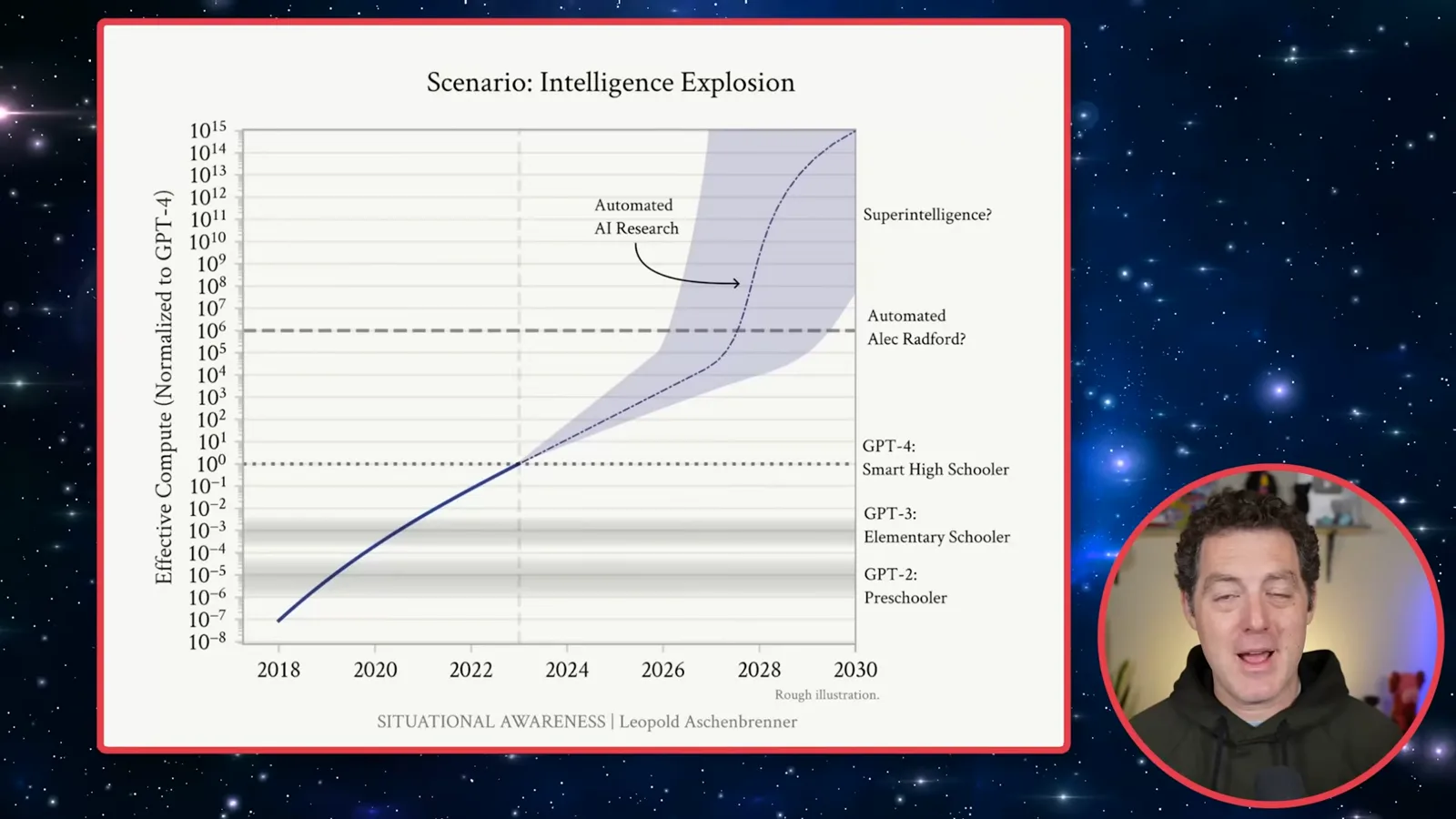
I return to Leopold Aschenbrenner's illustrative intelligence-explosion scenario: if AI research produces systems that improve AI research in turn, a feedback loop might accelerate progress. The chart is a scenario, and both the loop and its speed are uncertain.
I think coding could be an early area of exceptional AI performance. I draw an analogy with AlphaGo, whose self-play uncovered strategies such as its famous move 37; the analogy is suggestive, but software engineering involves more than a closed game with an agreed win condition.
Imagine copying a capable coding agent thousands or millions of times and having those agents work continuously. That scenario depends on actual model capability and on available compute, energy and practical deployment, rather than copying being free or unlimited.
Altman says the models he is discussing can program well when people have already done the relevant work, but are less capable of inventing new algorithms or science. He predicts that further increases in scale could change that; I regard the prospect as close, though the timing is speculative.
Altman describes a progression in competitive-programming estimates: an early reasoning model around the top million, another around the top 10,000, o3 around 175th and an internal result around 50th. He suggests the top rank might be reached by the end of 2025.
Those numbers concern competitive programming, not a direct ranking of every professional developer. I see coding, like chess and Go, as a domain where solutions can often be verified, but benchmark scores alone do not establish that a model is the world's best software engineer.
An agent that works for hours
Altman hopes future Pro models can tackle difficult questions using tools. Berman turns to the essay “Three Observations.”
Altman hopes that by the end of 2025 a Pro-tier user could give a model a difficult question and let it work for hours, using tools if necessary. He excludes problems requiring new scientific discovery; this is an aspiration about future capability, not a promise that AI can do virtually anything better than people.
I turn to Altman's essay 'Three Observations,' which says systems pointing toward AGI are coming into view. Its footnote explicitly says the essay's use of AGI is not intended to interpret or change the definitions governing OpenAI's relationship with Microsoft.
Altman presents AGI both as another tool in humanity's accumulation of technology and as a potentially different kind of change. I speculate that it might be the last major tool humans need to invent, while acknowledging that the consequences could be positive or negative.
The essay imagines curing disease, giving families more time and expanding creativity. I contrast that optimism with Altman's earlier warning against expecting an immediate AGI deployment. These are aspirations and predictions, not evidence of imminent cures or a settled deployment date.
Resources, costs and value
The essay links capability to resources, describes falling AI costs and proposes rapid growth in socioeconomic value.
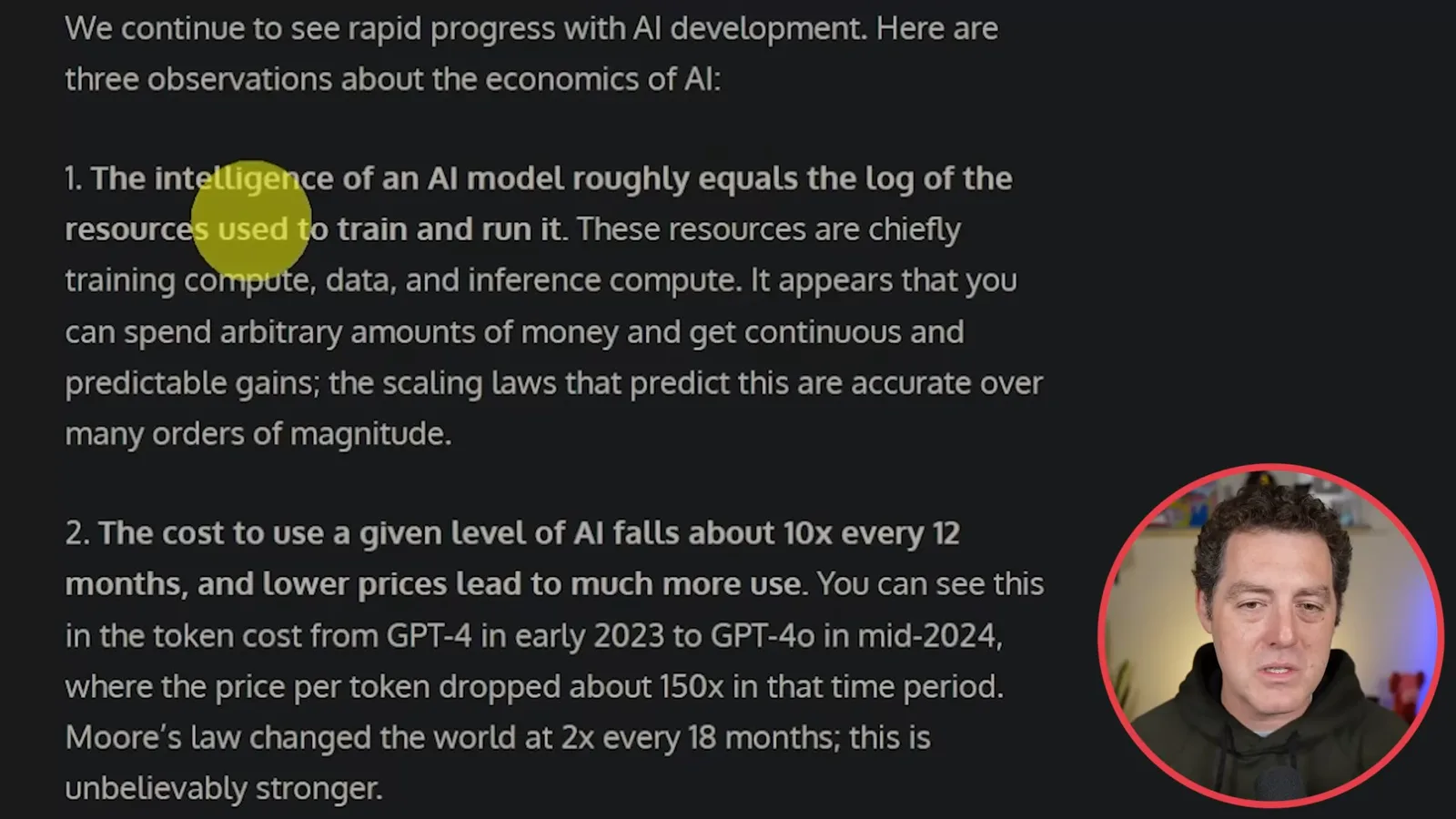
The first observation links model capability roughly to the logarithm of resources used in training and inference, including compute and data. Altman describes predictable gains across a range of scales; extrapolating those trends indefinitely, or to a particular discovery, remains uncertain.
The second observation is that the cost of using a given level of AI has fallen dramatically, with a claimed roughly tenfold annual reduction. The essay compares GPT-4 and GPT-4o token pricing; prices and model equivalence depend on the task, provider and input or output rates, and are not a universal physical law.
The third observation proposes that the socioeconomic value of increasing intelligence grows super-exponentially. I interpret this as a claim that value may increase faster than capability itself, but the size and distribution of that value are forecasts rather than established measurements.
Automation and its distribution
Berman considers replicated software agents and historical technology transitions. He closes with scientific hopes and concerns about labor and capital.
Altman asks readers to imagine an engineering agent able to do many tasks that take a skilled engineer up to a couple of days, then to imagine thousands or a million copies. I extend the thought experiment to other knowledge work; it should not be mistaken for a demonstrated workforce at that scale.
The essay compares AI with the transistor: an invention that spread through the economy until its effects became ordinary. I recommend Chip War for context on the history and geopolitics of semiconductors, while expecting AI's economic effects to become hard to ignore.
I expect disruption and friction as jobs change, but I am optimistic that people will find new activities. Mechanized agriculture reduced the share of workers needed on farms and helped make other occupations possible; that historical transition does not guarantee an easy or equally shared AI transition.
Faster scientific progress and lower prices for many goods are among the benefits I hope for. Altman also notes that scarce assets such as land and luxury goods might become more expensive, so improvements would not necessarily be distributed evenly.
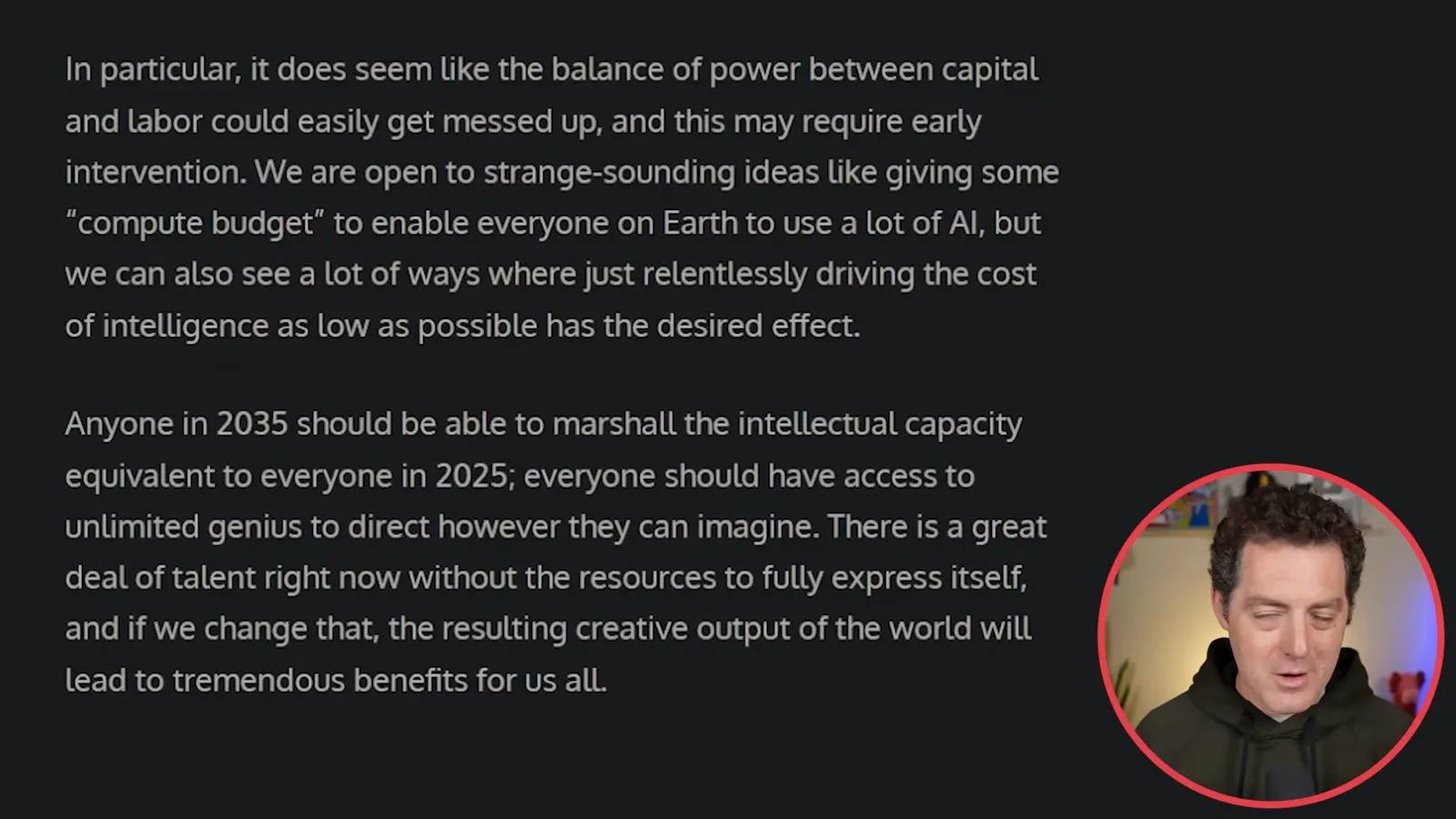
Altman warns that the balance of power between labor and capital could go wrong and may require early intervention. I worry that if owners can buy highly capable automated labor without the bargaining constraints of human workers, workers' negotiating power could weaken. Much remains unresolved even as I remain optimistic about the possibilities.
More from this channel
 25:50EN
 32:20EN
 45:08EN
 0:32EN
 12:14EN
 10:36EN