In 30 seconds
Granola co-founder Sam Stephenson joins Peter Yang to discuss preparing for meetings, learning from shared notes, and building an AI company around a calmer user experience. They also explore API and MCP integrations, interactive prototypes, the internal Nacho agent, and the work of refining a product after its first release. The episode is sponsored by Google AI Studio; Linear and Riverside are also listed as sponsors.
- 1Brief before the meetingBring relevant context together before a call, then use notes to recover what mattered afterward.
- 2Treat calm as a design constraintGranola makes core actions prominent and accepts reduced discoverability for a simpler experience.
- 3Respect the boundary around shared contextTeam searches draw on information the user can access; private meetings are not automatically visible to colleagues.
- 4Use existing connections for automationSam describes native scheduling as a future possibility; API and MCP users already connect external workflows.
- 5Pair coding agents with design judgmentReusable components, interactive prototypes and early feedback help teams retain coherence while building faster.
- 6Make internal knowledge usableGranola’s Nacho agent connects staff to information and tools, while human iteration continues to improve the product.
Takeaways
- Use a pre-meeting brief to surface useful context before the call and post-meeting notes to recover key points.
- A calmer interface may trade some feature discoverability for clarity and user control.
- Shared team knowledge can reveal trends, while access to private information remains bounded by permissions.
- Existing API and MCP connections enable external workflows; Sam discusses native automation as a possible future feature.
- Coding agents speed up prototypes, but shared design systems, feedback and sustained iteration remain essential.
Read the edited text by chapter
Prepare before and learn after meetings
Briefs and notes turn meeting context into useful preparation and reflection.
Granola co-founder Sam Stephenson says a useful meeting assistant begins before the call: a brief brings together relevant context so that participants arrive prepared. Peter Yang and Sam discuss how AI can make meetings less draining and how the company builds its own tools. The episode is sponsored by Google AI Studio, with Linear and Riverside also listed as sponsors.
One popular recipe answers “what did I miss?” after a meeting. Rather than forcing people to read a full transcript, Granola distills the conversation into useful notes, helping a participant return to the parts that matter.
Design for calm
Granola prioritizes simplicity, user control and a less intrusive assistant.
Sam shares Granola’s design principles: be calming, keep the core experience simple, and put the user in control. Meetings already create enough noise, so the product should feel like a handrail rather than another participant competing for attention.
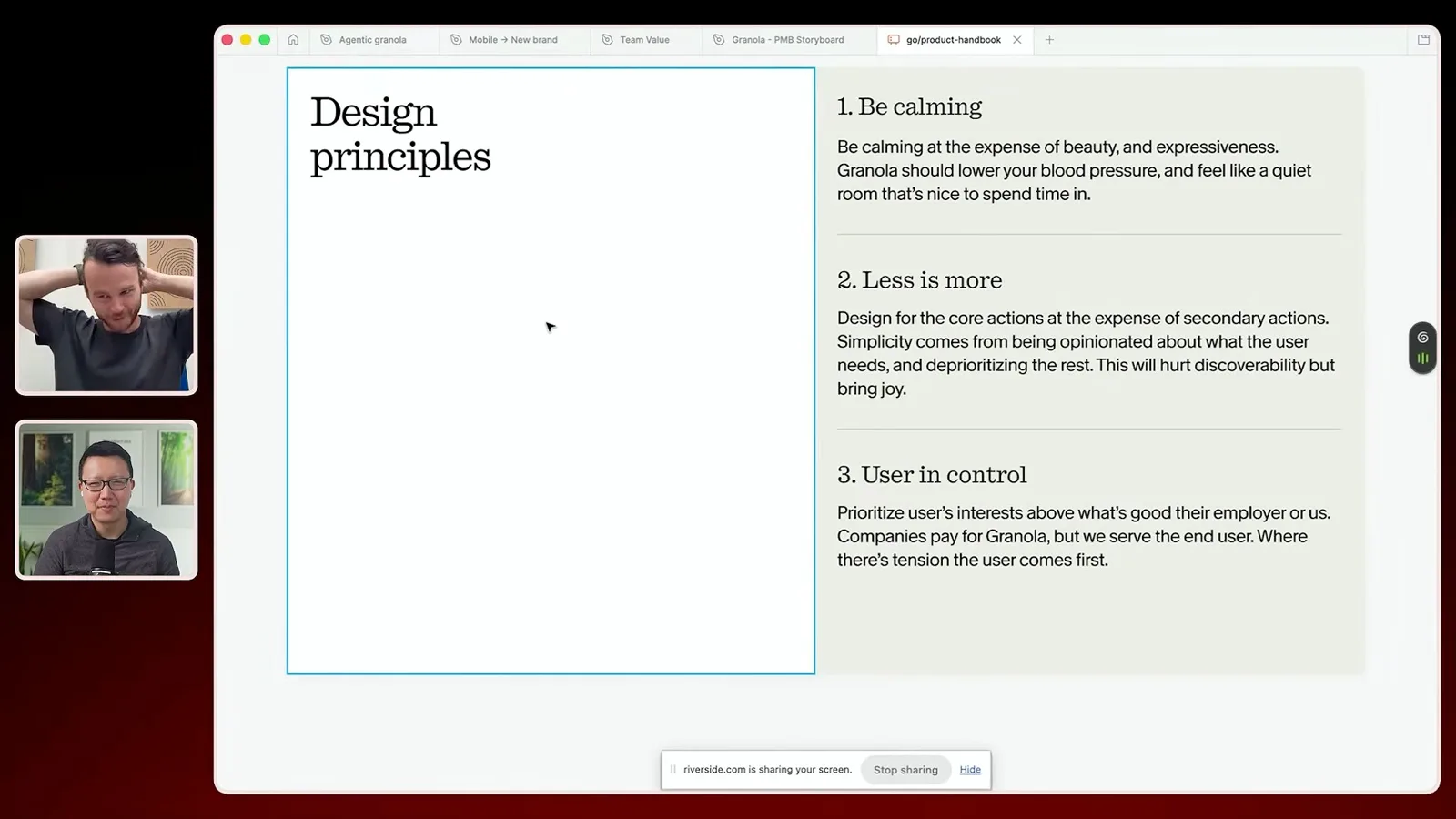
Those principles shape a controversial choice: the transcript is less prominent than the notes. Sam accepts some loss of discoverability in exchange for a simpler experience. A transcript remains useful, but the team wants the default view to focus on what people need next.
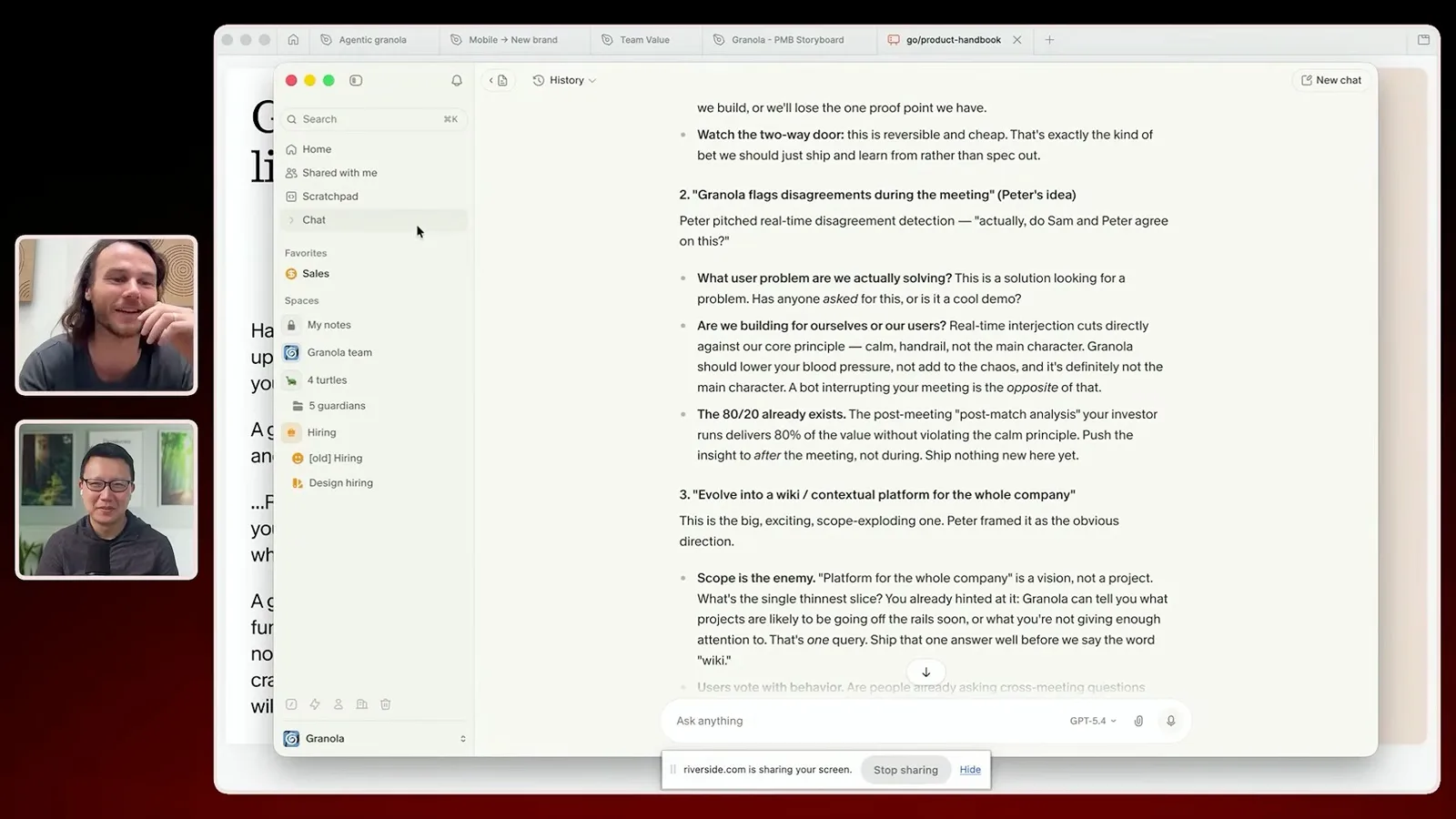
The team weighs requests for more active intervention against the atmosphere it wants to create. A real-time bot pointing out disagreements might be impressive, but could also interrupt a conversation; post-meeting analysis can offer feedback without making the assistant the center of the room.
Ask questions across meeting context
A founder-feedback example and shared notes show how context supports follow-up.
Sam demonstrates using meeting context to solicit feedback in the style of a founder or investor. He asks the assistant to reflect on ideas from the conversation, giving it product principles as context so the response can challenge proposals against the team’s actual priorities.
Granola can draw on shared team meeting notes as well as a person’s own accessible information. The distinction matters: Sam does not claim that a user can search everyone’s private meetings. Shared sales conversations, for example, can help surface recurring customer insights.
Connect meetings to the rest of work
API and MCP workflows can combine meeting records with other tools.
Peter asks about scheduled reports. Sam says the team has prototyped automation but wants high-quality outputs; native scheduling is a possible future direction, not a feature he promises is already available. Users can already combine Granola’s API or MCP with external tools. Peter describes sending himself a summary that joins Granola with other sources.
For a designer, the prospect that an agent might bypass the interface brings a pang of sadness. Sam says the company initially resisted opening up, but enterprise customers need tools to work with their internal systems. Granola can collect meeting context while other applications and agents put it to work.
Peter sees particular value in combining meetings with documents and other sources. Sam says the work behind pre-meeting briefs required finding relevant information in email, and sees opportunities to connect other company knowledge. They joke about agents meeting first and involving their owners only when necessary.
Build with agents without losing craft
Sam discusses working culture, prototypes and the design system.
The discussion turns to the way Granola works. Peter worries that AI-native companies can normalize relentless hours. Sam describes trying to use the technology to build an effective company while preserving a calmer working culture and making room for considered product work.
Sam says his use of Figma has fallen as coding agents make working prototypes easier. This does not make design judgment obsolete: the team still needs a shared design system, reusable components and clear principles to prevent the speed of generation from producing incoherent interfaces.
Designers start with ideas, sketches and discussions, then explore working code with agents. A shared system gives the agent constraints and lets the team compare real interactions instead of arguing only over static mockups. Sam still uses conventional design tools when they are the best way to think through a problem.
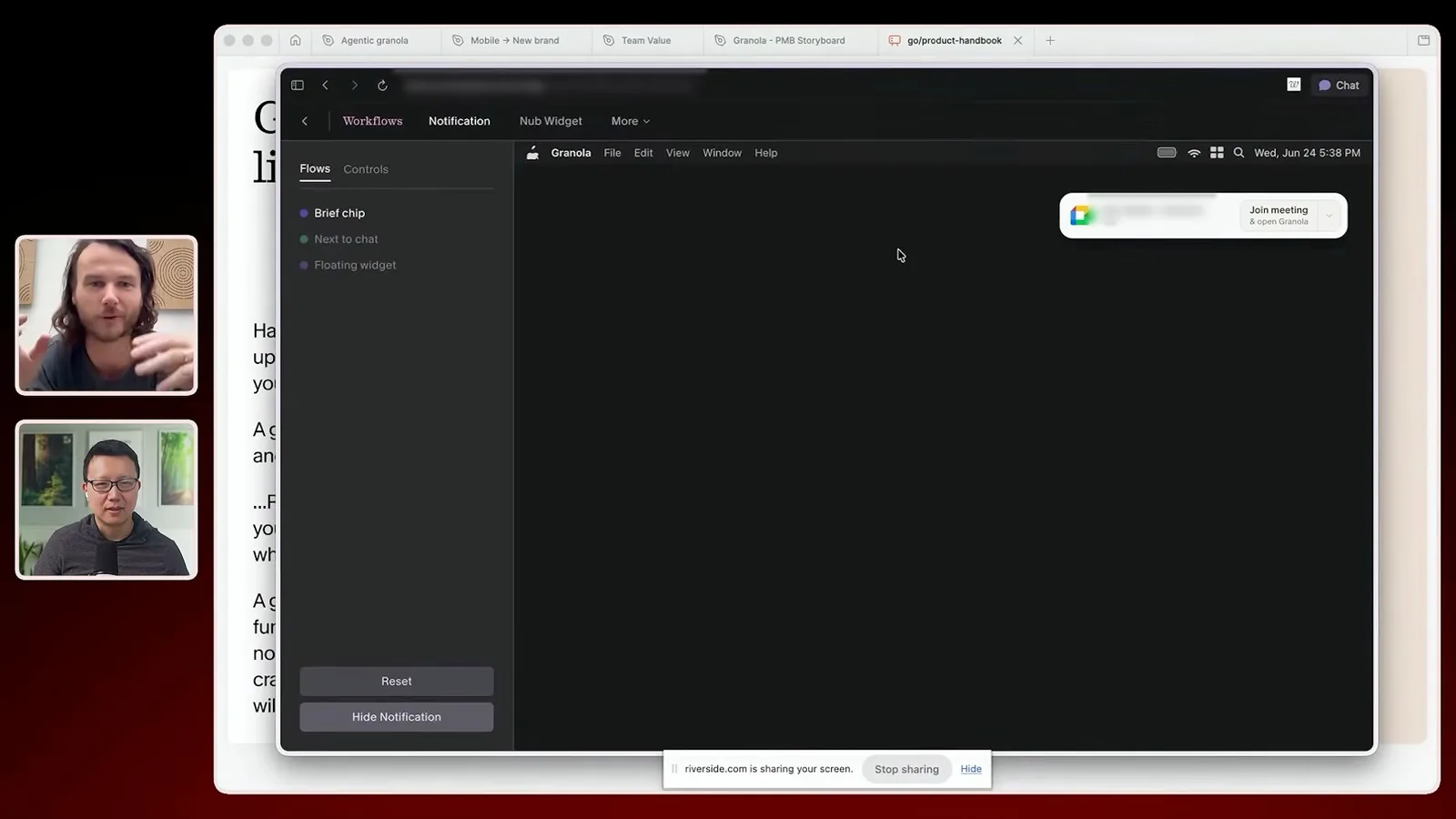
He shows an interactive prototype for pre-meeting briefs. The team can try different placements and behaviors in something resembling the real interface. Getting an imperfect version in colleagues’ hands early exposes problems and supports repeated improvement.
Nacho and the value of iteration
An internal agent helps staff investigate questions; refinement remains essential.
Granola also uses an internal agent called Nacho. Sam describes it as a first stop for company questions: it can draw on internal information and tools, including engineering and analytics resources, to help people investigate issues or answer questions without starting from scratch.
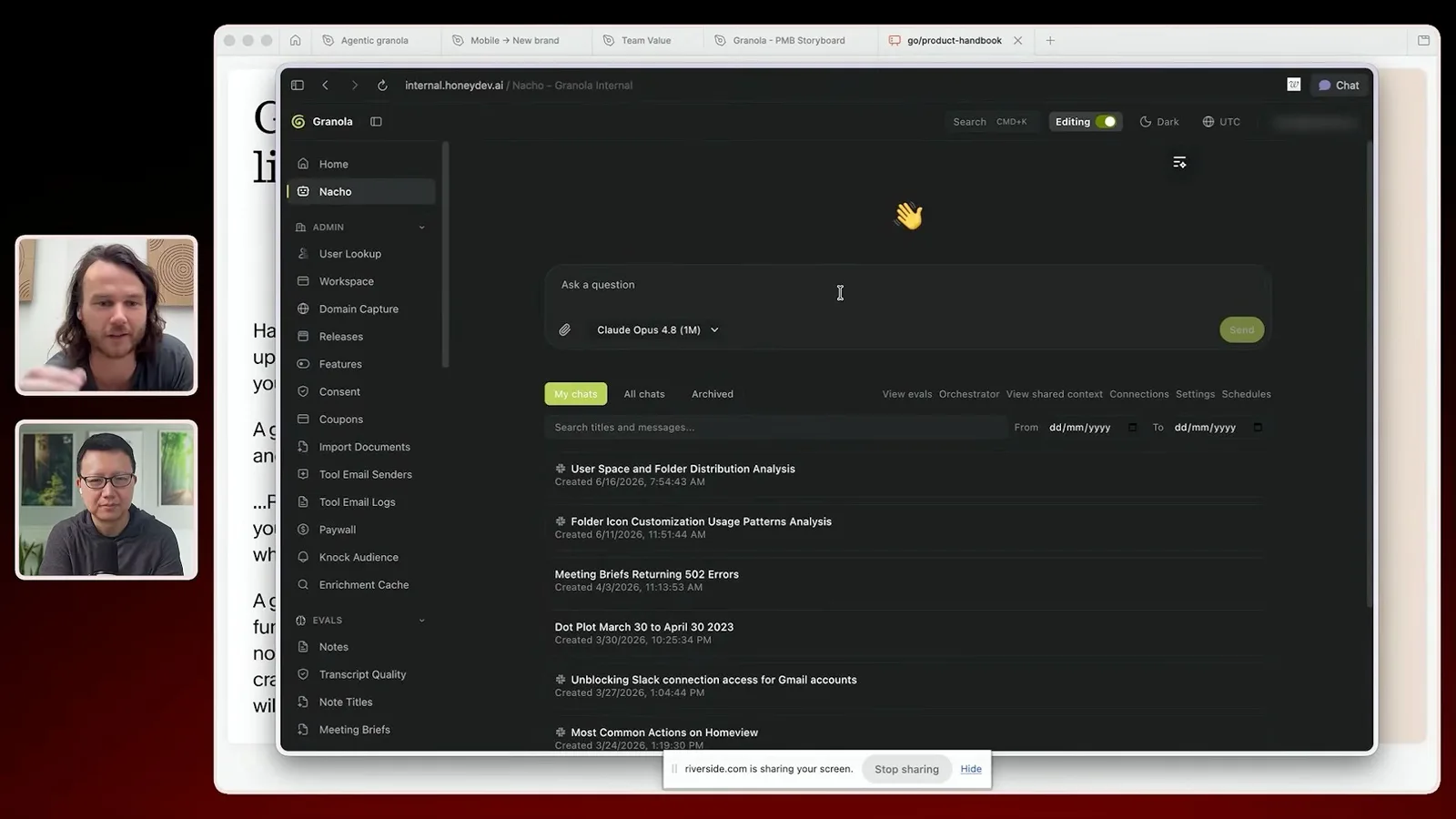
An engineer built the early version, and the wider team has helped improve it. The same pattern applies beyond engineers: people who understand a problem can use agents and shared tools to investigate and contribute. Sam still emphasizes that context, access and reliable answers matter.
The final lesson is that making a first version has become easier, but craft depends on what happens afterward. Teams can release something, observe where it falls short and keep refining it. Sam argues that many people stop improving a product too early; AI should create more room for that work rather than a race to produce endless features.
More from this channel
 46:40EN
 Peter Yang· Nov 8, 2026Podcast · 2 speakersAshley Alexander: How AI Helps Me Care for My Parents With CancerGuest Ashley Alexander · Host Peter YangA caregiver uses AI to prepare for appointments, organize records and ask better questions—while keeping doctors at the center of treatment.
 17:50ENPeter Yang· Nov 4, 2026PodcastPeter Yang’s Five Steps for Using AI to Help Care for His MotherYang uses a shared care brief and organized records to navigate appointments, while making time for family.
 15:03ENPeter Yang· Nov 3, 2026PodcastHow Peter Yang Used an AI Phone Agent to Negotiate His Internet BillAn AI call negotiated a lower price and faster service, but Yang still had to approve the change himself.
 33:09ENPeter Yang· Nov 1, 2026Podcast · 2 speakersJaclyn Konzelmann: When AI Can Build More, Choose What Deserves to ExistGuest Jaclyn Konzelmann · Host Peter YangGoogle Labs pairs short strategy documents with prototypes, user co-creation and lessons from experiments that end.
 13:05ENPeter Yang· Oct 28, 2026PodcastPeter Yang Tests Genie 4: Convincing Worlds, Unfinished GameplayFive live demonstrations show scenes that respond to prompts and sound, alongside inconsistent actions and limited game mechanics.
 1:06ENPeter Yang· Oct 26, 2026PodcastPeter Yang on Setting Up Payroll for a One-Person BusinessIn a paid partnership, Yang describes the paperwork he encountered and a payroll product integrated with a business account.