In 30 seconds
In this Box-sponsored episode, the hosts discuss new coding models, Modular’s portable inference software, software-market pressures and Axiom’s approach to formal proof. The guests describe their companies and investment interests; their forecasts and performance claims are attributed to them.
- 1Portable inferenceDavis describes Modular’s goal of reducing hardware lock-in for AI inference.
- 2Local versus cloudBerman distinguishes a local agent from the remote model it may call; Davis discusses smaller models and local embeddings.
- 3Software valuationsFloyd discusses valuation compression and says market moves cannot be attributed to one launch alone.
- 4Personal versus enterprise softwareFloyd argues that security, integrations and accountability make enterprise replacement harder than a personal prototype.
- 5Formal proofsHong describes Axiom’s goal of pairing generated solutions with machine-checked proofs.
Takeaways
- Modular’s Tim Davis argues for inference software that can run across different hardware vendors.
- A locally running agent can still rely on cloud inference; Davis describes local embeddings as one way to reduce context sent to cloud models.
- Investor Joseph Floyd sees software stock declines as involving multiple factors and expects different companies to face different AI risks.
- Axiom’s Carina Hong describes combining model generation with formally checked proofs and emphasizes possible verification applications.
- Formal verification checks properties against specified assumptions; it does not guarantee every real-world requirement is captured.
Read the edited text by chapter
New models and coding workflows
The hosts discuss Opus 4.6 and GPT-5.3-Codex using release information and personal impressions.
Matthew Berman and Nick Wentz open the February 6, 2026 show with news and interviews with Modular co-founder Tim Davis, Emergence Capital partner Joseph Floyd and Axiom founder Carina Hong. Box sponsors the show. The guests’ product, investment and research claims are their own, and their predictions are not established outcomes.
The hosts discuss Anthropic’s Claude Opus 4.6, highlighting agentic tool use and a one-million-token context window in beta. They note that a large context window is useful only if a model can retrieve and reason over its contents. Benchmark figures shown are historical vendor-reported results.
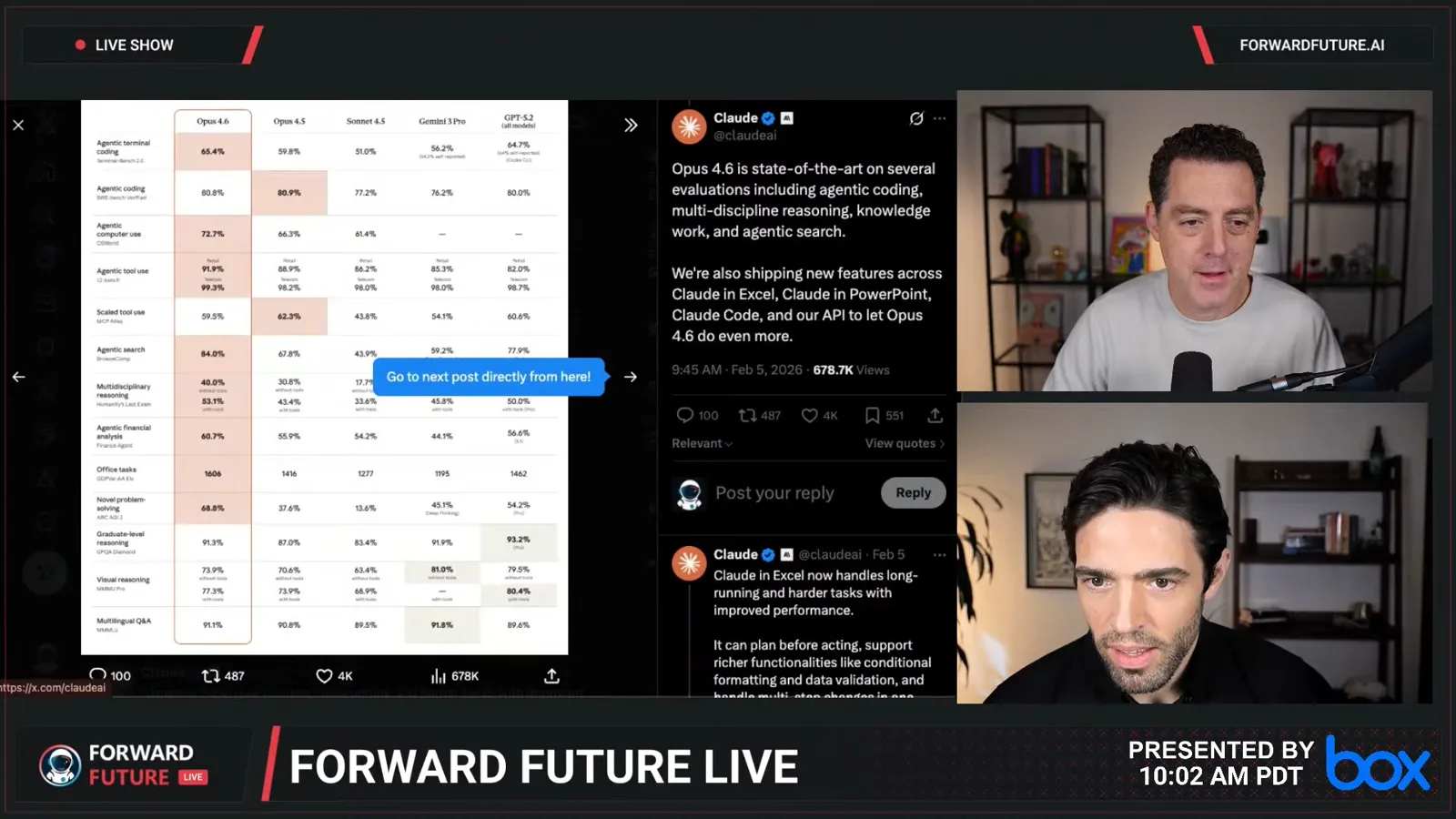
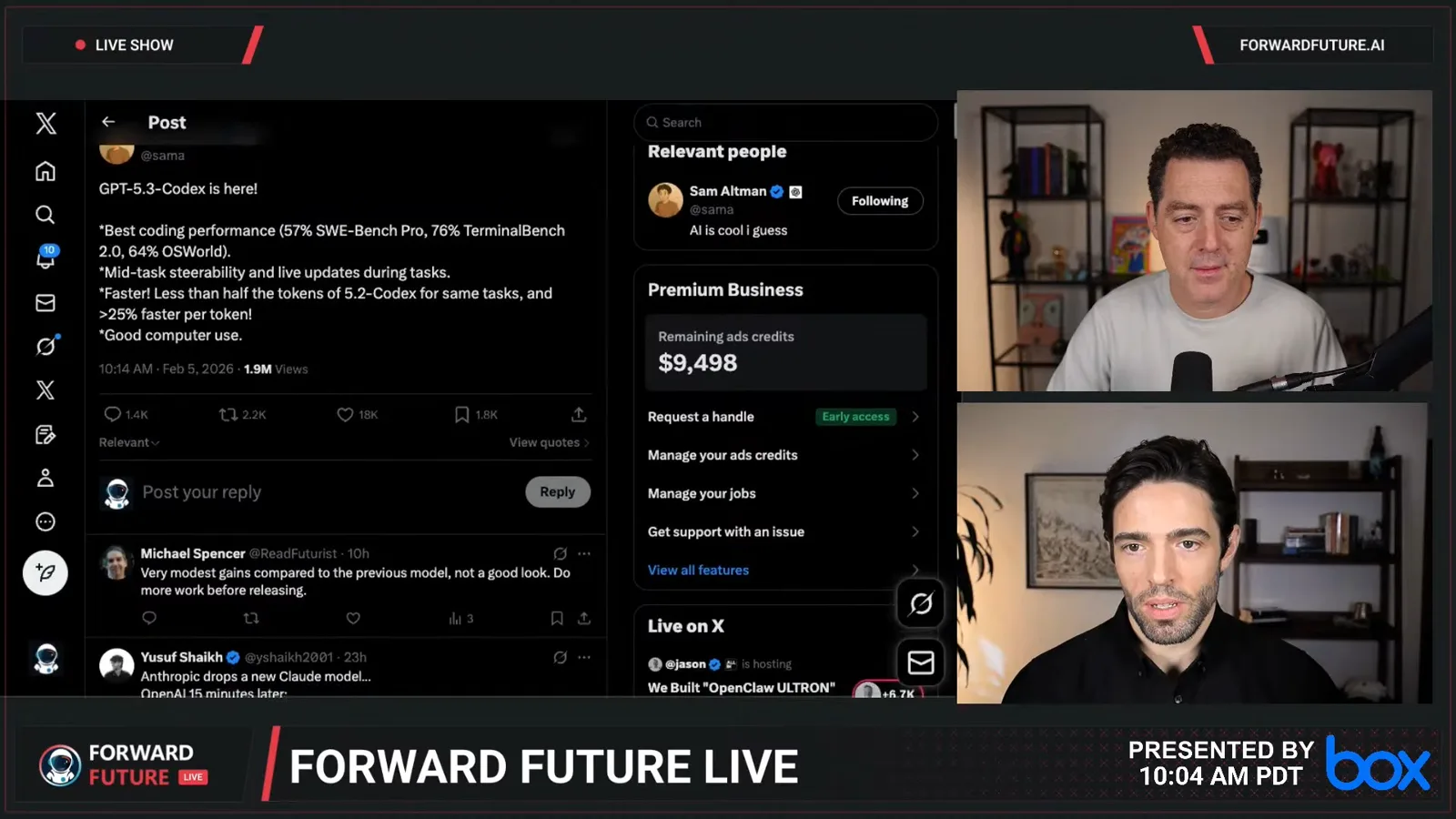
They turn to OpenAI’s GPT-5.3-Codex. Berman says his early experiences felt different: the Codex app appeared to inspect and change more files and take longer than the workflow he was accustomed to in an IDE. Wentz asks how transparency and trust affect that preference; these observations are anecdotal.
Wentz notes OpenAI’s claim that the model helped with aspects of its own development, distinguishing that from autonomous recursive self-improvement. Berman considers it an early hint of a possible future feedback loop. Both treat the timing and extent of future capabilities as uncertain.
Tim Davis on portable infrastructure
Modular’s co-founder discusses hardware abstraction, edge inference, agent security and his personal coding workflow.
Modular president Tim Davis joins to explain the company’s aim: a software layer that makes AI workloads easier to run across different hardware. He says developers usually start with performance, latency and cost goals rather than a desire for a particular chip, and argues portability can reduce dependence on one vendor.
Davis contrasts NVIDIA’s established ecosystem with alternative accelerators from cloud providers and other vendors. He says moving between them can require substantial engineering and that Modular focuses on inference for sophisticated labs and large deployments. These are the company co-founder’s descriptions of its offering.
Davis describes founding Modular with Chris Lattner after working on AI infrastructure at Google. He expects AI to move to edge devices as well as data centers, citing latency, privacy and personalization as reasons to process some tasks near users. Autonomous vehicles illustrate why some decisions cannot wait for a distant server.
Berman points out that a locally running agent can still send model inference to a cloud provider. Davis agrees that local models have further to go and expects distillation and task-specific routing to improve their usefulness, though his timeline is a prediction rather than a guarantee.
Asked why large companies have not shipped some agent experiences as quickly, Davis cites organizational choices, security and large user bases. He sees OpenClaw as a useful pattern that has encouraged experimentation; he does not claim to know Apple’s internal decisions.
Davis describes an experimental personal coding workflow that has different models plan, implement and review each other’s work. He also uses local embeddings to select relevant code context before sending material to cloud models. He estimates his own token usage fell substantially, without presenting a controlled benchmark.
Sponsor and Joseph Floyd on software
After a Box sponsorship message, Floyd discusses software valuations, AI agents and enterprise adoption.
After Davis leaves, the hosts discuss smaller local models and Berman’s personal CRM experiment. They then present the Box sponsorship and describe Box Extract as a tool for extracting structured information from documents.
Joseph Floyd of Emergence Capital joins to discuss the early-2026 selloff in software stocks. He characterizes it as a continuation of declining valuation multiples, not a movement that can be attributed solely to one AI product launch. His figures and market interpretation reflect his view at the time, not investment advice.
Floyd thinks investors are favoring companies perceived as having AI growth, while incumbent software companies may take longer to adopt AI. He argues that AI could eventually improve incumbents’ productivity and margins, but these are forecasts with uncertain outcomes; different companies face different competitive exposures.
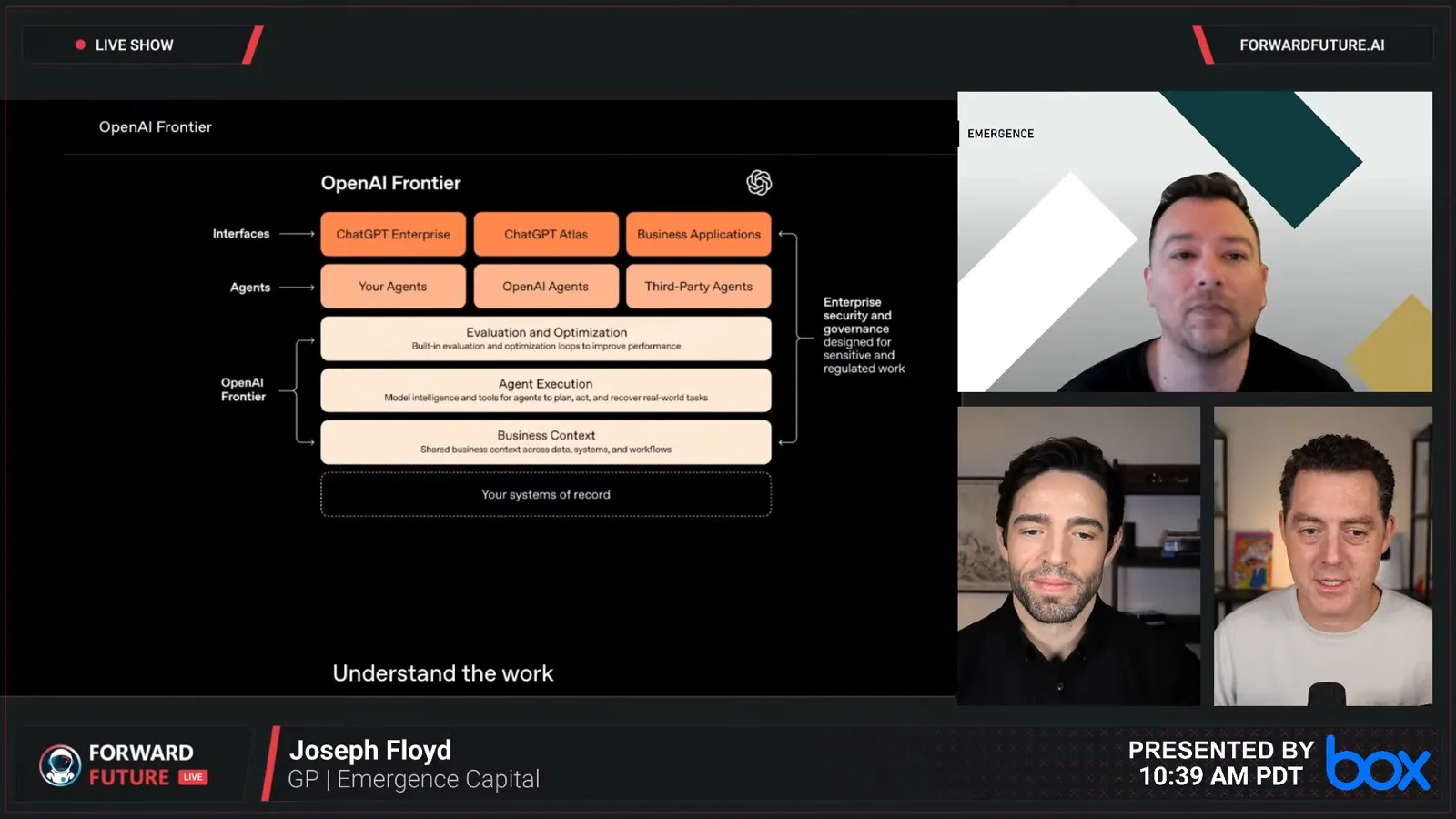
The hosts show an OpenAI Frontier architecture diagram. Floyd calls the diagram self-serving, while allowing that agents over systems of record could become more important over time. He expects a gradual transition and thinks established vendors with deep workflow context can also build useful agents.
Berman describes building a personal CRM instead of buying one. Floyd distinguishes a small personal tool from enterprise systems used by thousands: permissions, security, integrations, support and accountability can be difficult to reproduce. He recounts an alleged internal HR-tool mistake as an illustrative anecdote, not an independently verified case.
Advertising and investment themes
The hosts and Floyd discuss chatbot advertising and portfolio companies, including GenSpark and Bedrock Robotics.
The hosts and Floyd discuss competing AI advertising strategies and Anthropic’s parody ads. Floyd criticizes advertising in a free chatbot; Berman suggests ads could subsidize access for people who cannot pay. They distinguish these opinions from claims about exactly how any provider’s ads operate.
Floyd discloses that Emergence has invested in GenSpark and discusses the company’s planned Super Bowl advertisement. He also describes portfolio company Bedrock Robotics and its work on autonomous construction equipment. Potential safety and utilization benefits are his expectations, not proof of comparative safety.
Floyd says his firm is considering AI applications in hardware and biotechnology beyond its traditional software focus. His assertion that the old software business model is finished is a venture investor’s view, not a settled fact. The hosts thank him and play an example of Anthropic’s advertising.
Carina Hong on math and verification
Hong explains Axiom’s formal-math approach, reported results, potential applications and research goals.
Axiom founder and CEO Carina Hong joins. She describes her mathematics background and the company’s ambition to combine generation with formal verification, beginning with mathematics. She explains that a proof assistant such as Lean can check a formal proof against its stated assumptions.
Hong relates formal proof and programming, describing a workflow where a system generates a solution and a proof checks that it satisfies a specification. Formal verification depends on the correctness and completeness of the specification and assumptions; it does not automatically prove every real-world requirement or deployment is safe.
Hong says Axiom was a small, recently founded team and describes an AI system’s claimed perfect Putnam exam performance. She also discusses recruiting mathematicians and machine-learning researchers and the shortage of formal-math training data. The company’s reported result is not independently evaluated in the interview.
For practical applications, Hong identifies hardware and software verification, cryptography and legacy-code migration as possible areas. She argues that testing selected input-output pairs may miss edge cases and that formal methods can provide stronger guarantees for a precisely specified property.
Hong says human and AI strengths in mathematics can differ, creating opportunities for collaboration. She reports that Axiom generated formal proofs for research conjectures, a company claim that requires independent evaluation. She discusses conjecture generation and proof checking as a possible feedback loop for future research.
Asked about commercialization, Hong says it is early but points to organizations with mission-critical verification problems. She also discusses ideas from world-model research and mathematical domains as test environments. The hosts close by emphasizing the pace of the field; claims about eventual AGI or self-improvement remain speculative.
More from this channel
 25:50EN
 32:20EN
 45:08EN
 12:14EN
 10:36EN
 17:37EN