In 30 seconds
3Blue1Brown poses a counting problem about subsets of the integers from 1 to 2,000. A five-number example illustrates the question; the short clip points to a longer video for the solution.
- 1The questionCount subsets of {1, …, 2000} whose elements add up to a multiple of five.
- 2A smaller exampleAmong the 32 subsets of {1, 2, 3, 4, 5}, eight have a sum divisible by five.
- 3An exact countThe challenge is to find the precise answer for the larger set, not just estimate it.
Takeaways
- The problem asks for subsets whose element sums are divisible by five.
- The set {1, 2, 3, 4, 5} has 32 subsets, eight of which have sums divisible by five.
- The full set has 2^2000 subsets, making the exact count a much larger challenge.
Read the edited text by chapter
The puzzle and a small example
The speaker introduces the subset-sum question and illustrates it with five numbers.
How many subsets of {1, 2, 3, …, 2000} have elements that sum to a multiple of five? The question is easy to state, but finding an exact count is the challenge.
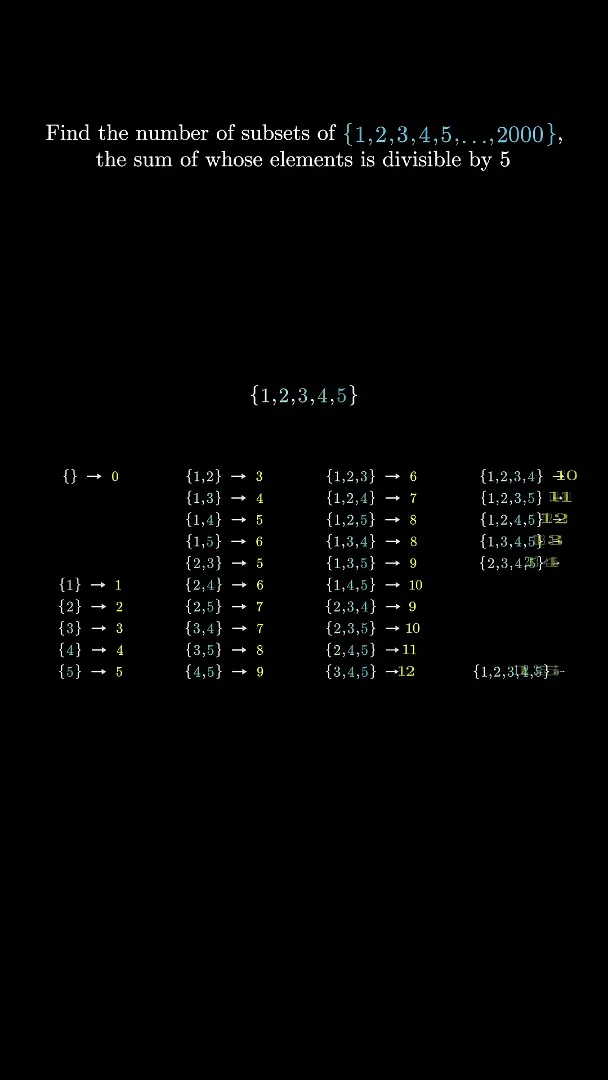
Start with the smaller set {1, 2, 3, 4, 5}. It has 2^5 = 32 subsets. If you add the elements in each subset and group the results by sum, eight have a sum divisible by five; the empty subset counts because its sum is zero.
The larger challenge
The exact count for 2,000 numbers requires a deeper technique, explained in the linked full video.
For the set through 2,000, there are 2^2000 subsets. A rough estimate might be tempting, but the problem asks for the exact answer. The speaker points to a surprising mathematical technique in the [full video](https://youtu.be/bOXCLR3Wric); this short clip does not give the solution.
More from this channel
 40:44EN
 3Blue1Brown· Oct 16, 2026Grant Sanderson: There's never been a better time to go into mathGrant Sanderson, Constantin Kogler · 3Blue1BrownStudents fear AI has solved mathematics. Grant Sanderson argues the opposite: even if machines prove theorems better than we do, the institution of math stays valuable—and this is a rare moment when newcomers can reshape it.
 51:55EN3Blue1Brown· Sep 18, 2026The last IMO problem AI could not solveGrant Sanderson · 3Blue1BrownGrant Sanderson walks through IMO 2025 Problem 6 — a tiling puzzle that frontier models missed — and the visual patience it takes to prove a construction is optimal.
 0:55EN3Blue1Brown· Jul 24, 2026The 64 Sugar Cubes Puzzle: Six Equal DistancesA 4×4×4 block has three colors; prove that six same-colored pairs share a distance.
 33:51EN3Blue1Brown· Jul 16, 2026What Cross-Entropy Connects: Compression, Language Models and KL DivergenceGrant Sanderson · 3Blue1BrownGrant Sanderson builds cross-entropy from code lengths and uses it to explain next-token training and distillation.
 2:25EN3Blue1Brown· Jun 12, 2026How Shannon Measured the Entropy of EnglishA guessing game helped Claude Shannon estimate how much information English text contains, and why prediction is central to compression.
 1:02EN3Blue1Brown· Jun 10, 2026A Robot Walk and the Puzzle of Optimal Binary EncodingHow few bits does it take to send directions that occur with unequal frequencies?