In 30 seconds
Boom Supersonic says it has fired a prototype engine core intended to serve both a data-center power turbine and a future supersonic airliner. Founder Blake Scholl hopes revenue from the ground product will fund aircraft development and provide extensive operating data, though turbine shipments remain a future plan. He also describes bringing manufacturing in-house after long supplier lead times, building a single-crystal foundry and using custom software to shorten blade-design iterations.
- 1Data-center power created a second market for the engine coreScholl says he explored using the core in a natural-gas turbine after hearing about grid and turbine shortages. He hopes that ground sales will precede and support the aircraft program.
- 2Ground operation could provide more engine dataScholl expects continuously operating turbines to accumulate experience that can inform a future aviation engine, alongside the work required for certification.
- 3A long blade lead time pushed manufacturing in-houseScholl compares a supplier quote for a printed set of blades with the price and delivery time of the printer itself. Boom chose to acquire equipment.
- 4Hot-section blades require specialized materialsScholl describes the extreme environment in a turbine and says Boom is building a foundry for single-crystal parts.
- 5Custom software aims to shorten blade-design iterationsScholl demonstrates a tool that updates geometry and simulations as an engineer adjusts parameters.
Takeaways
- Boom plans to use a shared core for its Superpower ground turbine and Symphony aircraft engine.
- Scholl expects ground turbine sales and operating data to help finance and inform the airliner program; these are plans and projections.
- A quoted 18-month wait for printed blades led Boom to purchase equipment and bring that process in-house.
- Scholl says custom design software allows engineers to adjust blade geometry and review simulations quickly.
- The company says its next milestone is turbine shipment in mid-2027, after the prototype core’s first firing.
Read the edited text by chapter
One engine core, two proposed products
Boom says it fired its prototype core after deciding to develop an engine for its planned supersonic aircraft. Scholl explains the subsequent opportunity he saw in data-center power.
Boom Supersonic says it fired its prototype engine core for the first time on November 21, 2026. Jared Friedman visits the company's Colorado factory to ask founder and CEO Blake Scholl how an engine project intended for supersonic passenger flight became connected to the demand for power from AI data centers.
Boom is developing Overture, a planned 60- to 80-seat supersonic airliner, after its XB-1 demonstrator broke the sound barrier. The company is also developing a related gas turbine called Superpower for power generation; the two products are intended to share an engine core.
Scholl says he initially suspected that the company would need to develop an engine alongside the aircraft because no off-the-shelf product fit. An early engine designer suggested modifying an existing Rolls-Royce engine instead, a plan that appeared to save substantial development costs.
That partnership also gave the young aircraft company credibility with customers and suppliers, Scholl says. When Rolls-Royce withdrew in 2022, he recalls, fundraising and commercial conversations became much harder. Boom announced its own engine program later that year.
In 2025, Scholl began considering whether the same core could serve a second market. He saw reports of long waits for grid connections and power turbines, and asked early investor Sam Altman whether a roughly 40-megawatt gas turbine would be relevant to AI infrastructure. Scholl says the response encouraged him to investigate the opportunity.
His proposal is to adapt much of the engine for ground use by connecting it to a generator rather than using it to propel an aircraft. He describes an approximately 42-megawatt natural-gas turbine; the narrator says Boom hopes to sell the power product before its passenger aircraft is ready.
Scholl predicts that the turbine business could fund aircraft development and says the company could become cash-flow positive after its first shipments. These are his projections for a planned business, rather than results from turbines already operating for customers.
He also expects ground installations running continuously to accumulate operating data far faster than a conventional engine test program. That experience, he argues, could help the company find problems and support a future aviation certification case, although the aircraft engine still needs to meet its own requirements.
Turbine demand and the choice to manufacture in-house
Scholl describes potential customer demand and supply constraints. A long quote for printed blades helped persuade Boom to acquire production equipment.
Scholl describes substantial prospective demand for data-center power equipment and says one potential customer wants to deploy more capacity each month than Boom's initial annual production plan. He presents demand as conditional on proving the product in the field.
Asked why existing suppliers cannot simply expand, Scholl argues that established industrial companies have weak incentives to invest rapidly when demand and prices are high. He connects turbine shortages to a broader argument about declining progress in US industrial capacity.
A particularly difficult component is the turbine blade, which must withstand hot gases and requires specialized materials and manufacturing. Boom encountered supply delays when purchasing parts for its own engine.
Scholl says a supplier quoted approximately 18 months and $1.3 million for a printed set of blades. When he learned a printer cost roughly $1.1 million and could arrive in weeks, he decided to bring the work in-house as a way to shorten iterations.
Inside the factory and blade-design process
Boom plans extensive in-house manufacturing and a single-crystal foundry. Scholl also demonstrates software intended to accelerate design changes.
The new factory is intended to bring processes from raw material through completed turbines under one roof. Scholl says Boom expects to manufacture about 85% of each Superpower turbine by weight in-house; the tour shows a facility still under construction with some machines already operating.
Scholl says Boom once believed it lacked the capital to integrate manufacturing vertically, but found outsourcing expensive and slow during the XB-1 project. Placing designers next to the people making parts, he argues, makes it easier to solve practical problems quickly.
He gives an assembly example: a component was difficult to reach, so an engineer designed a specially shaped wrench and the machine shop produced it overnight. He contrasts that turnaround with the longer delay he expects from an outside supplier.
The turbine's operating environment combines extreme heat and rotation. Scholl discusses single-crystal blades, whose material structure is designed for demanding conditions, and says Boom is building a foundry next door to manufacture and test such parts.
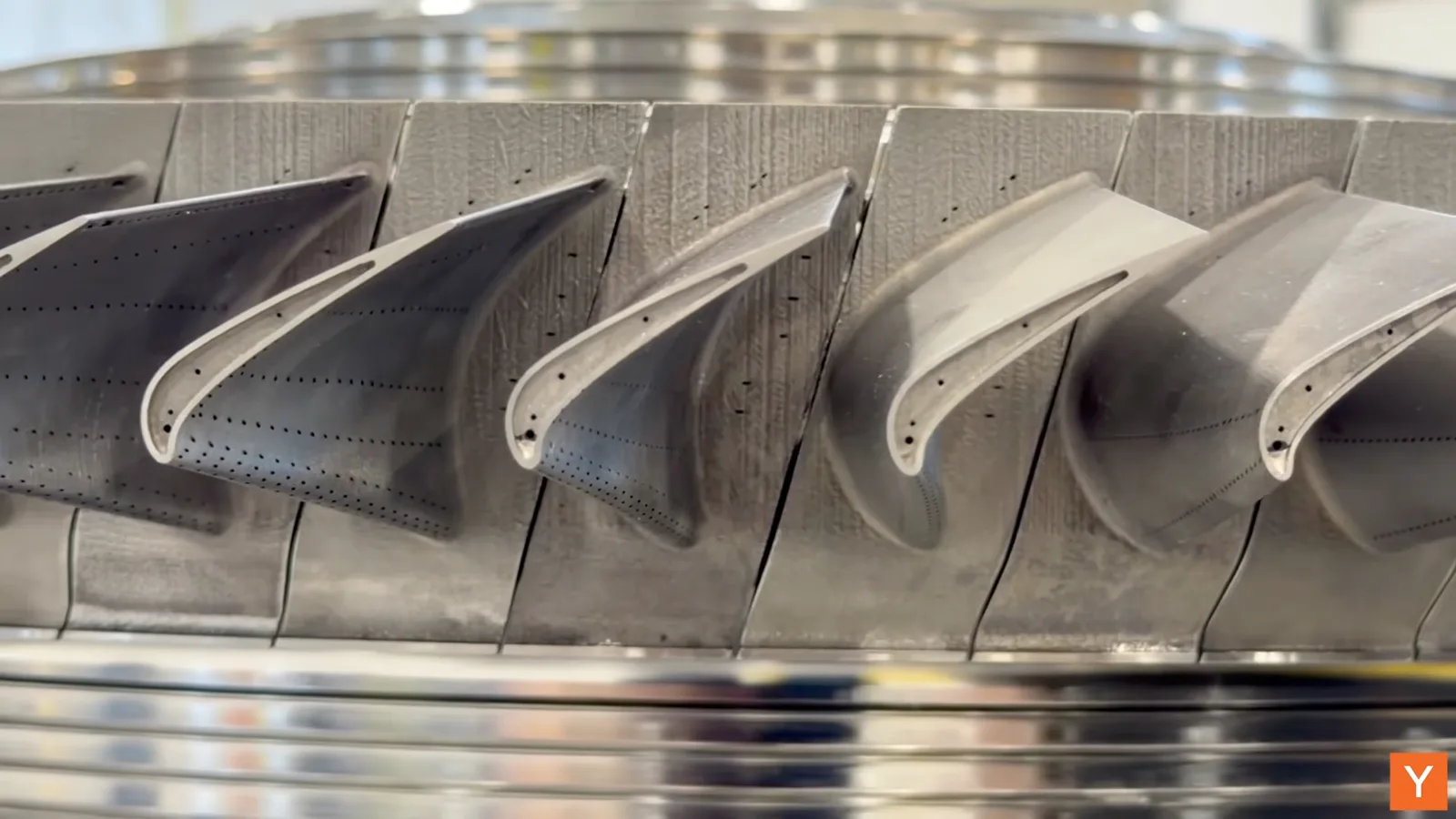
Before founding Boom, Scholl worked as a software engineer. He says the company places software engineers with hardware teams to automate engineering work, and argues that AI has made software development more accessible across the organization.
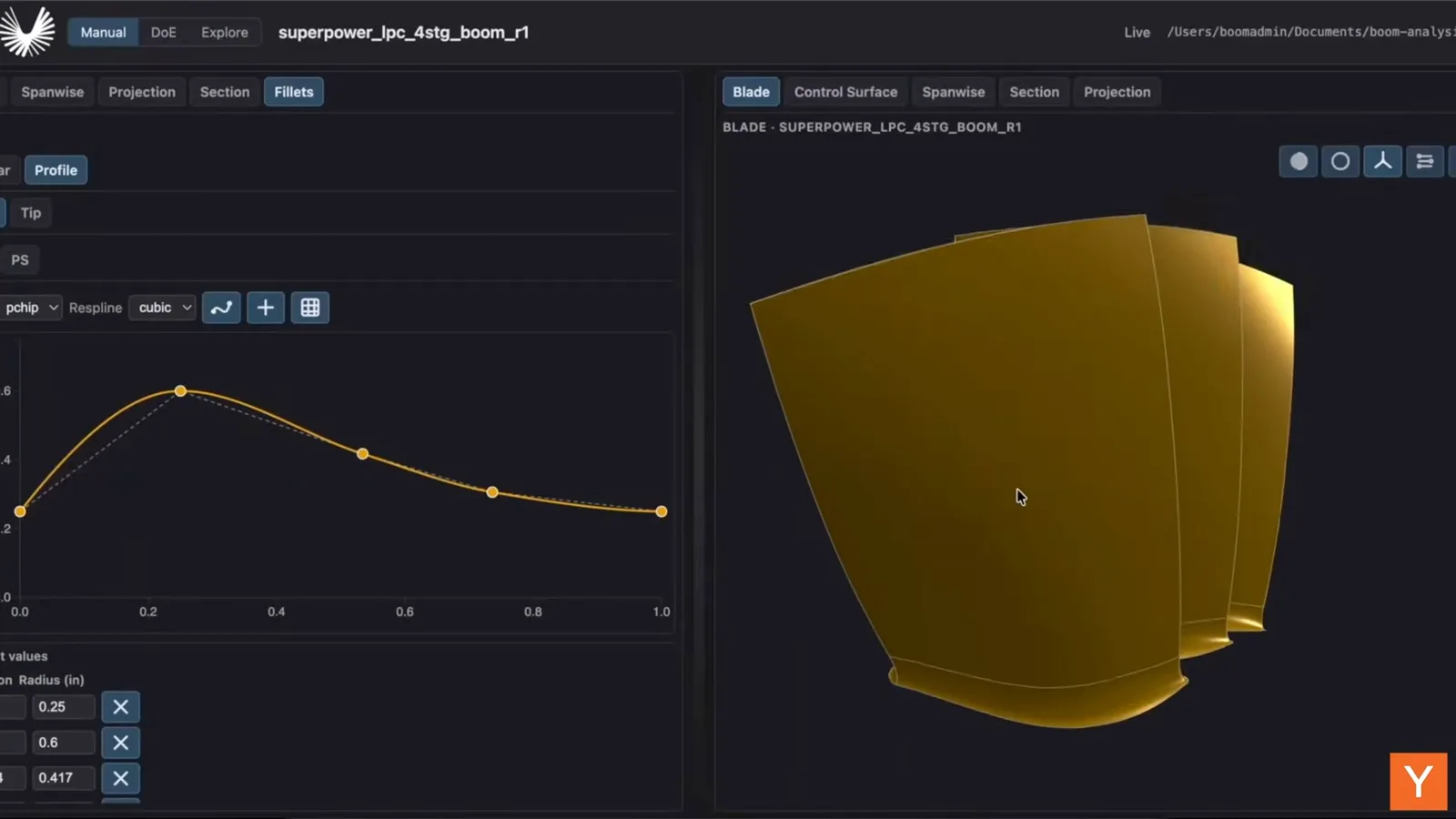
He demonstrates a blade-design tool called BladeRunner. Scholl says an engineer can adjust a parameter and see updated geometry and simulated aerodynamic and structural behavior quickly, compressing a process that formerly required larger teams and long iterations.
A small team and the next milestone
Scholl describes the company’s staffing goals and plans to ship turbines. He reflects on the first core firing and XB-1’s supersonic flight.
Scholl says the company has 165 people, including roughly 40 in manufacturing, and argues that small teams can pursue work larger companies may not. His stated internal goal is to keep the company below 250 people outside manufacturing while developing both the turbine and airliner.
The first core firing is a milestone, not a completed commercial deployment. The program's stated next step is to start shipping turbines in mid-2027. Scholl connects that progress to XB-1's earlier flight and says he believes the prospects for passengers eventually flying on Boom's aircraft have improved.
Reflecting on the XB-1 flight, Scholl says its significance lies in a small team doing something that might be remembered even if the broader venture fails. He describes flight as an expression of human ingenuity and sees the difficulties overcome along the way as part of the achievement.
More from this channel
 1:05:32EN
 Y Combinator· Nov 19, 2026Should governments slow AI? Coxon and Hanson dispute the risksVivian Midha Shen, Jacob Coxon, Robin Hanson · Y CombinatorJacob Coxon expects rapid automation and wants a slowdown; Robin Hanson favors liability and warns against broad global regulation.
 54:19ENY Combinator· Nov 18, 2026Eric Glyman: Give AI the Context and Authority to Do Useful WorkGarry Tan, Eric Glyman · Y CombinatorRamp’s co-CEO describes connecting agents to company workflows and judging AI spending by the value it creates.
 1:00:06ENY Combinator· Nov 14, 2026AI coworkers need earned trust, reliable checks and clear goalsLauren Tan, Roman Ugarte · SpaceXSIGrok Bot builders Lauren Tan and Roman Ugarte explain how shared bots work alongside teams and why product direction still matters.
 1:00:06ENY Combinator· Nov 14, 2026Grok Bot’s team: give agents checks before giving them autonomyLauren Tan, Roman Ugarte · Grok BotLauren Tan and Roman Ugarte explain how shared bots, codebase guardrails and human product judgment fit into their workflow.
 1:21:42ENY Combinator· Nov 8, 2026What AI biology can do now, from cancer data to DNA designAlfredo Gonzalez, Yusuf Roohani, Garyk Brixi, Divya NoriFour researchers explain patient-specific cancer analysis, virtual cells and genome models, separating early experiments from proposed clinical applications.
 44:15ENY Combinator· Nov 7, 2026Amjad Masad and Paul Graham on Replit’s Path to AI CodingPaul Graham, Amjad Masad · Y CombinatorThe Replit co-founder traces agentic coding from user observations and cloud infrastructure to his vision for enterprise work.