In 30 Sekunden
LinkedIn’s user-understanding agent now has an improvement loop that diagnoses failures and proposes prompt changes, with human-reviewed updates reaching production. But the feedback driving that loop needed work: after examining 180 human reviews, the team clarified its scoring rules and raised reported judge alignment from 57% to 64%. A second judge also needed to recognize when the first judge itself was wrong, lest the optimizer fix the wrong component.
- 1Seven steps turn traces into tested prompt changesThe loop scores agent traces, diagnoses causes, proposes edits and checks candidates before a held-out evaluation.
- 2The first optimized change reached production with human reviewThe team used GEPA for prompt optimization and reviewed the resulting change before deployment.
- 3The evaluator agreed with people much more often on high scoresAmong 180 completed reviews, agreement was 55.7% and 57.5% for scores of one and two, versus 80.4% for score three.
- 4Clearer rules raised reported human alignment from 57% to 64%The team corrected problems including formatting penalties and unclear scoring boundaries; reported mean error fell from 0.96 to 0.74.
- 5A diagnosis system must be able to blame the judgeThe original taxonomy lacked that category, so the second-level agent could blame the rubric when the first judge was wrong.
Das Wichtigste
- Calibrate the evaluator against human judgments before letting it drive automated changes.
- Treat ambiguous scoring rules and missing diagnosis categories as possible causes of failure.
- Test proposed prompt changes on held-out data and keep production review in the loop.
- Measure downstream agent quality and engineering effort, not just the number of generated edits.
Den bearbeiteten Text nach Kapiteln lesen
The improvement target is a career-understanding agent
The project uses production traces to find failures and improve the system around the model. Its immediate focus is prompt optimization.
Ziwei Guo and Saloni Gandhi describe an improvement loop for LinkedIn’s user-understanding agent. The goal is to learn from production traces, identify failure patterns and propose changes that improve how the agent represents a member’s career interests.
The user-understanding agent supports a broader career agent intended to help LinkedIn members pursue career goals. Developers collect problems from daily work and production traffic, evaluate the traces and use the resulting feedback to guide the next iteration.
Guo stresses that the evaluator must be objective and aligned with user feedback. Otherwise the loop may optimize the wrong thing: the quality signal is what identifies a bottleneck and determines which change the system tries next.
The surrounding agent system has several possible targets: planning logic, context and memory, interfaces to tools and data, and storage for outputs and logs. Evaluation sits across these components; the underlying model powers the system but is not currently being optimized in this project.
Guo describes a ladder of increasing complexity. The current work concentrates on prompts, the most direct place to make a change. Later possibilities include structured context, workflow design, harness code and eventually the optimizer itself; these are future directions rather than current results.
A seven-step loop proposes and tests changes
The team scores traces, diagnoses root causes and validates candidate edits, then checks the new baseline on held-out examples.
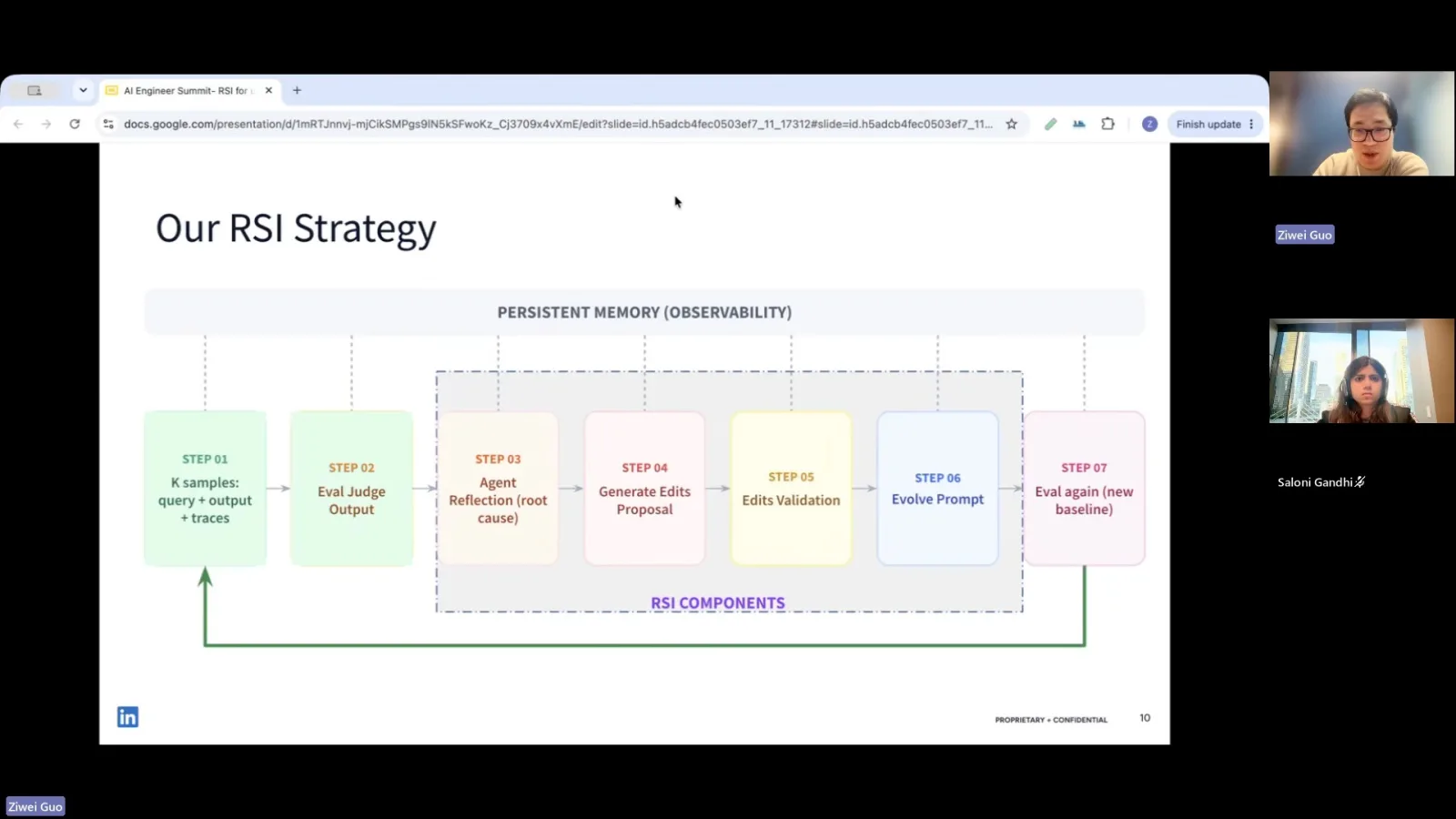
The loop has seven steps: run the agent and collect samples and traces; score them; diagnose causes; propose edits; validate candidates; evolve the prompt; and evaluate the new baseline on held-out data. The final test is intended to check that the change generalizes beyond the examples used to make it.
The reflection step asks why an output scored poorly. It may be an agent, model, prompt or tool problem, but the evaluator or its scoring rubric may also be at fault. Proposed edits are tested using the same evaluation engine and criteria before a candidate proceeds.
A final held-out evaluation compares the updated system with the previous baseline. If the change is adopted, it becomes the starting point for another iteration; the team plans to run the cycle on a regular cadence.
How the agent and two judging layers work
The agent produces structured career preferences with citations. One judge evaluates outputs and a second groups and diagnoses failures.
The target agent starts with a member identifier and retrieves information such as search history, profile, location and stated preferences. It synthesizes those signals into a structured understanding of the member.
One output field is preferred job titles. Alongside values such as network manager or account manager, the agent supplies a confidence level, citations to supporting information and a short explanation. Repeated saved searches, for example, can provide evidence for a title preference.
An evaluation judge scores the agent across task dimensions using product-defined rubrics. The example shows an overall score as well as per-dimension scores and rationales; the scoring scale runs from one for poor quality to three for very good quality.
Reflection begins by grouping failed examples by dimension without an additional model call. A second-level judge then diagnoses each example and tags its suspected root cause, which can include the agent, code, context, judge or rubric.
Because similar problems can be described in different words, the system merges near-duplicate diagnoses into canonical issues. Missing profile data and an incomplete profile picture, for example, can point to the same underlying lack of supporting information.
It then groups and ranks issues by frequency without another model call, generating a scorecard for humans and retaining the diagnoses for future iterations. Prior diagnoses can inform the second-level judge on later runs.
From diagnosis to production
GEPA proposes prompt changes, which are validated before adoption. Humans currently review production updates.
The proposal stage uses the judge’s evidence and reflection artifacts to suggest edits. The team uses GEPA to propose prompt changes in mini-batches, selects candidates, validates them and, when a candidate is accepted, updates the production baseline for subsequent cycles.
The team describes three areas of work: quality, automation and production updates. Human annotations improve both levels of judging, while analysis of judge variance addresses the instability that comes from using language models as evaluators.
The workflow can be scheduled weekly, every two weeks or monthly according to need. For now, humans remain involved in production updates to protect quality. The team hopes to reduce that effort gradually as its confidence in the process improves.
Human reviews exposed weaknesses in the evaluator
Agreement varied sharply by score and dimension. Clearer rubrics improved reported alignment and reduced mean error.
Gandhi says the team deployed its first improvement produced through the loop and GEPA after human review and quantitative measurement. It also invested in comparing the evaluator’s judgments with human annotations before trusting it to steer further changes.
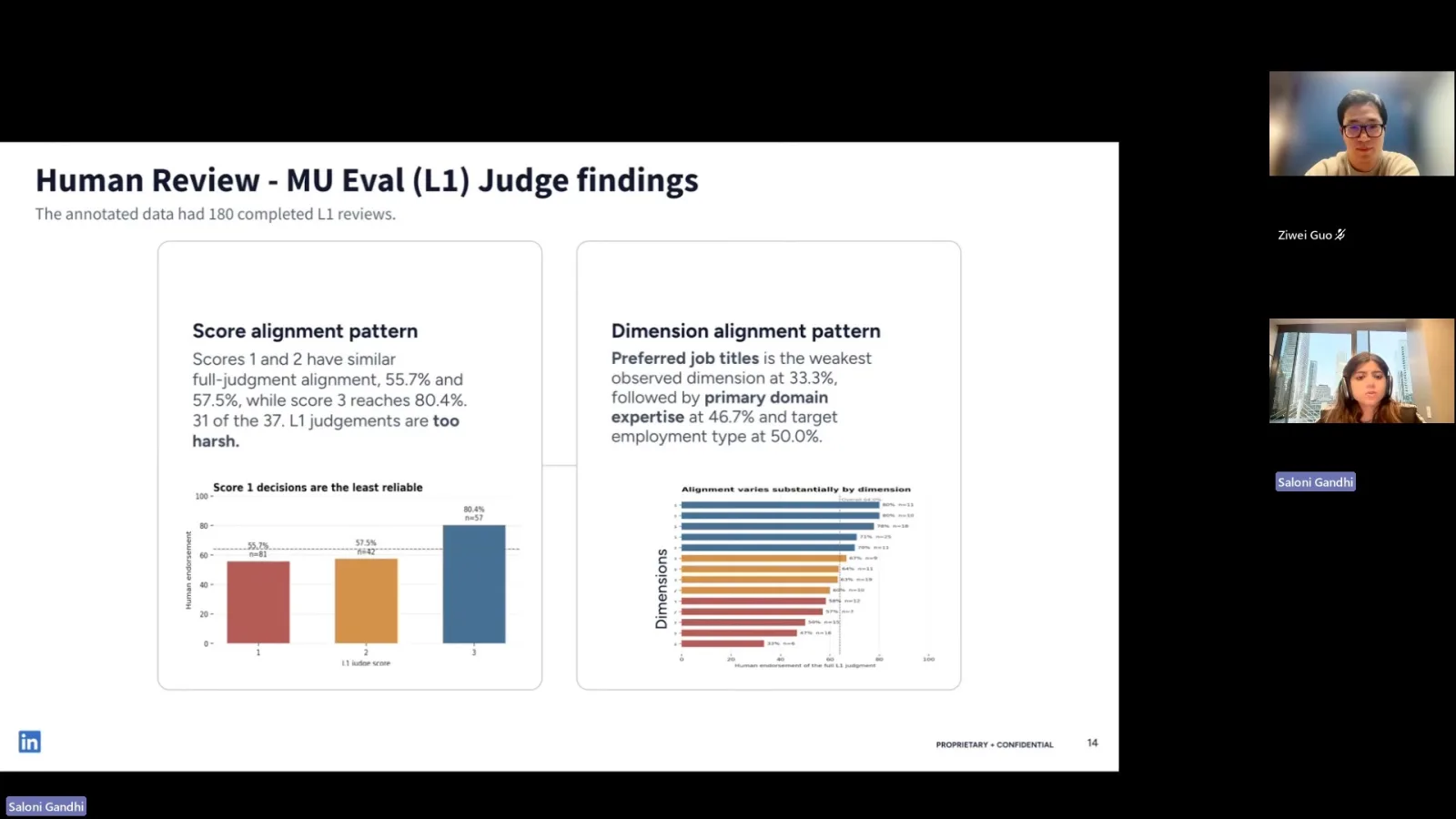
The slide reports 180 completed human reviews. For outputs the judge rated one or two, full agreement with reviewers was 55.7% and 57.5%; for a rating of three it reached 80.4%. The judge was better at recognizing strong outputs than distinguishing weaker ones.
Agreement also varied across dimensions. The slide reports preferred job titles as the weakest observed category at 33.3%, primary domain expertise at 46.7% and target employment type at 50%. These differences pointed to dimensions needing clearer definitions and evidence rules.
One recurring problem was plausibility being mistaken for completeness: a returned job title could sound reasonable while omitting an important signal of the member’s intent. Other disagreements arose because domain, function and skill were not clearly separated or partial credit was underspecified.
The judge sometimes penalized harmless formatting differences and made inconsistent assumptions about what employment information allowed it to infer. Of 37 judgments identified as too harsh, 31 concerned outputs the judge had assigned the lowest score.
The disagreements often reflected ambiguous evaluation policy, not simply a model malfunction. The team clarified rules for capitalization, title normalization, concurrent employment, seniority, geographic preferences and the boundary between poor and partially correct outputs.
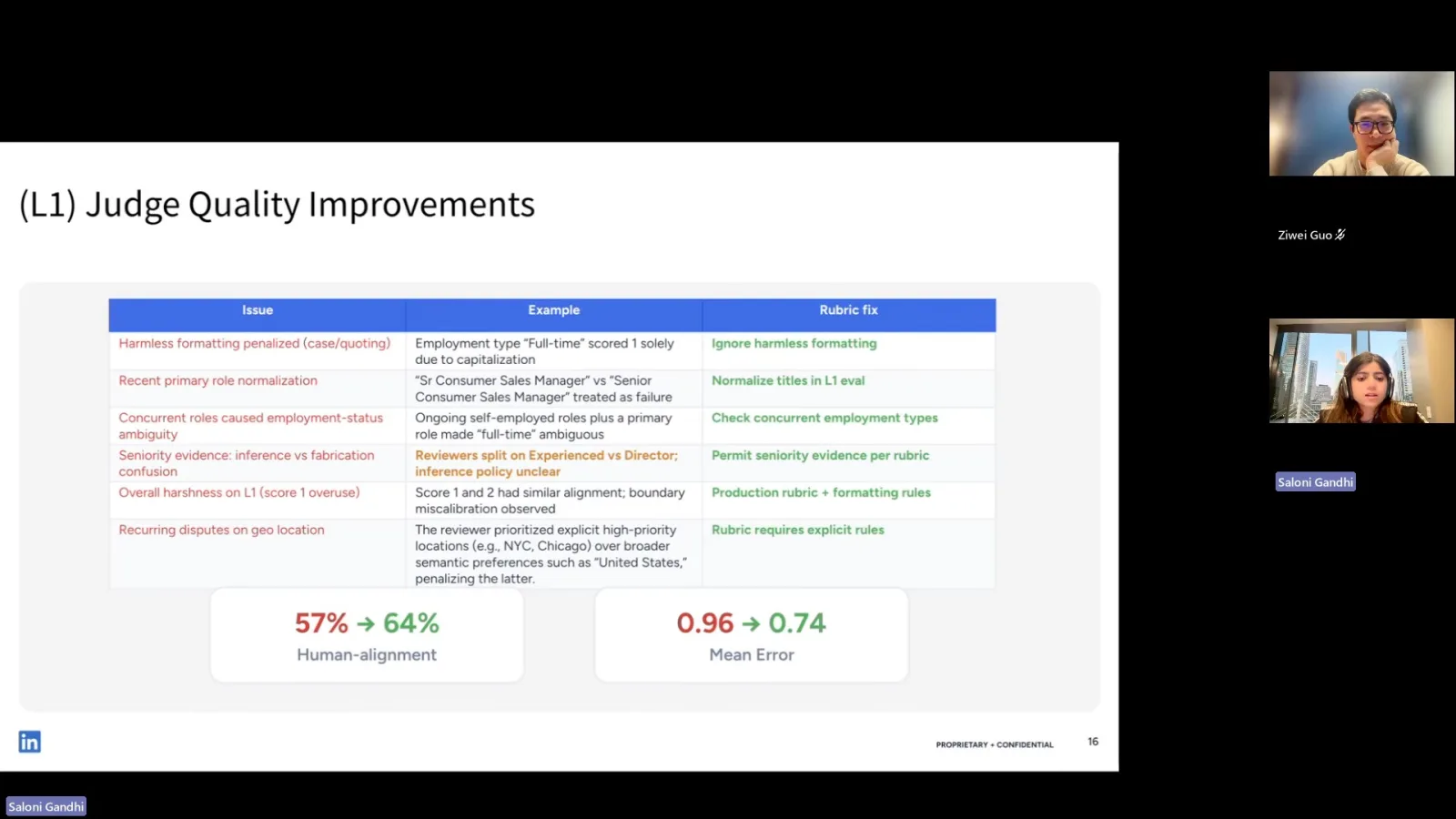
After the rubric changes, reported human alignment rose from 57% to 64%, while mean error fell from 0.96 to 0.74. Gandhi attributes the gain to making the specification of a correct evaluation clearer, not merely adjusting the model.
The root-cause judge could blame the wrong component
A missing category and uncritical reuse of the first judge’s rationale caused misleading diagnoses. The team aims to improve both judging layers.
The team conducted a similar review of the second-level reflection agent. Identifying the cause of a failure proved harder than noticing the failure itself: human reviewers agreed more often when the agent blamed the model than when it attributed a problem to other causes, particularly the rubric.
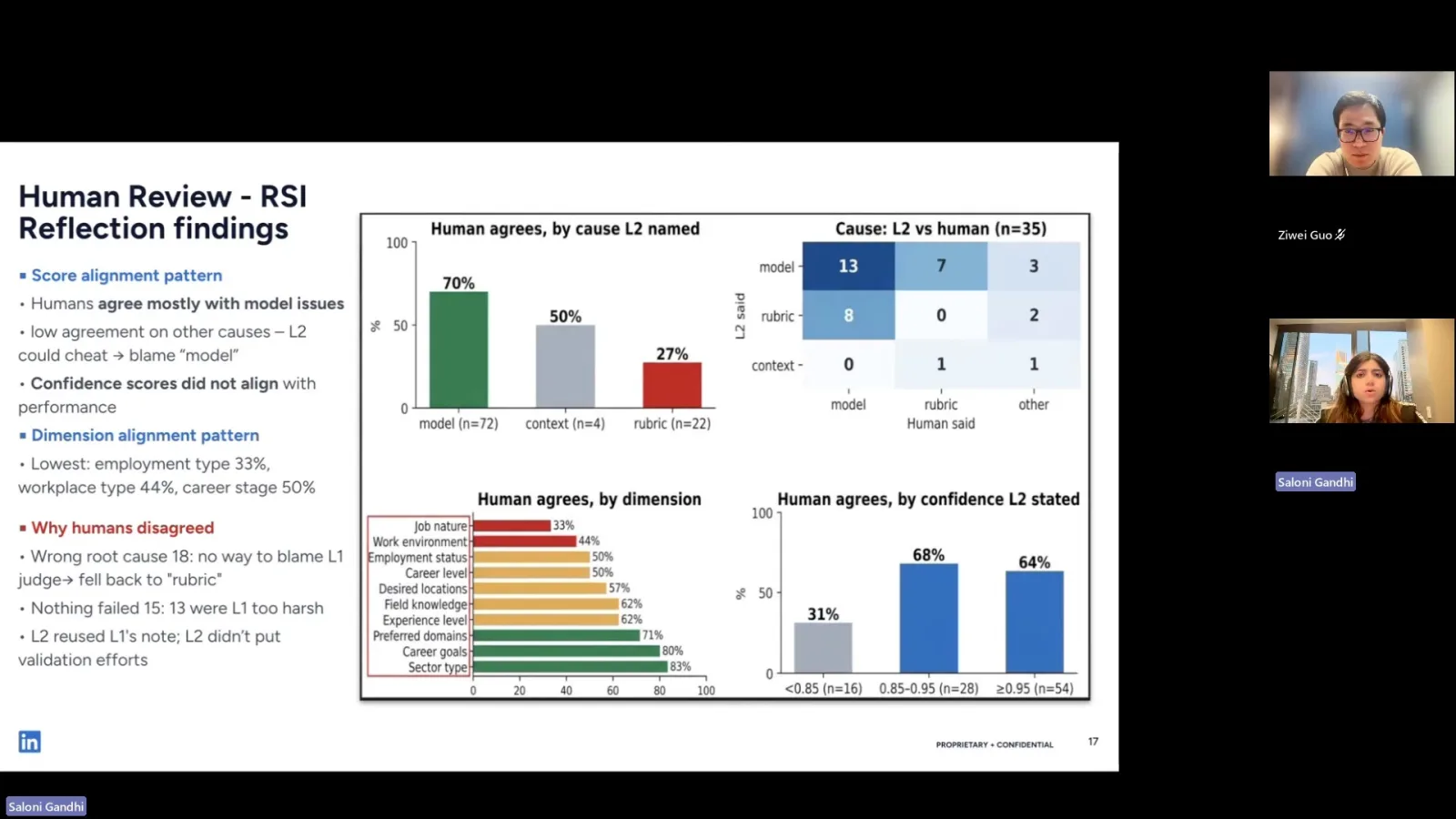
The original diagnosis categories had no explicit way to say the first-level judge was wrong. The reflection agent could therefore blame the rubric for a mistaken judgment. It also sometimes reused the first judge’s rationale without independently checking it against the agent’s output.
A convincing explanation is not the same as a correct diagnosis. If an optimizer uses a wrong root cause to produce a prompt edit, it may change the wrong part of the system. Improving diagnosis therefore became a priority alongside improving the first-level judge.
Gandhi says the team aims to stabilize first-level scores and make root-cause diagnosis more reliable. Majority voting and held-out evaluations help mitigate variance from individual language-model judgments, with adoption thresholds and confidence intervals informing decisions.
The broader measures are not just how many prompt edits the system produces. The team wants to track which changes can be generated and validated reliably, whether downstream response quality improves, and whether engineers save time maintaining agents.
Making the loop reusable across teams
The proposed shared stack combines evaluation, reflection, optimization and independent validation. Success is measured by downstream improvement rather than edit volume.
To scale this approach across teams, Gandhi describes a stack: useful agents at the base, repeatable evaluation above them, systematic reflection above that, and the improvement loop at the top. Each layer depends on the reliability of the layers below it.
The proposed shared infrastructure would provide reusable evaluation frameworks and human-calibrated judges, collect traces and diagnose failures, automate candidate generation, and validate changes with held-out data and regression tests. Self-service components would let other teams adopt the loop without rebuilding it all.
Gandhi distinguishes the target agent from the improvement engine. The engine evaluates performance, diagnoses failures and proposes changes; its ambition is not only to raise performance once, but to increase the rate at which the agent improves over time.
The team closes by emphasizing trust in the changes themselves. The project brought together evaluation, engineering and other collaborators because a useful improvement loop depends on the quality of both the proposed fix and the feedback behind it.
Mehr aus diesem Kanal
 12:57EN
 AI Engineer· 10. Nov. 2026Harvey’s agents scaled until their platform and merge queue brokeJoey Wang · HarveyAfter an alert spawned 900 agents and one engineer launched 950 tasks, Harvey added deduplication and fair scheduling.
 28:00ENAI Engineer· 10. Nov. 2026Robinhood’s AI reviewer merges 60% of data PRs without human reviewChetas Joshi · RobinhoodScripts verify live facts, an agent traces code risks, and people retain sensitive decisions.
 19:41ENAI Engineer· 9. Nov. 2026A high-reliability automation starts by routing the hard cases awayMatthew Jewkes · Standard CyberneticsMatthew Jewkes describes separating critical errors, ambiguous decisions and unusual exceptions in a biopharma indexing workflow.
 52:08ENAI Engineer· 9. Nov. 2026When coding agents overwhelm a self-hosted model, reject earlyHarshul Jain, Parv Khatri · AudibleAdmission control can protect GPU capacity, but benchmark it against every offered request—including the ones rejected.
 22:01ENAI Engineer· 9. Nov. 2026Zach Lloyd: make the software factory measurable and editableZach Lloyd · WarpWarp’s CEO proposes recording agent runs, scoring failures and testing changes to the workflow on real tasks.
 27:35ENAI Engineer· 9. Nov. 2026Uber traded an always-green trunk for faster AI-scale mergesPreetam Dwivedi, Manjari Akella · UberIts merge queue now relaxes some conflicts and validates the combined state after landing, with a verified-good fallback.