In 30 Sekunden
Tesla’s new Texas and Berlin factories were expensive to run while production was still low, Elon Musk said in 2022. He also acknowledged underestimating self-driving’s difficulty, described errors in training data and argued for a camera-based approach, while making another near-term prediction. The discussion ranges from car-sharing and population to the search for extraterrestrial life.
- 1A new factory can cost heavily before output catches upIn 2022 Musk described low production in Texas and Berlin and cited battery and equipment bottlenecks.
- 2Musk said he had underestimated the self-driving problemHe acknowledged earlier optimism while making another near-term prediction in 2022.
- 3Timing errors can change where a vehicle appears to beMusk gives a one-meter example and explains the need to align information from different models.
- 4Automated labels still require human correctionMusk says incorrect training labels can teach a driving model the wrong pattern.
- 5Musk sees the absence of alien evidence as a puzzleHe and the interviewers distinguish speculative answers from evidence.
Das Wichtigste
- New factories can incur large costs before their output reaches scale.
- Musk said he had underestimated the work needed for self-driving.
- Tesla’s supervised driving feature requires an attentive driver.
- Automated training labels can propagate errors unless corrected.
- Musk distinguishes the absence of alien evidence from a definitive answer.
Den bearbeiteten Text nach Kapiteln lesen
Why a Roadster became a rocket test payload
A viewer describes the launch’s impact, and Musk recalls how the car and Starman were chosen.
An interviewer thanks Musk for launching a Roadster carrying the Starman mannequin into space, saying it changed how he viewed the future of spaceflight.
Musk says new rockets usually carry an inexpensive test mass rather than a valuable satellite. He recalls that filmmaker Jonathan Nolan suggested using a Tesla, and Musk offered a Roadster from his own garage.
He says the first Falcon Heavy launch could have failed and recalls his surprise when it worked. The team added Starman to the driver’s seat and, at a friend’s suggestion, a miniature version of the car and driver.
Factories and supply chains took priority over car-sharing
Musk describes the Texas and Berlin production ramps and the difficulty of keeping factories supplied.
A car-sharing operator asks whether Tesla is building features for people who rent out their cars before autonomous driving becomes available. Musk says the company’s immediate focus was keeping factories operating amid supply-chain disruptions.
The interviewer argues that sharing would put parked vehicles to use. Musk replies that missing even one part can prevent a car from shipping, while idle factories and accumulated inventory create costs that must still be paid.
In 2022 Musk says the new Texas factory had low output and high costs. He cites difficulty ramping 4680 battery cells and structural packs, as well as equipment held up in China.
He says getting a new factory to high-volume production can take more effort than building it. Berlin faced similar expenses, although he says its initial battery configuration avoided some of the Texas factory’s risks.
Asked about a Plaid Model 3, Musk says the company was trying to reduce complexity. He describes the lower-priced Model 3 and Model Y as capable of reaching a much larger market than the more expensive Model S and Model X.
Paywalls, Twitter and the Cybertruck
The group considers ways to pay for news and returns to car-sharing and production plans.
Musk argues that advertising relationships can influence media coverage of carmakers, and says Tesla’s lack of advertising leaves it exposed to criticism. He also observes that Tesla sales rose during a period when he considered coverage negative.
The group discusses how readers share headlines without reading articles and how paywalls interrupt links. Musk says he finds multiple subscriptions and repeated logins cumbersome, even when he already subscribes.
One interviewer suggests a bundled news subscription through Twitter; Musk discusses paying a small amount for an individual article. He argues that publishers could earn revenue from occasional readers who would not otherwise subscribe.
Musk praises WeChat as an example of an app combining communication and payments. In 2022, while his proposed Twitter acquisition was still pending, the group discusses whether a similar experience could exist elsewhere.
The car-sharing operator returns to the practical work involved in maintaining a fleet. Musk imagines that, if cars eventually drive themselves, people could still manage cleaning, repairs and availability for groups of vehicles.
Musk says the Cybertruck design was then settled and cites semiconductor shortages and Chinese shutdowns as constraints on production planning. Asked when production might begin, he predicts the following year.
Musk’s concerns about birth rates
Musk and the interviewers discuss fertility, population density and potential long-term consequences.
The conversation turns to population. Musk expresses concern about falling birth rates and aging populations, pointing to Japan and China and warning about the consequences if low birth rates persist.
He and the interviewers discuss urbanization, education, income and religion as possible correlates of fertility. Musk says causes are difficult to establish, while offering his own interpretation of the patterns.
Musk disputes the idea that the existing human population is inherently unsustainable and uses sparse settlement as part of his argument. The group explores population density through thought experiments rather than a resource-use analysis.
The interviewers joke about how much physical space all humans would occupy. Musk distinguishes the appearance of crowded cities from the fraction of land actually occupied by people.
He recalls debris from the Space Shuttle Columbia disaster when discussing the low probability of a fragment striking someone on the ground. His point concerns physical distribution, not a calculation of how many people Earth can support.
The challenge of driverless city trips
Musk explains missed timelines, the radar decision and the neural networks behind Tesla’s system.
A beta tester asks for a way to give detailed feedback about recurring driving problems in different contexts. Musk says the immediate engineering goal was point-to-point city drives without driver intervention.
Asked why he had repeatedly predicted rapid progress, Musk says he underestimated the scope of the problem and found it easier to get close than to finish. He nevertheless predicted in 2022 that the goal was near.
He explains the decision to remove radar by saying radar and camera-based systems could disagree. In his account, removing radar forced the team to improve the vision system instead of relying on radar to mask weaknesses.
Musk describes repeated changes to the neural-network architecture. An interviewer asks whether separate competing teams should pursue different approaches; Musk says he sees the existing team’s capability and effort as strong.
He argues that roads are designed for people using eyes and that cameras and machine learning can address the task. Asked about licensing, he says Tesla would be willing to license its technology to other manufacturers.
Musk says self-driving and getting Starship to orbit occupied much of his attention at the time. He explains that a visible pause in progress can coincide with a substantial redesign of the system underneath.
He describes the challenge of combining information about moving and stationary objects in a common representation. If separate systems disagree about a vehicle’s position or timing, he says, the resulting error can affect driving decisions.
As an illustration, he says an object moving 30 meters per second travels roughly one meter in about 33 milliseconds. He argues that timing and position errors can therefore matter when vehicles pass close to each other.
An interviewer asks what benchmark should follow a city drive without interventions. Musk recounts a trip in which he adjusted the car’s chosen speed, and the group discusses how to count such actions.
They also discuss full stops and regulator scrutiny. Musk presents his account of disagreement over how a car’s displayed speed relates to whether its wheels have stopped.
Training data, safety and feature requests
The discussion covers automated labeling, safety claims and priorities for in-car features.
Musk argues that the value of autonomous driving is difficult to appreciate before experiencing it. He also says a driving system depends on training and debugging infrastructure, not only the software installed in a vehicle.
He describes automatic labeling of video frames followed by human review. In his account, automation lets a smaller labeling team correct large quantities of examples and feed the corrections back into the labeling process.
He says a systematic labeling error can teach the model the wrong pattern. The team therefore investigates cases where the model assigns a lower probability than expected and corrects mislabeled training examples.
The interviewers discuss crashes that driver assistance might prevent. Musk argues that safety should be judged by overall outcomes, while acknowledging that even a future autonomous system would not eliminate every accident.
Musk offers optimistic estimates of future safety improvements; they are predictions, not results established by this interview. Tesla’s current [FSD (Supervised) guidance](https://www.tesla.com/support/fsd) requires an attentive driver and says the feature does not make the car autonomous.
Owners ask about Apple Music in the car and thank the team for navigation waypoints. Musk says navigation could be improved further, including by making better use of calendar information.
The group clarifies that owners want a built-in music service rather than playback through a phone over Bluetooth. Musk says he uses Apple Music through Bluetooth and discusses improving audio connectivity.
An owner asks why a blind-spot camera feature is unavailable on an older vehicle. Musk says feature requests must be prioritized by the benefit and the number of people affected, given limited engineering capacity.
He says finding strong software engineers is difficult and notes that some capable people he knows reduced their work after becoming wealthy. He describes himself as unusually inclined to keep working.
Finding life and understanding the universe
The final discussion moves from the Fermi paradox to belief, evidence and Musk’s sense of purpose.
The interviewers connect his motivation to an interest in understanding existence. Musk says he wants to take actions that improve humanity’s ability to understand what is happening in the universe.
The discussion turns to the Fermi paradox: why, given the age and size of the universe, humanity has not found convincing evidence of extraterrestrial civilizations. Musk says the lack of evidence troubles him.
An interviewer suggests civilizations might exist at different times or in forms too small to detect easily. Musk distinguishes the absence of evidence from a certain answer about whether life exists elsewhere.
They discuss the possibility of simple life and the long history of microorganisms on Earth. Musk speculates about the development of complex cells and says finding even simple extraterrestrial life would be significant.
Asked about a creator, Musk says he favors drawing conclusions in proportion to evidence. He discusses uncertainty about the universe’s origin and raises the possibility of a simulated reality as a question.
He separates questions about the origin of the universe from beliefs about a deity judging individual actions. The interviewers discuss how religious belief and a search for meaning can guide people differently.
Musk describes his own aim as expanding consciousness to understand reality. He says he has no general objection to religion and returns to his concern about birth rates before the conversation ends.
Mehr aus diesem Kanal
 47:09EN
 Tesla Owners Silicon Valley· 12. Okt. 2026Elon Musk: Why Starship Reuse and Robot Hands Are So HardGast: Elon MuskMusk explains the next steps for catching Starship, the problems behind dexterous robot hands and his plan for faster chip design.
 1:05:06ENTesla Owners Silicon Valley· 11. Aug. 2025Musk on Starship, Optimus, Neuralink and the future of AIGast: Elon MuskAt X Takeover 2025, Musk discusses engineering challenges, product plans and speculative visions for human–machine integration.
 1:17:09ENTesla Owners Silicon Valley· 27. Juli 2025Musk describes the engineering and uncertainty behind Starship and OptimusGast: Elon Musk · Moderation: John Stringer, Kelvin GeeAt X Takeover 2025, Musk discussed reusable heat shields, robot hands, Neuralink research and the role of humans alongside AI.
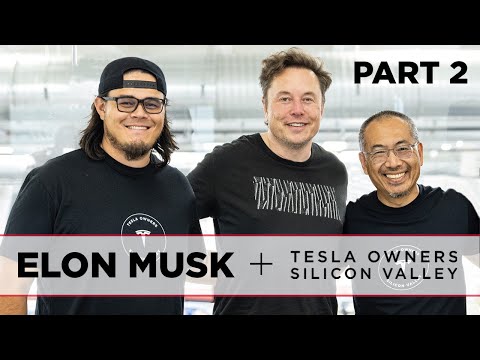 1:03:06ENTesla Owners Silicon Valley· 14. Juni 2022How a converted Smart helped Tesla survive, according to Elon MuskGast: Elon MuskMusk recounts Tesla’s early Daimler deal and explains why affordable cars and asking better questions matter to him.
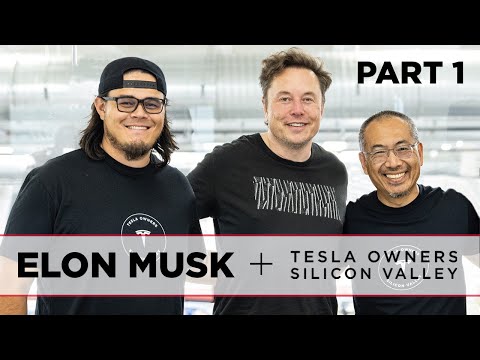 1:07:18ENTesla Owners Silicon Valley· 3. Juni 2022Musk recounts Tesla’s early years and the Roadster’s difficult startGast: Elon MuskIn a 2022 interview with Tesla owners, Musk describes early electric-car engineering and his disputed account of the company’s origins.