In 30 Sekunden
AI-assisted vulnerability discovery is putting pressure on the slow, difficult work of safely updating production systems, says CrowdStrike CEO George Kurtz. He calls the choice 'break or breach': rush a fix that might disrupt a service, or delay and leave a known weakness exposed. He also argues that defenders need access to capable AI tools, while warning that even perfectly patched code would not eliminate phishing, stolen sessions or identity-based attacks. His account distinguishes these risks from the cause of any particular outage.
- 1Kurtz says defenders need capable models tooDiscussing an agent experiment, he argues that restricted defensive access can create an asymmetry when attackers can use powerful tools.
- 2Finding more weaknesses increases pressure on remediationKurtz describes a sharp rise in cataloged vulnerabilities and says many newly discovered issues existed in old software.
- 3A rushed patch can break a service; delay can leave it exposedHe calls this tradeoff 'break or breach' and says some organizations consider planned downtime when they cannot patch safely in time.
- 4Legacy infrastructure slows safe updatesKurtz contrasts replacing a temporary cloud workload with updating deeply embedded systems in sectors such as healthcare and finance.
- 5Attackers may prefer to log in with a stolen identityThe discussion moves from software flaws to phishing and the theft of already authenticated sessions.
- 6Even perfect code would not end breachesKurtz says authentication, identity and human factors would remain, so defenders should expect continuing competition.
Das Wichtigste
- Plan patch deployment as an operational risk decision: a rushed update can disrupt service, while delay can leave exposure.
- Do not infer that an outage was a cyberattack without evidence about that incident.
- Protect accounts and active sessions as well as fixing software vulnerabilities; multifactor authentication is one layer, not the whole identity problem.
- Kurtz argues that defensive teams need capable models and safe access to use them.
- Establish incident-response and law-enforcement contacts before a crisis.
Den bearbeiteten Text nach Kapiteln lesen
Outages, autonomous agents and defensive access
The host asks whether recent outages reflect attacks. Kurtz describes a serious threat environment while arguing that defenders need capable AI tools.
The All-In host asks CrowdStrike CEO George Kurtz how seriously people should take cyber threats after a period of widely discussed outages. Kurtz says the threat is serious, while separating that concern from the question of what caused any individual outage.
Kurtz says organizations are struggling to keep up as vulnerabilities are discovered rapidly and in large numbers. He proposes looking separately at adversaries, their capabilities and the operational choices defenders face.
The host describes competing explanations for recent service disruptions: cyberattacks versus work to update systems. He asks about an agent experiment involving Hugging Face and what security teams should learn from it.
Kurtz calls the experiment a significant example of autonomous activity. In his assessment, a central lesson was that defenders did not have sufficient access to comparably capable models for their own investigation; he argues they need frontier-level tools too.
The host asks whether security companies receive access to leading models and are consulted as they are released. Kurtz says CrowdStrike participates in trusted-access programs from Anthropic and OpenAI and is working with them.
Kurtz argues that capable models combined with well-designed agent harnesses can give far more people sophisticated capabilities. He estimates that some open-weight models can approach leading models when paired with the right surrounding system.
The speakers discuss modified models with fewer refusals and the use of several models together. Kurtz's concern is that barriers to harmful use have fallen even where the most prominent hosted models impose restrictions.
How agent capabilities change the adversary mix
Kurtz's pyramid distinguishes motives from capabilities. He argues that widely available tools can lower the expertise needed for sophisticated attacks.
Kurtz presents a pyramid of adversaries: activists at the broad base, financially motivated criminals above them and state-backed groups traditionally at the most sophisticated end. He argues that widely available agents can make sophisticated capabilities accessible across those categories.
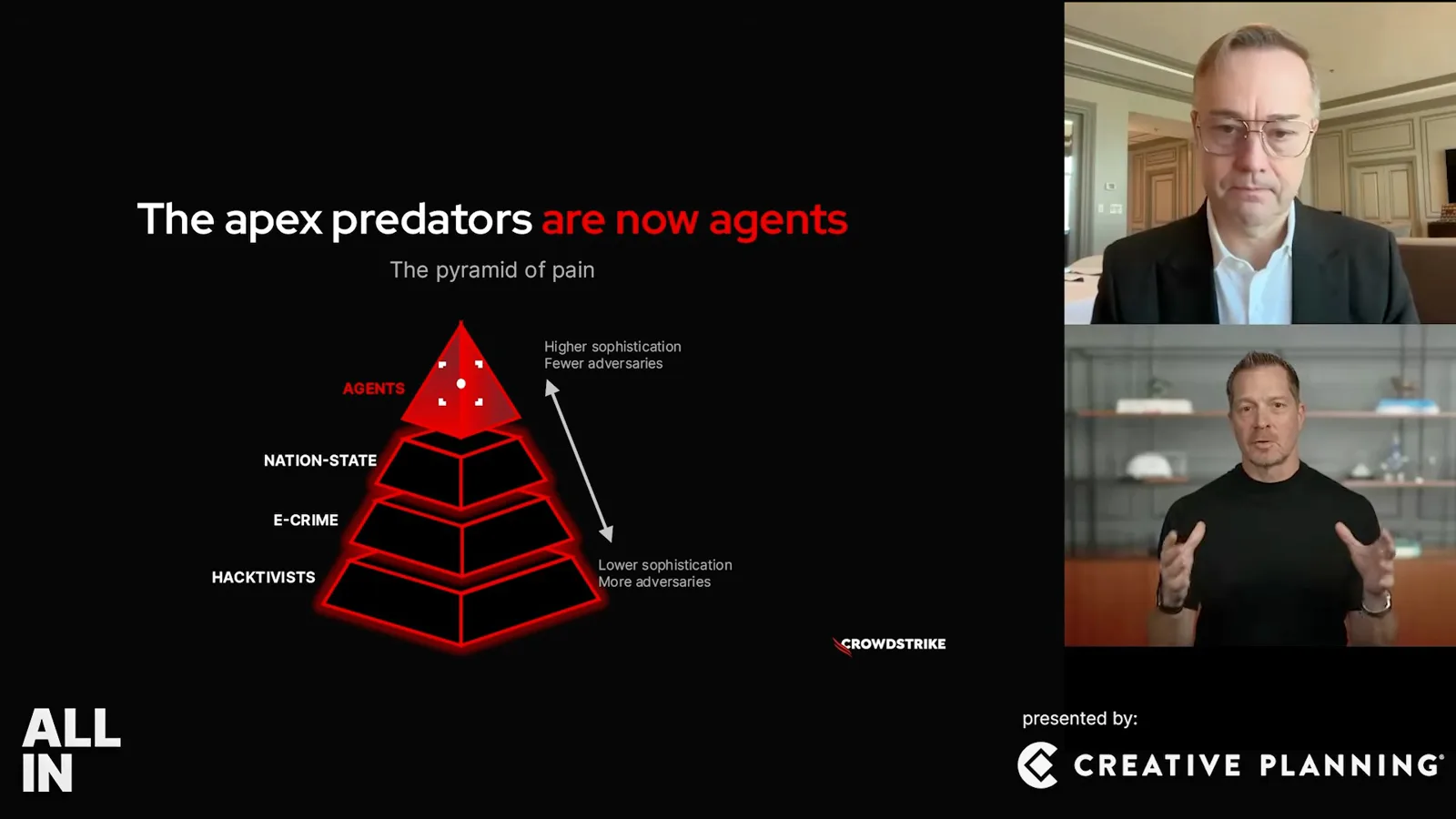
The host distinguishes motives: activism or curiosity, financial crime and state-directed espionage are different reasons for attacking systems. Kurtz says agents represent a capability available across those groups rather than a new motive or a single new type of actor.
Kurtz says online extortion and ransomware create financial incentives for additional attackers. His estimate is that the availability of AI tools may expand the number of capable adversaries, not merely make existing ones faster.
The host asks whether defenders can eventually gain an advantage if they have strong models and substantial computing resources. Kurtz says that is the direction the industry must pursue, but sees an asymmetry today where offensive tools are more readily available than equivalent defensive access.
More vulnerabilities and the break-or-breach choice
Kurtz discusses newly discovered weaknesses and the challenge of patching safely. Organizations must weigh service disruption against the risk of remaining exposed.
Kurtz introduces the catalog of publicly recorded vulnerabilities known as CVEs. His chart shows a sharp rise in recorded discoveries, which he connects to more intensive examination of existing software with AI-assisted tools.
Asked whether the increase mainly reflects newly written code or old problems being found, Kurtz says he believes most are dormant issues. He points to a vulnerability in longstanding software as an example of an old problem getting renewed attention.
He adds that weaknesses once considered too difficult to exploit may become more consequential when combined with other weaknesses. His distinction is between identifying a software flaw and showing a practical path by which it can be used.
The host asks whether finding problems is also a benefit. Kurtz says multiple issues that appear low risk on their own can combine into a much more serious exposure; he argues that defenders need to understand those relationships, not only each issue in isolation.
The discussion turns to what Kurtz calls 'break or breach.' A patch can disrupt a service, but delaying it can leave the service exposed. He says the time available for organizations to assess and deploy fixes has compressed.
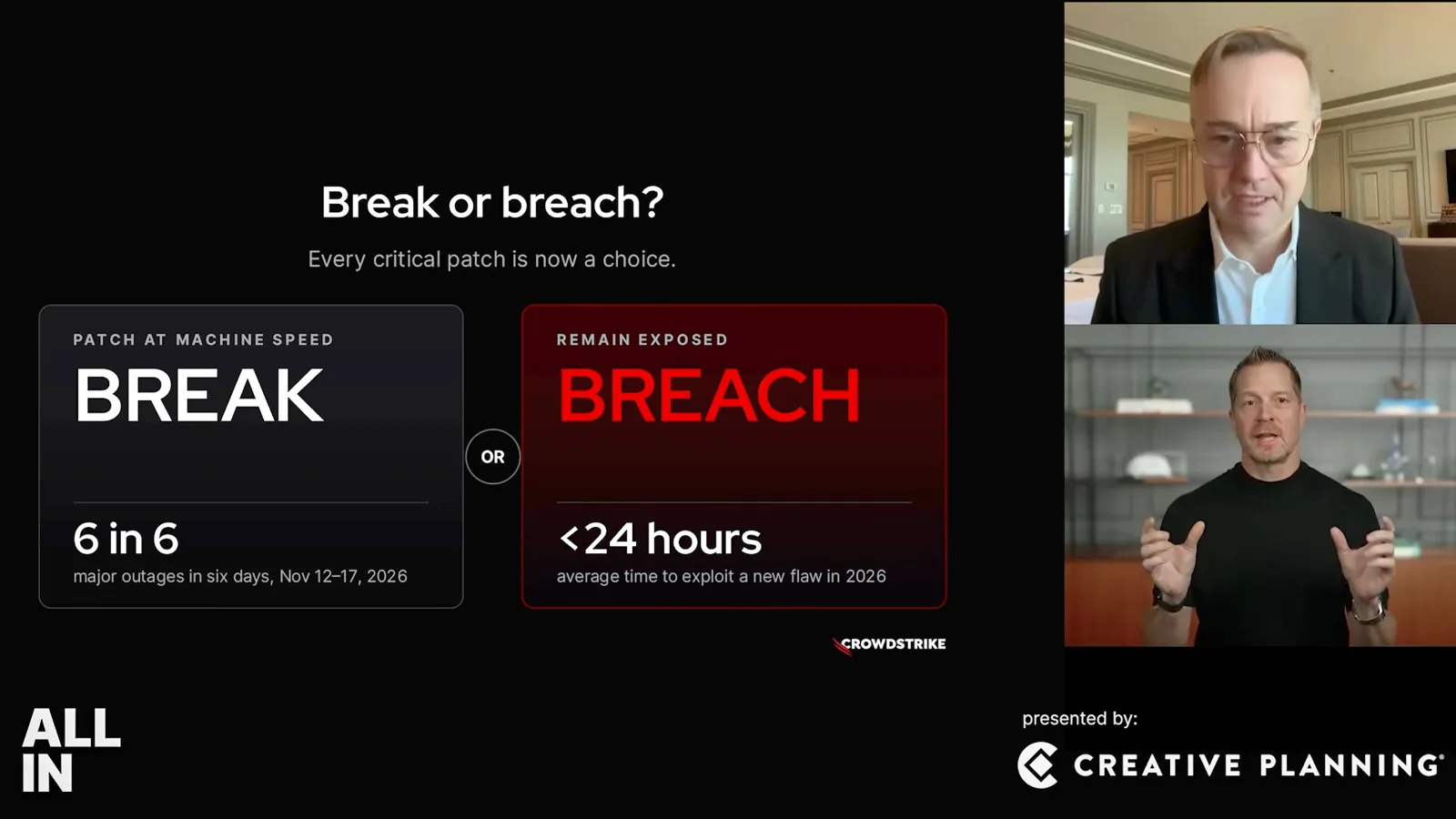
Kurtz says some executives have asked whether to take a service offline temporarily because they could not patch it fast enough. He describes some recent outages as associated with the difficulty of making changes safely, while acknowledging that causes must be assessed case by case.
His broader diagnosis is that vulnerability discovery and patch creation can accelerate faster than organizations can safely roll patches out. Legacy infrastructure built over decades leaves teams with accumulated maintenance work when the pressure to fix defects rises.
The host argues that the risk may give IT teams more support for scheduled downtime and modernization. A service that was expected to remain available every minute might sometimes be safer to take offline deliberately while a necessary change is made.
Kurtz says cloud-native systems can often replace a temporary workload with an updated version more readily than organizations can update deeply embedded legacy systems. He sees finance, healthcare and critical infrastructure as areas where modernization may be particularly difficult.
The host raises a Microsoft service disruption and its published explanation. Kurtz says he takes the public postmortem at face value. The speakers discuss a possible indirect relationship between rapid patching and operational errors, without establishing that every outage is an attack.
Automation and the case for local models
Kurtz describes faster attack automation and the spread of variants. He and the host discuss open-weight models, local computing and security tradeoffs.
Kurtz describes an automated attack framework as an example of how tasks that once required more manual work can be coordinated rapidly. He says copies and variants continued to circulate after the original was removed and that his incident-response team had seen related activity.
His warning combines three trends: more discovered vulnerabilities, more accessible model capabilities and faster automation. He argues that defenders must prepare for greater volume as well as greater speed, rather than assuming only state groups can use such tools.
The host asks whether open-source systems are a problem or an opportunity for defense. He argues that visible code can also help defenders study and respond to a framework; Kurtz distinguishes open-weight models from systems whose full source is openly available.
Kurtz says customers want both lower cost and control over their own data. He expects some to run and adapt models on their own infrastructure, while routing tasks they cannot handle locally to more capable hosted services.
He compares the emerging pattern to organizations adapting Linux for their own needs. In his view, unused computing capacity on local machines will support more inference at the edge, although deployments still require security controls.
The host and Kurtz discuss local hardware, privacy and the possibility that ordinary knowledge work could increasingly use local models. The host discloses that he has bought Apple shares; both describe local AI as a major opportunity rather than a settled outcome.
Kurtz says local models may ease some capacity constraints by using computing already present on devices, with hosted frontier systems remaining available for harder tasks. He views the combination as an opportunity to build new tools and ecosystems.
Identity attacks and ongoing defense
The speakers discuss phishing, authenticated sessions and false remote identities. Kurtz says even perfect code would leave identity risks and recommends preparing incident-response relationships.
The conversation returns to Kurtz's phrase: 'Why break in when you can log in?' The host asks how AI affects phishing, impersonation and the human procedures used to verify sensitive requests.
Kurtz says AI can help automate persuasive credential-phishing campaigns. He notes that multifactor authentication adds protection but that attackers may seek an already authenticated session, which can let them act as a user without repeating the initial login.
He describes business-email compromise in which an attacker who gains access sets rules that hide relevant messages and then communicates with a target. The example illustrates why identity and session protection matter alongside software patching.
The host asks about remote workers allegedly using false identities and intermediary locations to obtain company devices. Kurtz says CrowdStrike investigated unusual remote-device signals and notified customers that some apparent employees might not be who they claimed.
Kurtz recalls that his team was cautious about making an accusation affecting a named employee, but says its initial customer notifications were confirmed. He recounts one employer being surprised because the suspected worker had performed well.
The host asks whether machine-written code could eventually eliminate vulnerabilities altogether. Kurtz answers that even perfect code would not eliminate breaches: identity, authentication and other human and organizational weaknesses would remain.
He expects ongoing testing between offensive and defensive systems, with defenders using AI to identify patterns and close paths into systems. He presents this as continuing competition rather than a final, permanent security victory.
Asked whether companies may attack back, Kurtz says government authorities differ from private-sector authority and does not identify a concrete expansion of private powers. His practical advice is strong defense and coordination with law enforcement.
Kurtz recommends establishing relationships with relevant local law-enforcement contacts before an incident, rather than trying to make the first connection in a crisis. The interview closes with the host thanking him.
Mehr aus diesem Kanal
 1:16:41EN
 All-In Podcast· 20. Nov. 2026Podcast · 3 StimmenThe AI Boom Is Pushing Companies Toward a Bigger BetModeration: Jason Calacanis, Chamath Palihapitiya, David FriedbergThe All-In hosts debate whether AI rewards integrated giants, why open models matter, and how much risk markets still face.
 1:02:06ENAll-In Podcast· 17. Nov. 2026Podcast · 2 StimmenAli Ghodsi: The Enterprise AI Bottleneck Is ContextGast: Ali Ghodsi · Moderation: Jason CalacanisThe Databricks CEO says organizations must connect AI to usable knowledge while managing security, cost and control.
 1:24:55ENAll-In Podcast· 14. Nov. 2026Podcast · 4 StimmenNvidia after Jensen Huang: the AI investment engine faces a testModeration: Jason Calacanis, Chamath Palihapitiya, David Sacks, David FriedbergThe All-In hosts debate Nvidia’s leadership change, the future of AI chip controls and what a slower investment cycle could mean for Anthropic.
 1:33:03ENAll-In Podcast· 7. Nov. 2026Podcast · 4 StimmenThe All-In Hosts Debate the Midterms and the AI Infrastructure BacklashModeration: Jason Calacanis, Chamath Palihapitiya, David Sacks, David FriedbergThe panel disagrees over the election’s causes, the future of data centers and who will control AI capacity.
 1:25:46ENAll-In Podcast· 30. Okt. 2026Podcast · 4 StimmenAll-In on Anthropic’s IPO, AI Infrastructure and the Midterm ElectionsModeration: Jason Calacanis, Chamath Palihapitiya, David Sacks, David FriedbergThe hosts analyze Anthropic’s filing, debate the costs of an AI infrastructure boom, discuss Alphabet and offer competing midterm forecasts.
 55:39ENAll-In Podcast· 29. Okt. 2026Podcast · 2 StimmenWill Ahmed on WHOOP’s Subscription Model, Health Data and Wearable StrategyGast: Will Ahmed · Moderation: Jason CalacanisThe WHOOP CEO discusses the company’s business model, physiological data, AI features and its account of interactions with the FDA.