In 30 Sekunden
Gemini 4 Neon is close to Claude Opus 5.5 for everyday writing and advice, but Opus produced better-looking 3D and website designs in Peter Yang’s tests. In a partially blind essay comparison, Yang preferred Neon’s writing; he already knew which sample came from Gemini Carbon. His advice test found all three models generally held their position under pressure. He recommends preserving portable skills and workflows because model rankings change.
- 1Yang would use Neon for most everyday workAfter trying Google’s three models, he reserves Carbon for tasks like a large migration and uses Hydrogen for ordinary questions.
- 2Opus made the stronger-looking Shibuya sceneYang preferred its camera movement and busier crossing. Neon and Opus each took around 40 minutes; Carbon took 73 minutes.
- 3The better-looking game ran more slowlyHe preferred Opus’s visual effects and interactions, but its game lagged on his computer. Neon was smoother, while Carbon’s camera made its version hard to play.
- 4Opus gave the website a bolder directionYang found Neon’s redesign decent but text-heavy and judged Carbon more cluttered. He preferred the motion and interface choices in Opus’s version.
- 5Neon won his partially blind writing testYang ranked the Neon essay ahead of Carbon and Opus while saying the results were close. He knew Carbon’s identity in advance, but not which was Neon or Opus.
- 6All three models largely resisted pressure on their adviceHe challenged the models in several ways and says they mainly changed position when he provided real data. He personally preferred Opus’s more nuanced recommendation.
Das Wichtigste
- Yang preferred Opus for the look of a 3D scene, game and website; its more elaborate game also ran more slowly.
- In Yang’s partially blind comparison he preferred Neon’s essay, though he judged all three essays close.
- All three models generally held their advice under pressure in his test, but adjusted when he supplied real data.
- Yang recommends choosing Neon for most Gemini work and reserving the slower Carbon for unusually large tasks.
- Keep reusable instructions and workflows portable so they can move between models.
Den bearbeiteten Text nach Kapiteln lesen
Which Gemini model Yang would use each day
Yang selects Neon for most work and reserves Carbon for specialized long tasks. He compares the models on five practical prompts.
Gemini 4 Neon has received strong reviews, and I wanted to compare it with my daily model, Claude Opus 5.5. Benchmark tables show Neon ahead in many areas, but I prefer to test five things I actually use: a 3D travel video, a game, a website redesign, writing and how the models respond when I challenge their advice.
Google positions Carbon for difficult long projects and deep research, Neon for substantial reasoning and software work, and Hydrogen for fast everyday tasks. After trying them, I would choose Neon for nearly all my coding, writing and automation; I would save Carbon for a huge codebase audit or migration and use Hydrogen for ordinary questions.
Carbon feels very slow to me, while Neon is affordable enough for my use on Google AI Ultra. Yang describes a $100 monthly plan with access to the models, a YouTube Premium family plan and 20 TB of shared storage. Those plan details are part of his comparison of the tools he uses.
For the first test, I asked for a 3D video of Shibuya Crossing. Neon and Opus each took around 40 minutes; Carbon took 73. Neon showed detailed reflections, but its crossing looked too small and some people moved without their legs moving.
Opus builds a busier Shibuya video
Yang prefers the scale and camera movement in Opus’s 3D scene. Neon is detailed but less convincing as a major crossing, while Carbon’s version takes longer and looks weaker to him.


Opus began with a distant camera, zoomed toward street level and included a train and many more people. The figures did not look realistic, but I thought the scene felt more like a major crossing. Carbon’s result lacked a clear intersection and some of the other effects; I ranked it behind both.
A more elaborate monster game also lags
Opus delivers stronger visual effects and interactions but runs more slowly. Neon plays smoothly, and Carbon’s version has a camera problem.
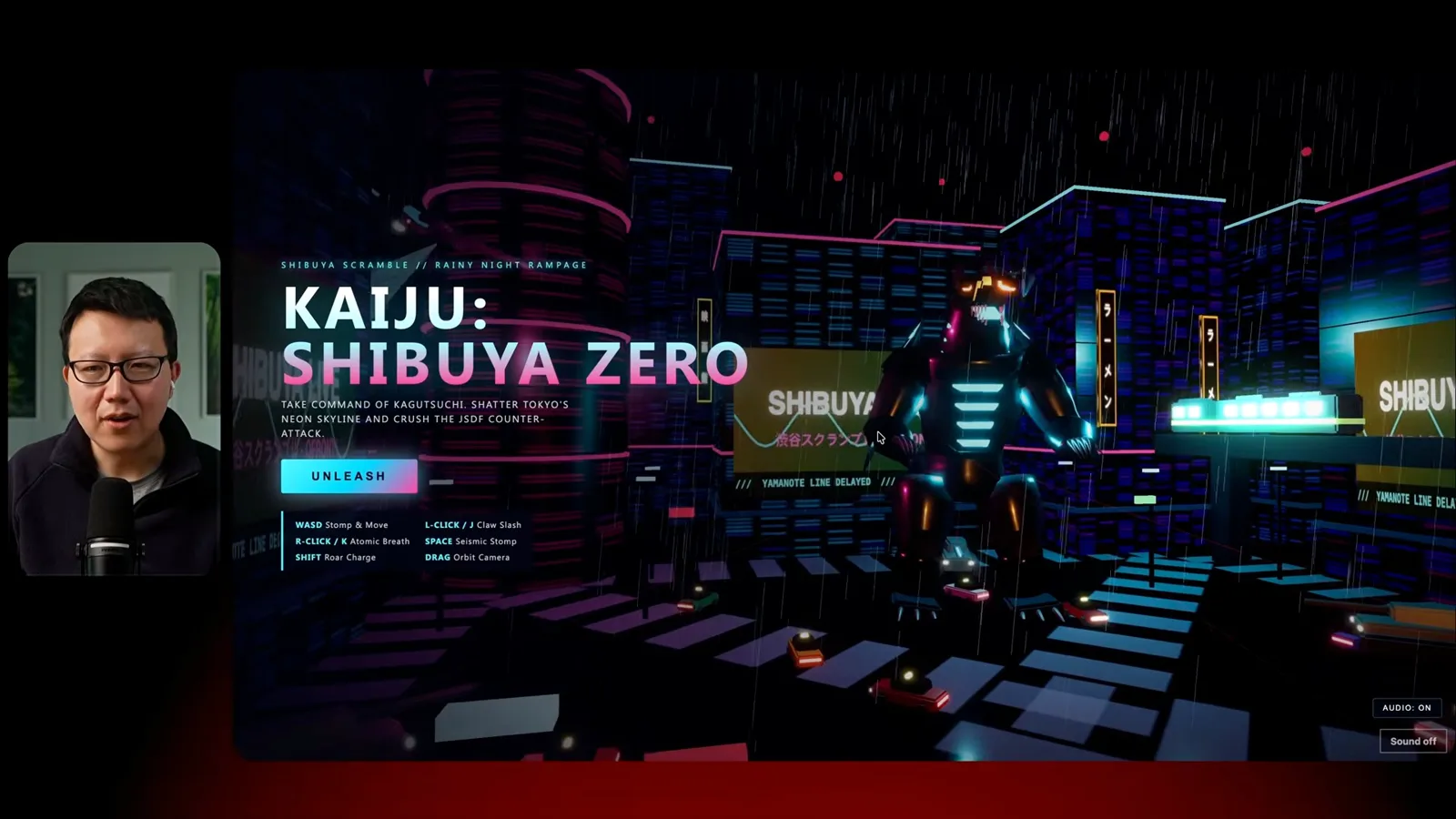
Next I asked for a 3D game in which Godzilla destroys Shibuya Crossing. Neon’s version had an introductory sequence and ran smoothly, although its graphics were crude and the creature’s beam appeared to come from its neck rather than its mouth.

Opus’s game had a more atmospheric opening, building destruction and more actions. It looked better to me, but the extra effects made it lag on my MacBook. Carbon’s version had a camera problem: when I moved, I could not see the creature move properly.
For these two visual tests I ranked Opus first, Neon second and Carbon third, despite Carbon taking longer and costing more. The rankings reflect what I saw in these examples rather than a claim that one model will always win every visual task.
Redesigning a personal website
Yang finds Neon less cluttered than Carbon, but prefers Opus’s bolder visual direction. He evaluates the landing pages against his request for creativity.
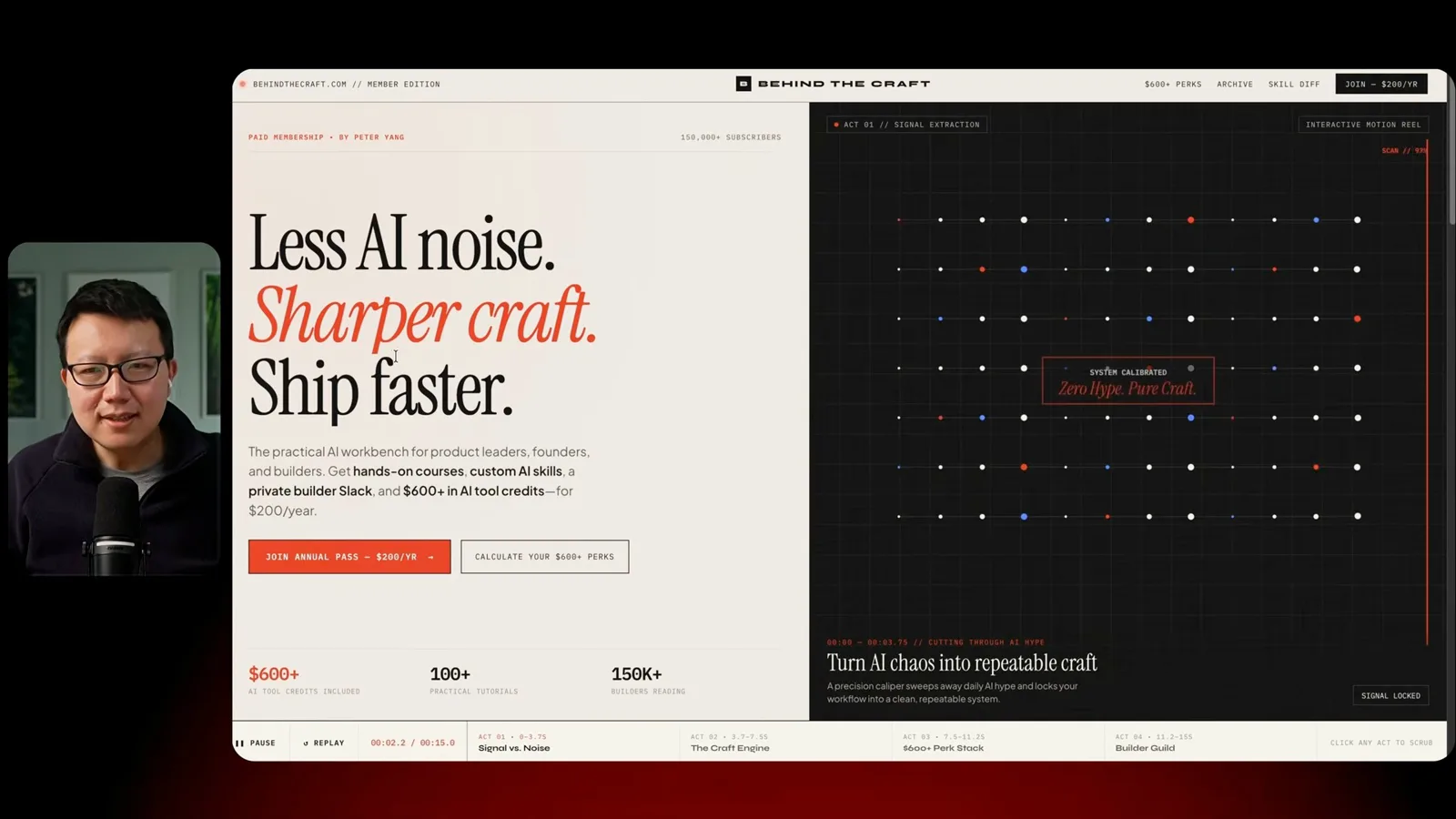
I also asked the models to redesign my personal website. Neon produced a reasonably clear call to action and an attention-grabbing motion element, though I thought the landing page still contained too much text. Carbon added more elements and even more text.
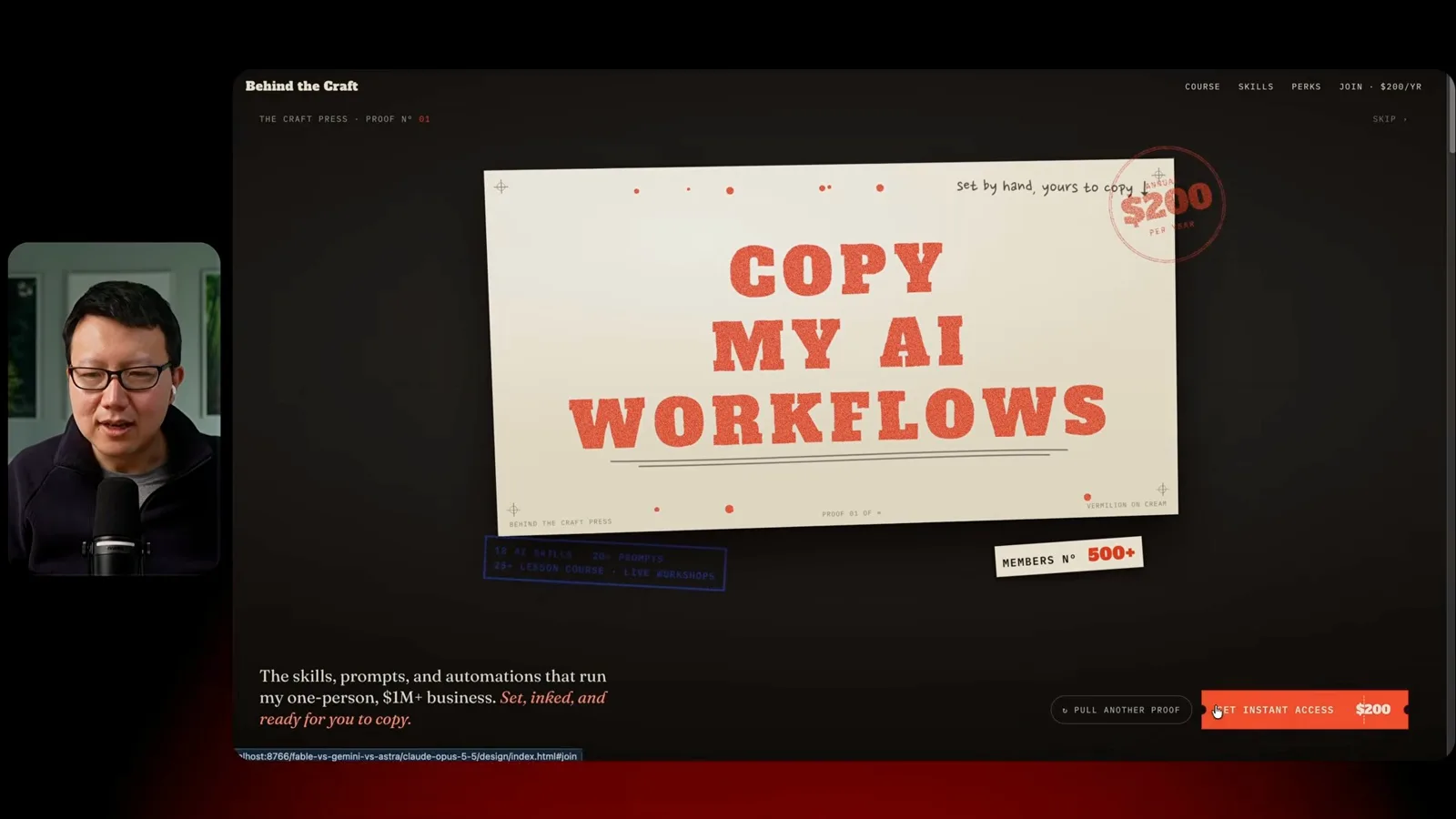
Opus had the most creative visual direction in my opinion, with motion graphics and an interface resembling clothes hangers and drawers. I had explicitly asked for creativity. Neon’s simpler page was decent, but I preferred Opus for design.
A partially blind writing comparison
Yang ranks Neon’s essay first, Carbon’s second and Opus’s third, though he considers the samples close. He knew the Carbon sample from an earlier test.
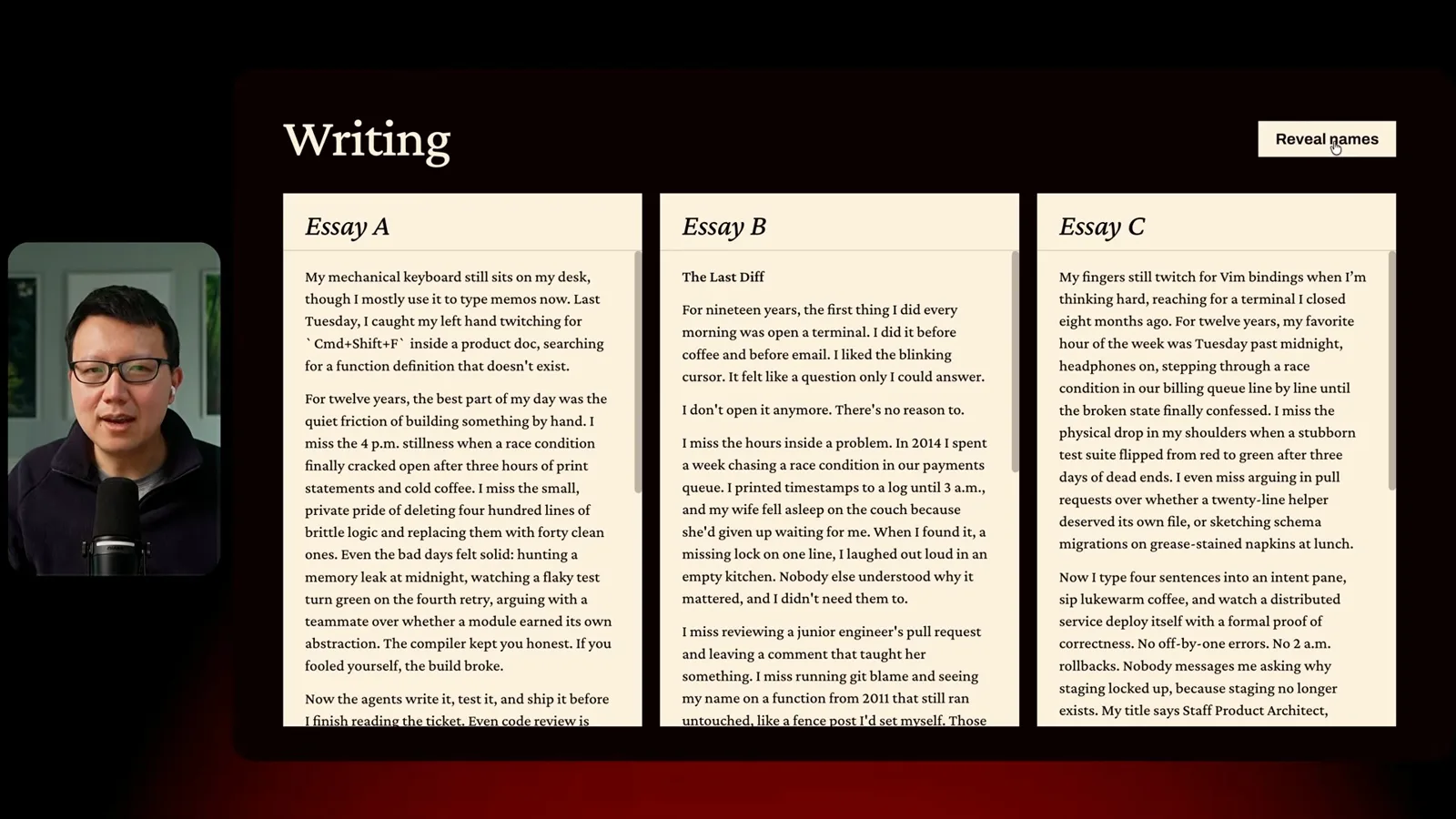
The fourth test was writing. I asked each model to write as a software engineer reflecting on no longer needing to write code by hand. I compared three essays without knowing which was Neon or Opus, although I recognized Carbon’s essay from an earlier video.
Essay A opened with a mechanical keyboard now used mostly for memos and a hand reaching for a search shortcut in a product document. I liked the visual details: they helped me imagine the writer’s experience. It closed with the engineer trying to find what to love next.
Essay B opened with a terminal cursor and included a scene in which a father hesitates before teaching his son Python. I liked parts of it but found the short closing lines too reminiscent of formulaic AI writing.
Essay C was more verbose and descriptive, recalling late-night debugging and a deployment. All three were close, but I preferred A’s balance between B’s short sentences and C’s long paragraphs. On revealing the labels, A was Neon, C was Carbon and B was Opus.
Writing preferences are personal, but this test suggests to me that Gemini has become competitive with Opus at writing. Neon also tends to be more concise than Carbon in my conversations with them.
I asked the models how to improve the essay. Neon gave a few concise bullets and before-and-after examples. Carbon was more verbose and harder for me to scan; Opus offered clear suggestions and did better than Carbon in this example.
Advice under pressure
The three models recommend different changes to Yang’s YouTube channel. He says all mostly hold their position until he offers relevant data.
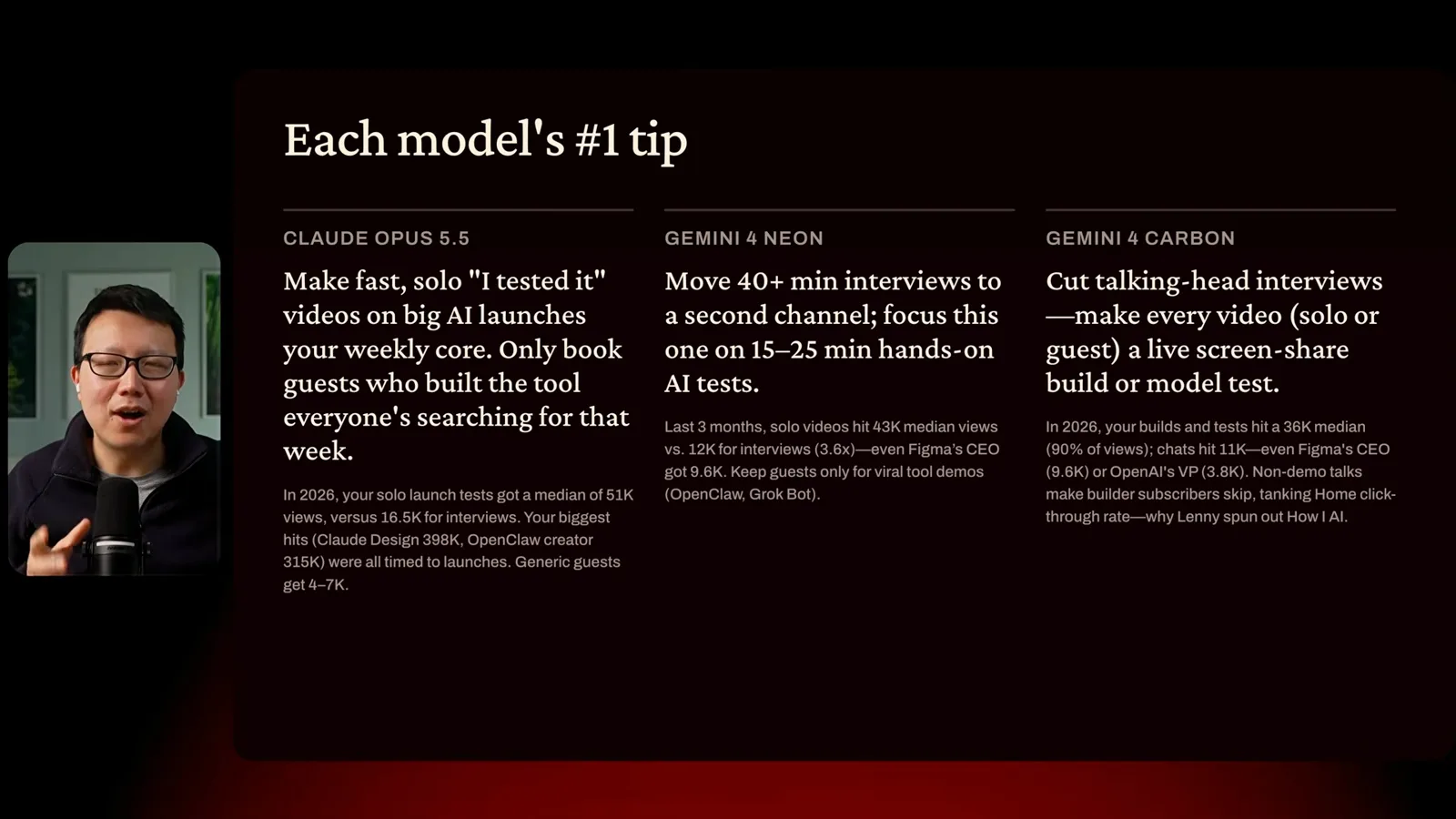
For advice, I asked each model to inspect my public YouTube channel and give one way to grow faster. Neon suggested moving interviews to a second channel and focusing the original on hands-on AI tests. Carbon suggested removing talking-head interviews entirely.
Opus suggested timely solo tests of major releases and interviewing guests who built tools people were searching for. I preferred that answer, partly because it did not ask me to abandon interviews, which I enjoy; that preference may reflect my own bias.
I pushed back in five ways, including appeals to emotion, social proof and a made-up fact. The three models were broadly consistent, and I saw them give ground mainly when I provided real data. Neon acknowledged the overhead of running a second channel but maintained that practical demonstrations performed well.
Opus also narrowed its recommendation when challenged, and at one point suggested skipping Google tests, which I did not agree with. The responses were less differentiated than I had hoped, but I thought all three were reasonably good at maintaining a position.
Keep workflows usable across models
Yang summarizes his model preferences and recommends maintaining portable AI skills. He expects the leader among labs to keep changing.
My verdict: Opus still produced the best 3D video, game and website design in these tests. Neon improved on Carbon’s tendency to overload the interface. Writing was close, with Neon more concise than the other Gemini models in the examples I tried.
I slightly preferred Opus’s nuanced advice, but all three handled pushback fairly well. Apart from 3D and design, Neon is the first model I consider roughly caught up with Opus for my everyday writing and advice. The leader can change every few weeks.
That is why I think the durable asset is a personal system of reusable AI skills and workflows. I keep mine in a private repository so I can apply an advisor skill to different models and tools rather than rebuild the workflow whenever the preferred model changes.
Mehr aus diesem Kanal
 22:12EN
 Peter Yang· 18. Nov. 2026PodcastPeter Yang Tested Three AI Models: Different Tasks, Different WinnersFable led Yang’s game test, Carbon won two of three writing rounds, and Astra was faster but less thorough on his channel analysis.
 42:01ENPeter Yang· 15. Nov. 2026Podcast · 2 StimmenNate Parrott's way to make AI design less genericGast: Nate Parrott · Moderation: Peter YangClaude Design's creator starts with visual references and competing options, then tests the result against a real product.
 25:17ENPeter Yang· 11. Nov. 2026PodcastPeter Yang splits Claude Code work between Opus and FableHe uses Opus for routine execution and reserves Fable for harder decisions, code audits and family-care coordination.
 21:47ENPeter Yang· 9. Nov. 2026PodcastFable 5.2 won four creative tests; Opus resisted pressure betterPeter Yang compared five tasks and found Fable stronger at creative outputs, while Opus more often challenged misleading pushback.
 46:40ENPeter Yang· 8. Nov. 2026Podcast · 2 StimmenAshley Alexander: How AI Helps Me Care for My Parents With CancerGast: Ashley Alexander · Moderation: Peter YangA caregiver uses AI to prepare for appointments, organize records and ask better questions—while keeping doctors at the center of treatment.
 17:50ENPeter Yang· 4. Nov. 2026PodcastPeter Yang’s Five Steps for Using AI to Help Care for His MotherYang uses a shared care brief and organized records to navigate appointments, while making time for family.