In 30 Sekunden
In this February 2024 video, Matthew Berman reconsiders Meta’s contributions to open software and reviews Mark Zuckerberg’s explanation of the company’s AI strategy. He highlights community scrutiny, standards, recruiting and the role of proprietary data and product integrations. Zuckerberg describes general intelligence as a long-term goal and speaks of opening it responsibly; the video’s confident prediction that AGI will be open is not an established outcome. Llama 2 was released with a community license containing restrictions, unlike the approved licenses of many conventional open-source software projects.
- 1A long-term goal, not an accomplished releaseZuckerberg says Meta aims to build general intelligence and open source it responsibly. That statement does not guarantee a future AGI release or its terms.
- 2Community scrutinyZuckerberg argues that outside feedback can improve safety, security and computing efficiency. These are potential benefits, not automatic guarantees.
- 3Standards and recruitingMeta expects a widely adopted stack to make outside innovations easier to integrate and help it recruit developers and researchers.
- 4Shared infrastructure, proprietary productsZuckerberg says unique data and product integrations can preserve Meta’s differentiation even when general infrastructure is shared.
- 5A longer history of software contributionsBerman points to React, PyTorch, GraphQL and other projects to broaden his assessment of Meta’s work.
Das Wichtigste
- Zuckerberg presented general intelligence and responsible openness as long-term goals, not proof that Meta had achieved AGI.
- Meta argued that community feedback can improve models and reduce computing costs.
- Widespread adoption of a shared technology stack can help Meta integrate outside advances and attract researchers.
- Meta also expects proprietary data and product integrations to provide differentiation.
- Meta has contributed to projects including React, PyTorch and GraphQL, but model licenses and software licenses differ.
Den bearbeiteten Text nach Kapiteln lesen
Reconsidering Meta’s record
Berman says he underestimated Meta’s earlier open software contributions. A Zuckerberg clip describes general intelligence and responsible openness as long-term goals.
I have praised Meta more recently for sharing AI work, but a viewer prompted me to look further back. I had not given the company enough credit for its earlier open software contributions. In this February 2024 video, I review Mark Zuckerberg’s explanation of the strategy and look at some of those projects.
In a clip, Zuckerberg describes Meta’s long-term goals as building general intelligence, open sourcing it responsibly and making it useful to people. That is an aspiration, not a demonstration that Meta has achieved AGI or an unconditional guarantee about any future release. In earlier public remarks, Zuckerberg said Meta could reconsider its approach if systems approached superintelligence.
The business case for shared infrastructure
Berman reviews Zuckerberg’s arguments about scrutiny, efficiency, adoption and recruiting. Meta also expects proprietary data and integrations to provide advantages.
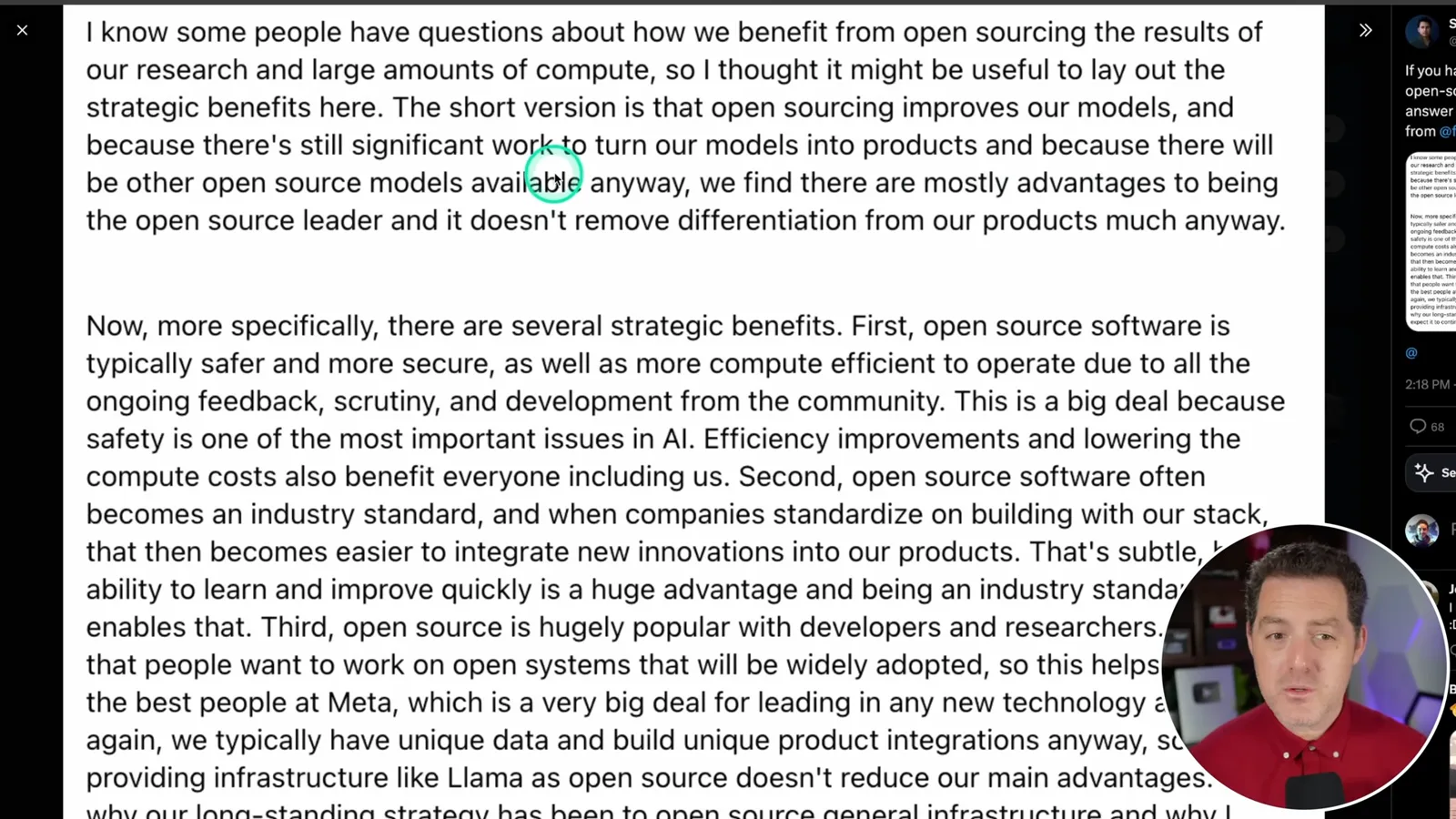
I turn to Zuckerberg’s remarks on Meta’s fourth-quarter 2023 earnings call, highlighted in a post by PyTorch co-creator Soumith Chintala. Zuckerberg says that sharing the results of costly research can improve models through outside input, while the work needed to turn a model into a product leaves room for companies to differentiate.
His first argument is that community scrutiny, feedback and development can make software safer, more secure and more efficient. I agree that a large community can find problems and contribute fixes that a smaller internal team might miss. Openness can enable scrutiny, although its actual safety and security depend on review, resources and deployment rather than following automatically.
Zuckerberg’s second argument is that shared software can become an industry standard. If others build on Meta’s stack, the company can more easily integrate innovations from the wider ecosystem. I think of established examples such as Linux, Python and Firefox to illustrate how widely adopted open projects can support a broad community; these are examples, not Meta products.
His third reason is recruiting: developers and researchers may want their work to be used widely and improved collaboratively. I find that appealing because it aligns a company’s business interests with engineers’ desire to share and refine their work. Zuckerberg argues that attracting strong people matters when competing in a new technology area.
Meta’s case also depends on keeping advantages elsewhere. Zuckerberg says unique data and product integrations can distinguish Meta’s services even if general infrastructure such as Llama is shared. He describes a strategy of sharing infrastructure while retaining specific product implementations; that does not imply all user data is made public or that every future model will be released.
Projects beyond Llama
The video surveys software and research projects associated with Meta. Berman closes with anticipation for Llama 3, which was still in training at the time.
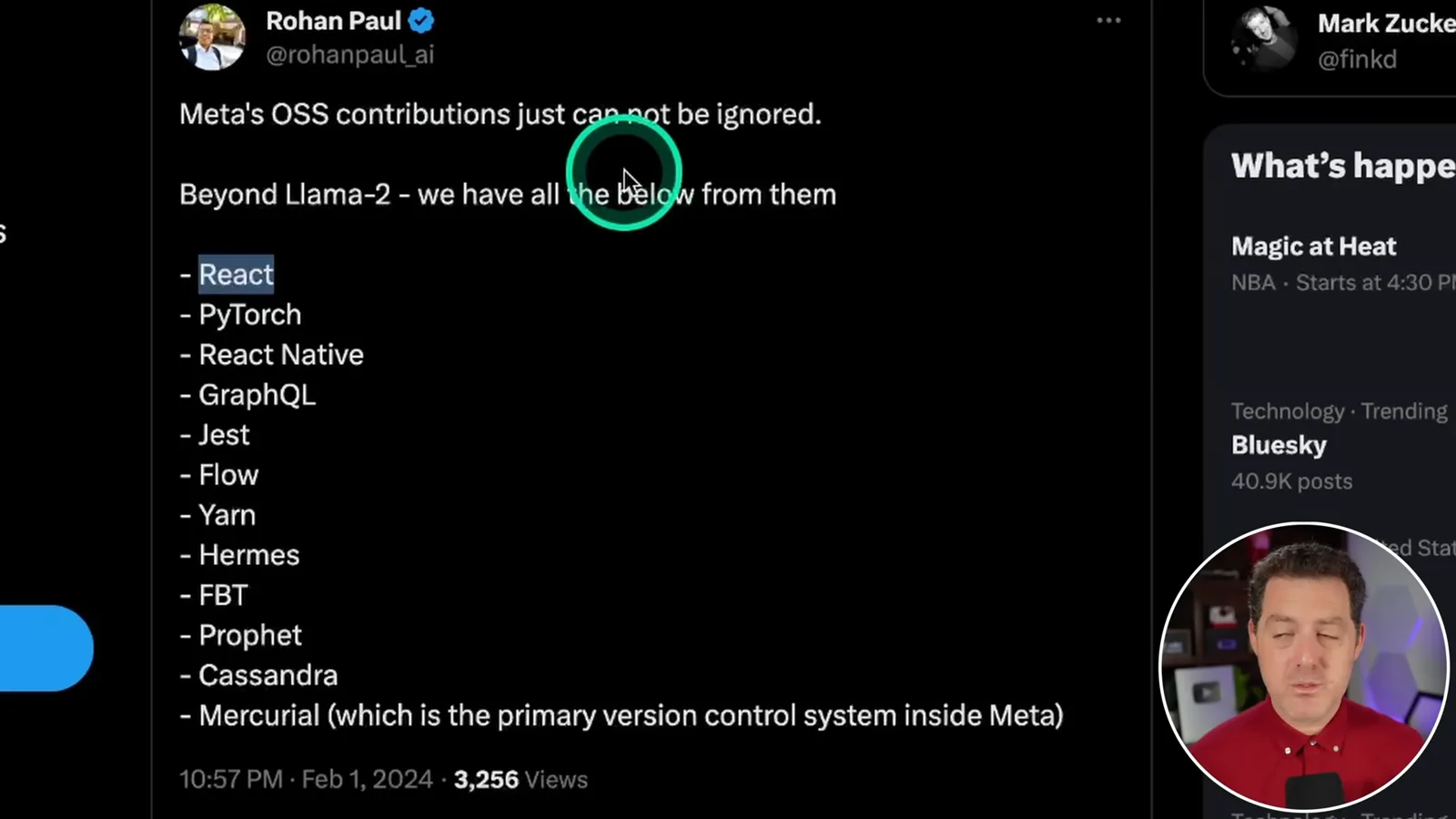
A response highlighted projects associated with Meta, including React, PyTorch, React Native, GraphQL, Jest, Flow, Yarn, Hermes, FBT, Prophet and Cassandra. I had focused too narrowly on Llama and underestimated this broader history. The list also mentions Mercurial, a version-control system Meta used and contributed to, not a project Meta originally created.
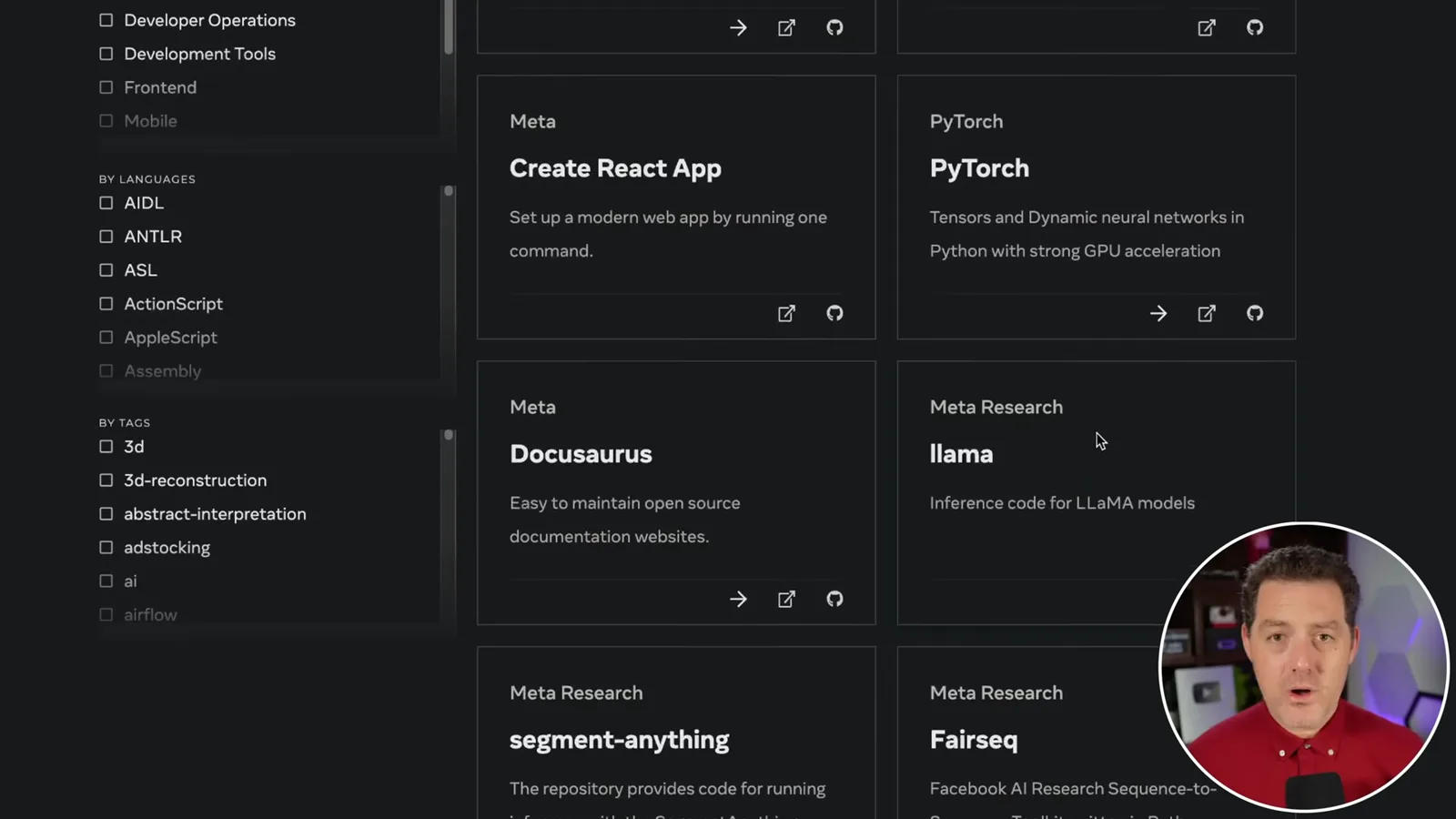
Meta’s open-source catalog contains many more projects and research assets. I scroll past work such as Segment Anything, Detectron and AudioCraft, which I have discussed as a text-to-audio tool. Individual projects differ in their licenses and what they release, so the catalog should not be read as one uniform set of permissions.
I also notice Apple releasing AI papers and projects, although the examples do not establish that Meta caused that change. I look forward to Llama 3, which Zuckerberg said was training at the time. Meta described Llama 2 as open source, but its community license included restrictions; the Open Source Initiative did not consider that license open source. Whether any future AGI is achieved or released remains an open question.
Mehr aus diesem Kanal
 34:21EN
 Matthew Berman· 27. Okt. 2026Matthew Berman Examines Anthropic’s IPO Filing, AI Growth and GovernanceMatthew Berman, Sam Altman · Forward FutureThe presenter reviews the S-1’s financial metrics, compute strategy and voting structure while questioning the tension between rapid AI development and safety.
 0:26ENMatthew Berman· 25. Okt. 2026Sam Altman on Human Values and Problem-Solving in an AI WorldSam Altman · OpenAIIn a short interview excerpt, Altman considers the enjoyment of solving hard problems and the human role in interpreting results.
 0:36ENMatthew Berman· 25. Okt. 2026Kimi K3.1 and a Rubik’s Cube Solver DemonstrationMatthew Berman · Forward FutureMatthew Berman shows a scrambled virtual cube being solved and gives the Kimi K3.1 test a favorable assessment.
 0:21ENMatthew Berman· 24. Okt. 2026An AI-Generated Kimi Benchmark Chart Used Invented ScoresMatthew Berman · Forward FutureMatthew Berman asks for a graph of Kimi K3.1 Pro benchmarks, then discovers that the displayed figures are illustrative placeholders.
 25:50ENMatthew Berman· 24. Okt. 2026Kimi K3.1 Pro Tested: Strong 3D Demos, Uneven Results and Competitive PricingMatthew Berman · Forward FutureMatthew Berman tests the open-weight model on coding, 3D rendering and visual explanations, then compares benchmark results and prices.
 32:20ENMatthew Berman· 23. Okt. 2026Who Is Local AI For? The Costs, Trade-offs and a Hybrid FutureMatthew Berman · Forward FutureMatthew Berman weighs data control and independence against hardware cost, setup complexity and inference speed.