In 30 Sekunden
In this November 2024 video, Matthew Berman examines the launch of ChatGPT Search and compares a handful of answers with Perplexity. He finds strengths and errors in both, noting that cited sources and the decision to search matter; the video is sponsored by Vultr.
- 1Search joins ChatGPTBerman sees the integration as competition for search products and a demonstration of platform risk.
- 2The two Rob ThomasesAn example from Perplexity conflates the television creator and Matchbox Twenty singer; ChatGPT distinguishes them.
- 3Restaurant presentationsBoth products display maps, but Berman prefers the organization of Perplexity’s restaurant answer.
- 4A game mechanics fact checkThe Factorio test illustrates why an answer with a relevant reference can be more useful for a detailed question.
- 5A historical market-data testChatGPT produces a dated stock list; Perplexity says it cannot provide real-time prices in the demonstration.
Das Wichtigste
- At its October 2024 launch, ChatGPT Search combined conversational answers with web links and initially reached paid and waitlist users.
- Perplexity conflated two people named Rob Thomas in one example, while ChatGPT distinguished them in a follow-up.
- A Factorio question illustrates why checking cited sources and the conditions behind a speed comparison matters.
- The restaurant and stock comparisons are small, historical demonstrations rather than controlled benchmarks.
Den bearbeiteten Text nach Kapiteln lesen
Launch and how search works
Berman explains the 2024 release, its initial access and its use of third-party search and publisher content. He frames it as competition for existing search tools.
ChatGPT Search has arrived inside ChatGPT, as I expected after trying the earlier SearchGPT prototype. I see it as a direct challenge to Perplexity and Google Search, and a reminder of platform risk: a business built on another company's technology can find that provider adding similar features itself.
OpenAI's interface includes a globe icon to initiate web searches, while ChatGPT can also decide to search automatically. I want to see how quickly it finds current information and how its answers compare with Perplexity. This video was published in November 2024, so the interface and access described here are historical.
At launch, [OpenAI said](https://openai.com/index/introducing-chatgpt-search/) Plus and Team users and SearchGPT waitlist users had access, with Enterprise, Edu and free access planned later. Its announcement was subsequently updated to say search became available to everyone in supported regions in February 2025. Access and product behavior can change.
The launch included source links and special displays for weather, stocks, sports, news and maps. OpenAI said its search model was a fine-tuned GPT-4o, post-trained with synthetic data including distilled outputs from o1-preview. Those details describe the 2024 launch, not necessarily the model used today.
OpenAI said it relied on third-party search providers and content from partners, including news publishers. I see those publishing relationships as part of the strategy behind getting timely information into answers, though the presence of a source does not by itself guarantee an accurate answer.
Finding a podcast and separating names
The first comparisons involve finding a specific interview and distinguishing two people named Rob Thomas. A Perplexity answer conflates them; ChatGPT makes the distinction.
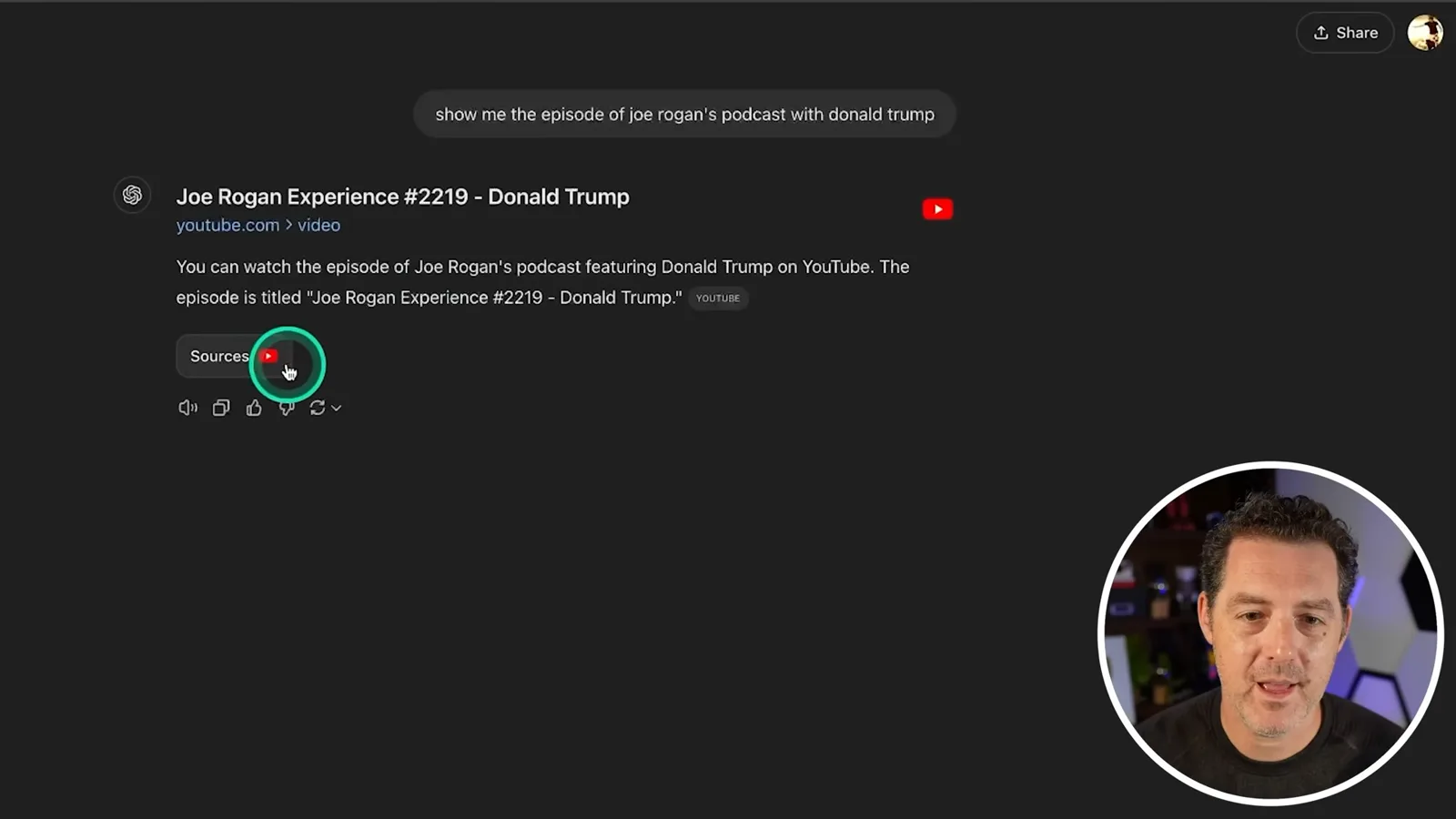
For the first test, I ask both tools to find the Joe Rogan episode featuring Donald Trump. ChatGPT gives me a direct YouTube link. Perplexity responds at a comparable speed in this instance but adds background about the interview and its reception, so the actual link is less direct.
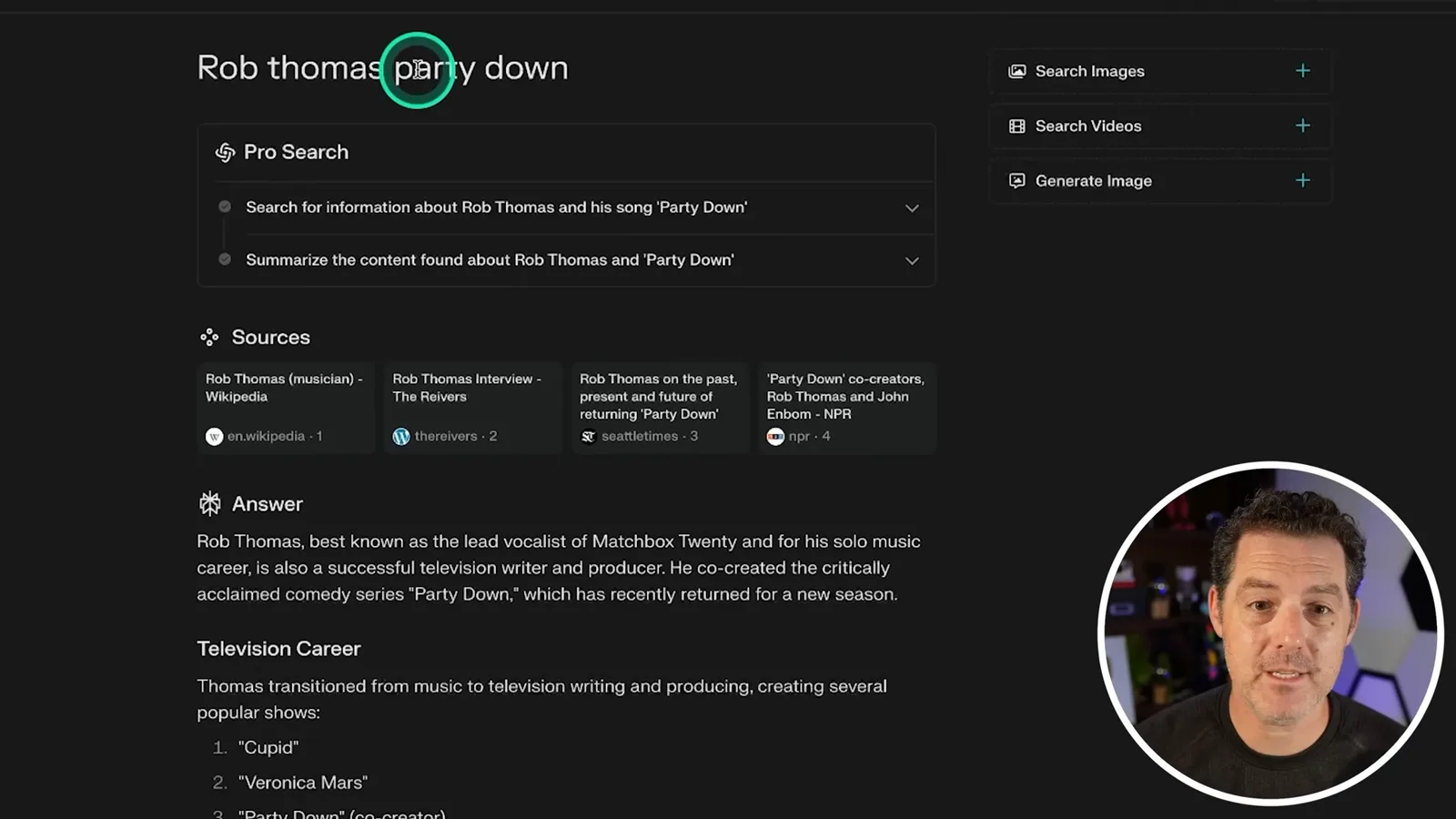
A previous Perplexity search for 'Rob Thomas party down' produced a more serious error. It conflated Rob Thomas, a co-creator of the television show Party Down, with the singer of Matchbox Twenty, who has the same name. The output incorrectly described them as one person and attributed the show's inspiration to the singer's music career.
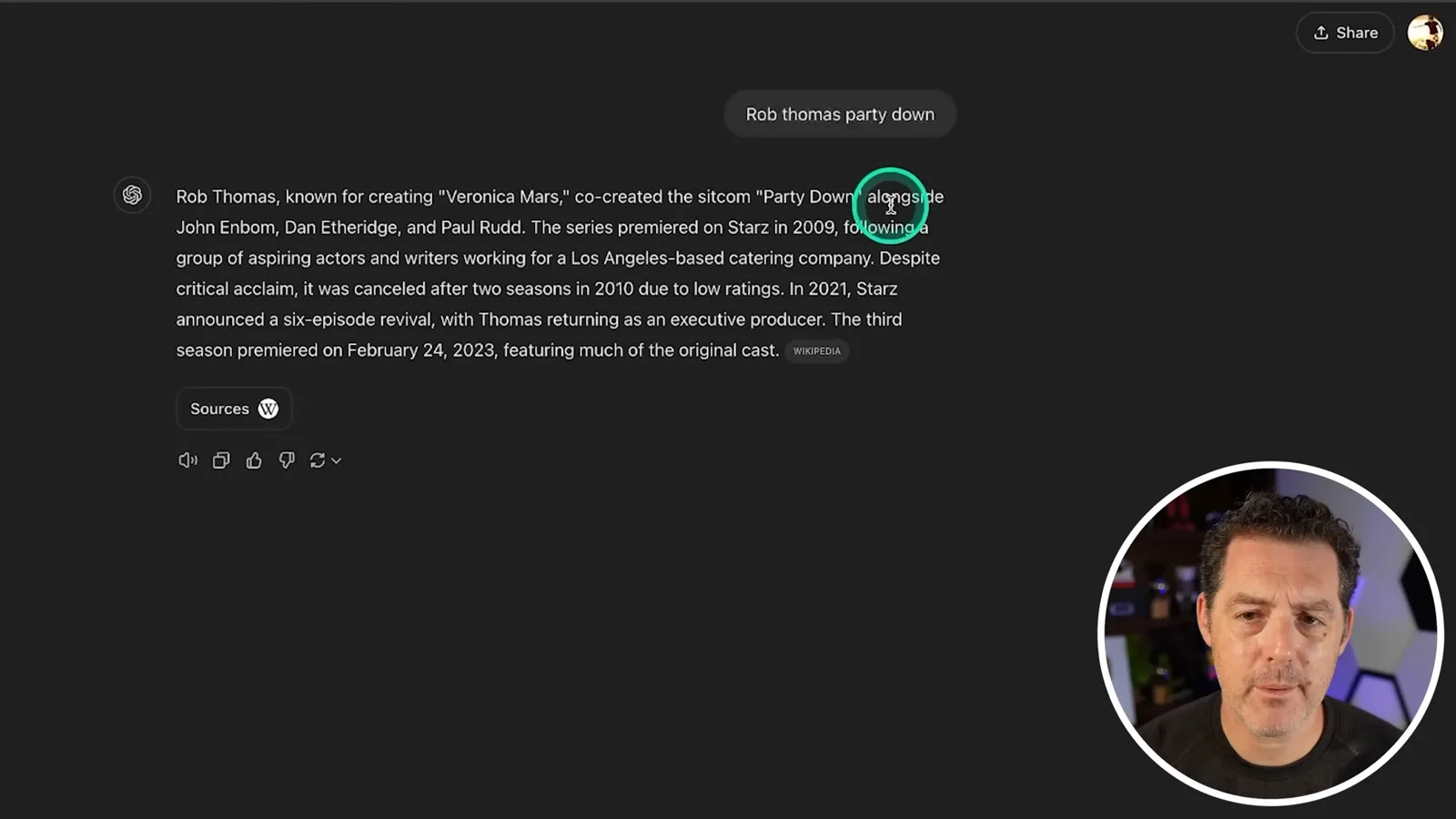
I try the same query in ChatGPT Search. Its shorter answer identifies the television creator and describes Party Down; when I ask explicitly whether he is the same person as the singer, it says they are different people. This individual example shows a correct distinction, not a comprehensive accuracy comparison.
Restaurants and Factorio
After a Vultr sponsorship disclosure, Berman compares restaurant maps and tests a detailed game mechanics question. He discusses the importance of sources.
The video is sponsored by Vultr. Berman describes its GPU cloud infrastructure, available NVIDIA hardware and Kubernetes offering, and mentions a promotional credit. These are the sponsor's 2024 claims and offer; availability, pricing and promotional terms may change.
Next I ask for the best restaurants in Las Vegas. ChatGPT produces an interactive map with restaurants, but I would prefer a separate list rather than having the results sit inside the map. Perplexity organizes its response by type, includes an interactive map and displays Yelp ratings; I prefer that presentation in this test.
For a more specialized query, I ask whether long-handed inserters are slower than regular inserters in Factorio. ChatGPT appears not to use search and says they are slower, which I think is wrong. Perplexity cites the game's wiki and says the long-handed version is faster.
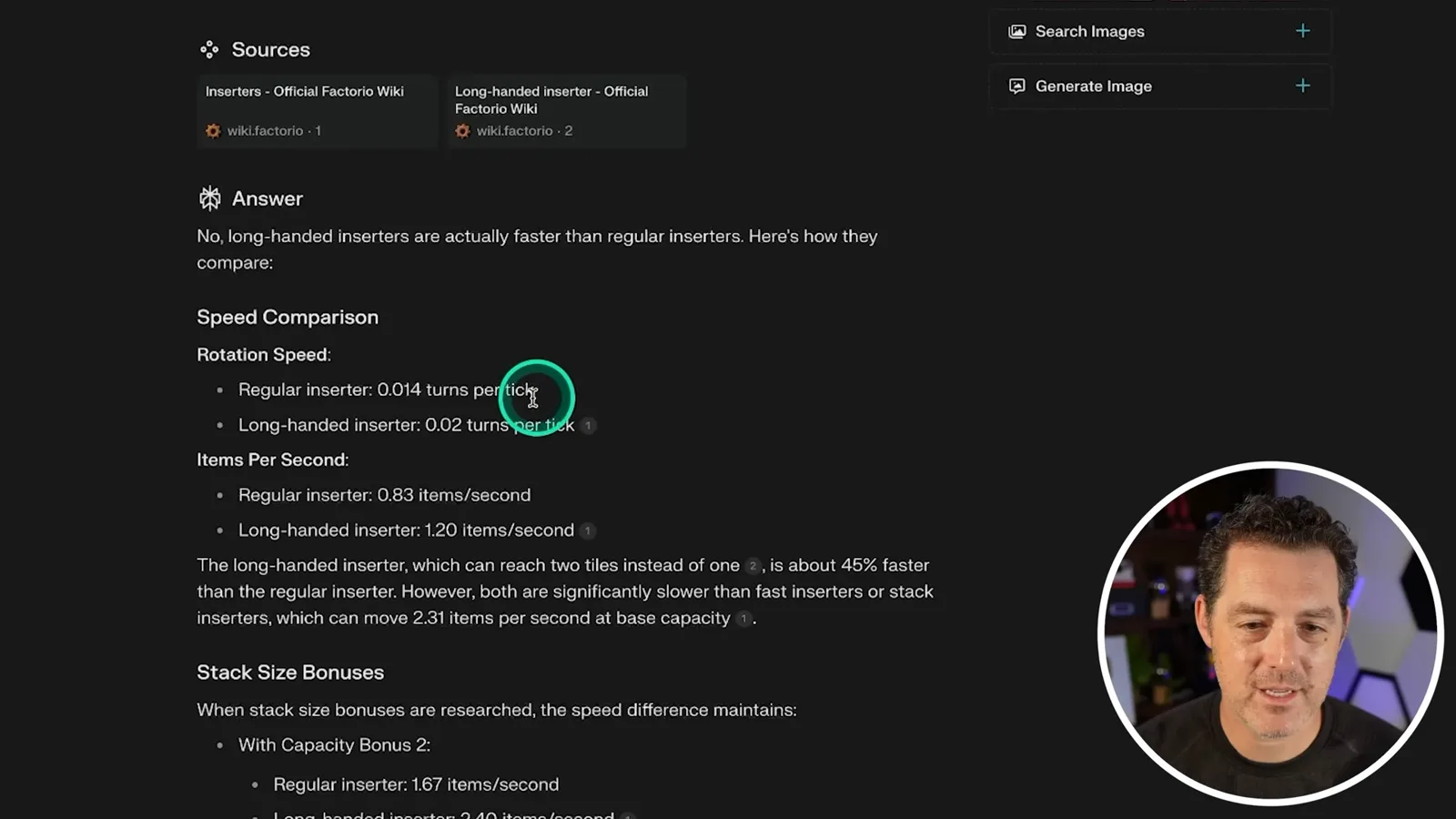
The [Factorio wiki](https://wiki.factorio.com/inserters) lists a higher base rotation speed for long-handed inserters than regular ones. Actual throughput depends on conditions such as pickup and drop positions, so rotation speed alone is not the whole story. This is a useful example of why I want a reference for a detailed factual claim.
In these examples, Perplexity appears to search each time, while ChatGPT sometimes answers without searching. That is my observation from a few queries, not a general test of either product. Retrieval can help with current facts, but a search result can also be misunderstood or misrepresented.
Stock data and first impressions
The products provide different answers to a request for same-day technology stock performance. Berman closes with his preferences after this small sample.
Finally I ask for the top-performing technology stocks today, meaning October 31, 2024. ChatGPT searches and provides a list attributed to Investor's Business Daily, although I cannot get it to display the chart shown in OpenAI's launch material. The displayed figures are historical and should not be treated as current market data.
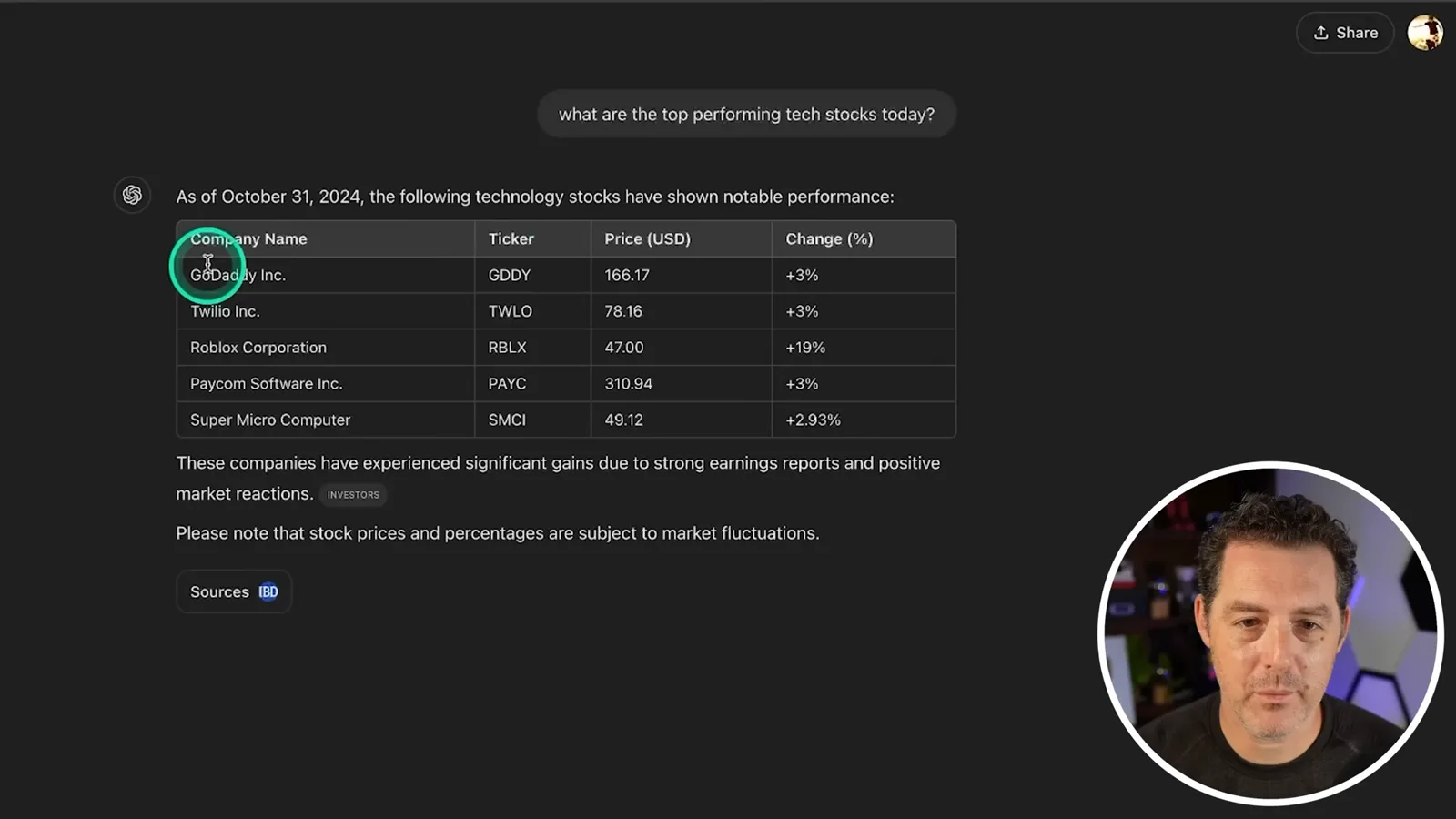
Perplexity returns a different list, which appears to emphasize longer-term performance rather than the day's price movement. When I clarify that I mean today's changes, it says it cannot access the real-time data. On this particular request I prefer ChatGPT's answer, although I have not independently audited all the stock figures.
I plan to keep testing and using both products. Perplexity's presentation impressed me in several examples, while ChatGPT was more direct in others. For my own workflow, I expect to use Google Search less often; that is a personal preference after a small demonstration, not a systematic evaluation.
Mehr aus diesem Kanal
 34:21EN
 Matthew Berman· 27. Okt. 2026Matthew Berman Examines Anthropic’s IPO Filing, AI Growth and GovernanceMatthew Berman, Sam Altman · Forward FutureThe presenter reviews the S-1’s financial metrics, compute strategy and voting structure while questioning the tension between rapid AI development and safety.
 0:26ENMatthew Berman· 25. Okt. 2026Sam Altman on Human Values and Problem-Solving in an AI WorldSam Altman · OpenAIIn a short interview excerpt, Altman considers the enjoyment of solving hard problems and the human role in interpreting results.
 0:36ENMatthew Berman· 25. Okt. 2026Kimi K3.1 and a Rubik’s Cube Solver DemonstrationMatthew Berman · Forward FutureMatthew Berman shows a scrambled virtual cube being solved and gives the Kimi K3.1 test a favorable assessment.
 0:21ENMatthew Berman· 24. Okt. 2026An AI-Generated Kimi Benchmark Chart Used Invented ScoresMatthew Berman · Forward FutureMatthew Berman asks for a graph of Kimi K3.1 Pro benchmarks, then discovers that the displayed figures are illustrative placeholders.
 25:50ENMatthew Berman· 24. Okt. 2026Kimi K3.1 Pro Tested: Strong 3D Demos, Uneven Results and Competitive PricingMatthew Berman · Forward FutureMatthew Berman tests the open-weight model on coding, 3D rendering and visual explanations, then compares benchmark results and prices.
 32:20ENMatthew Berman· 23. Okt. 2026Who Is Local AI For? The Costs, Trade-offs and a Hybrid FutureMatthew Berman · Forward FutureMatthew Berman weighs data control and independence against hardware cost, setup complexity and inference speed.