In 30 Sekunden
In June 2026 Matthew Berman reviews changing forecasts about AI and employment, company layoffs, aggregate hiring data and the cost of AI tools. He argues that organizational bottlenecks and human oversight still matter, and is optimistic about future work. Aggregate employment data cannot rule out displacement in specific jobs, and his conclusions about company motives and future job security are judgments rather than established facts.
- 1A revised forecastAltman said fewer entry-level jobs had been eliminated than he expected by that point; that is not a guarantee about future employment.
- 2Block’s workforce reductionDorsey announced a reduction from over 10,000 to under 6,000 people; attributing its full cause to either AI or prior overhiring requires evidence.
- 3What aggregate data can showApollo’s Torsten Slok cites ADP employment data; aggregate growth cannot rule out AI-related losses in specific jobs.
- 4AI spending versus outcomesUber’s COO questioned the link between rising AI usage and consumer-facing features; the report concerns a particular budget.
- 5Human work at the edgesBerman argues people still define goals and verify outputs, even as AI performs more intermediate work.
- 6Skills and uncertaintyLearning and experimentation may help workers adapt but cannot ensure any individual’s job is secure.
Das Wichtigste
- An executive revising a job-loss forecast does not establish that AI cannot displace workers.
- Company statements and aggregate employment trends do not isolate the cause of individual layoffs.
- Cheaper technology can increase demand, but Jevons paradox does not guarantee more jobs in every occupation.
- Token spending and activity counts need to be compared with verified outcomes and total costs.
- Deployment depends on organizational change, customer value and human oversight as well as model capabilities.
- Learning AI tools may help workers adapt, but it cannot guarantee job security.
Den bearbeiteten Text nach Kapiteln lesen
Reconsidering AI job forecasts
Berman welcomes signs that job losses have not matched some predictions. The outcome for individual workers and future employment remains uncertain.
I am optimistic that the predicted AI-driven white-collar jobs crisis is not unfolding as quickly as some feared. In this June 2026 commentary I cite remarks by Sam Altman and Dario Amodei about AI and work. That optimism is a judgment about an uncertain future, not proof that every job is safe or that AI has caused no displacement.
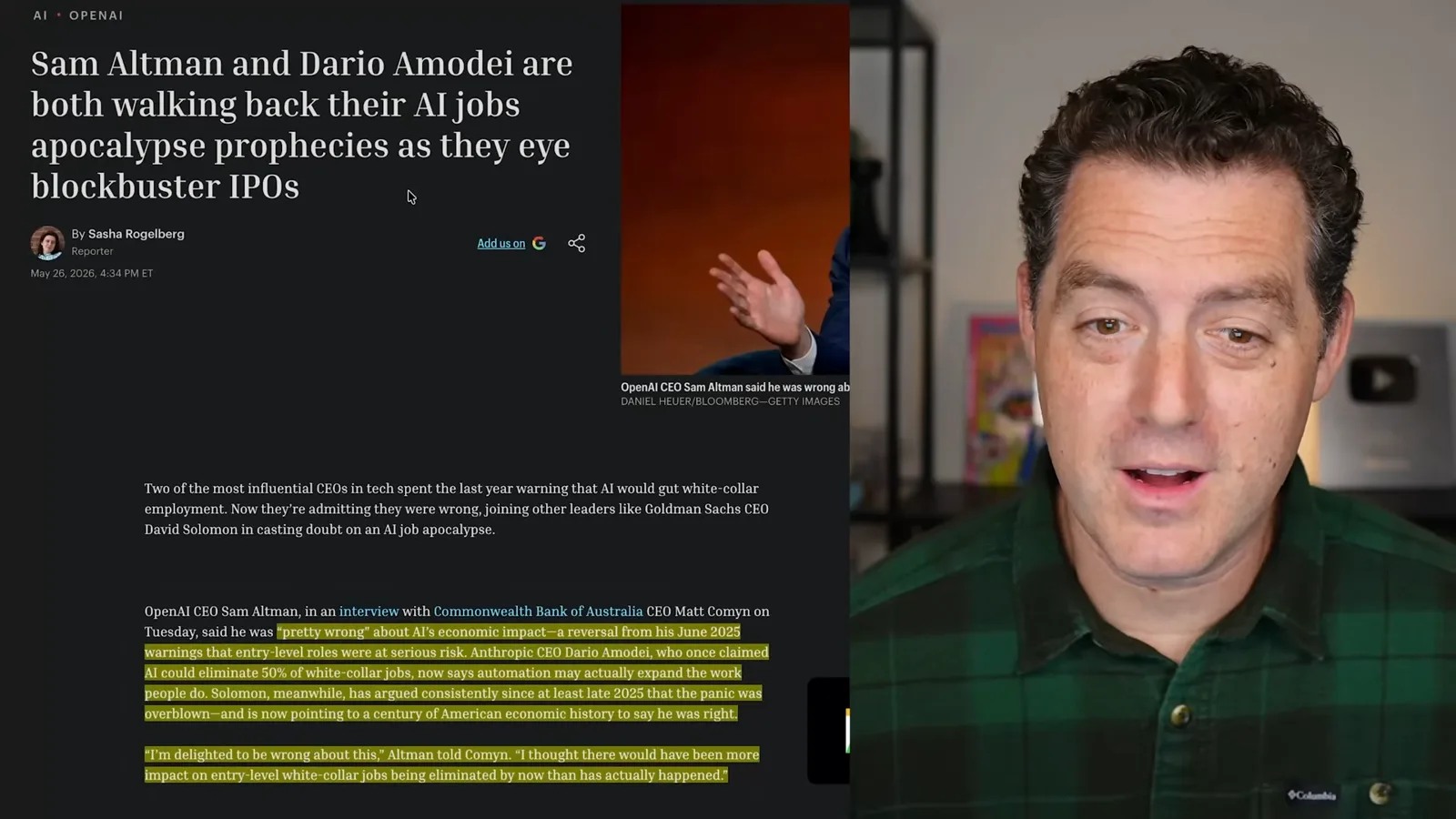
Altman said he expected more entry-level white-collar job losses by this point than had occurred, and described his own experiment delegating messages to AI as disappointing. I see that as a reminder to separate expectations from outcomes. One executive's experience does not establish the effectiveness of AI across every workplace.
Layoffs and company explanations
He examines examples including Block and questions whether AI caused the cuts. The video includes a Zapier sponsorship.
I then ask how to interpret layoffs in which companies have mentioned AI. I cite Duolingo's contractor reductions, Pinterest and Dow job cuts, and Amazon CEO Andy Jassy's expectation that AI agents could reduce some corporate roles. Those announcements show what companies said; they do not independently measure how much AI caused each decision.
In an interview clip, an AWS executive argues against replacing all junior staff with AI, saying younger employees learn the tools and organizations need people who can develop over time. I see this as a counterpoint to the idea that adoption automatically eliminates entry-level hiring.
I suggest some companies may invoke AI while correcting earlier overhiring. Block CEO Jack Dorsey announced plans to reduce the organization from over 10,000 people to under 6,000 and discussed rebuilding around AI. My claim that those employees were unnecessary and AI was merely a scapegoat is an inference, not something the announcement proves.
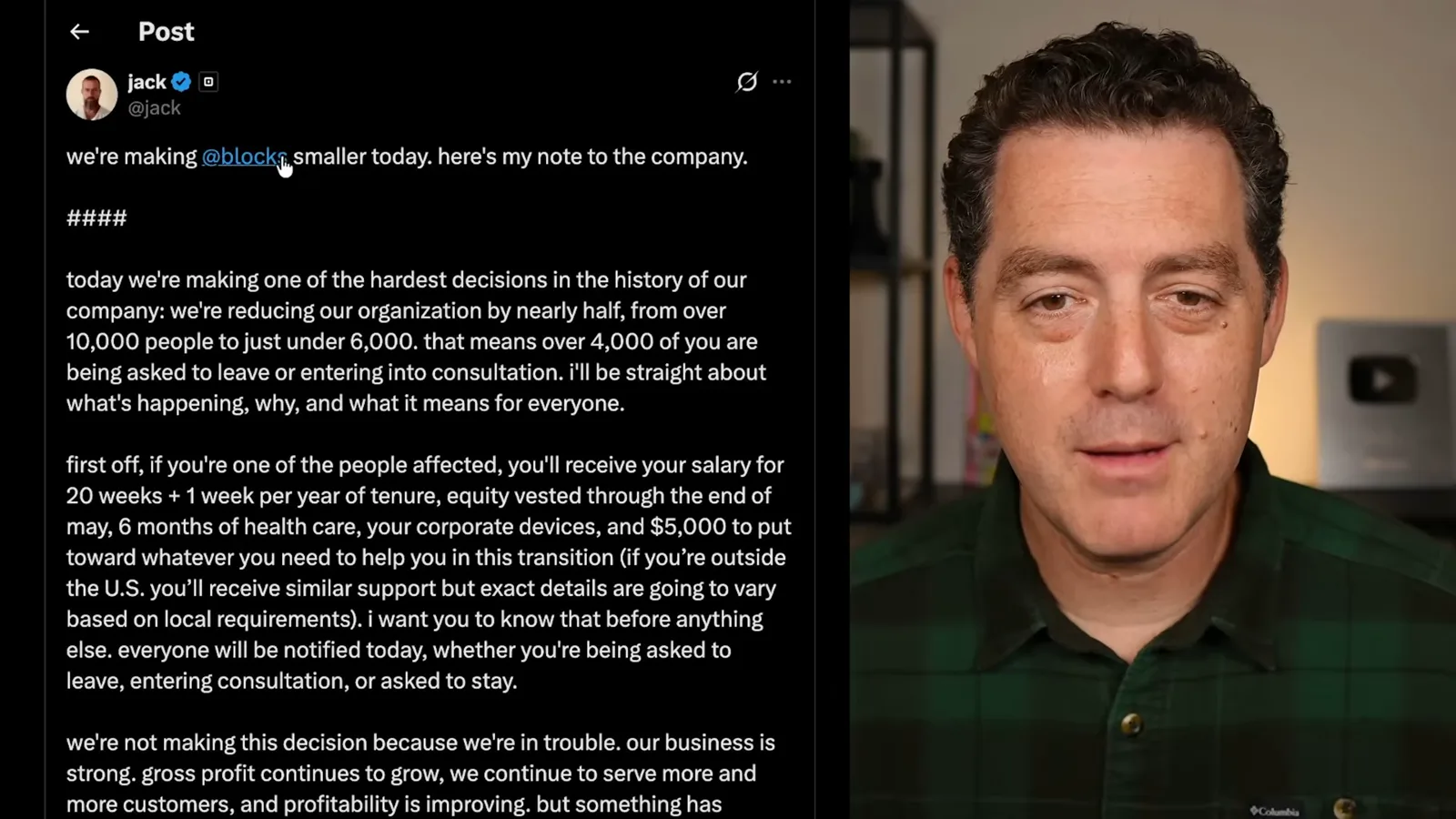
The video includes a sponsored segment for Zapier, which offers automation and an MCP server for connecting agents to services. After the sponsorship I return to the Block example and compare it with workforce reductions at Twitter following its acquisition. A company continuing to operate after layoffs does not by itself establish why those cuts occurred or their full effects.
Employment data and demand
Apollo’s aggregate employment analysis informs Berman’s optimistic view. Aggregate growth does not rule out displacement in particular roles.
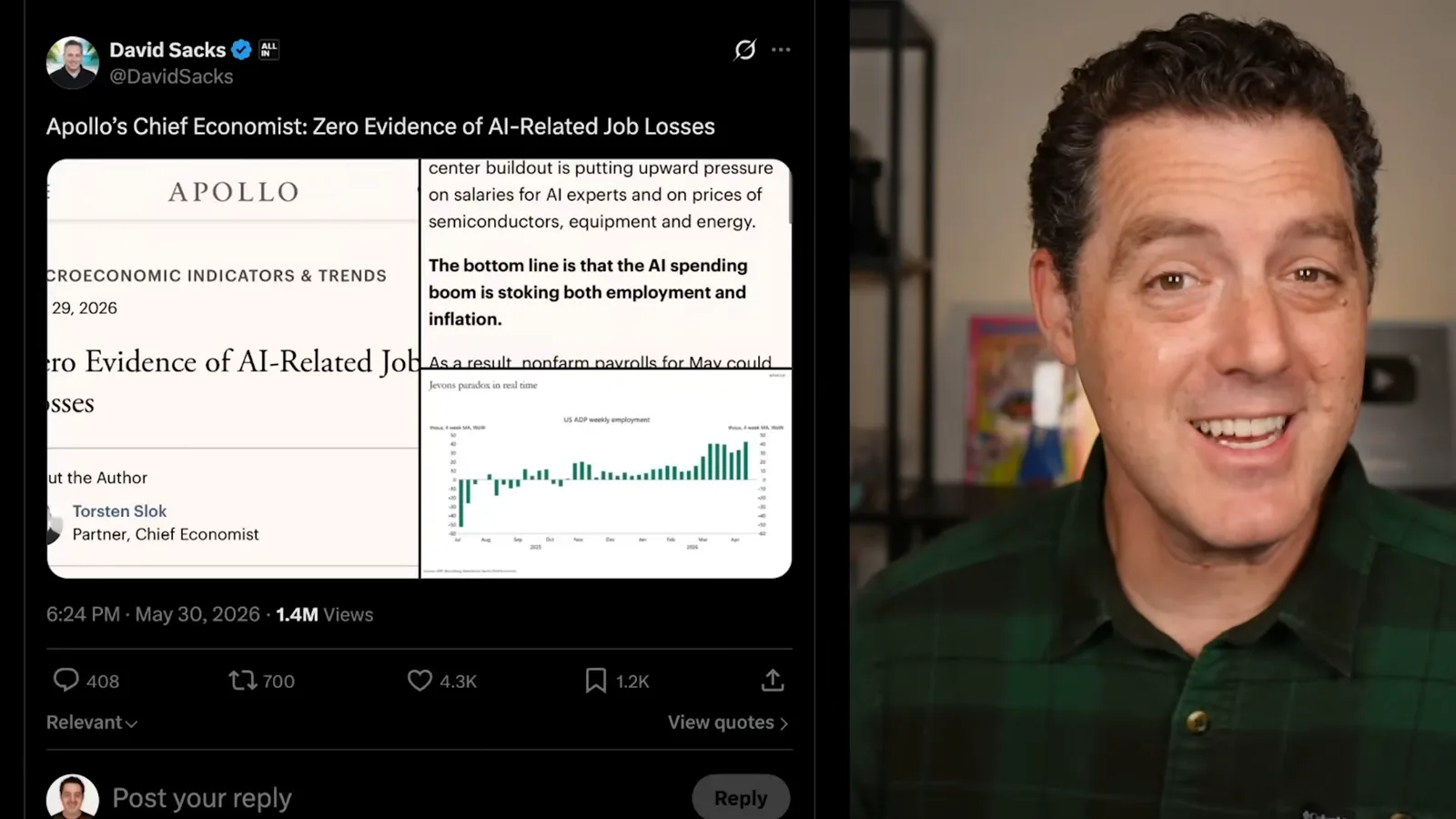
I cite Apollo chief economist Torsten Slok's May 2026 analysis of weekly ADP employment data. He argues that the aggregate series shows no evidence of AI-related job losses and points to hiring connected to AI investment. David Sacks shared the analysis; he is not its author. Aggregate employment can rise while some workers or occupations lose jobs, and this chart alone cannot identify AI's causal effect.
I use Jevons paradox to suggest that making a resource cheaper can stimulate demand and sometimes lead to greater total use. That mechanism is plausible in some markets, but it does not guarantee that every worker will retain a job or that AI will increase overall employment. The relevant demand response and distribution of gains remain empirical questions.
I observe rising weekly employment in the chart alongside rising AI spending and interpret the combination as encouraging. Correlation alone does not show AI caused the employment trend, establish economy-wide productivity gains, or rule out losses in particular sectors. Job outcomes can change over time.
The cost and value of AI
The host discusses Uber’s reported spending and historical model prices. He argues that costs must be compared with useful outcomes.

I question whether companies are receiving enough value for AI spending. Reporting quoted in the video says Uber's AI coding budget was exhausted within four months and its COO Andrew Macdonald found it hard to connect higher usage to consumer-facing features. The reported budget concerns a particular spending plan, not proof that all AI investment at Uber failed.
I also refer to an unverified report of an unidentified company spending $500 million on tokens in a month. Without a named company or underlying records I cannot establish that amount. It illustrates my concern about uncontrolled spending, not a verified industry-wide cost.
I compare then-current output-token prices: Anthropic listed standard Claude Opus 4.8 at $25 per million and Sonnet 4.6 at $15 per million, while I cite a much cheaper DeepSeek rate. Prices differ by model, provider, input versus output, caching and other terms; those figures are historical and do not establish a universal trend that all token prices rise.
My argument is that many applications do not need the most expensive frontier model. If a less costly system meets a task's quality, privacy and reliability needs, it may offer better value. What matters is useful work produced per dollar, not token price alone.
I think many organizations are still learning how to use AI beyond chat, email and simple automation. I speculate that relatively few people are operating at the frontier, and admit that I sometimes feel behind. The number I suggest is an impression, not a measured count of skilled users.
Automation and business bottlenecks
Reported OpenClaw activity leads into a discussion of organizational adoption and human verification. Raw activity counts do not establish value.
I cite OpenClaw creator Peter Steinberger's account of roughly $1.3 million in tokens in a month and describe the work as building a software factory: infrastructure that helps agents produce and review code. The reported figure and the value of the work are not independently audited here; a token valuation does not necessarily equal out-of-pocket cost.
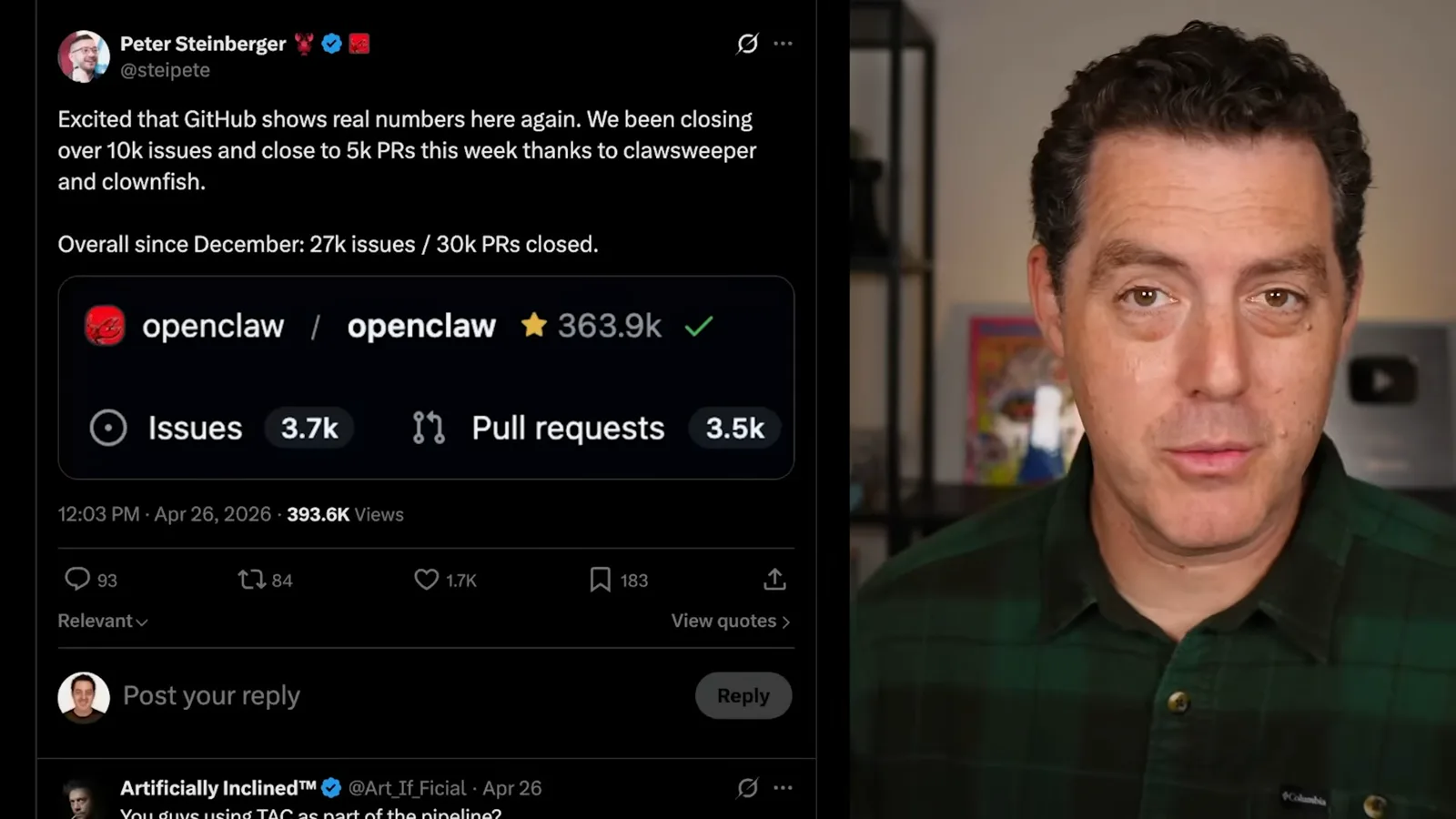
Steinberger also reports closing more than 10,000 issues and nearly 5,000 pull requests in a week with automation. That is his reported activity, not proof that all were solved, merged or produced equal value. I use it as an example of a different workflow rather than a direct productivity measurement.
I see two barriers to economic impact. First, enterprise adoption and organizational change take time. Second, faster code generation can expose bottlenecks elsewhere: packaging, marketing, selling, staff training and whether a customer actually benefits.
I point to investments in enterprise AI services by Anthropic and OpenAI as evidence that vendors want to help organizations deploy their products. The cited partnerships and reported valuations are business announcements or reports, not proof that every customer will obtain a return.
I find the distinction between middle-to-middle work and end-to-end work useful. AI can help with an expanding portion of a workflow, while people still define goals, guide systems and verify outputs. I expect the volume of work to grow as these tools become cheaper, but that is an economic hypothesis rather than an established guarantee.
What can AI-native companies do?
Berman questions claims of fully autonomous company building and plans his own tests. He closes with advice to keep learning while the outcomes remain uncertain.

I am skeptical of claims that an agent can reliably build and run a profitable company at the push of a button. I discuss the startup Polsia and the open-source Paperclip project as examples of a vision I find interesting, while saying I have not seen enough evidence that the full vision works today.
I read Y Combinator's ideas for an AI-native company and recognize that I may be missing practices at the frontier. Some proposals make sense to me, but I have not independently observed enough complete implementations to know how much is practical. Lack of personal observation is not proof that nobody has done it.
My approach with OpenClaw was to test advertised use cases and share what worked after many hours of experimentation. I am now trying to implement the AI-native company ideas myself and intend to report back. The effort is ongoing in the video; it is not presented as a finished evaluation.
I do not think this situation proves an AI bubble. My view is that valuable capabilities coexist with adoption delays and business bottlenecks. A useful model can still be overhyped or mispriced, and my optimism cannot determine investment outcomes or guarantee employment.
My practical advice is to keep learning, experiment with tools at work and in personal life, and test what actually produces value. Developing skills can improve adaptability, but no individual tool or learning strategy can guarantee permanent job security. I also encourage considering less expensive models where they meet the need.
Mehr aus diesem Kanal
 34:21EN
 Matthew Berman· 27. Okt. 2026Matthew Berman Examines Anthropic’s IPO Filing, AI Growth and GovernanceMatthew Berman, Sam Altman · Forward FutureThe presenter reviews the S-1’s financial metrics, compute strategy and voting structure while questioning the tension between rapid AI development and safety.
 0:26ENMatthew Berman· 25. Okt. 2026Sam Altman on Human Values and Problem-Solving in an AI WorldSam Altman · OpenAIIn a short interview excerpt, Altman considers the enjoyment of solving hard problems and the human role in interpreting results.
 0:36ENMatthew Berman· 25. Okt. 2026Kimi K3.1 and a Rubik’s Cube Solver DemonstrationMatthew Berman · Forward FutureMatthew Berman shows a scrambled virtual cube being solved and gives the Kimi K3.1 test a favorable assessment.
 0:21ENMatthew Berman· 24. Okt. 2026An AI-Generated Kimi Benchmark Chart Used Invented ScoresMatthew Berman · Forward FutureMatthew Berman asks for a graph of Kimi K3.1 Pro benchmarks, then discovers that the displayed figures are illustrative placeholders.
 25:50ENMatthew Berman· 24. Okt. 2026Kimi K3.1 Pro Tested: Strong 3D Demos, Uneven Results and Competitive PricingMatthew Berman · Forward FutureMatthew Berman tests the open-weight model on coding, 3D rendering and visual explanations, then compares benchmark results and prices.
 32:20ENMatthew Berman· 23. Okt. 2026Who Is Local AI For? The Costs, Trade-offs and a Hybrid FutureMatthew Berman · Forward FutureMatthew Berman weighs data control and independence against hardware cost, setup complexity and inference speed.