In 30 Sekunden
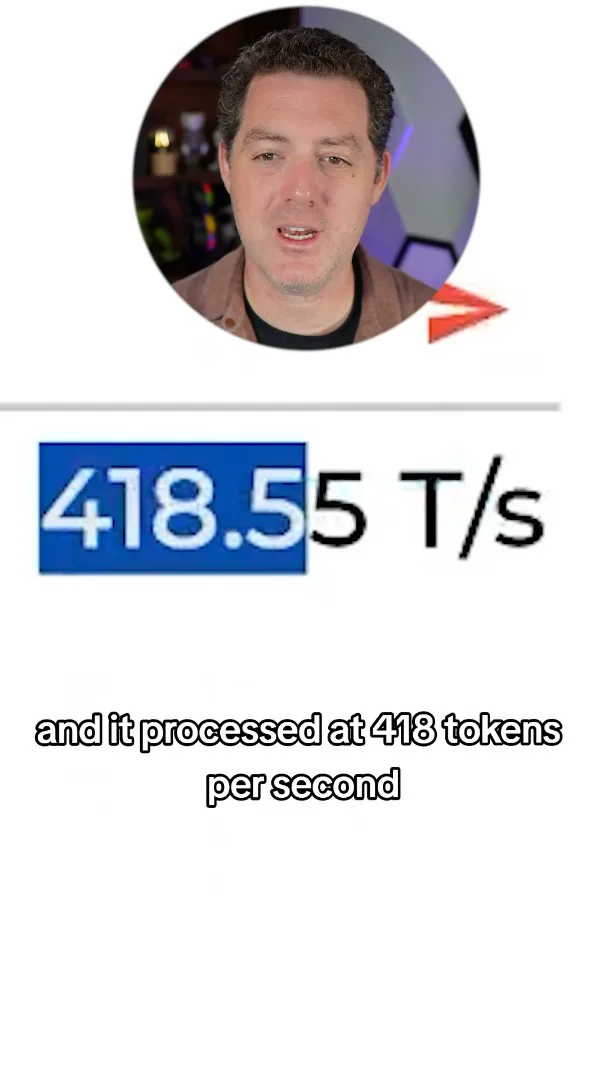
In this February 2024 short, Matthew Berman tries Groq’s custom-hardware inference service with Mixtral 8x7B. One displayed Python snake-game response runs at approximately 418.55 tokens per second, according to the interface. This is one historical demonstration, not a controlled comparison of model quality, latency or provider throughput. The video contains no disclosed sponsor.
- 1Inference speedBerman says he heard Groq could reach around 500 tokens per second; speed depends on the model and workload.
- 2Snake-game requestThe interface displays approximately 418.55 tokens per second for one generated Python response.
- 3Custom hardwareBerman attributes the service’s speed to custom hardware and discusses its founder’s Google TPU background.
Das Wichtigste
- Berman’s displayed Mixtral response reports 418.55 tokens per second in one example.
- His reference to around 500 tokens per second is a separate claim, not the measured speed of this response.
- Output token rate, time to first token and total response latency are different measures.
- The video does not test whether the generated snake game runs correctly.
- Groq’s Mixtral model ID was later deprecated, and historical free access should not be assumed to persist.
Den bearbeiteten Text nach Kapiteln lesen
A speed demonstration
Berman explains why inference speed matters to applications and requests a snake game in Python. He reads the displayed output rate.
I have just found Groq and am impressed by reports of inference around 500 tokens per second. Faster output could make language-model applications feel more responsive, although the rate depends on the model, workload and measurement. The short was published in February 2024 and contains no disclosed sponsor.
I ask the service to write a snake game in Python. I say the response takes about two and a half seconds; the screen displays 418.55 tokens per second for this example. That is one interface-reported generation rate, separate from time to first token or end-to-end latency; the video does not run or verify the game.
Hardware and access
Berman mentions Groq’s custom hardware and founder. His free-access statement reflects the video’s 2024 context.
Groq uses custom inference hardware. Its founder Jonathan Ross previously worked on Google’s TPU, which was developed by a team. I describe the product favorably and say the Mixtral 8x7B 32K service can be tried free at the time. Availability and terms can change: Groq later [deprecated that model ID](https://console.groq.com/docs/deprecations), so the 2024 example is not a current service guarantee.
Mehr aus diesem Kanal
 34:21EN
 Matthew Berman· 27. Okt. 2026Matthew Berman Examines Anthropic’s IPO Filing, AI Growth and GovernanceMatthew Berman, Sam Altman · Forward FutureThe presenter reviews the S-1’s financial metrics, compute strategy and voting structure while questioning the tension between rapid AI development and safety.
 0:26ENMatthew Berman· 25. Okt. 2026Sam Altman on Human Values and Problem-Solving in an AI WorldSam Altman · OpenAIIn a short interview excerpt, Altman considers the enjoyment of solving hard problems and the human role in interpreting results.
 0:36ENMatthew Berman· 25. Okt. 2026Kimi K3.1 and a Rubik’s Cube Solver DemonstrationMatthew Berman · Forward FutureMatthew Berman shows a scrambled virtual cube being solved and gives the Kimi K3.1 test a favorable assessment.
 0:21ENMatthew Berman· 24. Okt. 2026An AI-Generated Kimi Benchmark Chart Used Invented ScoresMatthew Berman · Forward FutureMatthew Berman asks for a graph of Kimi K3.1 Pro benchmarks, then discovers that the displayed figures are illustrative placeholders.
 25:50ENMatthew Berman· 24. Okt. 2026Kimi K3.1 Pro Tested: Strong 3D Demos, Uneven Results and Competitive PricingMatthew Berman · Forward FutureMatthew Berman tests the open-weight model on coding, 3D rendering and visual explanations, then compares benchmark results and prices.
 32:20ENMatthew Berman· 23. Okt. 2026Who Is Local AI For? The Costs, Trade-offs and a Hybrid FutureMatthew Berman · Forward FutureMatthew Berman weighs data control and independence against hardware cost, setup complexity and inference speed.