In 30 Sekunden
In this January 2025 short, Matthew Berman discusses Google DeepMind’s Genie 2, a research model that generates action-controllable virtual environments from a starting image. He sees potential for training agents and eventually embodied AI. DeepMind’s examples show visually plausible effects, not validated physical simulation or proven real-world robot training. The video contains no disclosed sponsor.
- 1A world from an imageGenie 2 generates action-controllable virtual scenes based on an initial image.
- 2Potential agent environmentsBerman sees diverse generated scenarios as a possible resource for embodied AI research.
- 3Physics and limitationsThe demonstrations suggest visual physical effects but do not validate a full simulator or robot learning outcomes.
Das Wichtigste
- Genie 2 generates interactive visual environments conditioned on a starting image and user or agent actions.
- DeepMind demonstrated agent interaction and described future training and evaluation as research opportunities.
- Visual examples of gravity or water do not establish accurate physical simulation or successful transfer to robots.
- The December 2024 research announcement reported consistent worlds of up to a minute, with most shown examples lasting 10–20 seconds.
Den bearbeiteten Text nach Kapiteln lesen
Generating interactive environments
Berman introduces Genie 2 and its potential for agent training. The model generates action-conditioned visuals from an initial image.
Google DeepMind’s Genie 2 was an important 2024 story: it can generate diverse interactive environments from a single starting image. I think the potential goes beyond visual novelty, offering possible new scenarios for AI research. DeepMind described the project as an early research system, not a finished universal simulator.
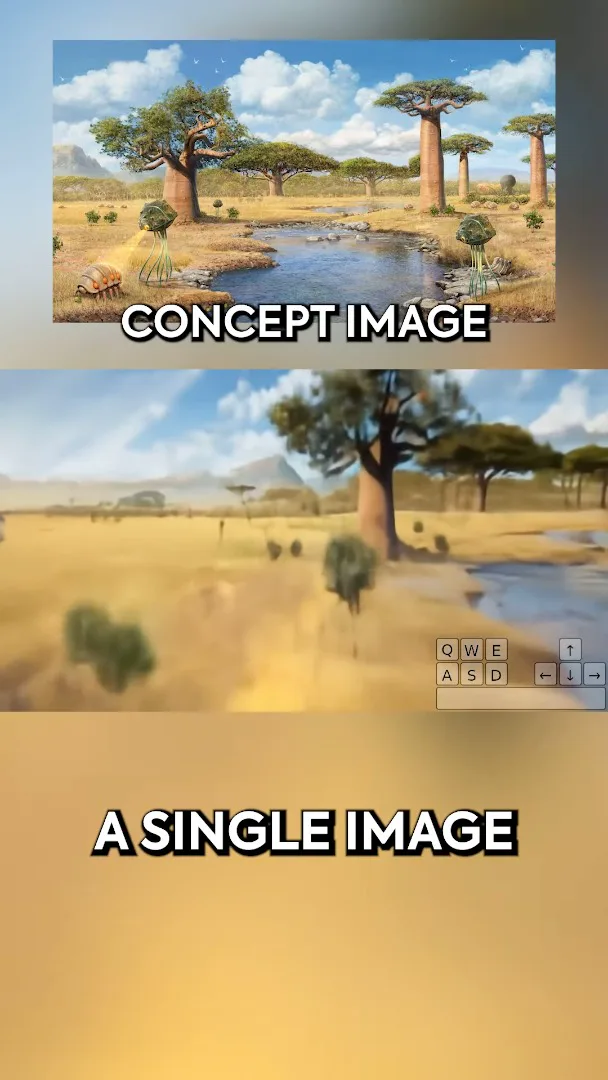
A human or AI agent can provide keyboard and mouse actions as the model generates subsequent visual frames. Berman sees these environments as a possible way to give agents varied experiences, including for future embodied AI. The [DeepMind announcement](https://deepmind.google/blog/genie-2-a-large-scale-foundation-world-model/) demonstrated its SIMA agent interacting with generated scenes; it did not establish that physical robots were successfully trained with Genie 2.
Physics and future potential
Berman points to apparent gravity, collisions and fluid behavior. These are early research examples, not proof of accurate real-world simulation.
I point to apparent gravity, collisions and fluid behavior as potentially useful for learning. DeepMind showed visual examples including gravity and water effects, but plausible images do not by themselves prove physical accuracy or reliable transfer to real robots. Its published examples were mostly 10–20 seconds long, with consistency reported for up to a minute, so “limitless” refers to potential variety rather than an indefinitely stable world.
I see Genie 2 as a step toward foundation world models that could eventually simulate aspects of the real world. That remains a research direction: the demonstrations do not establish a complete or faithful real-world simulation. The video links to a longer article for more detail.
Mehr aus diesem Kanal
 34:21EN
 Matthew Berman· 27. Okt. 2026Matthew Berman Examines Anthropic’s IPO Filing, AI Growth and GovernanceMatthew Berman, Sam Altman · Forward FutureThe presenter reviews the S-1’s financial metrics, compute strategy and voting structure while questioning the tension between rapid AI development and safety.
 0:26ENMatthew Berman· 25. Okt. 2026Sam Altman on Human Values and Problem-Solving in an AI WorldSam Altman · OpenAIIn a short interview excerpt, Altman considers the enjoyment of solving hard problems and the human role in interpreting results.
 0:36ENMatthew Berman· 25. Okt. 2026Kimi K3.1 and a Rubik’s Cube Solver DemonstrationMatthew Berman · Forward FutureMatthew Berman shows a scrambled virtual cube being solved and gives the Kimi K3.1 test a favorable assessment.
 0:21ENMatthew Berman· 24. Okt. 2026An AI-Generated Kimi Benchmark Chart Used Invented ScoresMatthew Berman · Forward FutureMatthew Berman asks for a graph of Kimi K3.1 Pro benchmarks, then discovers that the displayed figures are illustrative placeholders.
 25:50ENMatthew Berman· 24. Okt. 2026Kimi K3.1 Pro Tested: Strong 3D Demos, Uneven Results and Competitive PricingMatthew Berman · Forward FutureMatthew Berman tests the open-weight model on coding, 3D rendering and visual explanations, then compares benchmark results and prices.
 32:20ENMatthew Berman· 23. Okt. 2026Who Is Local AI For? The Costs, Trade-offs and a Hybrid FutureMatthew Berman · Forward FutureMatthew Berman weighs data control and independence against hardware cost, setup complexity and inference speed.