In 30 Sekunden
In December 2025, Matthew Berman reviews Gemini 3 Flash using side-by-side coding demos, Google’s benchmark table and external reports. He is impressed by the apparent speed and cost advantages and believes the model could be economically important for Google’s products. The coding examples and rankings are snapshots, not universal comparisons; Google’s own table shows different winners on different coding benchmarks. The video was sponsored by HubSpot, which partnered with Berman on a guide to his company’s automations.
- 1Three visual demosFlash finishes the bird, terrain and weather examples faster in the displayed comparisons, with quality assessed subjectively by Berman.
- 2Launch pricingGoogle listed Flash input at $0.50 and output at $3 per million tokens; consumer free access is distinct from paid API use.
- 3Coding benchmark contextFlash scored 78.0% against Pro’s 76.2% on Google’s SWE-bench Verified comparison; Pro scored higher on Terminal-Bench 2.0.
- 4HubSpot sponsorshipBerman says HubSpot sponsored the video and collaborated on a guide to Forward Future’s AI automations.
- 5ARC resultsThe high-thinking preview scored 84.7% on ARC-AGI-1 and 33.6% on ARC-AGI-2 with reported per-task costs.
Das Wichtigste
- Berman prefers Flash in two visual coding demos and sees similar quality in a third; those examples do not establish overall superiority.
- Google reported 78.0% for Flash and 76.2% for Pro on SWE-bench Verified, but Pro led on Terminal-Bench 2.0 in the same table.
- At launch Google listed $0.50 per million text input tokens and $3 per million output tokens for Flash; prices and access can change.
- The video’s HubSpot sponsorship is separate from its coverage of Google; Berman says Google did not pay him.
- ARC Prize’s high-thinking result was 84.7% on ARC-AGI-1 and 33.6% on ARC-AGI-2, under its specific test conditions.
Den bearbeiteten Text nach Kapiteln lesen
Visual coding comparisons
Berman reviews bird, terrain and weather-app examples comparing Flash with Pro. He favors Flash’s speed and two of its displayed designs.
Google has just released Gemini 3 Flash, and I think its combination of speed, cost and quality makes it a major contender. I also say it beats Gemini 3 Pro at coding, but that needs qualification: Google’s launch comparison shows Flash ahead on SWE-bench Verified, not every coding task or benchmark. These are impressions and results from December 2025.
First I show a side-by-side flock-of-birds simulation. Flash finishes in about 21 seconds using roughly 3,000 tokens, while Pro takes about 28 seconds in this example. I prefer the Flash result. This is a visual demonstration with a subjective judgment, not a controlled study of coding quality.
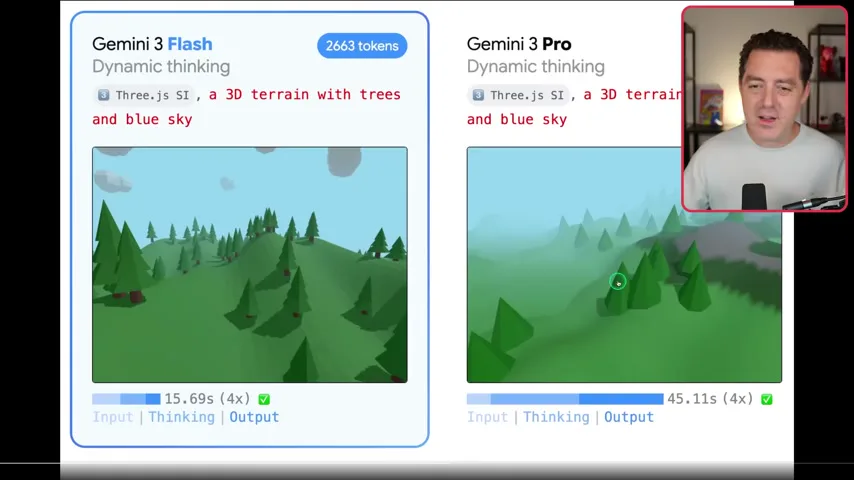
For a 3D terrain scene, Flash finishes in about 16 seconds with roughly 2,600 tokens; Pro takes about three times as long and uses around 4,300 tokens. I think both scenes look good, with different visual details. The result is an example of similar apparent quality with different time and token use, not proof that all tasks behave the same way.
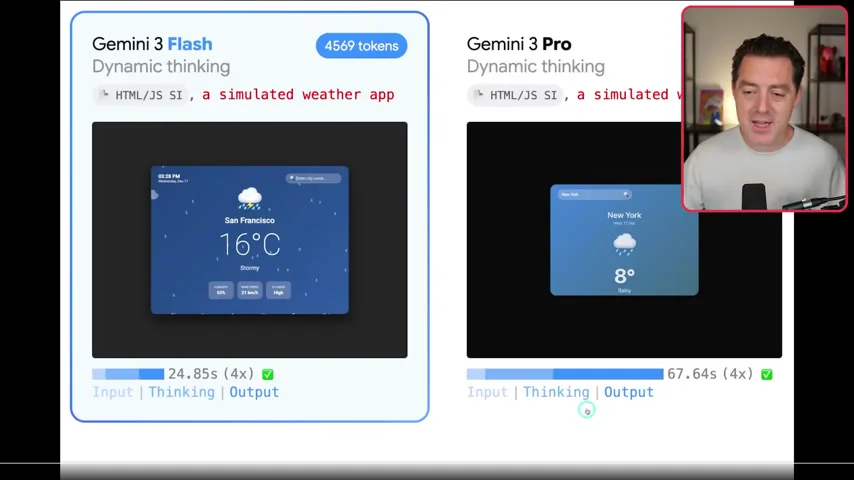
A simulated weather app is the third example: Flash takes about 25 seconds and 4,500 tokens, versus roughly 68 seconds and 6,100 tokens for Pro. I prefer Flash’s animated design over the simpler Pro version. These single examples show appearance and timing but do not establish robustness or production readiness.
Benchmarks, pricing and sponsor
He reviews launch pricing and benchmark results, including SWE-bench Verified. A HubSpot-sponsored segment describes a guide to his company’s automations.
The launch pricing table lists Flash at $0.50 per million text input tokens compared with $2 for Pro at the stated tier. Google also listed Flash output at $3 per million tokens versus $12 for Pro. Those are December 2025 API prices; output, context length and other charges affect actual cost, and pricing may change.
On Google’s launch table, Flash scores 33.7% on Humanity’s Last Exam without tools and 43.5% with search and code execution; GPT-5.2’s listed results are 34.5% and 45.5%. Flash scores 90.4% on GPQA Diamond and 81.2% on MMMU-Pro. These numbers reflect the reported versions and settings, and performance across different tests is not interchangeable.
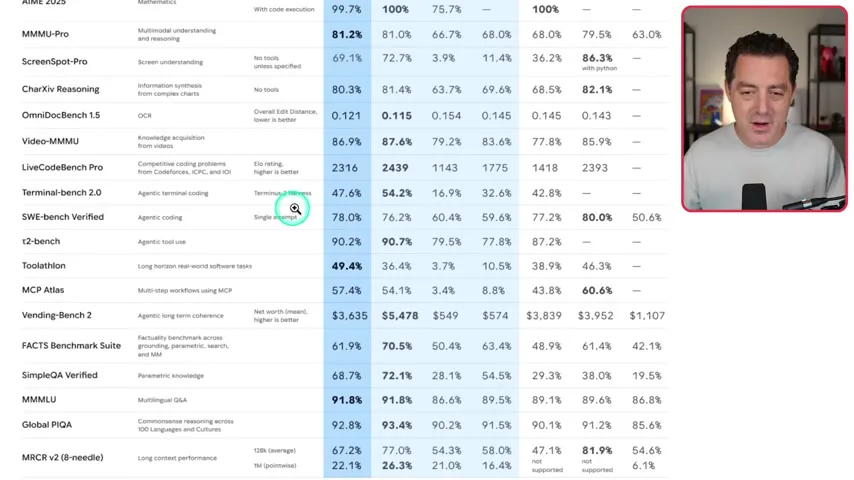
The coding result that catches my eye is SWE-bench Verified: Google reports 78.0% for Flash and 76.2% for Pro, with GPT-5.2 at 80.0%, under its single-attempt setup. That is a specific benchmark advantage, not a blanket claim that Flash is better at all coding: Google’s same table gives Pro 54.2% versus Flash 47.6% on Terminal-Bench 2.0.
I look at a chart comparing LMArena Elo with price and see Flash near Pro’s score at a lower price. The horizontal axis is reversed, so points farther right are cheaper on this particular chart. Arena preferences and a chosen token mix are only one way to compare quality and cost.
HubSpot sponsored this video. Berman says he partnered with HubSpot on a free guide to nine automations used by his company, Forward Future, including research and content workflows.
Distribution, efficiency and outside tests
Berman discusses Google’s product rollout and strategic position, then cites token efficiency, external rankings and ARC Prize results.
Flash supports multimodal inputs including text, images, audio and video. At launch, Google said it was rolling out as the default in the Gemini app and AI Mode in Search, with a no-cost consumer experience. That does not make all API usage or every product tier free, and present-day availability may differ.
I think Google’s combination of model quality, distribution and custom hardware puts it in a strong competitive position. I also discuss its potential for agentic coding and contrast it with smaller models made by coding companies. My claim that Google could dominate is a forecast, and comparisons with other companies’ internal models depend on the task and access terms.
I point to a Google chart showing lower average token use than other Gemini models in the displayed comparison and a Browserbase account saying its Stagehand agent approached Pro accuracy at lower cost and latency. These are reported results for particular traffic or workflows, not guarantees that Flash always uses fewer tokens or matches Pro.
I also cite Artificial Analysis and LMArena positions from the time, where Flash appeared near leading models. Rankings depend on the benchmark, model version and date; a leaderboard position in December 2025 is not a current ranking.
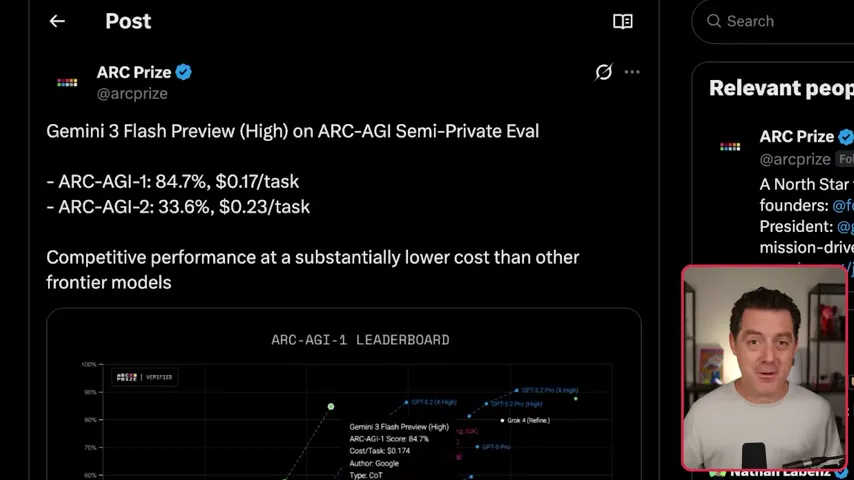
ARC Prize reported 84.7% on ARC-AGI-1 at about $0.17 per task and 33.6% on ARC-AGI-2 at about $0.23 per task for Gemini 3 Flash Preview at high reasoning. I also mention Box’s comparison with Gemini 2.5 Flash. Together these are useful test results, but each covers its own tasks and setup.
I conclude that fast responses combined with strong quality make Flash compelling, especially for my own preference for speed. I say Google did not pay me for this opinion; the separately disclosed sponsor of the video was HubSpot.
Mehr aus diesem Kanal
 34:21EN
 Matthew Berman· 27. Okt. 2026Matthew Berman Examines Anthropic’s IPO Filing, AI Growth and GovernanceMatthew Berman, Sam Altman · Forward FutureThe presenter reviews the S-1’s financial metrics, compute strategy and voting structure while questioning the tension between rapid AI development and safety.
 0:26ENMatthew Berman· 25. Okt. 2026Sam Altman on Human Values and Problem-Solving in an AI WorldSam Altman · OpenAIIn a short interview excerpt, Altman considers the enjoyment of solving hard problems and the human role in interpreting results.
 0:36ENMatthew Berman· 25. Okt. 2026Kimi K3.1 and a Rubik’s Cube Solver DemonstrationMatthew Berman · Forward FutureMatthew Berman shows a scrambled virtual cube being solved and gives the Kimi K3.1 test a favorable assessment.
 0:21ENMatthew Berman· 24. Okt. 2026An AI-Generated Kimi Benchmark Chart Used Invented ScoresMatthew Berman · Forward FutureMatthew Berman asks for a graph of Kimi K3.1 Pro benchmarks, then discovers that the displayed figures are illustrative placeholders.
 25:50ENMatthew Berman· 24. Okt. 2026Kimi K3.1 Pro Tested: Strong 3D Demos, Uneven Results and Competitive PricingMatthew Berman · Forward FutureMatthew Berman tests the open-weight model on coding, 3D rendering and visual explanations, then compares benchmark results and prices.
 32:20ENMatthew Berman· 23. Okt. 2026Who Is Local AI For? The Costs, Trade-offs and a Hybrid FutureMatthew Berman · Forward FutureMatthew Berman weighs data control and independence against hardware cost, setup complexity and inference speed.