In 30 Sekunden
In February 2025, Matthew Berman reviewed Microsoft’s Majorana 1 announcement and its ambition to scale topological quantum computing. He discusses protecting and reading quantum information and anticipates applications in chemistry and materials. The peer-reviewed parity-measurement paper does not itself establish Majorana zero modes, and a million-qubit machine remains a goal rather than an achieved result.
- 1A future scaling goalOne million qubits is an architecture ambition rather than an achieved device.
- 2What the paper measuredThe peer-reviewed work reports parity readout in hybrid devices; it does not by itself prove the states are topological.
- 3Applications are prospectiveChemistry, materials and enzyme examples depend on future hardware and algorithms.
- 4Protection remains to be shownTopological encoding aims to reduce error sensitivity, but the degree of protection and scalability need evidence.
Das Wichtigste
- Microsoft’s million-qubit design is a proposed future architecture, not a demonstrated million-qubit computer.
- The 2025 paper reports parity measurements but says those measurements alone do not establish a topological state.
- Topological qubits are intended to reduce sensitivity to noise, but protection and scalable error correction require further evidence.
- Applications in chemistry, medicine and materials are future possibilities rather than results demonstrated by the announcement.
Den bearbeiteten Text nach Kapiteln lesen
The Majorana 1 announcement
Berman introduces Microsoft’s proposed topological architecture and explains the million-qubit ambition. The announcement does not establish a working million-qubit machine.
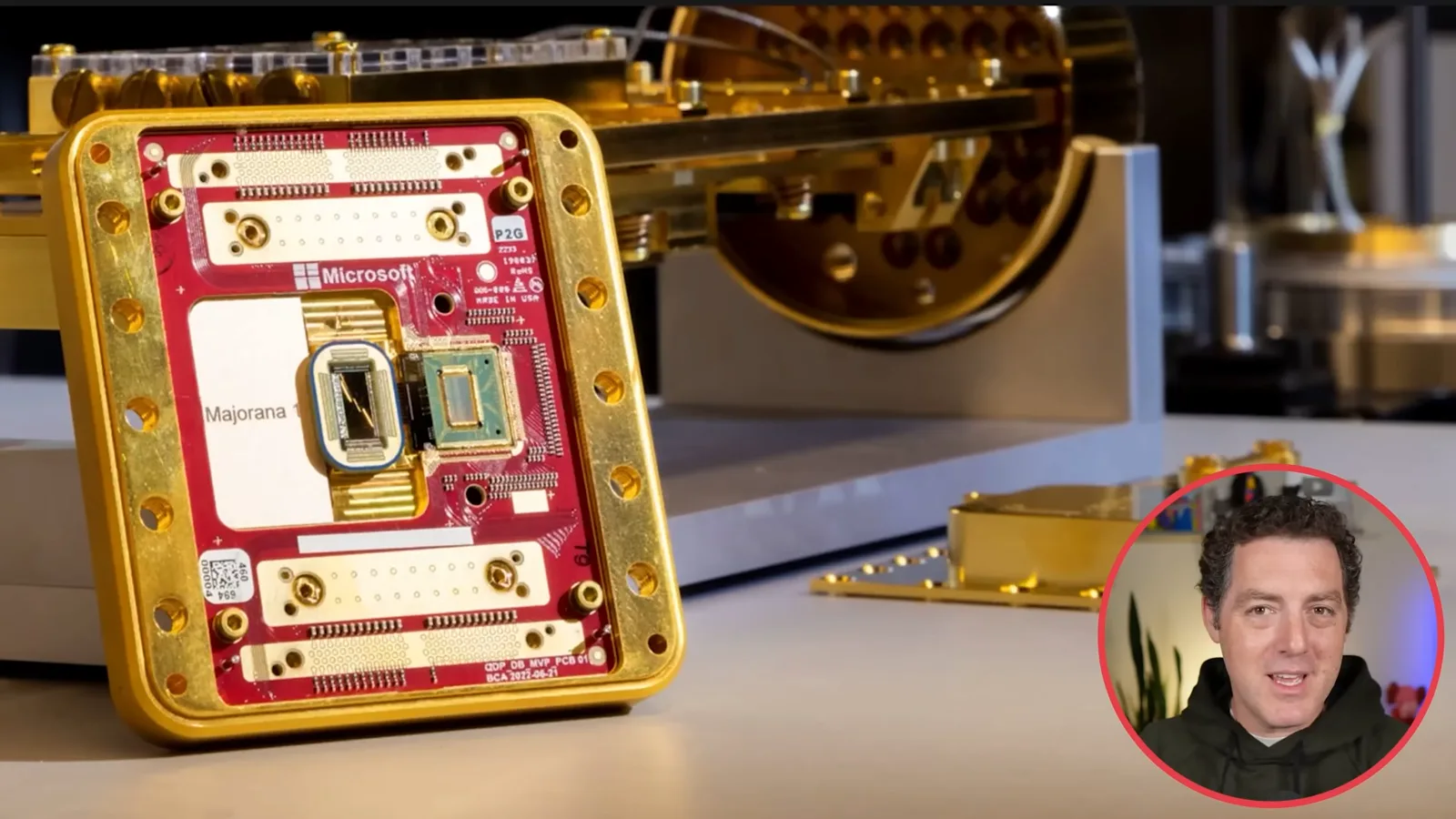
Microsoft has announced Majorana 1 and a proposed topological approach to quantum computing. In this February 2025 video I describe it as a new state of matter and an important step toward a much larger machine. Those claims require qualification: the company describes a topological phase, not a new everyday category alongside solid, liquid and gas, and the interpretation of its experimental evidence remains contested.
Microsoft presents Majorana 1 as a chip architecture that could eventually scale to a million qubits, not a chip already performing computations with a million qubits. A qubit is a quantum information unit whose state can be a superposition of 0 and 1; a measurement yields an outcome rather than simply reading both values at once.
Quantum systems are susceptible to noise and error, so a useful large-scale machine requires error management. Microsoft proposes topological qubits designed to protect information and reduce the overhead of error correction. Whether its device achieves the required protection and scalable error correction is not established by the announcement.
Measurements and possible applications
Microsoft describes a parity-readout technique; the published paper does not by itself establish Majorana zero modes. Berman considers future uses in materials and chemistry.
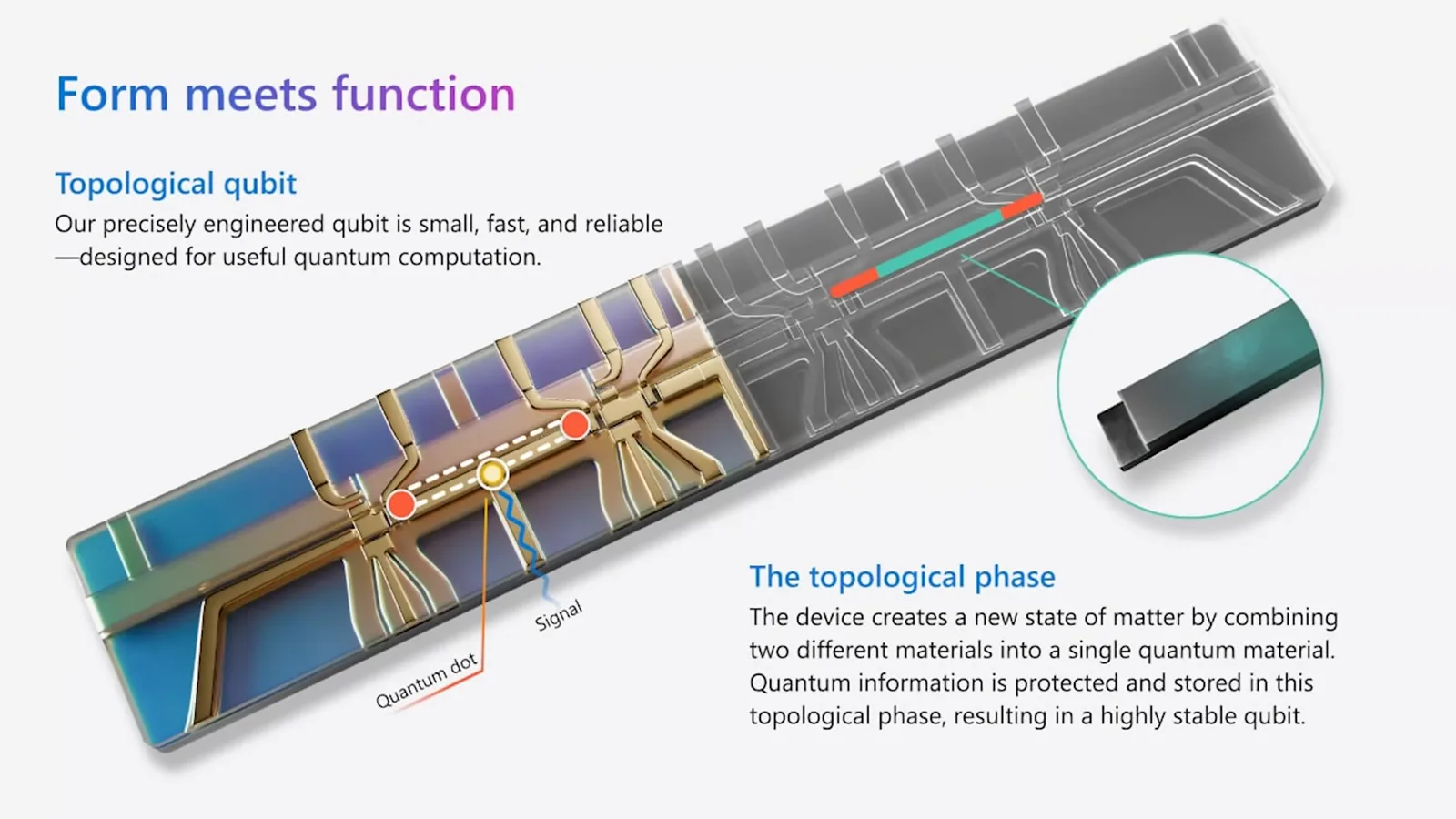
The company's device uses indium arsenide and aluminum. Microsoft describes measuring a property called fermion parity with a microwave technique and says its approach can distinguish the effect of an additional electron in a superconducting wire. The measurement is significant to the proposed architecture, but sensitivity alone does not demonstrate a fault-tolerant quantum computer.
I quote Microsoft's description of its peer-reviewed paper as confirmation of Majorana particles. The Nature paper reports single-shot parity measurements in hybrid devices; its authors say those measurements alone do not determine whether the detected states are topological. Nature's editorial review note also says the results are not evidence of Majorana zero modes in the reported devices. Microsoft's broader interpretation therefore remains a claim, not a settled finding.
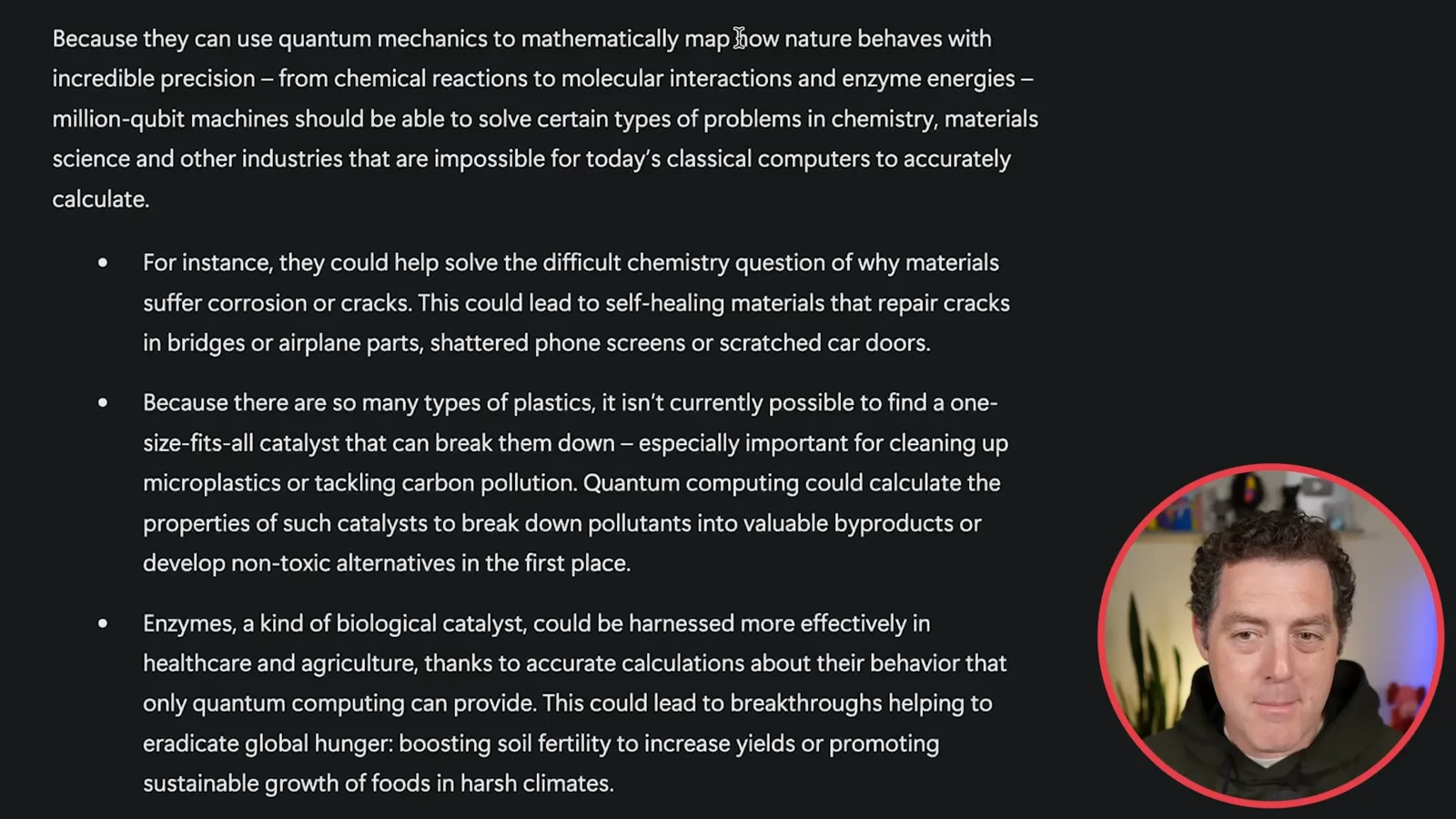
I am excited by the possibility that sufficiently capable quantum machines could model chemistry and materials, including molecular reactions and enzymes. Microsoft presents a million-qubit machine as a route to problems that may be difficult for classical computers. Such applications depend on developing a suitable, reliable machine and algorithms; they were not demonstrated by this announcement.
I imagine applications in self-healing materials: understanding corrosion or cracks could eventually inform materials for bridges, aircraft, vehicles or screens. I also wonder whether better molecular calculations could help design enzymes for breaking down different plastics. These are prospective research directions rather than products Majorana 1 has produced.
Healthcare and agriculture are other possible areas, and I speculate that quantum machines could greatly accelerate difficult calculations. The video includes a sponsored segment for Monica, an AI assistant. My suggestion that a production-ready system is very close is an optimistic forecast, not a demonstrated timeline.
Why topological qubits are difficult
Berman explains the goals of protecting and measuring quantum information. He closes with scaling hopes and potential applications.
Quantum information is sensitive to disturbances from its environment. The challenge is to store and manipulate a state while preserving enough coherence to perform a computation, and to read it out. Microsoft has pursued topological qubits in the hope that their structure will offer greater protection and lower correction overhead.
The approach seeks Majorana zero modes—quasiparticle excitations predicted in suitable engineered systems—and a way to measure information associated with them. Protecting information while being able to retrieve it is central to the design. The 2025 measurement paper is a step toward that architecture, but it does not by itself establish the existence of those modes in the tested devices.
Microsoft's proposed compact design aims eventually to fit many qubits on a chip. That scaling goal is not a demonstrated million-qubit device, and comparisons with room-sized systems are projections rather than measured equivalent machines. Microsoft technical fellow Krysta Svore describes the difficulty of fabricating layers with very few defects.
I am optimistic about possible future applications: drug discovery, personalized medicine, better batteries, climate modeling, self-healing materials and transportation. These are opportunities for research, not outcomes shown in the video, and their feasibility depends on quantum hardware and algorithms reaching the necessary performance.
Mehr aus diesem Kanal
 34:21EN
 Matthew Berman· 27. Okt. 2026Matthew Berman Examines Anthropic’s IPO Filing, AI Growth and GovernanceMatthew Berman, Sam Altman · Forward FutureThe presenter reviews the S-1’s financial metrics, compute strategy and voting structure while questioning the tension between rapid AI development and safety.
 0:26ENMatthew Berman· 25. Okt. 2026Sam Altman on Human Values and Problem-Solving in an AI WorldSam Altman · OpenAIIn a short interview excerpt, Altman considers the enjoyment of solving hard problems and the human role in interpreting results.
 0:36ENMatthew Berman· 25. Okt. 2026Kimi K3.1 and a Rubik’s Cube Solver DemonstrationMatthew Berman · Forward FutureMatthew Berman shows a scrambled virtual cube being solved and gives the Kimi K3.1 test a favorable assessment.
 0:21ENMatthew Berman· 24. Okt. 2026An AI-Generated Kimi Benchmark Chart Used Invented ScoresMatthew Berman · Forward FutureMatthew Berman asks for a graph of Kimi K3.1 Pro benchmarks, then discovers that the displayed figures are illustrative placeholders.
 25:50ENMatthew Berman· 24. Okt. 2026Kimi K3.1 Pro Tested: Strong 3D Demos, Uneven Results and Competitive PricingMatthew Berman · Forward FutureMatthew Berman tests the open-weight model on coding, 3D rendering and visual explanations, then compares benchmark results and prices.
 32:20ENMatthew Berman· 23. Okt. 2026Who Is Local AI For? The Costs, Trade-offs and a Hybrid FutureMatthew Berman · Forward FutureMatthew Berman weighs data control and independence against hardware cost, setup complexity and inference speed.