In 30 Sekunden
In this June 2026 livestream, Matthew Berman reviews Anthropic’s “When AI Builds Itself,” comparing reported engineering and research measurements with possible futures for human oversight and recursive self-improvement. He is optimistic about productivity but critical of the company’s safety and slowdown messaging. The essay says full recursive self-improvement has not been achieved and is not inevitable; several measurements are company-reported, narrow or subjective. Berman identifies Box as a channel sponsor.
- 1A future possibilityAnthropic says AI is accelerating its work but does not claim full autonomous recursive self-improvement has been achieved.
- 2Task-horizon contextThe cited human-time horizon is a benchmark estimate at a specified success rate, not a guarantee of arbitrary long-task performance.
- 3Internal code metricsAnthropic reports over 80% of merged code authored by Claude; lines of code are not a quality or productivity measure on their own.
- 4An invalid comparisonBerman’s inference that AI code is half as valuable divides two different metrics and is not supported by the data.
- 5Selected research decisionsThe 64% result uses 129 selected detour cases and a model judge with access to outcomes, not a representative direct comparison of human and AI researchers.
- 6Coordination debateAnthropic proposes options for coordinated slowing; Berman questions the incentives of a leading company.
Das Wichtigste
- Anthropic reports increased AI assistance in its own engineering and research but says full recursive self-improvement is not yet here or inevitable.
- METR time horizons describe a specified probability of success on a particular software-focused task suite, measured in human task time.
- Eightfold merged lines of code and a fourfold employee self-assessment measure different things and cannot establish per-line code quality.
- The 52-fold speedup and 64% research-choice result come from specific company-run tests, with important selection and judging limits.
- The essay outlines stalled progress, human-directed acceleration and fully recursive improvement as scenarios, not established forecasts.
- Anthropic proposes building options for coordinated slowing; Berman’s criticism of its incentives is his interpretation.
- The stream identifies Box as a channel sponsor.
Den bearbeiteten Text nach Kapiteln lesen
Anthropic’s recursive improvement argument
Berman introduces the essay and its illustrations of increasing AI involvement. He compares a possible automated research loop with earlier predictions while distinguishing it from present capability.
Anthropic’s essay “When AI Builds Itself” discusses how the company uses AI in engineering and research and considers a future in which AI could develop its own successors. I find the data fascinating, but I am also skeptical of the company’s safety messaging and incentives. Full recursive self-improvement is a hypothetical future, not an achievement reported by the essay.
I criticize what I see as fear-based marketing in Anthropic’s presentation. That characterization reflects my view of its communication; the underlying safety questions and the company’s internal measurements can be assessed separately.
Anthropic says it is delegating a growing share of AI development to AI systems. I think that can move people further from the implementation details even as it expands what they can accomplish. How to retain understanding and oversight is one of the recurring questions in this discussion.
The essay suggests that, taken far enough with sufficient compute, this trend could lead to autonomous design of successor models. I compare that possibility with Leopold Aschenbrenner’s Situational Awareness and its illustration of an automated AI researcher and an intelligence explosion. That graph is a forecast, not proof that all of its predictions have come true.
Anthropic explicitly says full recursive self-improvement is not inevitable and has not happened. I think it looks increasingly plausible, but there is still an important gap in the ability to choose and judge research directions. The company also warns that a loss of human control is a possible risk, a concern I take seriously.
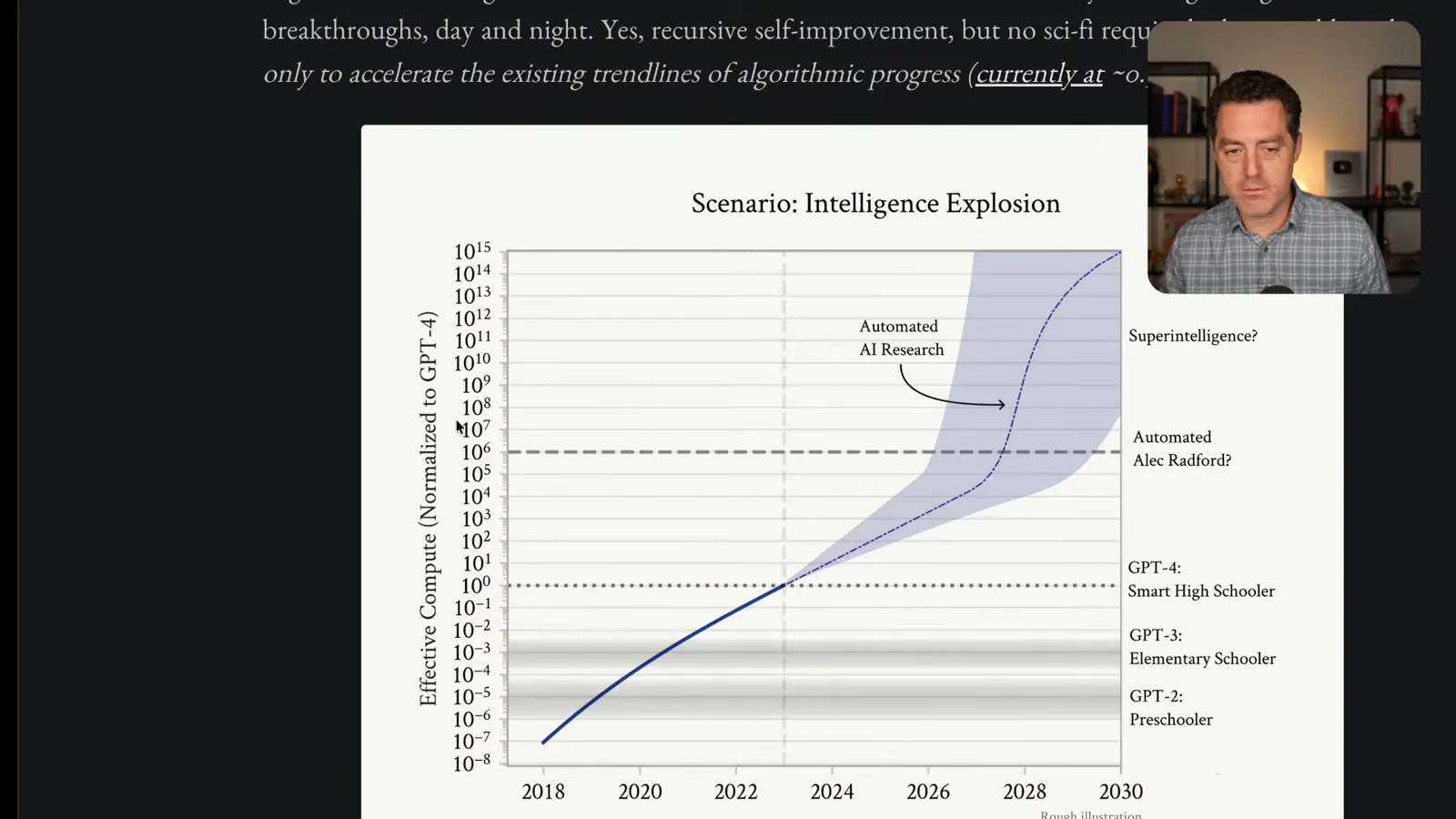
In the earlier forecast, an automated AI researcher would contribute to a rapid rise in effective capabilities. I see parallels with Anthropic’s discussion, but the speed and timing of a hypothetical intelligence explosion remain unknown.
The essay illustrates a progression from people writing code directly to chatbots, coding agents, and agents delegating to other agents. In the graphic, more of the work is mediated by software. This is a simplified depiction of a changing workflow, not a measurement that humans no longer participate today.
The earliest stage depicts people directly writing code and documentation. The chatbot stage adds generated suggestions that people can copy into their work; the illustration treats these as stages in a workflow rather than a quantitative comparison.
A chatbot can help a person build software, and a coding agent can carry out some steps. The illustration then adds subagents and parallel workers. I say this can produce far more code from a single instruction, while acknowledging that lines of code are not a measure of quality.
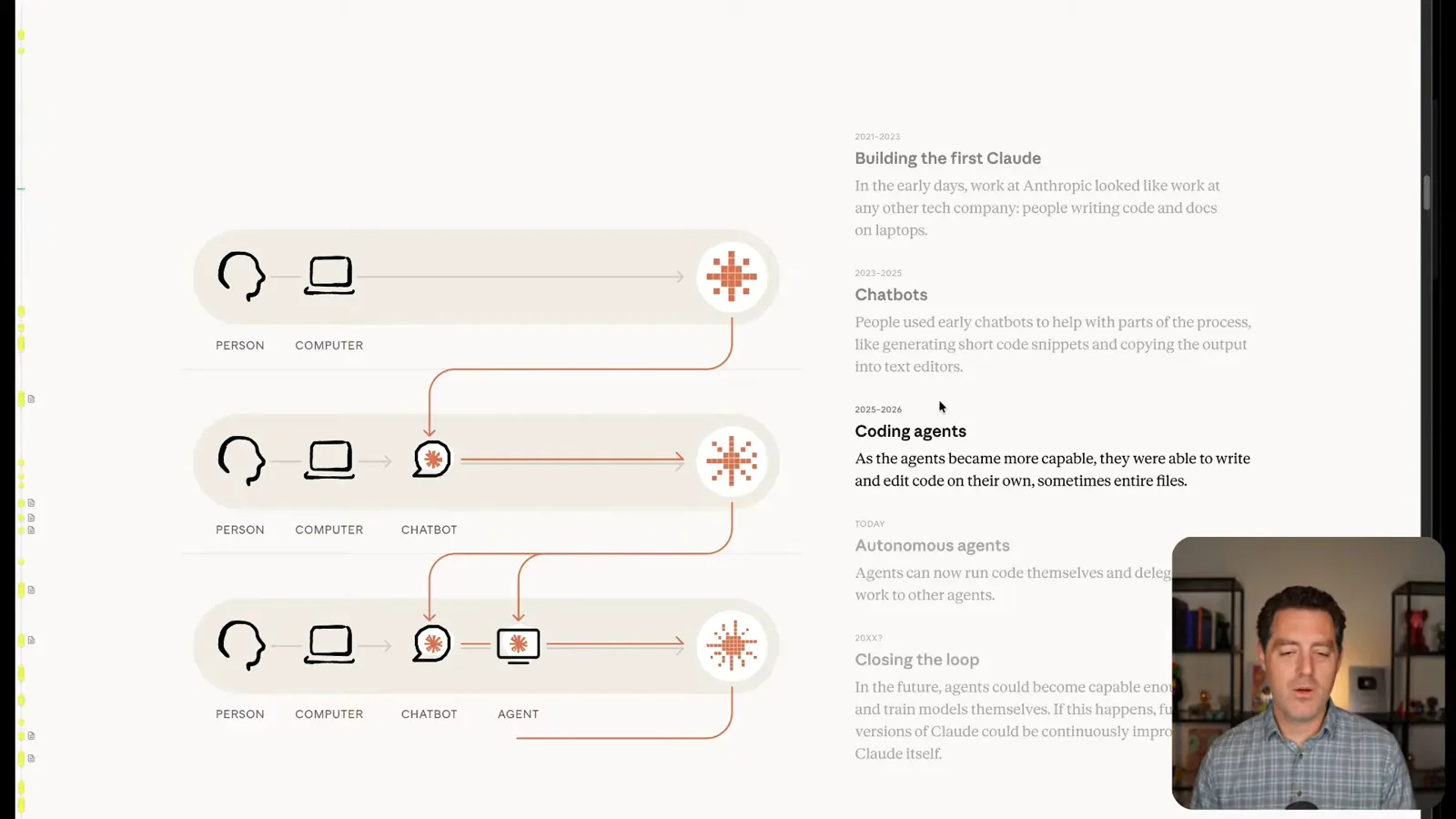
With agents delegating tasks to subagents, I focus on parallelism: a short human instruction could initiate many pieces of work. The number of lines produced says little on its own about correctness, security or usefulness.
The final illustration imagines a closed loop in which agents develop and train future models. I emphasize the absence of a human in that diagram and the role of compute. Whether such a loop can exist, and what other constraints would bind it, remains uncertain; the essay itself also discusses oversight and other bottlenecks.
Task horizons and research benchmarks
He discusses METR time horizons and CORE-Bench. Both measurements apply to defined tasks and are not proof of complete autonomous research.
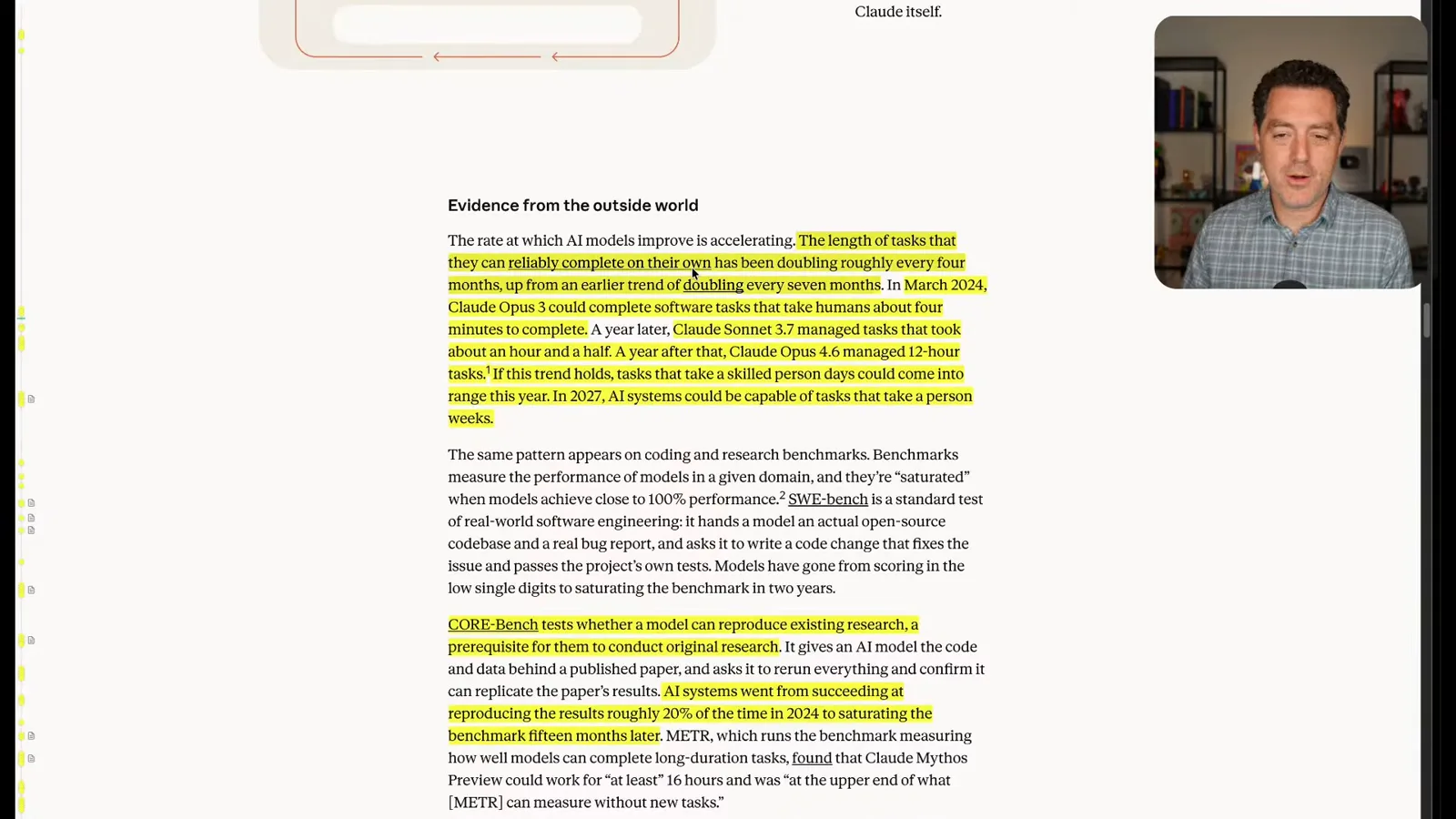
Anthropic turns to outside evidence, including task-completion time horizons that it says have recently doubled roughly every four months. I see that as a sign of rapid progress, while noting the company says end-to-end recursive improvement is not here. Shorter automated research loops are suggestive examples, not proof that a system can independently build a successor.
I point to examples of constrained automated experimentation and harness improvements as early signals worth watching. None independently demonstrates an agent that can design, train and validate a frontier successor without human guidance.
The essay cites Claude 3 Opus on tasks taking a human around four minutes, then Sonnet 3.7 around 90 minutes, and Opus 4.6 around 12 hours. METR’s time horizon is based on task duration for a human expert at a specified predicted success rate—commonly 50%—on its software-heavy task suite. It does not mean the model reliably completes every 12-hour human project or runs for precisely 12 hours.
Berman notes that model time and human task time are not the same thing. His own account of agents running long jobs is an anecdote; the benchmark measures estimated task difficulty through the human completion-time scale.
Anthropic extrapolates that if the trend continues, tasks requiring days of skilled human work could come into range in 2026 and weeks in 2027. I think progress may arrive sooner than many expect. Both statements are forecasts, not measured outcomes, and the benchmark’s narrow tasks should not be generalized to all jobs.
CORE-Bench evaluates whether an agent can reproduce published research, using the paper’s accompanying code and data. The essay reports an improvement from roughly 20% in 2024 to near saturation about fifteen months later. That benchmark result does not mean models can reproduce every novel AI paper or originate its discoveries.
The distinction matters because reproducing supplied results involves code, data and an existing method. Discovering the question and designing a new experiment are different steps, even if reproducing work can be useful research infrastructure.
Engineering, judgment and internal coding
Anthropic separates execution from goal selection and reports that Claude authors much of its merged code. Berman questions both metrics and competitive incentives.
Anthropic distinguishes engineering from research. Engineering includes code, infrastructure and training operations; research includes choosing experiments, interpreting results and deciding what to try next. I see the difference between executing a project and selecting a worthwhile direction as important.
Within Anthropic’s account, an engineer supplies a goal while the model can work out implementation details, and research staff still choose directions. I think execution is becoming easier, but project success also depends on testing and selecting useful goals.
I describe how I give coding tools underspecified requests, such as a screenshot of an error with “fix it.” In my experience they can often find a method once I have identified the problem. I also mention Sakana AI’s work on automated research as another example of efforts in this direction.
I say that I have used Codex to open a browser and configure infrastructure on services such as DigitalOcean or Vercel. That is my personal experience, not a controlled measurement of how often the agent succeeds or what supervision a particular deployment requires.
Anthropic says substantial gaps remain in choosing goals and exercising broader judgment. I agree that models can carry out a task after a human sets the problem more readily than they can reliably decide what a team should build next quarter. This does not mean every individual execution task is easy or every model result is correct.
I contrast a defined request to fix an export button with a broader request to investigate a network slowdown and the strategic question of what to build next. I find current answers to the last question less impressive. My claim that models cannot produce genuinely novel ideas from learned data is an opinion, not something established by the essay.
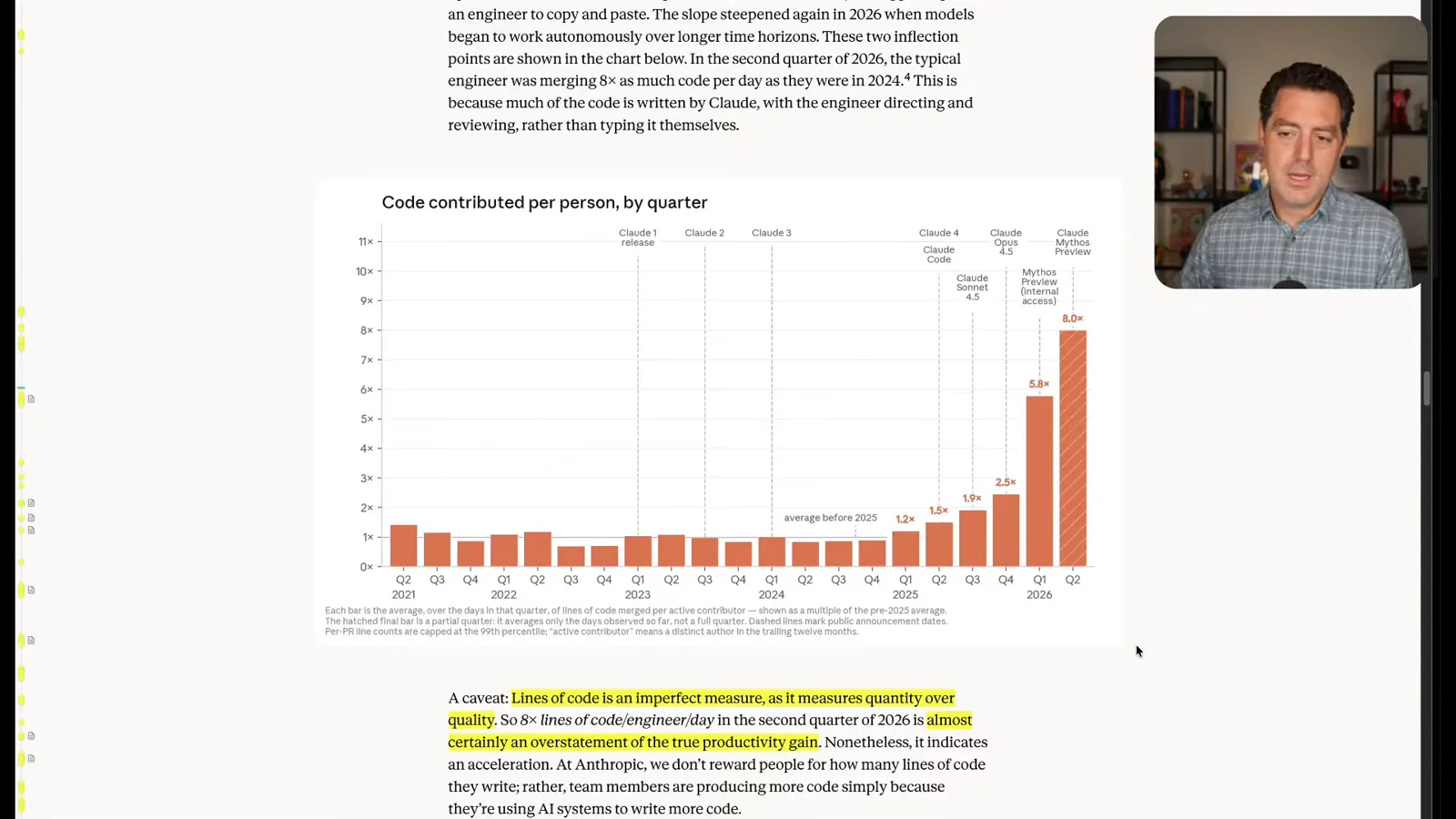
Anthropic reports that as of May 2026 Claude authored more than 80% of code merged into its codebase, up from low single digits before the Claude Code research preview in February 2025. This is the company’s internal measure, with engineers directing and reviewing the work, not a measure of all software development.
I relay a CEO’s joke that the reported proportion of Claude-authored code might explain bugs. That is an anecdote, not an evaluation of Anthropic’s defect rate. The company’s own figures do not establish a comparison with all other firms.
A graph shows merged lines per engineer rising sharply in late 2025 and early 2026. I recognize why developers dislike lines of code as a metric: fewer readable, correct lines can be more valuable than more lines. Anthropic itself warns that the eightfold increase in lines is likely to overstate productivity growth.
I argue that readable, efficient code that actually solves the problem can be more valuable than a longer implementation. The company’s graph should therefore be read as a measure of merged code quantity, with its stated limitations.
I associate the shift with the arrival of more capable coding models such as Opus 4.5 and GPT-5, based on my own experience. The chart shows a correlation over time, not a controlled causal estimate of any individual model’s contribution.
I discuss Anthropic’s internal use of Mythos Preview and a report that xAI employees lost access to Anthropic models through Cursor. I regard dependence on a competing model provider as platform risk. My claim that Anthropic withheld a model primarily to extend its competitive lead is an interpretation of its motives, not an established fact.
I view the reported restriction on a competitor’s access and internal use of Mythos as evidence of strategic incentives. I speculate about the company’s reasons, but the report and the internal-access chart do not prove why a release decision was made.
The essay says eight times as many lines is almost certainly an overstatement of productivity. I speculate that AI-generated code might be lower quality or that marketing, sales, adoption and documentation could become bottlenecks. The line count alone does not establish either explanation.
My car analogy is that engine power alone is useless if tires cannot put it on the road. Likewise, faster coding can expose constraints in launch, support and adoption; the analogy does not quantify which constraint matters most.
Productivity, new work and employment
Employee estimates, lines of code and anecdotes are discussed with their limits. Berman also identifies Box as a channel sponsor and considers new work.
In a March 2026 poll of 130 Anthropic research staff, the median respondent estimated around four times as much output with Mythos Preview as without AI on work they would otherwise have done. This is a subjective estimate for that group and context; Anthropic itself expects the actual uplift was somewhat lower.
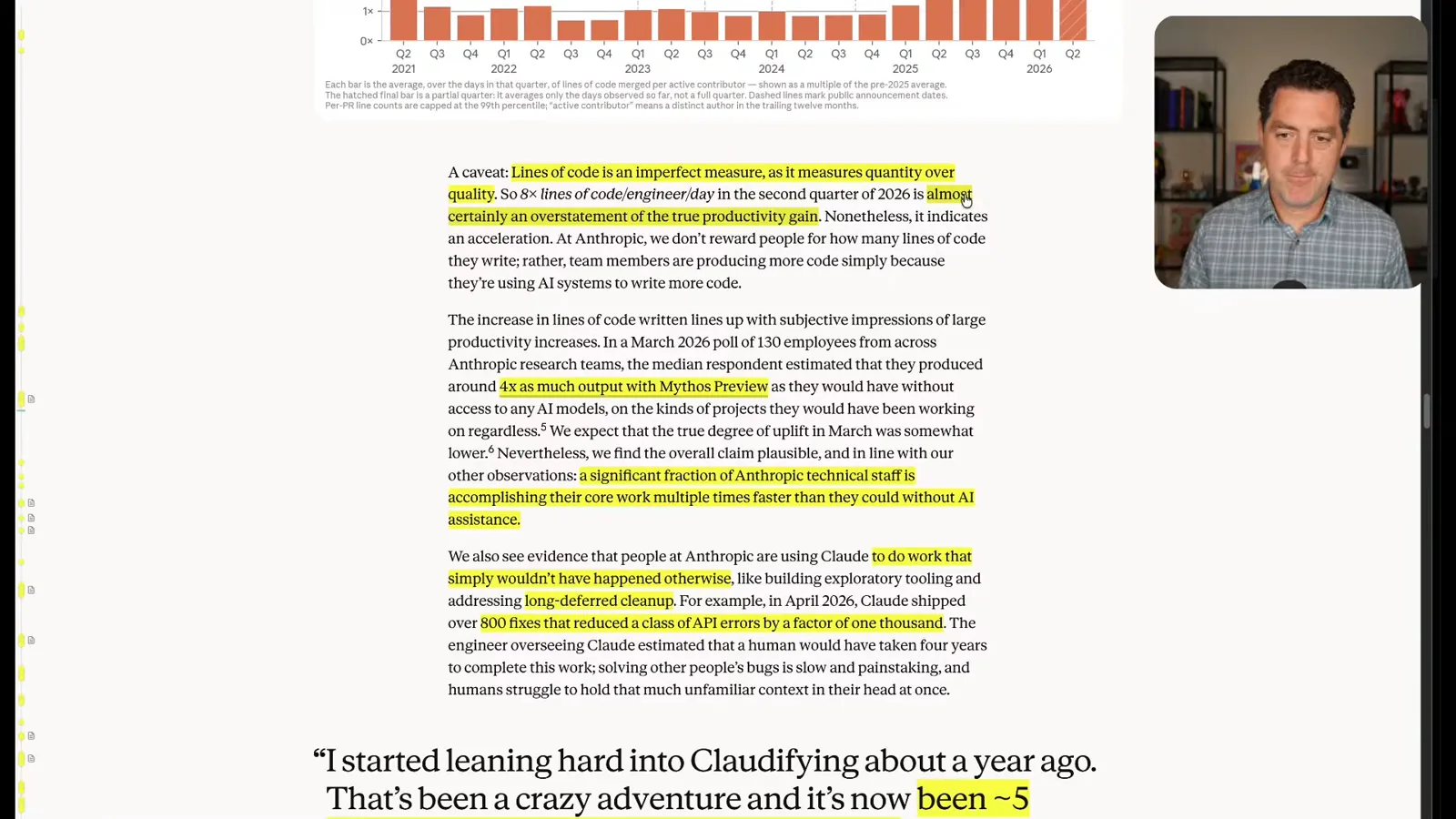
I compare the fourfold estimate with the eightfold line count and suggest AI-written code is half as valuable. That arithmetic does not support the claim: the figures measure different outcomes, populations, baselines and periods. They cannot be divided to infer the quality or value of an individual line of code.
I also speculate that better harnesses and deployment could produce gains even if the model stayed the same. Those organizational changes are separate from the employee survey, which did not directly measure future potential.
I argue that even if model capabilities stopped improving, better tooling, adoption and removal of other business bottlenecks could produce additional value. More software projects might also require people in sales, marketing, support and maintenance. These are possible effects, not proof that AI will increase employment overall.
Anthropic reports that staff also use Claude for work that otherwise might not have happened, such as exploratory tools and deferred cleanup. I find this “net new work” more interesting than thinking only about replacing existing tasks. Whether it generates durable value depends on what gets built and how it is used.
Some firms may focus on automating work to reduce staffing; I prefer asking what new work becomes feasible. This is a management preference and a prediction about business strategy, not a measured comparison of firm outcomes.
I invoke Box CEO Aaron Levie’s view that companies should ask what new work AI makes possible. Box is a sponsor of my channel, which I disclose in the stream. The argument is a strategic perspective, not independently verified evidence about economy-wide employment.
An Anthropic employee says they have not personally written code for five months. I ask how engineers review an expanded volume of machine-generated code and suggest that AI will also assist with review. An individual anecdote does not establish that all employees stopped writing or reviewing code.
I discuss Levie’s claims that expanding software projects can create demand for maintenance, security, sales, customer success and marketing. I see this as a counterargument to a job-collapse narrative. A company’s experience or a social-media post does not resolve the net employment effect across sectors.
The argument for more jobs includes maintaining systems and addressing security as well as supporting more products. At the same time, individual examples cannot rule out displacement or show what happens across the labor market.
Model judges and research experiments
Berman examines Claude-judged session outcomes, a fixed optimization task and a selected next-step evaluation. These results are narrow and do not resolve general research capability.
Anthropic’s chart categorizes Claude Code sessions from trivial tasks to substantial and open-ended problems. The company reports larger gains on harder categories. Its session success metric uses a Claude judge, and changing workloads can affect the trend; it is not an independent audit of all code produced.
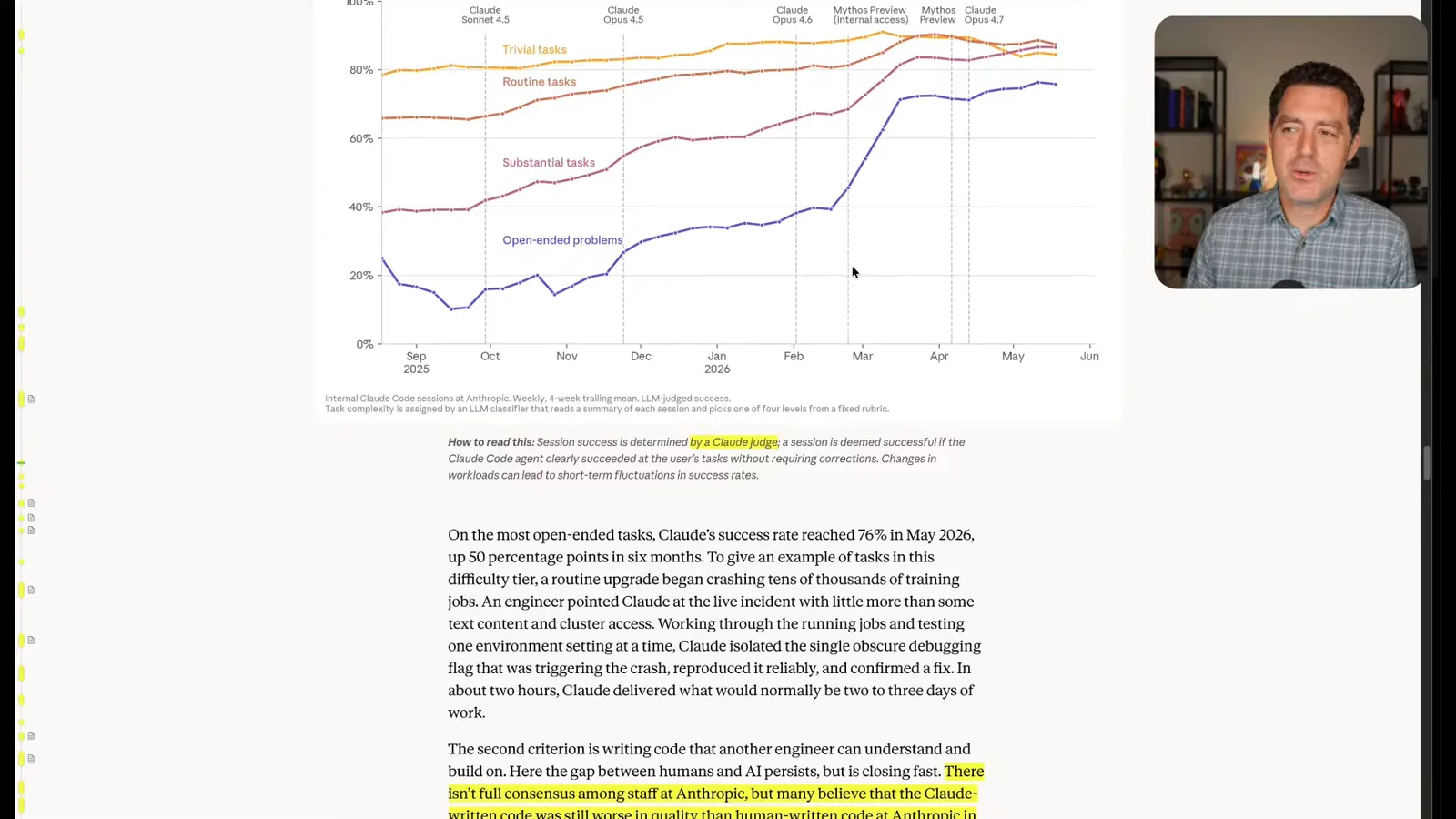
The use of a model as judge raises a broader issue for me: AI is increasingly writing and evaluating code, while people may become more distant from details. I refer to the idea that thinking can be delegated but understanding still matters. Model judging can help scale evaluation, but its own accuracy must also be assessed.
I worry that losing track of implementation details could make it harder for humans to maintain or validate systems. The observation that a model judges a session does not mean no human review exists in the company’s workflow.
Anthropic reports that many staff viewed Claude-written code as somewhat worse than human-written code in late 2025 and roughly at parity at the time of the essay. It expects improvement within the year. Those are staff views and a company forecast, not proof drawn from the ratio of the two earlier metrics.
The essay then describes a narrowly specified research loop. The model rewrites code for training a small AI model, runs it and measures speed while meeting fixed correctness checks. The task is optimization against a supplied goal, not the autonomous invention of an entire research agenda.
Anthropic reports an average roughly threefold speedup for Opus 4 in May 2025 and roughly 52-fold for Mythos Preview in April 2026. It says a skilled human researcher would need four to eight hours to reach fourfold on its calibration. These are company-reported results for this particular task and setup, not general productivity multipliers or a direct comparison across all research.
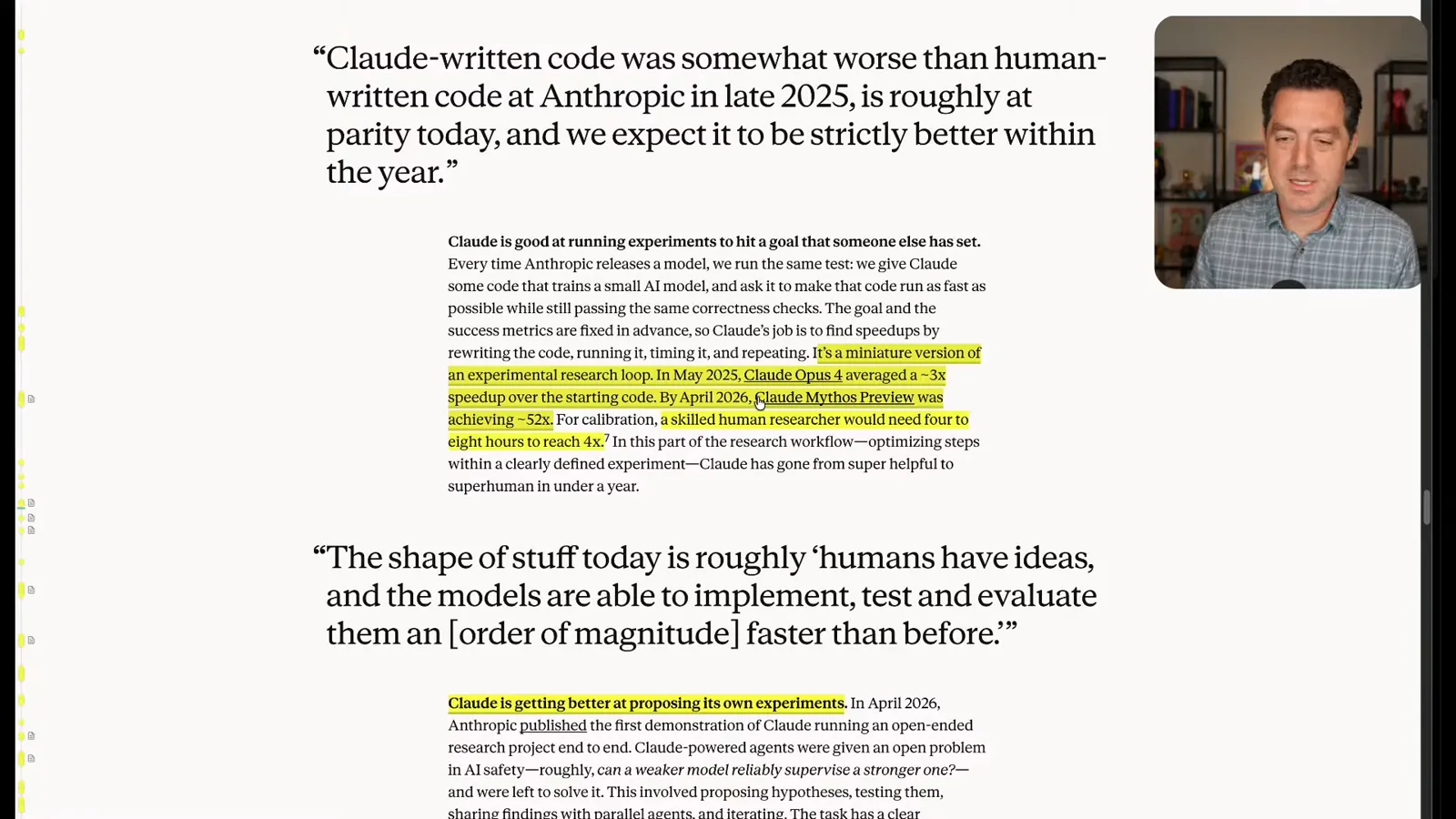
The optimization example gives the model a fixed objective and fixed correctness checks, allowing it to iterate on implementation. Its reported speedup concerns code execution speed on that task, not how much faster every researcher works.
I mention Andrej Karpathy’s autoresearch project, which uses an agent to propose and run experiments toward a defined training objective. I also mention his move to Anthropic. The project illustrates iterative experimentation within a constrained setup, not proof of unrestricted recursive self-improvement.
The essay says Claude is improving at proposing research steps. I suggest that abundant compute and parallel experiments can reduce the need for human taste in highly verifiable domains, while recognizing that real compute is limited. This is a hypothesis about how search might scale, not evidence that judgment no longer matters.
Anthropic also examined 129 past research sessions where a human had taken a detour before the investigation returned to a useful path. Models saw the context before the detour and proposed a next step; another Claude, with access to the outcome, judged the suggestions. The cases were deliberately selected where human decisions had room to improve.
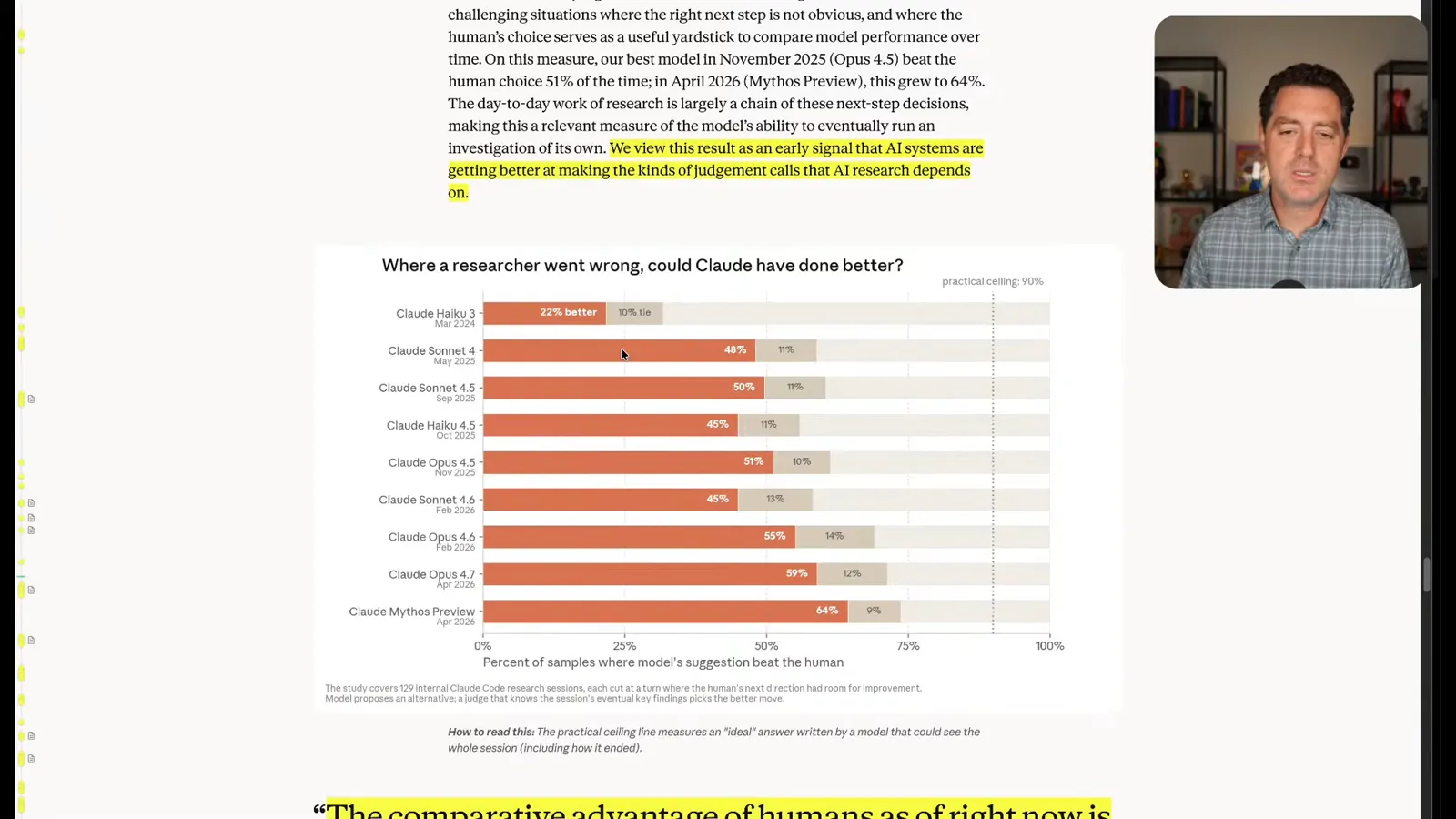
The company reports that Mythos Preview’s suggestion beat the human choice 64% of the time in that selected test, compared with 51% for Opus 4.5. Because of the selection and model-based judging, this is not a representative head-to-head measure of all human research judgment. It is a company-reported signal on a particular set of decisions.
I return to the distinction between setting a goal, executing the middle of a task and verifying the result. In my view humans still provide much of the big-picture judgment and verification. The boundary may move as models improve, but the timeline is uncertain.
I describe prompting and verification as the two ends of a workflow, with AI doing an expanding portion in the middle. This is a useful framing for my experience, though actual boundaries vary by task and model.
Human judgment and possible futures
The essay examines verification bottlenecks and three future scenarios. Berman discusses access to compute and possible inequality as speculative outcomes.
Anthropic suggests human review could become a bottleneck if AI produces code faster than people can inspect it. I revisit the startup maxim that ideas are cheap and execution is hard: easier implementation may increase the relative value of selecting the right problem, although execution still includes product, customers and operations.
The company identifies research taste as choosing which problems matter, what results to trust and when an approach has reached a dead end. I agree this is a major gap. The statement is about current comparative strengths, not a permanent guarantee that humans will always retain this advantage.
Anthropic considers the possibility that current architectures never achieve the full autonomous research capability required for recursive improvement. I contrast ideas and execution, invoking Edison’s inspiration-and-perspiration saying. The company argues that automation of much routine experimentation could still compound progress even if humans keep setting directions.
I say that human direction might steer much more work when models handle execution. In a fully verifiable domain, large-scale search may help compensate for weak judgment, but compute, chips, data centers and energy remain finite. Unbounded compute is a thought experiment, not an available resource.
The essay sets out three possible futures. First, model progress could stall while existing capabilities spread through society. Anthropic considers that less likely, but I agree that adoption, tools and organizational changes could still have major effects even without more capable base models.
The second scenario has continued efficiency gains and substantial automation while humans still choose research directions and judge outcomes. I imagine a small organization producing the work of a much larger one, but that numerical comparison is speculative. Unaccelerated parts of a workflow can still limit overall progress.
The third scenario is full recursive self-improvement: AI systems become capable of building successors themselves. I ask viewers which scenario they find most likely. Neither my optimism nor the responses in chat establish that the third outcome is inevitable.
In the second future humans remain involved in steering research even as much execution is automated. The third posits a capability to build successor systems; neither scenario specifies a proven arrival date.
Anthropic describes such a future as plausible if technical progress continues and AI acquires the relevant research abilities. I link this to an intelligence explosion, but the speed and consequences of any feedback loop depend on evidence not yet available. The essay also describes possible human oversight and verification, rather than declaring every human role gone.
I discuss the idea of a “permanent underclass”: if access to compute and capital determines who benefits from powerful AI, existing inequality might become entrenched. I find that frightening. This is a speculative distributional scenario, not a demonstrated result of recursive self-improvement or an inevitable freezing of social mobility.
If capital buys scarce compute, I fear the people with resources could accumulate further advantages. Governance, ownership and access could affect the result, so the permanent-underclass story is a possible concern rather than a settled economic law.
Anthropic says it cannot confidently predict an economy driven by fast recursive improvement and speculates that robotics could follow. I question whether simulations could overcome long waits for evidence about drug effects. Better simulation might help, but it does not by itself validate a drug’s long-term effects in people; real-world testing remains a separate evidentiary challenge.
Slowdown, viewer questions and a side project
Berman challenges Anthropic’s proposed coordination and answers viewer questions. He shows a personal Codex quota prediction website and closes with his newsletter.
Anthropic argues that an effective slowdown could be beneficial if it gave society and alignment research time to catch up, but warns that unilateral slowing could let less cautious actors advance. I criticize the proposal as potentially self-serving for a leading lab. That is my assessment of incentives, not proof of the company’s motive or of a single objective ranking among labs.
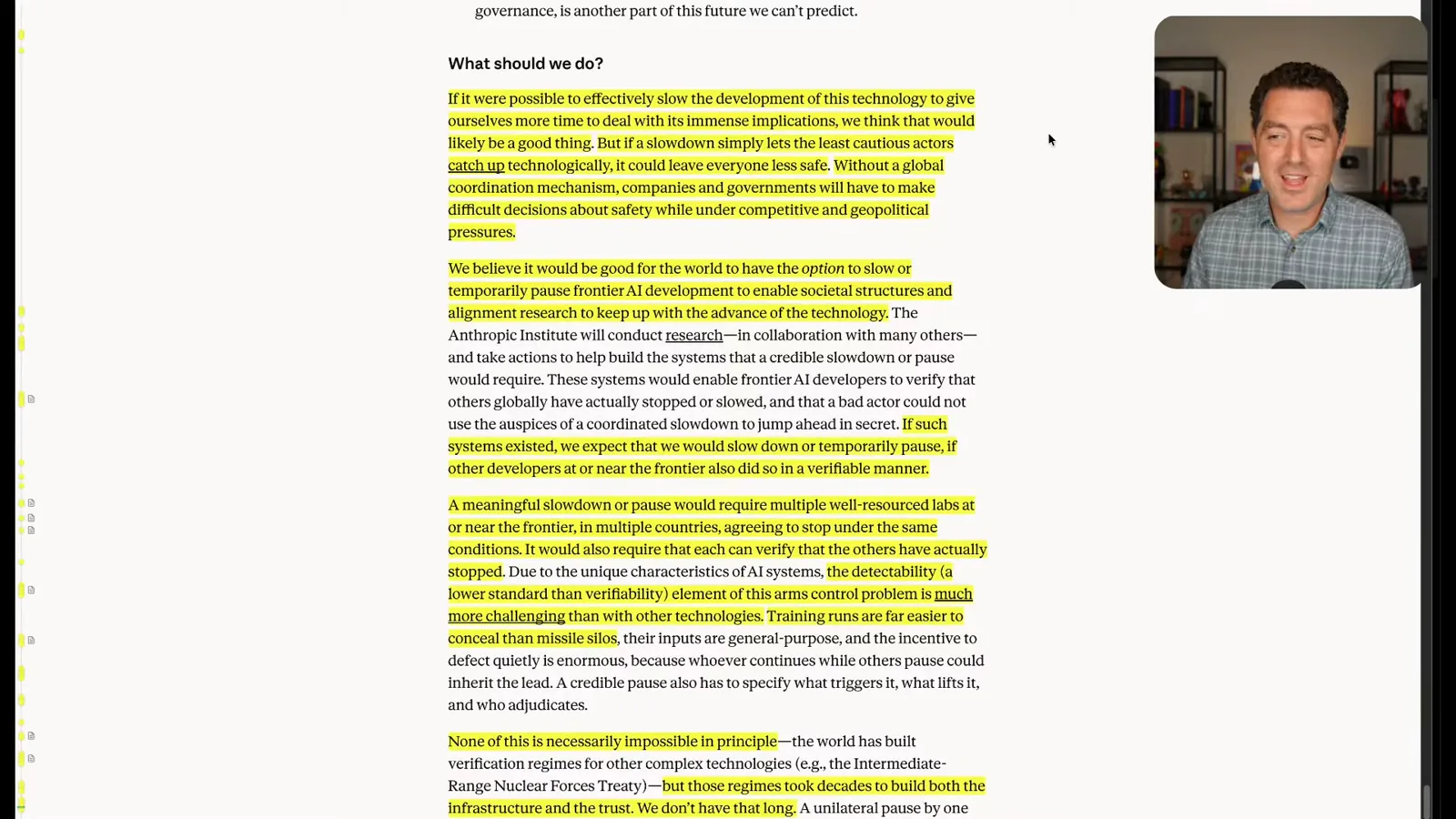
I compare a coordinated slowdown to a race leader asking everyone to slow together, and argue it could preserve an advantage. This analogy expresses my skepticism; it cannot establish the company’s private intentions.
The essay calls for options for coordinated slowing or a temporary pause, with multiple labs and countries able to verify one another’s actions. I question whether that could be achieved and note Anthropic’s comparison with arms control: training runs can be harder to detect than missile silos. The essay is a policy proposal, not an agreement that such coordination exists.
The essay says verification would require more than an announcement: participants would need to know whether others actually stopped, agree on conditions and address incentives to defect. It acknowledges that building trust and monitoring would be difficult.
I summarize the essay as a mix of internal observations, projections and safety arguments. The reported engineering and research metrics are informative but come from a company discussing its own systems. I ask viewers for their responses and remain optimistic while acknowledging that outcomes are uncertain.
Asked whether we are doomed, I say I do not know and prefer optimism. I think fully self-improving systems are possible, but expect human involvement to remain important in the near term. That is my view, not a settled prediction about safety or the economy.
A viewer asks about alternatives to language models. I mention world-model research, Yann LeCun’s JEPA work and Ilya Sutskever’s interest in new approaches. I have not fully read every work mentioned, and I do not establish which architecture will ultimately succeed.
I mention that some researchers pursue world models or different architectures, but do not claim these alternatives are proven substitutes for current language models. Their eventual role remains a research question.
I show a small website I built with Codex to predict whether a Codex quota will reset. It uses signals such as public posts, possible releases and service status; I describe it as a fun project. Its predictions are not verified probabilities or an official OpenAI reset schedule.
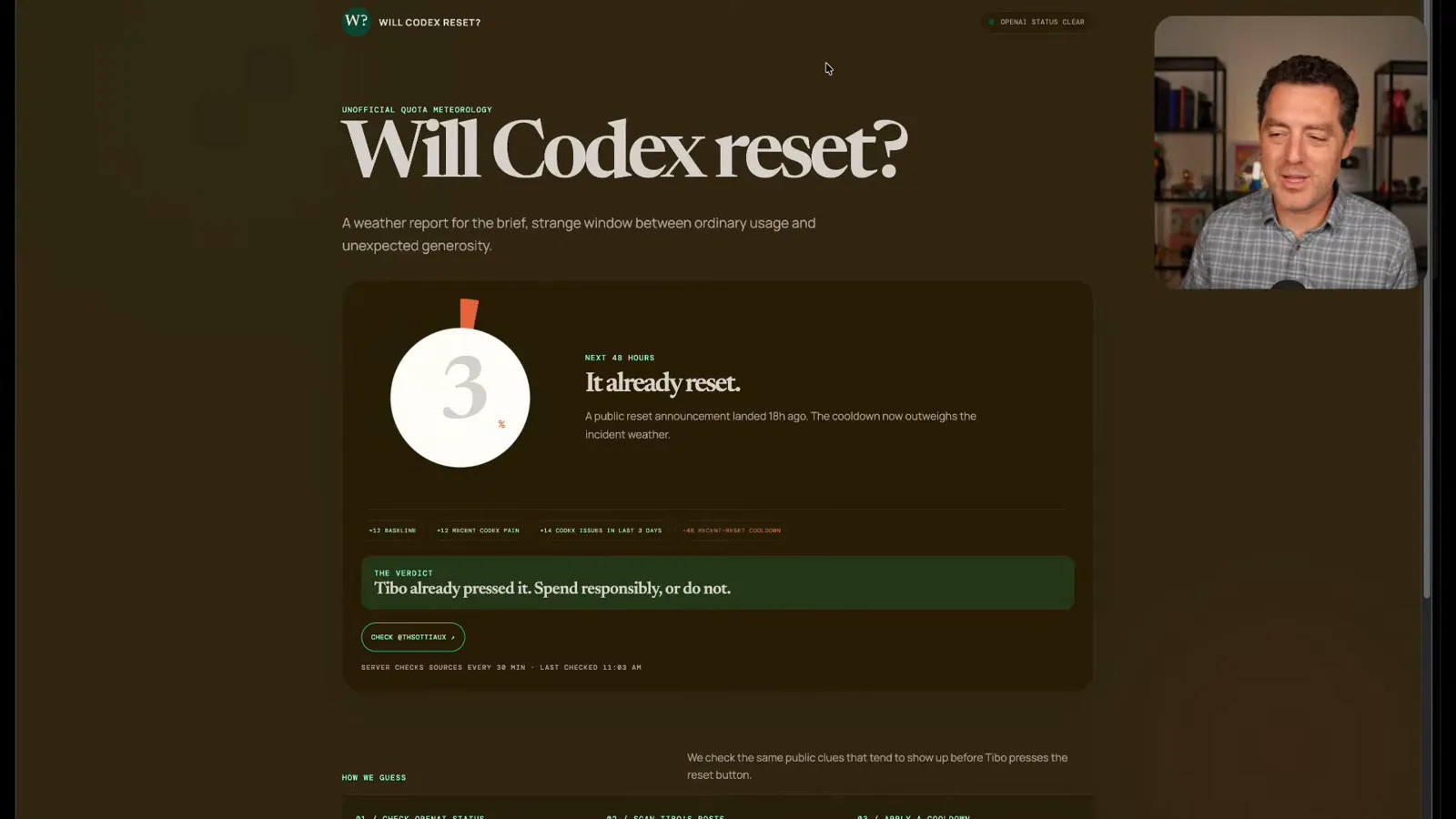
A viewer suggests notifications for resets or a high predicted probability, and I say I may add both. I explain my understanding of quota resets and contrast company usage changes as I have experienced them. The site and my descriptions are informal and should not be taken as guarantees of subscription limits.
I close by showing Forward Future and its newsletter, mentioning original pieces from Ahmad Osman, Scott Santens and Dave Shapiro. The work discussed throughout the stream reflects a June 2026 snapshot of fast-changing products and research.
Mehr aus diesem Kanal
 34:21EN
 Matthew Berman· 27. Okt. 2026Matthew Berman Examines Anthropic’s IPO Filing, AI Growth and GovernanceMatthew Berman, Sam Altman · Forward FutureThe presenter reviews the S-1’s financial metrics, compute strategy and voting structure while questioning the tension between rapid AI development and safety.
 0:26ENMatthew Berman· 25. Okt. 2026Sam Altman on Human Values and Problem-Solving in an AI WorldSam Altman · OpenAIIn a short interview excerpt, Altman considers the enjoyment of solving hard problems and the human role in interpreting results.
 0:36ENMatthew Berman· 25. Okt. 2026Kimi K3.1 and a Rubik’s Cube Solver DemonstrationMatthew Berman · Forward FutureMatthew Berman shows a scrambled virtual cube being solved and gives the Kimi K3.1 test a favorable assessment.
 0:21ENMatthew Berman· 24. Okt. 2026An AI-Generated Kimi Benchmark Chart Used Invented ScoresMatthew Berman · Forward FutureMatthew Berman asks for a graph of Kimi K3.1 Pro benchmarks, then discovers that the displayed figures are illustrative placeholders.
 25:50ENMatthew Berman· 24. Okt. 2026Kimi K3.1 Pro Tested: Strong 3D Demos, Uneven Results and Competitive PricingMatthew Berman · Forward FutureMatthew Berman tests the open-weight model on coding, 3D rendering and visual explanations, then compares benchmark results and prices.
 32:20ENMatthew Berman· 23. Okt. 2026Who Is Local AI For? The Costs, Trade-offs and a Hybrid FutureMatthew Berman · Forward FutureMatthew Berman weighs data control and independence against hardware cost, setup complexity and inference speed.