In 30 Sekunden
Matthew Berman records three back-to-back meetings using a Genspark SecondBrain Note and then tries to recall details without it. He forgets several items and shows an automatically generated slide deck. The video promotes a purchase link with a 10% discount; it does not present a controlled accuracy comparison or enough detail to independently score the device.
- 1Three meetingsBerman records three consecutive meetings and proposes comparing the device’s output with his memory.
- 2Recall questionsHe remembers some details and misses others, including the project name and Alex’s responsibilities.
- 3Generated deckBerman shows a slide deck and promotes the product with a discount link. The clip does not independently verify every generated item.
Das Wichtigste
- Berman uses a card-shaped Genspark device to capture meeting audio and produce a slide deck.
- He recalls the audience, a 45-minute duration and an 11:15 lunch, but cannot recall the project name or Alex’s responsibilities.
- The edited demonstration does not provide a complete transcript, scoring rubric or independent accuracy check for the generated deck.
- The video promotes a purchase link and discount; no explicit paid-sponsorship disclosure appears in the transcript or description.
Den bearbeiteten Text nach Kapiteln lesen
Recording the meetings
Berman introduces the card and shows excerpts from three discussions. The meetings contain a workshop, assignments and a lunch time.
I am about to attend three back-to-back meetings and will use Genspark’s card-shaped SecondBrain Note to capture them. Afterwards I will try to remember the details and compare my recall with what the device produces. Genspark describes the product as hardware for recording conversations and generating transcripts and summaries ([product help](https://www.genspark.ai/helpcenter/secondbrain-note)).
The edited meeting excerpts discuss a small-business AI automation workshop, its name, a change from one hour to 45 minutes, and a newsletter module. Another exchange specifies an 11:15 lunch and says two short videos will be edited and distributed. The automatic captions make the project name unclear, so I do not reconstruct it as a verified title.
Testing recall and showing the result
Berman answers memory questions and shows an AI-generated deck. He closes by promoting a product link.
Afterwards I cannot remember the project name, but recall that the workshop is for small businesses and say it lasts 45 minutes. I name some responsibilities for Brian, cannot recall Alex’s responsibilities, and remember lunch at 11:15. I say I lost the comparison, though the clip does not provide a full answer key or independent scoring.
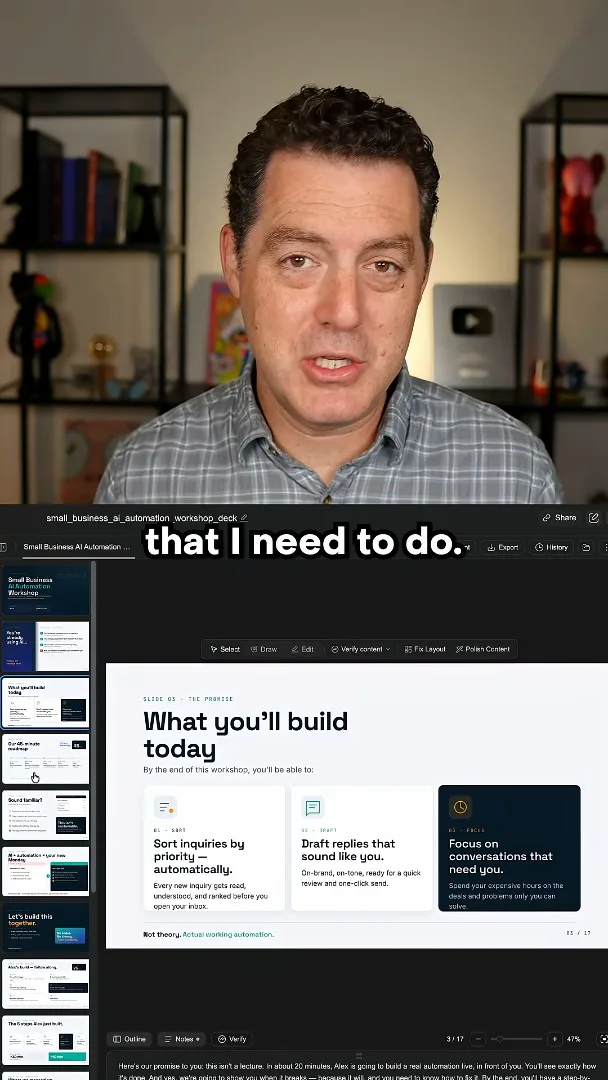
I show a slide deck generated from the meetings and say it helped with my forgetfulness. The short video does not show a complete comparison of the deck with the original recordings or establish its error rate. I promote a purchase link offering a 10% discount; the video does not explicitly state whether the promotion is paid.
Mehr aus diesem Kanal
 34:21EN
 Matthew Berman· 27. Okt. 2026Matthew Berman Examines Anthropic’s IPO Filing, AI Growth and GovernanceMatthew Berman, Sam Altman · Forward FutureThe presenter reviews the S-1’s financial metrics, compute strategy and voting structure while questioning the tension between rapid AI development and safety.
 0:26ENMatthew Berman· 25. Okt. 2026Sam Altman on Human Values and Problem-Solving in an AI WorldSam Altman · OpenAIIn a short interview excerpt, Altman considers the enjoyment of solving hard problems and the human role in interpreting results.
 0:36ENMatthew Berman· 25. Okt. 2026Kimi K3.1 and a Rubik’s Cube Solver DemonstrationMatthew Berman · Forward FutureMatthew Berman shows a scrambled virtual cube being solved and gives the Kimi K3.1 test a favorable assessment.
 0:21ENMatthew Berman· 24. Okt. 2026An AI-Generated Kimi Benchmark Chart Used Invented ScoresMatthew Berman · Forward FutureMatthew Berman asks for a graph of Kimi K3.1 Pro benchmarks, then discovers that the displayed figures are illustrative placeholders.
 25:50ENMatthew Berman· 24. Okt. 2026Kimi K3.1 Pro Tested: Strong 3D Demos, Uneven Results and Competitive PricingMatthew Berman · Forward FutureMatthew Berman tests the open-weight model on coding, 3D rendering and visual explanations, then compares benchmark results and prices.
 32:20ENMatthew Berman· 23. Okt. 2026Who Is Local AI For? The Costs, Trade-offs and a Hybrid FutureMatthew Berman · Forward FutureMatthew Berman weighs data control and independence against hardware cost, setup complexity and inference speed.