In 30 Sekunden
In January 2025, Matthew Berman reviews DeepSeek-R1 and R1-Zero, discusses the company’s reinforcement-learning approach and tries three prompts in DeepSeek’s chat interface. He welcomes the availability of weights and compares reported results with OpenAI models. Benchmark results are provider-reported, license conditions vary for distilled base models, and the small demonstrations do not establish general reliability.
- 1Benchmark comparisonBerman reviews DeepSeek’s reported math, coding and knowledge scores against OpenAI o1. These results depend on the particular test and setup.
- 2Distilled models and licensingDeepSeek released smaller Qwen- and Llama-derived models. Their underlying licenses matter alongside the R1 release terms.
- 3Historical API pricingThe 2025 launch listed different prices for cache hits, cache misses and output, with rates lower than the compared offerings in the video.
- 4Three informal testsThe model answers a letter-counting puzzle, a marble scenario and a sentence-ending request. The examples are illustrative rather than a controlled evaluation.
- 5R1-Zero and R1 trainingDeepSeek reports reinforcement learning without initial supervised fine-tuning for R1-Zero and a multistage approach with cold-start data for R1.
Das Wichtigste
- DeepSeek released R1 and R1-Zero weights and a technical report, with strong reported results on selected reasoning benchmarks.
- DeepSeek’s R1 repository and principal weights use the MIT license, while distilled Qwen and Llama variants also have their respective base-model terms.
- R1-Zero used reinforcement learning without an initial supervised fine-tuning stage; R1 added cold-start examples and further training to improve readability and performance.
- The shown January 2025 API prices distinguish cached input, uncached input and output; they should not be treated as current prices.
- A visible reasoning trace is generated text and may contain errors, even when the final answer is correct.
- Three illustrative prompts and selected benchmarks do not prove R1 is universally equivalent to or better than a rival model.
Den bearbeiteten Text nach Kapiteln lesen
Release, benchmarks and licensing
Berman compares DeepSeek’s reported benchmarks and introduces the open weights and distilled models. Licensing and benchmark claims require scope.
DeepSeek released R1, an open-weight reasoning model, in January 2025. I am excited because its reported results approach OpenAI o1 on several tests and its hosted API was priced lower in the comparison I show. Benchmark parity on selected tasks is not proof that the systems are equivalent in every capability.
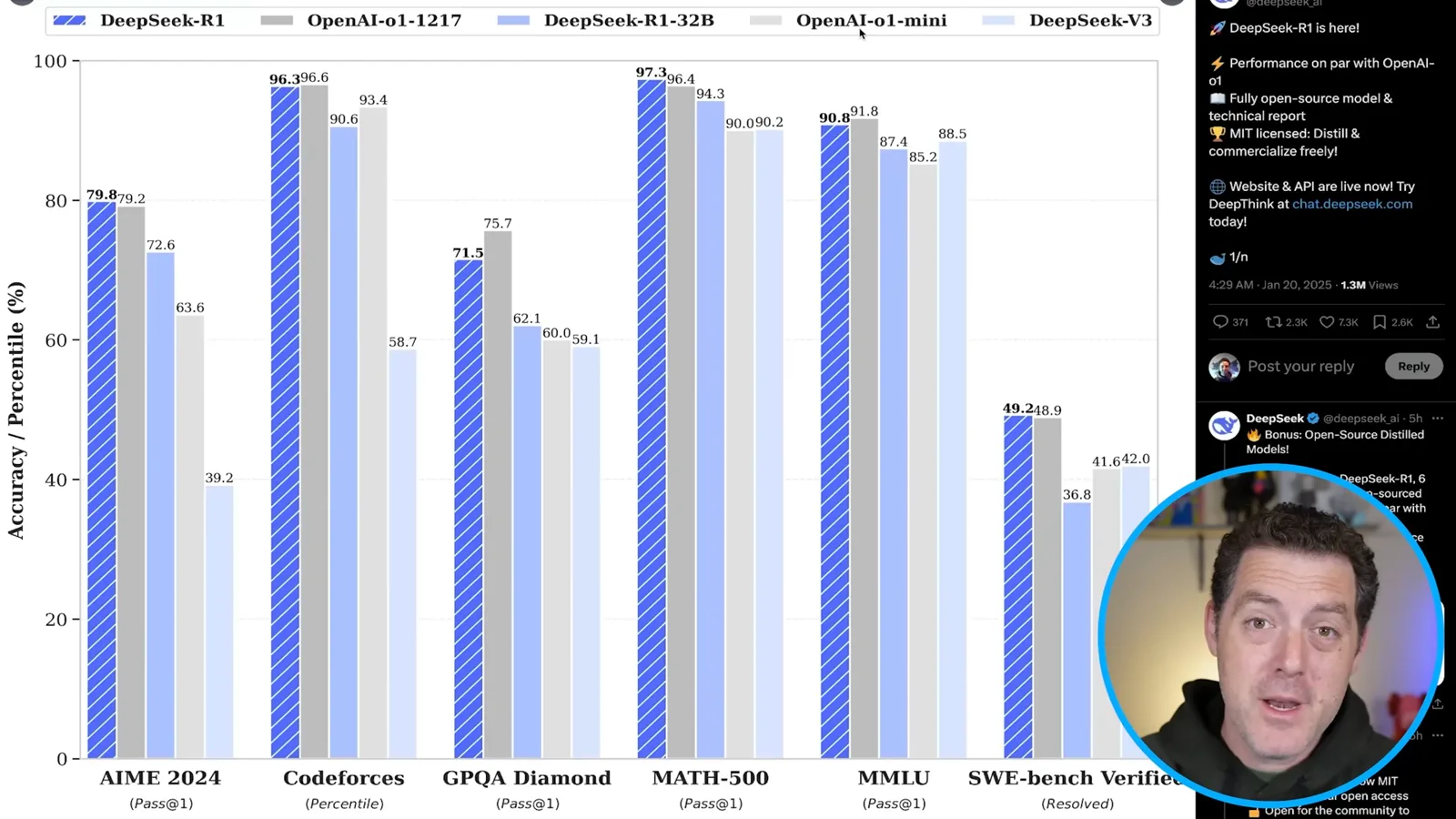
DeepSeek’s chart compares R1, o1, a distilled R1 model, o1-mini and DeepSeek-V3 on mathematics, coding and general-knowledge evaluations. The reported results vary by benchmark: R1 leads on some and trails on others. These are developer-reported measurements under specific prompts and settings, not an independent universal ranking ([technical report](https://arxiv.org/abs/2501.12948)).
I see the availability of weights and a technical report as valuable for competition and research. I predict that open-weight reasoning models will rapidly follow closed models. The release supplies model weights and describes the approach, but “fully open source” should not be taken to imply that all pretraining data and every detail needed to reproduce the entire training run were released.
DeepSeek also released six smaller models distilled from R1 using Qwen and Llama bases, with sizes from 1.5B to 70B. The reported scores are promising, but the small models differ from the full R1 and from one another. DeepSeek says its repository and R1 weights use the MIT license; its [repository](https://github.com/deepseek-ai/DeepSeek-R1) also identifies the underlying Qwen and Llama licenses for the distilled variants, so check the relevant terms before use.
Prices and informal tests
He reviews launch API prices and tests three prompts. The visible reasoning contains an error before a correct final answer.
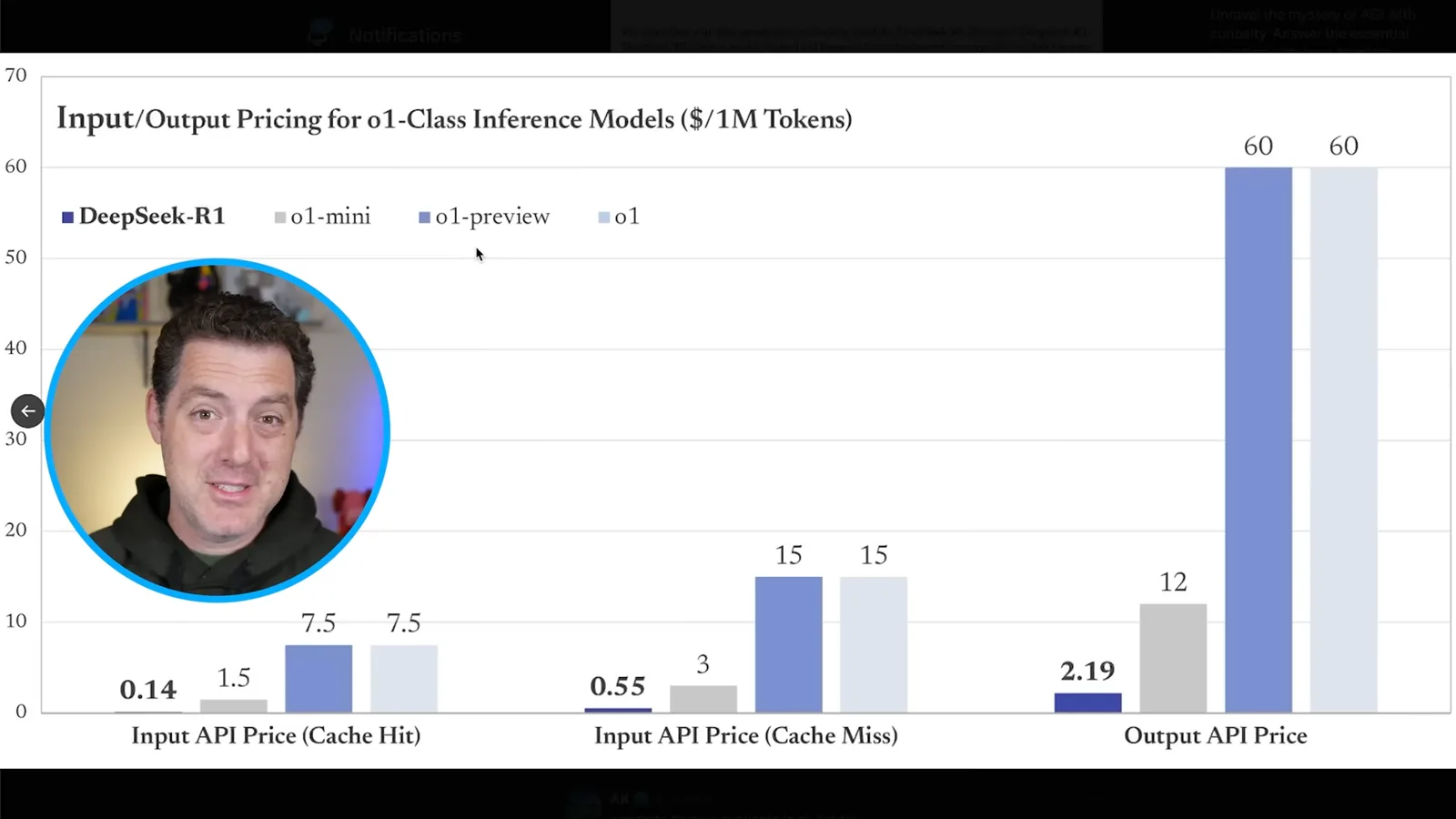
For the January 2025 launch, DeepSeek listed $0.14 per million input tokens on a cache hit, $0.55 on a cache miss and $2.19 per million output tokens. I compare them with the then-displayed o1 prices. These are historical provider rates, not current quotes; cache conditions, workload and the chosen model affect the comparison ([DeepSeek release](https://api-docs.deepseek.com/news/news250120/)).
My first prompt asks how many times the letter r appears in “strawberry.” The displayed reasoning goes back and forth and even briefly suggests an incorrect count, but the final answer is three. The readable trace is model-generated text; it is useful to inspect but should not be treated as a reliable account of an inner human-like thought process.
Next I ask about a marble in a glass that is inverted on a table and then moved to a microwave. The model considers whether the marble fits through the rim and concludes it remains on the table. I call this a good answer under the usual open-glass assumptions, although the exact outcome depends on the unstated handling and geometry.
At the time I note that the chat interface does not combine search and DeepThink in my test. I then request ten sentences ending in “apple,” and the displayed response satisfies the format. These few examples are informal observations, not a systematic comparison or proof that the model will be reliable on similar prompts.
Training approach
Berman summarizes R1-Zero, R1, distillation and group-relative policy optimization. He compares reinforcement learning with AlphaGo.
DeepSeek’s paper describes R1-Zero as a model trained with large-scale reinforcement learning without an initial supervised fine-tuning stage. It starts from a pretrained base model, not from zero knowledge, and the authors report problems including readability and language mixing. R1 adds cold-start data and a multistage training pipeline to address these weaknesses.
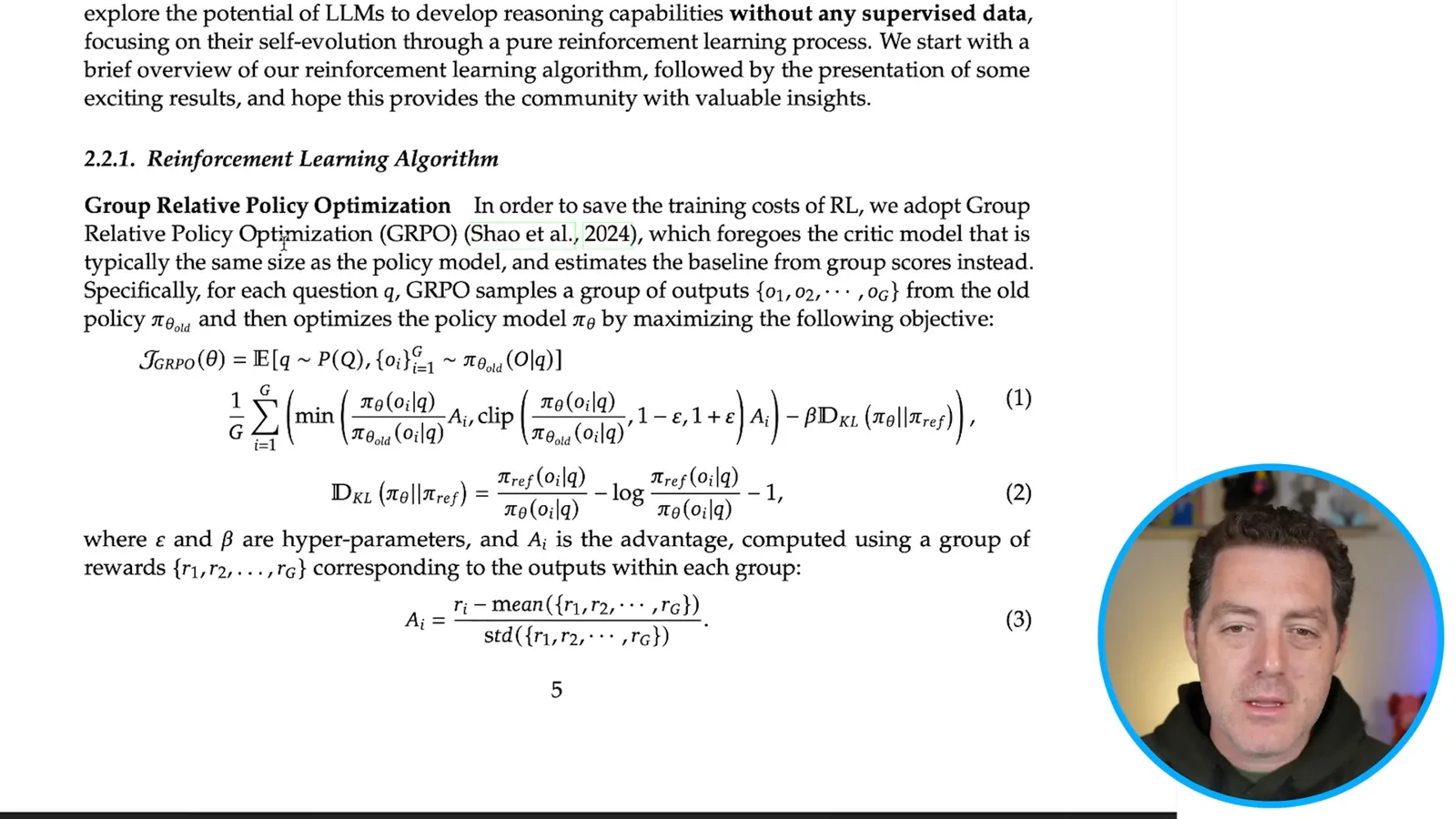
I discuss group relative policy optimization, which compares a group of sampled outputs to estimate relative advantages instead of relying on a separately trained value critic in the described setup. This does not mean the training uses no rewards, evaluation or other supervision. DeepSeek also uses R1-generated examples to train smaller Qwen- and Llama-based models.
The paper shows an R1-Zero prompt format separating reasoning and answer sections, and describes a case where the model revisits its initial approach with additional reasoning. The authors call this an “aha moment.” One example illustrates a behavior observed under their training setup; it does not prove every visible revision is correct.
I compare reinforcement learning with AlphaGo’s advances in Go. The distinction matters: AlphaGo Zero learned from self-play without human game examples, while the famous move 37 occurred in the earlier AlphaGo match against Lee Sedol, not AlphaGo Zero ([DeepMind](https://deepmind.google/blog/alphago-zero-starting-from-scratch/)). I plan to explore the paper further and test the released models myself.
Mehr aus diesem Kanal
 34:21EN
 Matthew Berman· 27. Okt. 2026Matthew Berman Examines Anthropic’s IPO Filing, AI Growth and GovernanceMatthew Berman, Sam Altman · Forward FutureThe presenter reviews the S-1’s financial metrics, compute strategy and voting structure while questioning the tension between rapid AI development and safety.
 0:26ENMatthew Berman· 25. Okt. 2026Sam Altman on Human Values and Problem-Solving in an AI WorldSam Altman · OpenAIIn a short interview excerpt, Altman considers the enjoyment of solving hard problems and the human role in interpreting results.
 0:36ENMatthew Berman· 25. Okt. 2026Kimi K3.1 and a Rubik’s Cube Solver DemonstrationMatthew Berman · Forward FutureMatthew Berman shows a scrambled virtual cube being solved and gives the Kimi K3.1 test a favorable assessment.
 0:21ENMatthew Berman· 24. Okt. 2026An AI-Generated Kimi Benchmark Chart Used Invented ScoresMatthew Berman · Forward FutureMatthew Berman asks for a graph of Kimi K3.1 Pro benchmarks, then discovers that the displayed figures are illustrative placeholders.
 25:50ENMatthew Berman· 24. Okt. 2026Kimi K3.1 Pro Tested: Strong 3D Demos, Uneven Results and Competitive PricingMatthew Berman · Forward FutureMatthew Berman tests the open-weight model on coding, 3D rendering and visual explanations, then compares benchmark results and prices.
 32:20ENMatthew Berman· 23. Okt. 2026Who Is Local AI For? The Costs, Trade-offs and a Hybrid FutureMatthew Berman · Forward FutureMatthew Berman weighs data control and independence against hardware cost, setup complexity and inference speed.