In 30 Sekunden
Tesla shareholders approved Elon Musk’s 2025 performance award by more than 75% of votes cast, according to preliminary results announced at the November meeting. Shareholder proposals exposed disagreement over board accountability, labor oversight and an investment in xAI. Musk then laid out forecasts for Optimus robots, autonomous cars and AI chips, while responding to shareholder questions. The technology schedules and performance claims were his projections at the time.
- 1A shareholder proposes an investment in xAIStephen Hawk argues that an investment could integrate AI capabilities; Tesla’s board makes no recommendation on the advisory proposal.
- 2New York’s comptroller challenges the derivative-suit thresholdThomas DiNapoli argues that requiring 3% ownership restricts shareholders’ ability to hold directors accountable.
- 3Preliminary votes show support for annual director electionsThe board’s recommendation prevailed on most shareholder proposals, but not the annual-election proposal; the separate company proposal to remove supermajority requirements failed.
- 4Musk’s CEO award wins more than 75% supportTesla’s general counsel announces approval of the 2025 performance award before Musk begins his presentation.
- 5Musk describes AI5 as a chip specialized for TeslaHe forecasts improvements over AI4 and discusses chip supply and the possibility of building a large semiconductor factory.
Das Wichtigste
- Tesla announced preliminary approval of Musk’s 2025 CEO award with more than 75% voting in favor.
- Shareholders supported annual director elections against the board’s recommendation, while a company proposal to remove certain supermajority requirements did not pass.
- An advisory proposal on investing in xAI drew more votes for than against, with many abstentions; the board said it would consider the result.
- Musk outlined ambitious production goals for Optimus and Cybercab, alongside plans for more AI chip capacity.
Den bearbeiteten Text nach Kapiteln lesen
The board reviews Tesla’s year
Chair Robyn Denholm describes the company’s vehicle and energy businesses and its safety and sustainability objectives.
Tesla general counsel and corporate secretary Brandon Ehrhart opens the 2025 annual shareholder meeting in Texas. He says the formal business will cover 14 ballot items before Elon Musk’s presentation and introduces board chair Robyn Denholm.
Denholm thanks shareholders and says their engagement supports Tesla’s work. She describes the company as being at an inflection point as it pursues a goal it calls sustainable abundance.
Denholm says the Model Y was the world’s best-selling vehicle in 2024 and that Tesla deployed 31 gigawatt-hours of energy storage that year, more than double the 2023 amount. She says the company is investing in its vehicle and energy businesses and sees services such as robotaxi and virtual power plants as future opportunities.
She says Tesla customers avoided nearly 32 million metric tons of greenhouse-gas emissions in 2024, according to the company’s estimate. She says Tesla also considers safety and the environmental effects of raw materials, manufacturing, use and end-of-life handling.
Denholm cites a company statistic of one crash per 6.8 million miles and compares it with average US driving. She says Tesla expects further improvements from autonomy technology. The figures are her comparison during the meeting.
Denholm points shareholders to Tesla’s impact report and describes its goals for responsible procurement, employee safety, employee equity incentives and making products more accessible. She thanks employees, management, fellow directors and shareholders.
Denholm says Tesla has the team, technology and infrastructure to pursue its ambitions, and hands the meeting back to Ehrhart. He formally opens the polls and confirms that a quorum is present.
Shareholder proposals on investment and oversight
Proponents present proposals covering xAI, executive pay, labor, legal rights and director elections; Tesla’s board opposes most.
Ehrhart says shareholders can vote online or at the meeting and identifies the independent election inspector. He says meeting materials were sent or made available to shareholders of record and a majority of outstanding shares is represented.
He outlines six company proposals, including director elections, an advisory compensation vote, auditor ratification, changes to certain supermajority requirements, the equity incentive plan and the 2025 CEO performance award. The board recommends support for the nominees and proposals except that it makes no recommendation on the supermajority item.
Ehrhart introduces eight shareholder proposals. He says the board opposes the proposals except the advisory proposal on a potential xAI investment, on which it makes no recommendation.
Shareholder Stephen Hawk proposes that the board authorize an investment in xAI. He argues the relationship could combine Grok models with Tesla’s work in autonomous driving, robotics and energy, and presents it as an opportunity for shareholders.
Hawk says board oversight can address conflicts and urges shareholders to support the advisory proposal. Ehrhart then introduces a Tulipshare proposal to link some executive compensation to sustainability targets; Tesla’s board recommends voting against it.
Tulipshare CEO Antoine Argouges asks the board to tie a portion of executive pay to measurable sustainability performance. He suggests targets such as lower carbon intensity per vehicle, improvements in worker safety or supply-chain transparency, alongside financial goals.
Stefan Padfield of the Free Enterprise Project presents a proposal requesting a child-labor audit of Tesla’s supply chain. He says a zero-tolerance policy should be backed by independent verification and reporting, and cites risks associated with cobalt sourcing.
Padfield argues that labor practices present governance, legal and operational risks as well as ethical questions. He asks shareholders to support a transparent report or third-party audit; the board has recommended against the proposal.
Ehrhart introduces a proposal by the New York State comptroller to repeal Tesla’s 3% ownership threshold for shareholder derivative lawsuits. The board recommends against it.
Comptroller Thomas DiNapoli says the threshold limits investors’ ability to hold directors and officers accountable. He argues that it would require ownership of about 3% of Tesla shares, a stake he values at roughly $30 billion at the time, and that courts already have ways to dismiss meritless cases.
DiNapoli criticizes the board’s independence and asks shareholders to restore the ability to bring derivative cases. He links the rule to a broader concern about oversight of management and the CEO’s other ventures.
Illinois treasurer Michael Frerichs presents a proposal requiring shareholder ratification if the board adopts more restrictive thresholds for submitting proposals under Texas law. The board recommends against it.
Frerichs contrasts the potential Texas thresholds with lower federal shareholder-proposal thresholds and argues that greater restrictions could silence investors. He says his proposal would leave the board free to evaluate options while requiring a supermajority vote to ratify such a change.
James McRitchie presents a proposal to elect all directors annually instead of staggering their terms. He says similar proposals had won majorities in 2021 and 2024 but failed to clear Tesla’s supermajority requirement.
McRitchie argues annual elections would improve accountability and help shareholders replace directors when necessary. He also supports a separate proposal on simple-majority voting. The Tesla board recommends against his proposal.
John Chevedden presents an advisory proposal for simple-majority voting. He asks shareholders to support both his proposal and a binding Tesla proposal on similar supermajority provisions, saying the advisory item could serve as a backup.
Chevedden argues that annual director elections and simpler voting rules would make directors more accountable. Ehrhart then introduces the last shareholder proposal, which also concerns shareholder approval before restrictions on proposal rights.
Bruce Herbert of Newground Social Investment presents the final proposal. He asks Tesla to hold a shareholder vote before adopting bylaws that would restrict the ability to submit shareholder proposals.
Herbert argues that higher ownership thresholds could exclude individual investors and that proposals can identify labor, climate and governance risks early. The board recommends against the measure.
Preliminary voting results
Tesla reports approval of Musk’s CEO award, support for annual director elections and mixed results on other governance proposals.
Ehrhart closes the polls and announces preliminary results. Shareholders followed the board’s recommendations on proposals 8 through 14 except for proposal 12, which concerned annual director elections.
On the advisory xAI investment proposal, Ehrhart says votes in favor exceeded votes against but there were substantial abstentions. He says the board will consider next steps in light of that support; the result is not an announcement that an investment has been made.
Ehrhart says the company proposal to eliminate certain supermajority voting requirements was not approved. Shareholders approved the advisory pay vote, ratified PricewaterhouseCoopers as auditor and reelected the three nominated directors.
He announces approval of the amended equity incentive plan. Tesla’s 2025 CEO performance award for Musk also receives more than 75% support among votes cast, according to the preliminary result. Ehrhart then closes the formal meeting and introduces Musk.
Musk’s vision for robots and autonomous vehicles
Musk presents long-term Optimus and Cybercab plans and discusses automated driving and AI chips.
Musk points to Optimus robots moving and dancing at the event, then thanks shareholders and the board for their support. He says Tesla is entering a new phase in which robotics will play a central role.
He says Optimus robots have been walking around Tesla’s engineering office and charging themselves. Musk predicts that humanoid robots could become a vast product category, with personal helpers and additional robots working in industry; he also emphasizes safety.
Musk imagines demand for a personal robot as well as several industrial robots for each personal one. He says safety deserves close attention as that potential scale grows.
Musk describes plans for a one-million-unit production line in Fremont and a ten-million-unit annual line in Texas. He speculates about much larger future volumes, describing a production ramp rather than completed capacity.
He predicts humanoid robots could increase access to medical care and reduce poverty, including by eventually performing precise procedures. These are proposed future uses, not medical capabilities demonstrated by the meeting.
As an example of the future he imagines, Musk predicts a robot could eventually be more precise than a human surgeon. He presents this as a prospect for expanding access to medical care.
Musk imagines a robot monitoring a person who has committed a crime as an alternative form of confinement. He recommends Iain M. Banks’s Culture novels as one fictional picture of a mostly optimistic AI future.
Musk speculates that AI and robotics could greatly expand economic output and eventually change the role of money. He suggests electricity could become a useful measure of resources, then encourages shareholders to hold their Tesla stock.
Musk returns to Tesla’s original mission of accelerating sustainable energy, citing electric vehicles, batteries and solar power. He says the company now describes its mission as sustainable abundance: meeting people’s needs while preserving nature.
He defines sustainable abundance as a future in which people can obtain goods, services and medical care while forests and natural places are preserved.
He says many Tesla owners have not tried Full Self-Driving, including some who paid for it. Musk compares an ordinary-looking Tesla to a fictional cat with hidden abilities and says sales and service staff will demonstrate the feature to customers.
Musk says Tesla staff will sit with customers and demonstrate supervised driving, including to owners who have paid for it but not activated it. He regards customer awareness as important to adoption.
Musk predicts that Tesla may eventually allow drivers to text while the system operates, subject to its review of safety data. Tesla’s Full Self-Driving (Supervised) requires the driver to pay attention to the road and remain ready to take over; it does not make the vehicle autonomous.
Musk asks European customers to support regulatory approval of supervised FSD and says Tesla has partial approval in China. He expresses hope for broader approval there in the following months.
Musk says he has discussed FSD approval with European regulators and asks customers to press for access. He also describes the situation in China as a partial approval, with broader access dependent on regulators.
Musk introduces Cybercab as a vehicle designed for unsupervised robotaxi operation without pedals or a steering wheel. He says Tesla plans to start production at the Texas factory in April 2026.
He compares Cybercab manufacturing to high-volume consumer electronics and says a cycle time below ten seconds may eventually be possible, with five seconds a theoretical longer-term target. He describes the resulting annual volumes as possibilities rather than current output.
Musk says the Cybercab’s manufacturing system is meant to differ from a conventional car line. His estimate of a shorter cycle time depends on developing a high-volume process over several years.
Musk describes cars as robots on wheels and says Tesla can reuse expertise in batteries, electronics, motors, vision, software and fleet management for Optimus. He identifies a dexterous hand, real-world AI and volume manufacturing as major challenges.
Musk describes the difficulty of a useful humanoid hand: fingers must move, sense and grasp objects with the necessary strength and dexterity. He says vehicle manufacturing experience alone does not make that problem easy.
Musk shows a prototype Optimus production line and says a high-volume line would be more automated. He estimates production cost could reach roughly $20,000 at sustained output of about a million units per year; that figure is a future estimate, not a retail price.
The estimated Optimus manufacturing cost depends on a production rate near one million units per year. Musk emphasizes that achieving the requisite production scale will itself be difficult.
He describes the robot on display as version 2.5 and says version 3 is intended to begin production in 2026, with later generations envisioned for 2027 and 2028. He predicts successive improvements and much higher production volumes.
Musk cites Tesla’s own driving safety statistics and predicts substantial benefits from FSD. He forecasts that a future software release could allow a driver to sleep; the supervised system instead requires active attention and readiness to intervene.
Musk praises progress in FSD 14.1 and predicts further improvements in later versions. His prediction that a future release could allow occupants to sleep does not describe an approved capability of the supervised system.
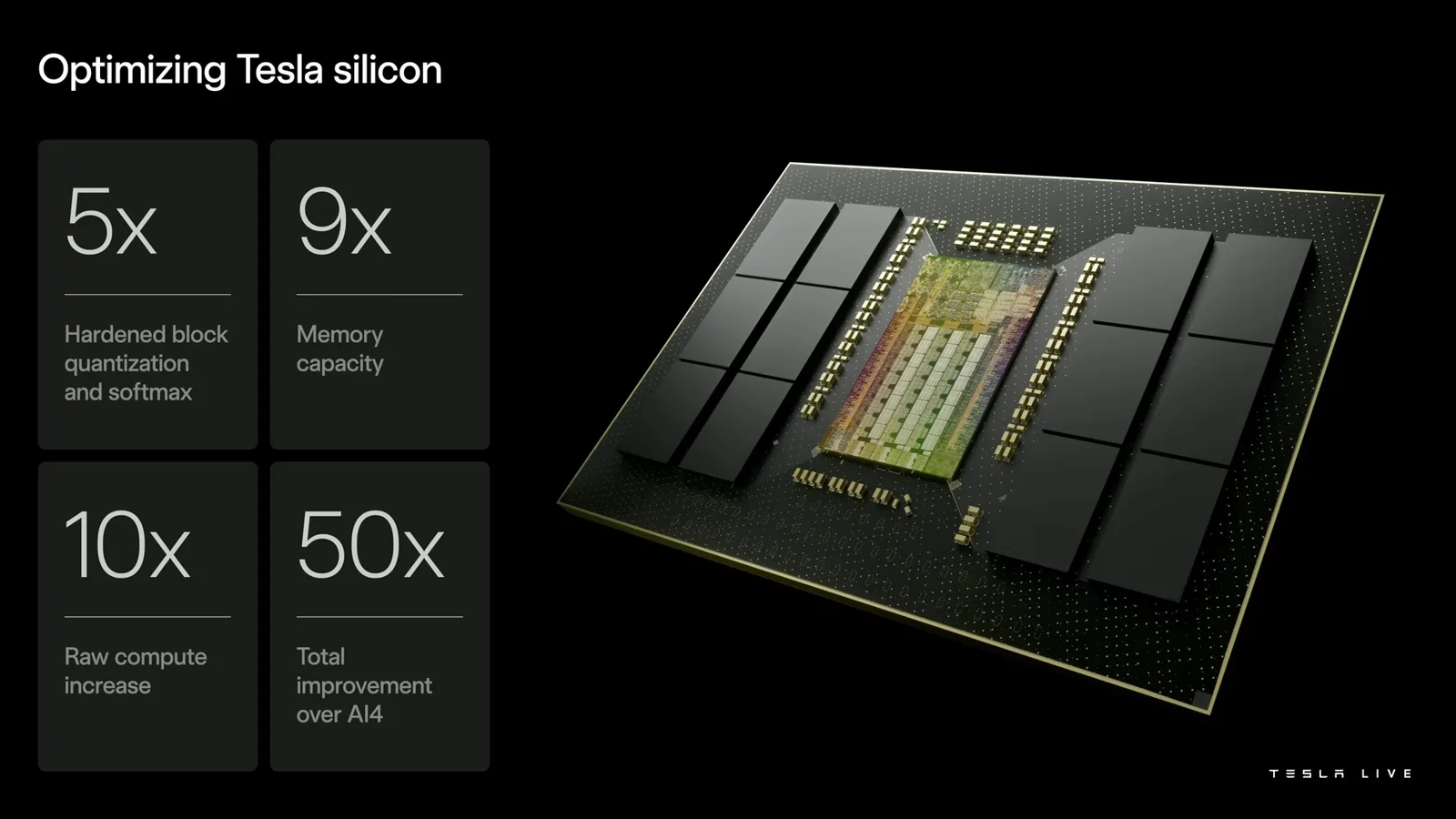
Musk says Tesla’s AI5 chip is designed for efficient inference in vehicles and robots. He predicts lower power use and cost than a general-purpose Nvidia chip, explaining that Tesla can optimize the design for its own software.
Musk says the chip is intended for Tesla’s own AI software rather than every possible workload. He contrasts that specialization with a general-purpose chip supplier serving many different customers.
He says Tesla trains its software for integer-based inference, which he considers more efficient, and names manufacturing locations involving TSMC and Samsung. He hopes AI6 will follow AI5 rapidly with greater performance.
He explains that most Tesla inference uses integer arithmetic, which he says can use silicon and power more efficiently than floating-point calculations, provided the models are trained accordingly.
Musk says even optimistic projections of supplier capacity may not deliver enough chips for Tesla’s plans. He raises the possibility of a very large Tesla chip fabrication plant, which he calls a Terafab; he also says no Intel deal has been signed.
Musk says Tesla respects suppliers TSMC and Samsung, and that discussions with Intel might be useful, while explicitly noting there is no Intel agreement. He describes a Terafab as a possible response to an anticipated supply constraint.
He returns to solar and batteries, arguing that the Sun’s energy makes solar a long-term power source. Musk predicts that solar-powered AI satellites will become important and that Tesla will have a role.
Musk reviews Tesla’s car lineup and Cybertruck, then says Tesla Semi prototypes are already operating. He expects volume Semi production at the northern Nevada factory in 2026, alongside planned Cybercab and Optimus ramps.
Musk says PepsiCo and other customers have operated Semi prototypes. He lists Semi, Cybercab and Optimus as three products targeted for production ramps in 2026.
He argues that batteries could let the grid use more of its existing generating capacity by shifting electricity from low-demand periods. He describes plans to simplify utility-scale Megapack deployment and integrate more power electronics.
He says future Megapack versions could integrate additional power electronics and eventually output at higher voltage, simplifying how utility-scale battery installations connect to the grid.
Musk highlights expansion of the Supercharger network and the adoption of Tesla’s charging network by other carmakers in North America. He also says the company continues to invest in factory safety.
He describes a Texas lithium refinery, a cathode factory and the 4680 battery cell as parts of Tesla’s supply-chain strategy. Musk says Tesla will also continue purchasing cells and chips from suppliers.
Musk says the company is developing its own 4680 cells for Cybertruck and future products while continuing to buy from suppliers. He frames in-house work as a way to add capacity when supplier output cannot meet demand.
After showing the Semi factory, Musk closes the presentation and invites shareholder questions. He suggests Optimus might answer some questions at a future meeting.
Shareholder questions on Tesla and its future
Musk responds to questions on vehicles, energy, SpaceX and AI, before closing the meeting.
A shareholder asks Tesla to hold the next meeting in a larger venue so more retail investors can attend. Musk agrees to consider an arena or stadium and thanks shareholders for their support.
Musk suggests an arena or soccer stadium as possible larger venues for a future annual meeting. The shareholder also asks that investors have access to more of Musk’s other companies at the event.
Another attendee asks whether Full Self-Driving purchases can transfer to a new Tesla rather than staying with the old vehicle. Musk says Tesla has allowed transfers before and agrees to extend the opportunity for at least another quarter.
Asked about a wheelchair-accessible vehicle, Musk says a larger Robovan-type vehicle would have the necessary space. He expects Tesla to make one, but says the Cybercab, Optimus and Semi ramps take priority.
Musk says the larger accessible vehicle might come later because several other products were already scheduled for production ramps. He states that Tesla intends to make a wheelchair-accessible vehicle.
A shareholder asks about dry-cathode battery manufacturing. Musk says it proved harder than expected to make reliably at high volume and, looking back, he might have chosen a wet process, although he expects dry cathodes to succeed and reduce cost.
Musk says he believes Tesla is approaching unsupervised autonomy and wants to expand production. He offers aspirational annualized exit rates of roughly 2.6–2.7 million vehicles by the end of 2026, four million by the end of 2027 and five million by the end of 2028.
Musk cautions that his vehicle production numbers are rough aspirations and that suppliers must expand in step with Tesla. He says output can be limited by any one of thousands of components.
A Roadster reservation holder asks about a future unveiling. Musk says early reservation holders should be invited and describes the vehicle as a showcase for technology rather than an essential part of Tesla’s abundance plan.
Musk tells the Roadster reservation holder that early reservations should be honored in order. He says the vehicle is not necessary for Tesla’s core mission but could demonstrate unusual technology.
Asked about chip manufacturing, Musk says Tesla has agreed to buy substantial supplier output but still anticipates a shortage. He sketches the possible scale of a Terafab and says memory and packaging would also need to be addressed.
Asked about the proposed chip factory’s size, Musk speculates about a facility starting at 100,000 wafer starts per month and possibly growing into a larger complex. He says memory and packaging capacity would also be needed.
An attendee asks about expansion beyond Earth. Musk imagines Tesla vehicles and Optimus robots helping build and operate future Moon and Mars settlements, with a pressurized vehicle needed to carry people.
A shareholder asks how autonomy might reduce travel costs and change vehicle demand. Musk says Tesla sees a possible path below 20 cents a mile and predicts greater productivity could put downward pressure on prices.
Musk reasons that if the supply of goods and services grows faster than the money supply, prices could fall. He presents that as his view of how productivity gains from automation could affect inflation.
On fleet size, Musk predicts autonomous vehicles could reduce the number of vehicles needed while increasing total miles traveled, because passengers could use travel time for work or entertainment.
Asked whether regulators will permit Cybercab deployment as production ramps, Musk predicts approvals and output will progress at roughly the same rate. He credits Waymo with helping establish a path for autonomous vehicles.
A shareholder asks whether human consciousness could be uploaded into an Optimus body. Musk speculates that an approximate mental snapshot might become possible using Neuralink within 20 years; he acknowledges it would not be identical to the person. This is a prediction, not a demonstrated procedure.
Musk says a hypothetical uploaded mental snapshot would be approximate and a robot body would differ from a human body. He treats the idea as a future possibility rather than a current Neuralink product.
Asked about space-based solar power and transmitting electricity to Earth, Musk says reusable Starship launches could lower the cost of putting equipment in orbit. He sees solar-powered AI satellites as a particularly promising application.
He argues that making orbital launches much cheaper could make new space-based energy and computing projects feasible. He speculates about moving some AI computing into solar-powered satellites.
Musk argues that space-based solar could eventually access far more of the Sun’s energy than Earth receives. He says some power could be sent back to Earth but discusses limits to how much could be transmitted.
A shareholder asks whether Tesla investors could gain access to SpaceX shares. Musk says he would like to find a way for supporters to participate but describes the costs and constraints of becoming a public company, and raises a possible future listing without announcing one.
Musk says he would like supporters to have access to SpaceX ownership but describes a shareholder-count threshold and the burdens associated with public-company status. He does not announce a transaction or listing.
Another attendee asks how Musk estimates uncertain milestones and whether Tesla anticipated future uses for its AI chips. Musk says he tries to estimate to the nearest order of magnitude rather than claim precision.
Musk says Tesla built its own chip team because low-cost, power-efficient car computers were a limiting factor. He describes hiring Jim Keller and moving through AI3 and AI4, says AI5 encountered mistakes, and expects a rapid transition to later designs.
Musk says earlier AI vehicle hardware used Nvidia technology, but Tesla needed a lower-cost, power-efficient car computer. He says the company formed its own chip team and hired Jim Keller to help build it.
He suggests that, with customer consent, idle vehicles might someday run distributed AI inference and earn their owners a payment. Musk uses a hypothetical fleet of 100 million vehicles to illustrate potential computing capacity; no such service or payment is announced as available.
Musk illustrates the concept with a hypothetical 100 million vehicles, each contributing a kilowatt of inference capacity while idle. He says participation would require customer consent and floats possible compensation without announcing a program.
During shorter exchanges, Musk agrees to consider a Cybertruck-inspired longhorn display at the factory and says a person may give away a Tesla purchased through normal channels.
Asked about the next Roadster, Musk tentatively proposes an April 1, 2026 unveiling and estimates production roughly a year or more afterward. He treats the dates as goals rather than confirmed delivery commitments.
Musk says the Roadster unveiling is tentatively targeted for April 1, 2026, and jokes about the date. He estimates production might follow roughly 12 to 18 months later, while stressing that the timetable is tentative.
A shareholder asks whether an abundant economy would require powerful people to surrender power. Musk speculates that an AI exceeding the combined intelligence of humanity might ultimately be in charge, and says it should be friendly.
Asked about expensive insurance and whether driving-assistance use should affect premiums, Musk says Tesla Insurance faces different regulations in each US state. He says Tesla wants to expand coverage and suggests the company could self-insure vehicles operating as robotaxis.
The insurance questioner says Tesla coverage is not available everywhere and asks why insurers do not account for FSD use. Musk responds that insurance regulation differs by state and says Tesla is working on broader coverage.
A shareholder asks how much computing is needed to train Optimus and whether xAI could help. Musk says significant training compute will be needed to produce efficient software for a power-limited robot, and sees potential for collaboration with xAI and SpaceX.
Musk says substantial training computation can help produce a smaller, efficient AI model that runs within a robot’s power constraints. He estimates that training infrastructure could ultimately cost tens of billions of dollars.
Asked whether xAI could help, Musk sees potential cooperation but notes that transactions between companies in which he has an interest require additional procedures. He does not announce a completed deal.
The final attendee asks for Hebrew and other languages in the Tesla app. Musk says the app should support all languages and closes the meeting.
Mehr aus diesem Kanal
 24:44EN
 Tesla· 6. Nov. 2026Elon Musk Unveils the Cybertruck: Steel Body, Cracked Glass and a New Pickup DesignElon Musk · TeslaAt Tesla’s 2019 event, Musk introduced the electric pickup and demonstrated its body, glass, suspension and cargo bed.
 59:56ENTesla· 21. Okt. 2026Tesla Q3 2026: Cash Flow, FSD Demand and the Cost of Scaling RobotsElon Musk, Vaibhav Taneja, Travis Axelrod · TeslaExecutives discuss quarterly margins, capital spending and plans for Cybercab, Optimus and chip production.
 23:21ENTesla· 16. Okt. 2026Tesla’s Roadster Event: A Ramp Stunt, Aerodynamics and a 2028 Production TargetElon Musk, Franz von Holzhausen, Lars Moravy · TeslaElon Musk, Franz von Holzhausen and Lars Moravy demonstrate a prototype developed with SpaceX engineering.
 1:09:55ENTesla· 22. Juli 2026Tesla’s Q2: Margins Narrow as Spending on Robots and AI RisesTravis Axelrod, Elon Musk, Vaibhav Taneja, Ashok Elluswamy, Lars Moravy · TeslaTesla reported higher energy deployment and negative free cash flow while executives outlined Robotaxi and Optimus plans.
 27:27ENTesla· 21. Mai 2026Tesla’s Final Model S and X Deliveries: How the Cars EvolvedElon Musk, Franz von Holzhausen, Lars Moravy · TeslaElon Musk and Tesla’s team recall a tent-based design studio, years of changes, and plans for the former production line.
 1:05:20ENTesla· 22. Apr. 2026Tesla Plans a $25 Billion Investment Year as It Prepares OptimusTravis Axelrod, Elon Musk, Vaibhav Taneja, Lars Moravy · TeslaOn Tesla’s Q1 2026 call, executives detail one-time margin gains, battery constraints and plans for robots and driving software.