In 30 Sekunden
Stripe CEO Patrick Collison says the company combines isolated development environments, gradual releases and firm security controls to preserve reliability while engineers use AI. One engineer merged more than 600 AI-written changes in six months, with one reverted; Collison also says incidents per unit time rose slightly, though overall reliability remained essentially unchanged. A separate project reached launch in two months with two to three engineers. He sees AI helping teams undertake more work, but does not assume every project speeds up equally.
- 1Gradual releases help Stripe combine speed with reliabilityCollison says Stripe invests in end-to-end development and quality assurance, beginning with development environments and rolling changes from a few machines to a wider share. He says the company wants frequent customer feedback without sacrificing reliability.
- 2One engineer merged 600 AI-written changes with one revertCollison gives the example for the first half of the year. He also says quality per pull request improved over 18 months while incidents per unit time rose slightly; secondary safeguards kept overall reliability essentially unchanged.
- 3Hard security boundaries matter more than trusting a model aloneCollison says no model is perfect, so Stripe relies on fixed constraints and access guarantees. Work on data tagging and fine-grained permissions began in 2017 and helped prepare the company for agentic development.
- 4Two to three engineers built Stripe Projects in about two monthsThe project integrates with around 50 services to help agents create accounts. An engineer estimated that, before AI, it would have taken a larger team six months; Collison emphasizes that acceleration varies between projects.
- 5A detailed plan can coordinate ten parallel agentsCollison describes an engineer who works with a strong model on a plan and sends parts to ten development environments, sometimes for a day or longer. He says learning how to work this way is a changing target.
- 6New businesses launching on Stripe roughly doubledCollison says launches per unit time rose by about a factor of two and that average revenue per new business also increased. He treats Stripe’s data as a proxy for broader activity and says the acceleration appeared across many countries.
Das Wichtigste
- Combine fast releases with isolation, tests and gradual deployment rather than relying on model behavior alone.
- Collison says a rise in quality per code change can coexist with a slight rise in incidents per unit time when teams ship more.
- Invest in data tagging and fine-grained permissions so people and agents cannot access information they should not.
- For a complex task, Collison describes an engineer making a detailed plan before assigning different parts to multiple agents.
- Treat Stripe’s reported rise in new businesses as a measure of activity on its platform; Collison sees it as a proxy for wider entrepreneurship.
Den bearbeiteten Text nach Kapiteln lesen
Reliability and rapid development at the same time
Collison describes Stripe’s investment in isolated development and gradual deployment. He says the company seeks frequent customer feedback while preserving high reliability.
Patrick Collison says he installed a weather station at home and used Claude to design a multimodal model from scratch. In his account, it predicts afternoon weather better than the National Weather Service.
Boris Cherny asks why Stripe committed to remote development environments. Collison says reliability and security matter because Stripe aims for what he calls five and a half nines of reliability for its core APIs, while also wanting to launch features rapidly and deploy continuously.
In financial services, Collison says, some organizations deploy monthly, quarterly or even less often. That can provide local stability, but it slows customer feedback and makes migrations more fraught as months of changes accumulate. Stripe wants feedback multiple times a day, he says, and was unwilling to trade that away.
To combine reliability with continuous development, Stripe invested in the entire development and quality-assurance process. Development boxes are one component: they provide instrumentation and visibility. Changes then roll out gradually, first to a handful of machines, then perhaps 1%, before expanding further.
AI-generated changes and the safeguards around them
Collison reports an engineer’s 600-plus AI-written pull requests and one revert, alongside a slight rise in incidents per unit time. Stripe relies on hard security boundaries and years of data-permission work.
Collison says AI-assisted development raises a question: can teams move much faster without losing quality when people may scrutinize fewer lines? He spoke with a Stripe engineer who merged more than 600 pull requests in the first half of the year. All were written with AI, he says, and one had to be reverted.
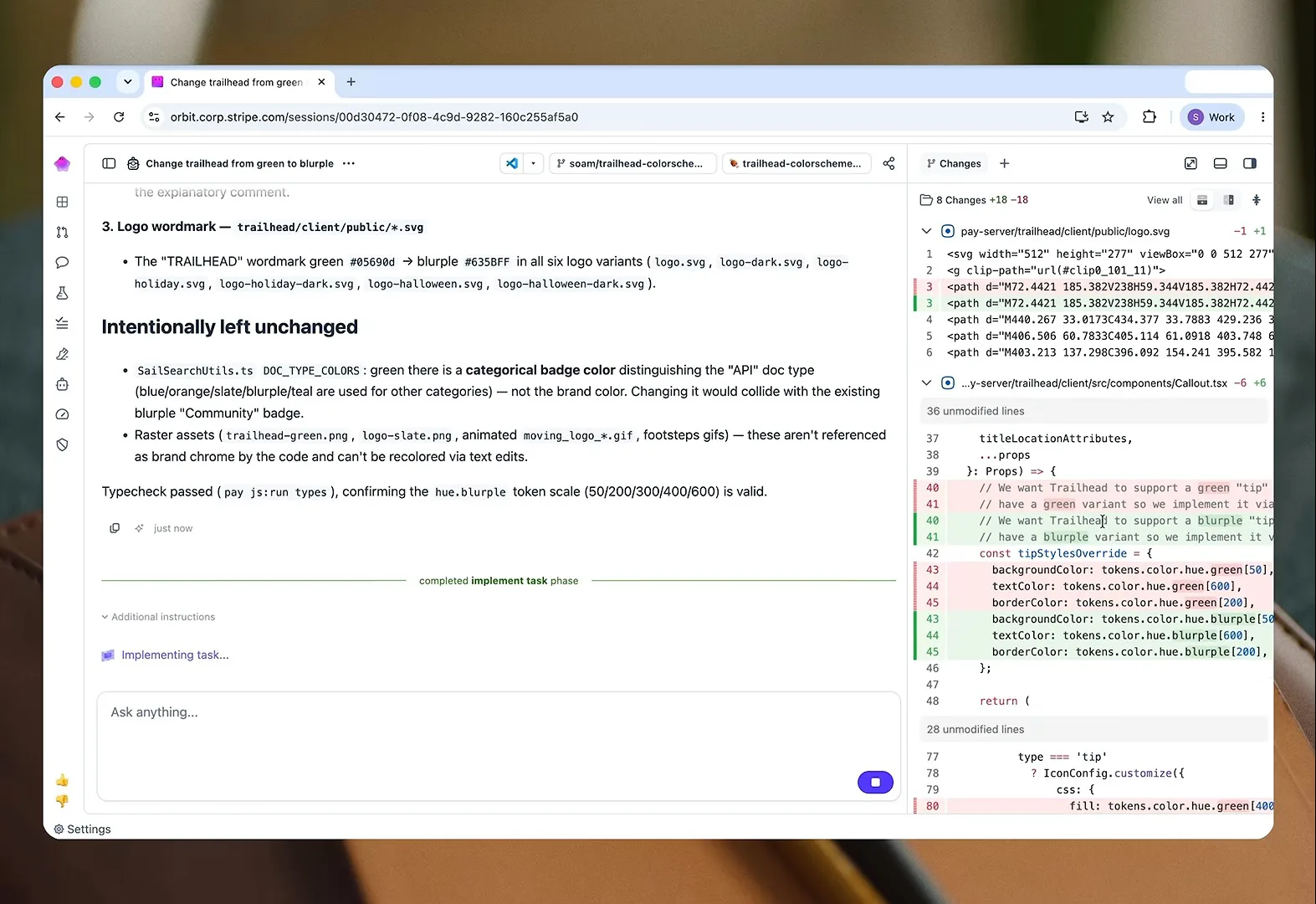
Stripe’s Minions system can receive a task through Slack, a web interface or another tool, create a fresh virtual machine and carry out the work. Collison says it packages and submits the change, builds it and runs the test suite as part of the process.
Collison says quality per pull request improved over the previous 18 months, although incidents per unit time rose slightly. Most were minor, and secondary mechanisms caught problems before they became serious, leaving overall reliability essentially unchanged. He expects AI to help build better monitoring and automated checks, making Stripe more reliable over the next year or two.
Asked which guardrails allow faster shipping without a quality trade-off, Collison emphasizes fixed constraints and hard barriers over subjective or probabilistic safeguards. It helps when a model is aligned and more likely to write secure code, he says, but no model is perfect, so systems should rely on guarantees.
Cherny points to guardrails built into infrastructure and data segregation that prevents unauthorized access. Collison agrees: Stripe began investing in data tagging and context-aware controls in 2017, followed by years of annotation and fine-grained permissions. The security work also left it better positioned for agentic development, he says.
Collison thinks there is an open question about whether AI ultimately favors attackers or defenders. His guess is that, in equilibrium a couple of years ahead, it will substantially favor defense.
A small team builds Stripe Projects
Two to three engineers brought Stripe Projects from idea to public launch in about two months, Collison says. He contrasts this with a larger-team, six-month estimate for the pre-AI approach.
Every Stripe development box has Claude Code pre-installed, Collison says, and it is the usual starting point for a task. One example is Stripe Projects, inspired by the need for projects built with Claude Code to connect to services such as logging, hosting and databases.
Because many such service providers were already Stripe customers, Stripe worked with them to make it easy for an agent to create an account. Collison says two to three engineers took the project from initial idea to public launch in about two months, including internal services and integrations with roughly 50 external services.
An engineer involved estimated that the pre-AI version would have required a larger team and six months. Collison offers a hypothetical doubling of the team size to illustrate a roughly sixfold relative change, while acknowledging uncertainty and warning that acceleration is not necessarily uniform: some projects move much faster than others.
More experiments, better code and parallel agents
Collison says Stripe is building more products and investing in its codebase. He describes an engineer coordinating multiple agents from a detailed plan.
Cherny asks what engineers do with the time gained. Collison says Stripe is creating more products and running more experiments. At its annual Sessions conference, he says, the number of new products and features was well ahead of prior years; the engineering organization was somewhat larger, but he sees a productivity effect as well.
Stripe is also taking on more work to improve its architecture and codebase, Collison says. He cites the idea that every codebase is now a prompt for another codebase, and expects Stripe’s code quality to be higher in three years. Cherny adds that AI can also be used to build infrastructure and guardrails, not only product code.
Asked about barriers to adoption, Collison says engineers adopted the tools enthusiastically. Claude Code itself and subsequent model improvements were inflection points. A remaining challenge is developing an intuition for what is possible and how work can be organized as the technology changes.
He describes one engineer who works with the strongest available model to make a detailed plan, then dispatches roughly ten development boxes with agents executing different pieces. Some may work for a day or, in an extreme case, multiple days. Collison says it is not obvious at first how much work an appropriately guided model can perform and verify.
Collison says he had undervalued planning and has changed how he uses the model. Cherny says projects that once remained unfinished can now be completed before he decides whether he wants the result. Collison agrees that curiosity pays off more when ideas can more readily become real.
New business formation and the agent economy
Collison says new businesses launching on Stripe roughly doubled per unit time and average revenue rose. He expects agents to play a growing role in transactions and describes Stripe’s preparations.
Cherny asks whether Stripe sees evidence that small teams are becoming more competitive. He says that, among very small startups he asks, roughly 70% now say they write all their code with AI. He also sees more startups moving faster and tackling more ambitious problems.
Collison says Stripe has about 15 years of data on business creation and considers it a proxy for activity in the wider ecosystem. New businesses launching on Stripe per unit time have roughly doubled, he says, a larger relative acceleration than any the company had previously observed.
He says about a quarter of Delaware corporations now incorporate with Stripe, and believes its share of true startups is higher. The acceleration appears in most countries, he says. In the UK, he contrasts official figures showing a year-over-year decline with Stripe’s own analysis, which he says points to a surge in new entrepreneurship.
According to Collison, average revenue per new business is rising, and the number reaching thresholds such as $100,000 or $1 million in revenue has also increased substantially. He sees a better environment for entrepreneurship and says the data Stripe observes points toward more firm creation rather than the economic centralization some fear from AI.
Asked how that changes Stripe’s products, Collison says the company is considering how AI agents will sign up for Stripe, use its tools and transact with one another. This includes whether existing interfaces are sufficient and how to make operations accessible to agents.
Collison says Stripe’s working view is that most transactions will be between agents within roughly three years. He distinguishes transaction count from dollar volume: he does not necessarily expect most money to move directly between agents, but expects many relatively small agent-to-agent payments.
Mehr aus diesem Kanal
 16:17EN
 Claude· 6. Nov. 2026How Salesforce doubled effective coding output with Claude CodeBoris Cherny, Muralidhar Krishnaprasad, Richard Pack · AnthropicSalesforce describes how it measures AI-assisted work, trains engineers to use agents, and checks the resulting code for defects.
 10:38ENClaude· 23. Okt. 2026Factory’s Matan Grinberg on building software agents people can trustKai Gill, Matan Grinberg · AnthropicFactory’s CEO says an agent learned from one bank’s COBOL migration, reducing human involvement in the next by 90%.
 12:19ENClaude· 8. Okt. 2026Shopify’s Mikhail Parakhin: Spend on AI to do what was once impossibleBoris Cherny, Mikhail Parakhin · AnthropicShopify’s CTO describes a merchant prediction system and argues for using the largest models in development, then cheaper ones in production.
 33:46ENClaude· 6. Okt. 2026How Every builds a shared AI coworker that learns a team’s styleKatelyn Lesse, Dan Shipper, Willie Williams · AnthropicEvery’s Slack agent shares workflows, learns from an editor’s past changes and uses isolated sessions to respect access boundaries.
 34:42ENClaude· 8. Sept. 2026Three founders on verifying, scaling and paying for AI agentsLance Martin, Sahaj Garg, Mihir Garimella, Todd Olson · AnthropicWispr, Actively and Pendo explain how they build agent products, test their work and decide what infrastructure to manage themselves.
 22:23ENClaude· 2. Sept. 2026How the Claude Code team moved from supervising steps to setting goalsThariq Shihipar, Sid Bidasaria, Robert Boyce · AnthropicAnthropic engineers describe delegating work in Slack, reviewing findings with multiple agents and removing scaffolding as models improve.