In 30 Sekunden
In this October 2025 tour, Matthew Berman visits Cerebras’s Oklahoma City facility with CEO Andrew Feldman and speaks with Scale Data Centers COO Billy Wooten. They explain the wafer-scale processor, the cooling loop, electrical resilience, a second data hall and the engineering history behind the system. The speakers describe 44 exaflops of AI compute and future capacity, but the video does not provide a common benchmark or precision for comparing the site against other supercomputers. Feldman’s performance and medical forecasts are his claims and expectations.
- 1Why Oklahoma CityFeldman cites labor, construction and electricity costs, room to expand, and building design suited to local weather.
- 2Wafer-scale computeThe company’s unusually large processor places substantial memory on-chip; its performance comparisons depend on what is measured.
- 3Keeping the machines coolWooten describes a 6,000-ton chilled-water plant, heat exchange and condensation controls.
- 4Backup powerFeldman describes batteries and three 3-megawatt backup generators that can support the data hall during an outage.
- 5Expansion underwayA second data hall was under construction; Feldman estimated about 20 additional exaflops when deployed.
Das Wichtigste
- Cerebras says its Oklahoma City site provided more than 44 exaflops of AI compute at its 2025 opening, a capacity figure rather than proof of a universal speed ranking.
- The wafer-scale engine places substantial memory near compute, but Cerebras systems can also use external memory.
- The facility’s cooling system uses a 6,000-ton chiller plant, heat exchangers and water temperature controls to manage heat and condensation.
- Batteries bridge power interruptions while backup generators start, according to Feldman.
- A second data hall and its additional 20 exaflops were described as plans and estimates at the time of filming.
- Feldman’s expectations for AI in medicine and education are predictions, not demonstrated clinical outcomes.
Den bearbeiteten Text nach Kapiteln lesen
A new AI data center
Berman introduces the Oklahoma City site and interviews CEO Andrew Feldman. The company’s compute figure and speed claims are presented in their 2025 context.
Matthew Berman visits Cerebras’s new Oklahoma City data center to explore the infrastructure behind AI responses. In this October 2025 tour he speaks with Cerebras CEO Andrew Feldman and Scale Data Centers COO Billy Wooten. Berman calls the facility the fastest AI infrastructure on Earth, but the video does not provide a standardized comparison sufficient to establish a universal ranking.
Berman says the newly opened facility provides 44 exaflops of AI compute. Cerebras also [announced more than 44 exaflops](https://www.cerebras.ai/blog/okc) at the 2025 opening. This is the company’s stated capacity; the video does not define a common arithmetic precision, workload and measurement method for comparing it with other systems or actual user-facing inference speed.
Feldman says Oklahoma City offered reasonable labor and electricity costs, space for construction and room to expand. Asked about natural hazards, he explains that building ratings affect insurance and must reflect local risks. He says the concrete facility is prepared for tornadoes, just as the company’s California sites are built with earthquakes in mind.
The wafer-scale processor
Feldman describes the chip’s size and the role of on-chip memory. His comparisons with GPU systems are company claims without a matched benchmark in the video.
Feldman introduces Cerebras’s wafer-scale engine, a processor covering most of a silicon wafer. He describes its area as approximately 46,250 square millimeters and contrasts it with a conventional large chip of roughly 750 square millimeters. Each system contains one wafer-scale processor, mounted upright behind its power supplies with cooling on the other side.
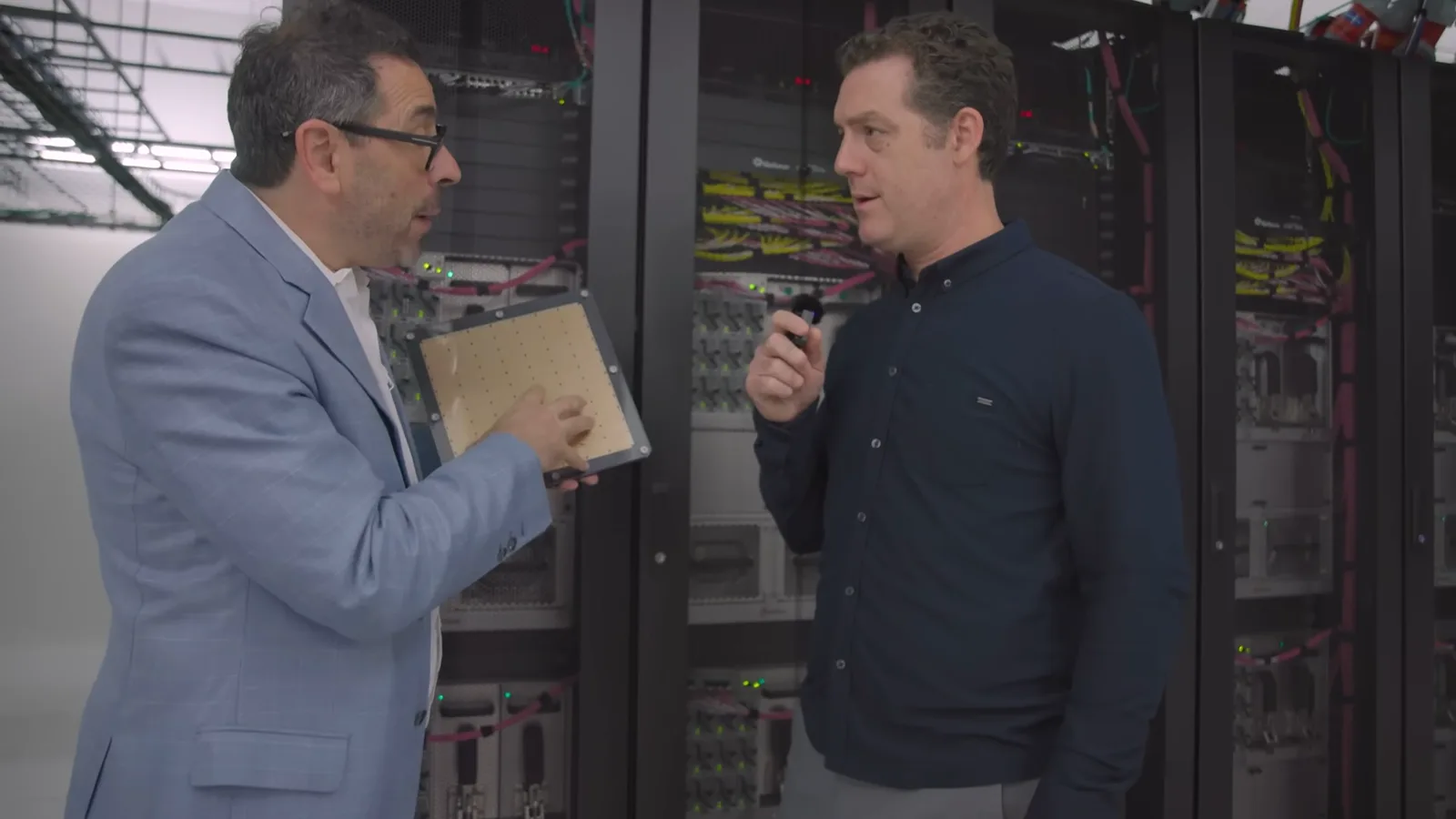
Feldman says placing memory on the chip reduces data movement compared with accessing off-chip memory and cites roughly a 2,500-fold advantage in getting to data. That is a company comparison, not a measured 2,500-fold improvement in every inference task; the relevant memory-bandwidth baseline and workload matter. The system’s on-chip memory is substantial, but [Cerebras also describes external memory options](https://www.cerebras.ai/press-release/cerebras-announces-third-generation-wafer-scale-engine), so it is not accurate to infer that every byte in every deployment must reside on the wafer.
Liquid cooling and power
Feldman and Billy Wooten show the cooling infrastructure. The tour then covers grid power, batteries and backup generators.
The tour turns to cooling. Berman says a wafer draws about 18 kilowatts, while Feldman describes the machines as water cooled. He points out cold supply and warm return lines and the raised floor underneath, where water infrastructure and monitored valves help operators track pressure and other conditions. A cooling method alone does not establish an independent facility-wide energy-efficiency comparison.
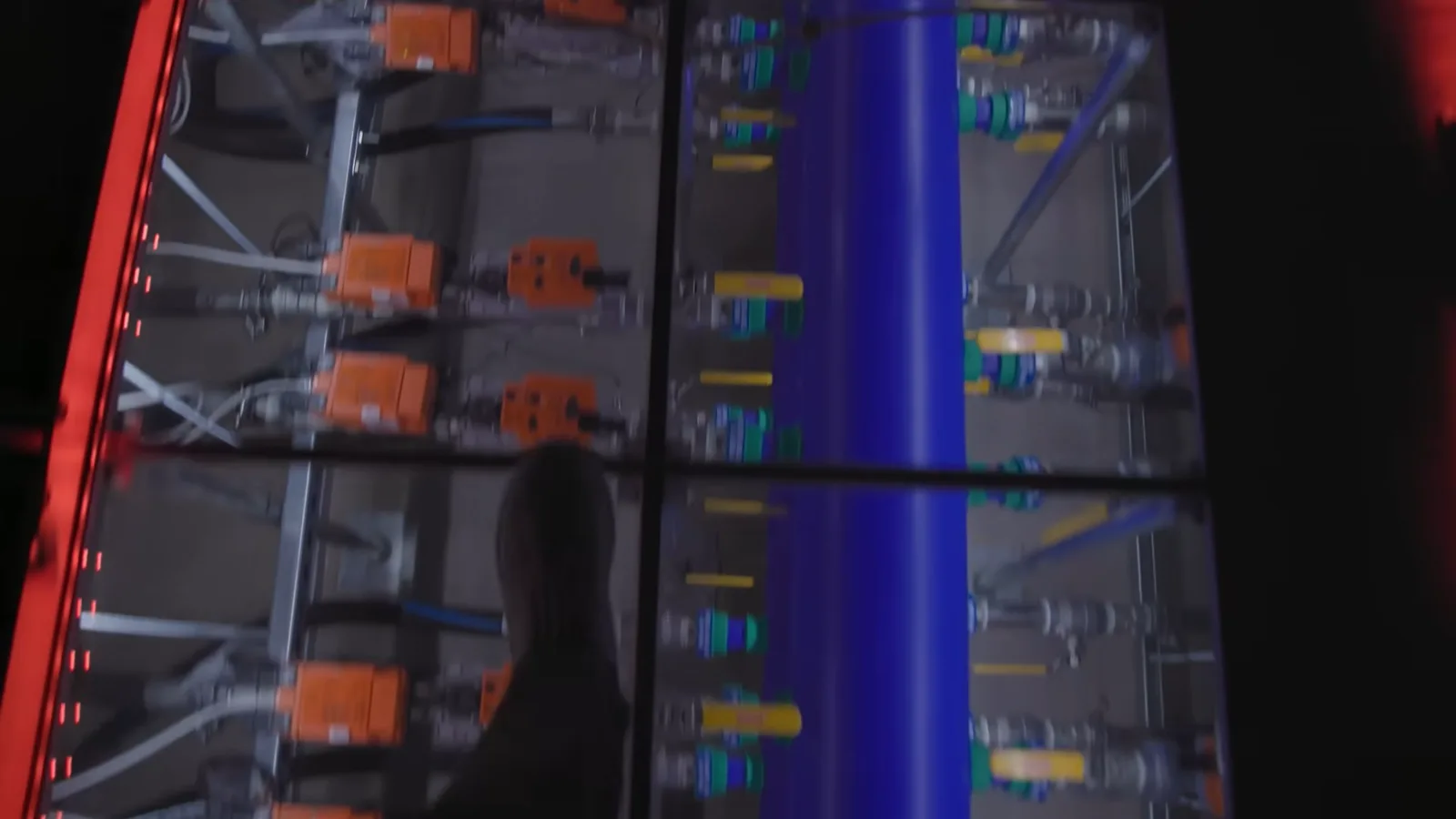
Billy Wooten, COO of Scale Data Centers, says the site uses a 6,000-ton chilled-water plant and has room for another 6,000 tons of cooling capacity as it grows. He describes chilled water at roughly 42 degrees Fahrenheit and a heat exchanger supplying water to the chips at around 70 degrees Fahrenheit; outside cooling towers help reject heat in a recirculating system.
Asked why the chip-side water is warmer, Wooten explains that excessively cold surfaces can lead to moisture and condensation in servers. He discusses keeping the temperature difference around 15 degrees, while the tour shows monitoring of inlet and outlet temperatures. The figures are the operators’ description of this particular cooling setup.
For power resilience, Feldman shows a 3-megawatt backup generator and says the primary electricity is generated from natural gas. The generator is not the normal supply: it starts if primary power fails. He describes the generator as able to use diesel or liquid natural gas and says the facility has three such units serving the room shown.
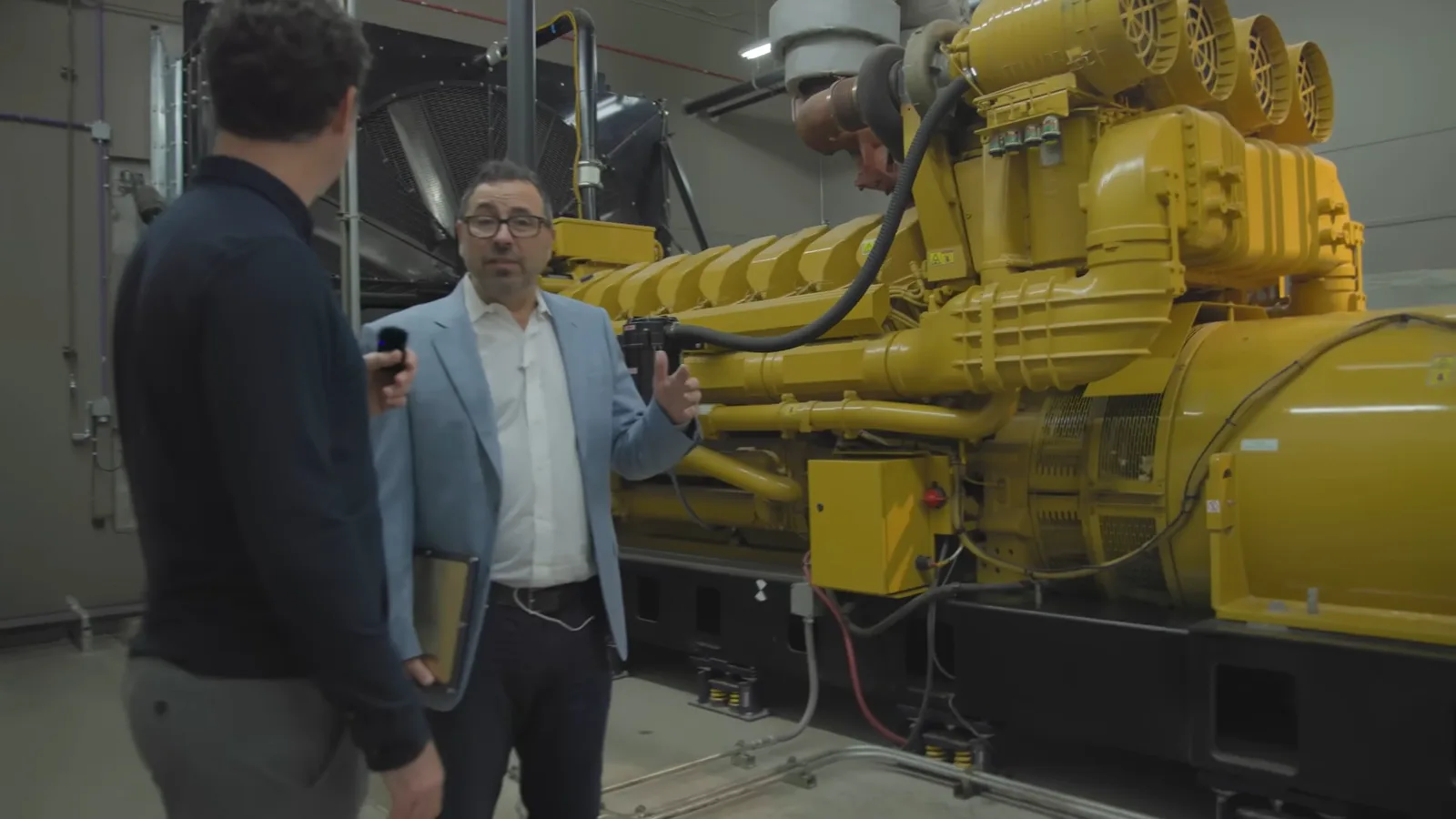
Feldman explains that battery backup takes over immediately during an interruption and is provisioned to bridge about five minutes while generators start; he says startup is often closer to three minutes. Depending on the load and failure, one, two or three generators can come online. His description of nearly uninterrupted service is a design claim, not a published uptime measurement in the video.
Berman asks why some AI infrastructure projects are described in gigawatts while Cerebras discusses compute output. Feldman says gigawatts describe how much electrical power a facility can deliver, whereas compute figures describe processing capacity. He argues Cerebras looks better by the latter measure, but a meaningful efficiency comparison also requires a specified workload, precision and measured power.
A second data hall and manufacturing
The team tours an expanding data hall and discusses US system assembly. Feldman describes the engineering effort required to make the technology work.
The first hall, OKC1, is described as operational. Berman and Feldman next visit OKC2, a second hall that Feldman expects to enter production in three or four weeks from filming. He explains that racks and cabling are installed first, followed by the machines, and estimates that the room will add about 20 exaflops of compute.
Feldman compares that projected capacity with a US Department of Energy computer, claiming roughly ten times its output. The video does not specify equivalent numerical precision or a shared benchmark, so the ratio is not a valid like-for-like performance result on its own. Planned capacity and deployment timing are statements from the 2025 tour.
Asked why Cerebras builds in the United States, Feldman says its systems are packaged and assembled in Milpitas, California. He describes domestic manufacturing as part of the company’s commitment to the US economy. The interview describes final system manufacturing and assembly; it does not establish that every component or fabrication step occurs in the United States.
Feldman recalls a 15-to-18-month period during development when the company had not solved a key engineering problem while spending around $8 million a month. He says the board stayed supportive and the team repeatedly investigated failures and corrected mistakes. Eventually a system worked in a small improvised lab, with a hole in the wall venting hot air; he recalls the five founders standing silently for half an hour.
Hopes for medicine and education
Feldman predicts AI may accelerate drug development and change education. These are aspirations rather than clinical or educational results shown in the tour.
Asked which changes from AI excite him most, Feldman points to medicine and education. He hopes AI could shorten drug development from what he describes as 17–19 years to under ten and create different ways to teach children. These are his aspirations and estimates, not clinical or educational results demonstrated by the facility tour.
Mehr aus diesem Kanal
 34:21EN
 Matthew Berman· 27. Okt. 2026Matthew Berman Examines Anthropic’s IPO Filing, AI Growth and GovernanceMatthew Berman, Sam Altman · Forward FutureThe presenter reviews the S-1’s financial metrics, compute strategy and voting structure while questioning the tension between rapid AI development and safety.
 0:26ENMatthew Berman· 25. Okt. 2026Sam Altman on Human Values and Problem-Solving in an AI WorldSam Altman · OpenAIIn a short interview excerpt, Altman considers the enjoyment of solving hard problems and the human role in interpreting results.
 0:36ENMatthew Berman· 25. Okt. 2026Kimi K3.1 and a Rubik’s Cube Solver DemonstrationMatthew Berman · Forward FutureMatthew Berman shows a scrambled virtual cube being solved and gives the Kimi K3.1 test a favorable assessment.
 0:21ENMatthew Berman· 24. Okt. 2026An AI-Generated Kimi Benchmark Chart Used Invented ScoresMatthew Berman · Forward FutureMatthew Berman asks for a graph of Kimi K3.1 Pro benchmarks, then discovers that the displayed figures are illustrative placeholders.
 25:50ENMatthew Berman· 24. Okt. 2026Kimi K3.1 Pro Tested: Strong 3D Demos, Uneven Results and Competitive PricingMatthew Berman · Forward FutureMatthew Berman tests the open-weight model on coding, 3D rendering and visual explanations, then compares benchmark results and prices.
 32:20ENMatthew Berman· 23. Okt. 2026Who Is Local AI For? The Costs, Trade-offs and a Hybrid FutureMatthew Berman · Forward FutureMatthew Berman weighs data control and independence against hardware cost, setup complexity and inference speed.