In 30 Sekunden
In the January 16, 2026 livestream, Matthew Berman and Nick Wentz discuss Apple’s Google partnership, then interview Gauntlet AI founder Austen Allred, Box CEO Aaron Levie, Harmonic CEO Tudor Achim and Ramp economist Ara Kharazian. The guests describe AI engineering education, document agents, formal proof tools and business spending data, while making forecasts and company-specific claims that should be read in their stated context.
- 1Apple and Google partnerThe hosts discuss a collaboration to base next-generation Apple Foundation Models on Gemini technology and cloud infrastructure.
- 2Gauntlet AI’s training modelAllred describes a selective, free-to-students engineering program funded through recruiting fees.
- 3Making enterprise content usableLevie discusses Box Extract and the evaluation, permissions and context needed for document agents.
- 4Checking mathematical proofsAchim describes AI-assisted proofs and Lean formalization, while differentiating Erdős problems from Millennium problems.
- 5What spending can measureKharazian explains Ramp’s 46.6% estimate, its sample limitations and differences from Census survey measures.
- 6Two different bubble questionsRising customer spend and renewals do not resolve whether AI infrastructure investment will pay off.
Das Wichtigste
- Allred says Gauntlet AI trains experienced engineers at no student cost and earns fees from hiring partners.
- Levie argues that enterprise agents need reliable context, permissions, evaluation and workflow integration in addition to capable models.
- Achim describes using Lean to check formalized mathematical proofs while distinguishing research problems from the harder Millennium problems.
- Ramp’s 46.6% December 2025 AI adoption estimate tracks paid services in its data and is not a census of actual use.
- Kharazian says spending and renewals suggest demand but do not determine whether AI infrastructure investment will earn a return.
- The guests’ predictions about jobs, education and scientific progress are opinions rather than established outcomes.
Den bearbeiteten Text nach Kapiteln lesen
Apple, Google and the AI landscape
The hosts discuss Apple’s announced collaboration with Google and its possible strategic implications. They distinguish the announcement from their own speculation.
Matthew Berman and Nick Wentz open the January 16, 2026 show with Apple and Google’s announced collaboration. The companies said the next generation of Apple Foundation Models would draw on Gemini models and Google cloud technology for future Apple Intelligence features, including a more personalized Siri.
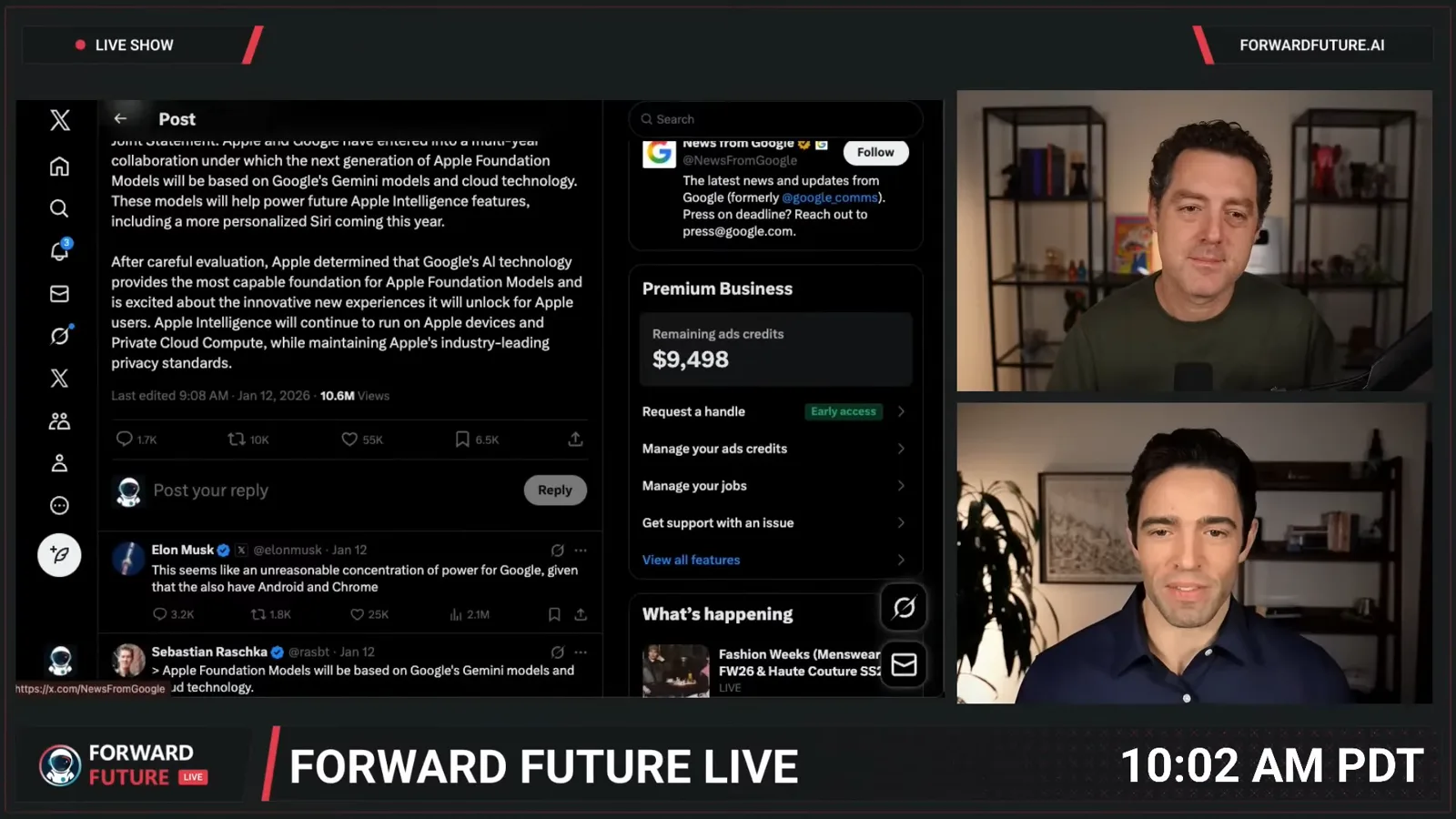
Berman sees the choice of Google as evidence that Apple had struggled to build the model it wanted, though he does not know the deal’s financial terms. Wentz interprets it as a strong endorsement of Google’s technology. Both observations are their interpretations, not disclosures about Apple’s internal decision-making.
The hosts discuss Elon Musk’s concern about concentration of power given Google’s Android and Chrome businesses. Berman notes Musk has a competitive interest in xAI, and the hosts speculate about possible antitrust scrutiny; they do not establish that this particular agreement triggered an investigation.
Asked whether outsourcing is temporary, Berman hopes Apple will eventually improve its own capabilities and argues that organizational culture may matter as much as resources. Wentz suggests waiting for technology and costs to mature could be a deliberate strategy. Neither knows how long the arrangement will last.
Austen Allred: training AI engineers
Allred describes Gauntlet AI’s selection, training and recruiting model, and offers views on software productivity. He also discusses education and a company revival project.
The first guest is Austen Allred, founder of Gauntlet AI. He describes a selective engineering program that he says charges students nothing and instead earns recruitment fees from hiring partners. Applicants take a cognitive assessment and coding tests, with weekly challenges determining who continues.
Allred says participants who reach the later stages are brought to Austin with housing, meals and other support, and work 80–100 hours a week on AI-assisted engineering and agents. He describes a job offer of at least $200,000 for those who complete the program; these are his descriptions of the program, not independently verified outcomes.
Participants are commonly experienced engineers in their early thirties, Allred says, though ages and backgrounds vary. Some cohorts prefer or require several years of experience, making the program more a way to advance existing engineers than an entry-level training course.
Allred says hiring partners range from large technology companies to smaller and private-equity-backed businesses. In his view, a skilled engineer using AI can handle work previously assigned to a team, although that is an observation from his own program rather than a measured economy-wide effect.
On employment, Allred expects companies to build more, with uncertain short- and long-term effects on job counts. He describes seeing projects once expected to take months completed in days and backlogs moving into production, while acknowledging that the technology is changing rapidly.
Allred describes a shorter customer feedback loop: a business can ask a prospective customer what feature would close a sale, build it in days, and return with a working product. He gives an example of engineers responding to requests from a government customer within hours and says some participants generated substantial contracts.
According to Allred, the curriculum must be rewritten for each cohort because earlier week-long assignments have become much easier. He estimates that staying at the leading edge takes roughly an hour of learning per day, and advises graduates to expect their jobs to keep changing.
Wentz asks why the program begins with engineers if every occupation needs AI fluency. Allred says engineering was a natural starting point because of his company’s hiring network and the immediate applicability of coding tools. He says expansion into other occupations is being explored, although the economics differ.
Allred predicts many office jobs will change substantially within one or two years. He estimates typical Gauntlet placements around $200,000–$300,000, with higher outliers, while noting he does not know the precise average. These figures and forecasts are his own claims.
On Austin’s startup culture, Allred contrasts what he perceives as a focus on cash flow and durable businesses with San Francisco’s emphasis on venture capital and rapid growth. He sees benefits and drawbacks in both, and attributes the difference partly to local incentives and other industries.
Berman asks about a business revival project involving Marin Software, an advertising platform. Allred says partners handed his team an old codebase with no customers or revenue, and Gauntlet participants had six weeks to find an opportunity, build a product and sell it.
Allred says the project reached $1.5 million in annual revenue during those six weeks, that a team now runs the company, and that a reality series about the process was being edited and pitched. The revenue and profitability statements are his account.
The discussion turns to education costs. Allred argues that government funding and accreditation rules slow change in higher education. He offers his view that new providers face barriers to accessing federal aid; the interview does not evaluate the full range of causes of tuition increases.
Allred says his children attend Alpha School in Austin and describes roughly two hours of adaptive computer-based academic work each day, with remaining time used for other activities. He acknowledges its approximately $40,000 annual listed tuition and describes prospective remote options linked to Texas funding.
Allred claims the model delivers unusually rapid learning and strong scores. Those broad comparisons come from his account and are not established by the interview. He describes remote variants involving sports, group activities or homeschooling alongside the academic software.
Looking ahead, Allred expects elite universities to persist while their influence gradually changes, and predicts a faster shift in K–12 education. After he leaves, the hosts express interest in the school model while noting that experiments do not always work.
Aaron Levie: enterprise content and agents
Levie explains Box Extract and the context, evaluation and permissions needed for business workflows. He discusses adoption, human judgment and the limits of proactive AI.
The next guest, Box co-founder and CEO Aaron Levie, calls AI the largest technology shift he has experienced. He compares it with the web, cloud and mobile, and explains why Box has repositioned its platform around information stored in enterprise documents.
Levie says organizations traditionally had to know what to search for or inspect documents manually. Agents can now help extract information, answer questions and automate workflows around contracts, invoices, research, marketing plans and other unstructured content. He sees enterprise content as a source of context for those agents.
Box had just announced Box Extract, which Levie describes as agents targeted at sets of files to extract structured data. He says organizations often do not know everything in their archives, so the goal is not merely to automate an existing task but to enable analysis and workflows they could not previously undertake at scale.
A contract might contain an important obligation, or an older research file might prevent a team from repeating work. Levie argues that extracting such information can support new decisions and free people for more strategic work. These are proposed and observed use cases from a vendor, not guaranteed outcomes.
Asked what made the product possible, Levie says models are only part of the solution: documents need preparation, agents need to be targeted to relevant material, and results need evaluation. Box is developing tools to compare model outputs against a customer’s ground truth on particular document types.
For banking, legal and health workflows, Levie says simply uploading a file and trusting the model is inadequate. He wants systems that can benefit from better models while discarding accuracy-related scaffolding when the model no longer needs it.
Some infrastructure remains valuable even as models improve, he argues: permissions, security, document normalization, access to the right data and comparisons with expected results. Repeatable enterprise processes also require more than asking a general chatbot to reconstruct the same context each time.
Berman asks about proactive AI that could surface a useful document during a conversation. Levie sees a tension: an agent must intervene enough to help, but a few irrelevant interruptions may make people turn it off. Timing and interface design could be as important as model ability.
Levie says agents still struggle with missing context and knowing what they do not know. An agent might stop after finding eight facts when a human knows ten exist; retrieval can also select the wrong material. Organizations must make context comprehensive, authoritative and current.
On adoption, Levie sees both excitement and practical caution. Many organizations still think of coding AI as autocomplete, he says, while advanced users already delegate much longer tasks. Helping nontechnical employees adopt such workflows requires change management and usable product scaffolding.
Levie recognizes concerns about jobs and energy costs. He argues that experts often discover that judgment and context are still needed to assess AI output, while AI can remove tedious work. His legal-advice example illustrates his experience, not a general guarantee about professional reliability.
He predicts strong engineers can become more productive when routine maintenance and package updates are delegated, freeing time for architecture and product decisions. His numerical descriptions of productivity are illustrative estimates, not measurements from a controlled study.
Asked whether Claude Cowork might bring agentic work to other knowledge workers, Levie says it is possible but points to differences in verification. A slide deck he tested had a bullet placed outside the visible area, illustrating why users still need to inspect generated artifacts.
Levie describes a proposed document agent for answering requests for proposals using prior responses and documentation. He estimates that it could reduce a multi-hour task to a short agent run followed by human review; the timing is an example, not a published evaluation.
Tudor Achim: formal mathematics
Achim explains AI-assisted mathematical proofs and Lean checking. He discusses research, limits and his prediction for a Millennium problem.
The third guest, Harmonic co-founder and CEO Tudor Achim, discusses recent work on Erdős problems and the company’s Aristotle system. He corrects the hosts’ characterization: these are open research problems, but they vary in difficulty and are not equivalent to the Millennium Prize problems.
Achim says, based on what he had seen published, users worked with GPT-5.2 Pro on candidate proofs and then used Aristotle to translate them into Lean for computer checking. He was not directly involved in their work, and notes that other users had previously solved problems directly with Aristotle.
Achim sees recent AI mathematics results as part of a progression from school problems to contests and research problems. He considers the growing use of formalization especially significant: a proof assistant can check the steps of a formal statement much faster than relying solely on an informal review.
Formal verification checks that a proof follows from its specified definitions and assumptions; it does not by itself establish that the formal statement perfectly captures the intended natural-language problem. Achim also sees machine-checkable feedback as useful for reinforcement learning, because a proof checker can supply a precise reward signal.
Asked whether the model is reasoning or recalling training data, Achim says he has not seen fundamentally new techniques but believes the solutions combine known techniques creatively. This is his assessment of the examples discussed, not a complete audit of model training data.
Achim describes mathematical reasoning as a way to express objectively checkable chains of logic. He thinks some of that skill can transfer to programming and quantitative sciences, while recognizing that mathematical ability does not automatically generalize to every field.
The hosts and Achim discuss scientific discovery as an optimistic counterpoint to concerns about job losses. Achim imagines applications in medicine, fusion and energy, while presenting these as possibilities rather than achieved breakthroughs.
On training, Achim points to Harmonic’s technical report on its 2025 IMO-level system. He contrasts rewards based on a Lean-checked proof with less precise judgments of natural-language text, and says this can be data-efficient for tasks expressible in formal mathematics.
Achim expects formal mathematical reasoning to help with code verification and quantitative science, but does not claim it already solves every kind of problem. He says Harmonic hopes to contribute to a Millennium Prize problem by 2028, a prediction he explicitly bases on extrapolating progress.
He explains that Millennium problems such as the Riemann hypothesis and P versus NP have broad mathematical implications. The latter could affect security assumptions if P equaled NP, although the practical consequences would depend on the algorithms and their efficiency.
Achim expects mathematicians to adopt tools that can automate subproblems and check proofs. He argues that formalization could reduce some checking work; human review still matters for selecting the right definitions, assessing relevance and interpreting the result.
He describes Aristotle’s API as an agentic service that can take an English mathematics problem, work on it for an extended period and return formally verified progress. It may not finish every task, and he expects combinations of specialized models to be useful.
Asked about superhuman reasoning, Achim says an AI independently solving a Millennium problem would be a stronger signal than the Erdős examples. He cautions that the latter do not demonstrate a step change toward such a breakthrough, which he thinks may require new insights.
The hosts reflect on the promise of AI-assisted science and express excitement about discoveries while acknowledging possible downsides. Their predictions of faster scientific and medical progress are hopes about the future rather than results established in the episode.
Ara Kharazian: measuring AI adoption
Kharazian compares Ramp spending data with Census surveys and explains sample and measurement limitations. He discusses renewals, competition, open models and the AI bubble debate.
The final guest is Ara Kharazian, Ramp’s lead economist. Ramp provides business finance tools, and he says its research uses spending across about 50,000 businesses and approximately $100 billion in annual spend to study adoption of AI services.
Kharazian introduces the January 2026 Ramp AI Index, which estimated 46.6% of businesses in its measurement were paying for AI models or services in December. The figure is based on spending observed by Ramp, not a direct census of every US business or a measure of how intensively employees use AI.
He contrasts that estimate with a Census survey that had asked whether businesses used AI to produce goods and services. He says the wording could miss internal uses such as engineering, marketing or customer service, even as the ecosystem of AI products expanded.
Kharazian says a revised Census question about use in any business function raised the estimate from roughly 8% to 18%. The measures still differ because survey questions and payment data capture different things, as well as different populations and periods.
He acknowledges that Ramp customers are not perfectly representative of the economy: even outside the technology sector, firms choosing Ramp may be more tech-forward. Free services may be missed, while buying a subscription or API access does not establish who actually uses it or how much value it creates.
Kharazian points to rising contract sizes and approximately 80% year-over-year retention, up from around 60% previously, as suggestive evidence that businesses perceive value. These spending and retention patterns are indirect indicators; they do not independently measure productivity or return on investment.
The data show OpenAI at more businesses on Ramp, Kharazian says, while Anthropic customers tend to spend more and include heavier technology and API users. Adoption by business count and dollars spent answer different questions; free Google Workspace access may also be undercounted.
Asked whether AI purchases are displacing other software, he says Ramp’s data did not show a broad slowdown in software spending outside AI, although AI spending was rising faster. He distinguishes this observation from anecdotes about firms tiring of per-seat pricing or switching vendors.
Kharazian says more startups and software tools are entering the market as development becomes easier, so expenditure may move toward new providers rather than disappear. He expects AI product pricing to evolve as buyers pay for work performed by agents rather than seats alone.
On an AI bubble, Kharazian separates two questions. His data address whether customers are buying and renewing tools; they do not determine whether model companies are overbuilding data centers or can earn a return on capital expenditure. Growing customer spend alone cannot resolve the investment question.
He says the company’s evidence includes larger contracts, retention and customer conversations, which suggest a growing market. These observations are useful but are not direct proof that every customer gets a positive return or that the infrastructure buildout is financially justified.
Discussing competition, Kharazian says DeepSeek saw limited direct adoption in Ramp’s data and suggests US business concerns about sending data abroad as one possible reason. The hosts point out that open-weight models can also be hosted elsewhere, which direct vendor payments would not fully capture.
Kharazian expects many companies to favor access to frequently improving frontier models over maintaining their own fine-tuned open models. He acknowledges some do use open models, while Ramp can observe only part of that activity through payments and cloud-compute spending.
On selecting models, he reports engineers’ advice to use the best model appropriate to the task, rather than automatically choosing the most expensive one, and to expect costs to change. This is a practical view from his conversations, not a universal price comparison.
Kharazian says the lack of transparent data about private AI vendors motivated Ramp’s research. He predicts adoption will rise beyond technology and finance, including in industries such as restaurants where AI might assist with marketing or financial operations; that is a forecast, not a measured productivity gain.
The hosts close by thanking Kharazian and the other guests. Across the program, their discussions connect faster engineering, enterprise document workflows, formal mathematics and business spending, while leaving the speed and distribution of AI’s economic effects open to debate.
Mehr aus diesem Kanal
 34:21EN
 Matthew Berman· 27. Okt. 2026Matthew Berman Examines Anthropic’s IPO Filing, AI Growth and GovernanceMatthew Berman, Sam Altman · Forward FutureThe presenter reviews the S-1’s financial metrics, compute strategy and voting structure while questioning the tension between rapid AI development and safety.
 0:26ENMatthew Berman· 25. Okt. 2026Sam Altman on Human Values and Problem-Solving in an AI WorldSam Altman · OpenAIIn a short interview excerpt, Altman considers the enjoyment of solving hard problems and the human role in interpreting results.
 0:36ENMatthew Berman· 25. Okt. 2026Kimi K3.1 and a Rubik’s Cube Solver DemonstrationMatthew Berman · Forward FutureMatthew Berman shows a scrambled virtual cube being solved and gives the Kimi K3.1 test a favorable assessment.
 0:21ENMatthew Berman· 24. Okt. 2026An AI-Generated Kimi Benchmark Chart Used Invented ScoresMatthew Berman · Forward FutureMatthew Berman asks for a graph of Kimi K3.1 Pro benchmarks, then discovers that the displayed figures are illustrative placeholders.
 25:50ENMatthew Berman· 24. Okt. 2026Kimi K3.1 Pro Tested: Strong 3D Demos, Uneven Results and Competitive PricingMatthew Berman · Forward FutureMatthew Berman tests the open-weight model on coding, 3D rendering and visual explanations, then compares benchmark results and prices.
 32:20ENMatthew Berman· 23. Okt. 2026Who Is Local AI For? The Costs, Trade-offs and a Hybrid FutureMatthew Berman · Forward FutureMatthew Berman weighs data control and independence against hardware cost, setup complexity and inference speed.