In 30 Sekunden
Matthew Berman describes Darkbloom, a service that routes AI inference to participating Macs, and sees it as a possible step toward distributed personal data centers. He cites an earnings estimate and argues that such a network could be cheaper and more secure; those benefits and earnings depend on conditions and are not guaranteed.
- 1An earnings projectionThe displayed calculator estimates $192–$4,983 per year for an example Mac, subject to assumptions about availability and demand.
- 2Sharing unused computeBerman says Mac owners can install Darkbloom and serve AI requests using spare compute.
- 3A distributed networkHe imagines home computers becoming nodes in a distributed alternative to centralized data centers.
Das Wichtigste
- Darkbloom aims to route AI inference requests to participating Apple Silicon Macs.
- The $192–$4,983 annual range shown in the video is a projection for an example configuration, not guaranteed income.
- Actual results depend on hardware, network demand, availability and costs; Berman's security and cost comparisons are not independently established in the video.
Den bearbeiteten Text nach Kapiteln lesen
Earning from a Mac
Berman introduces Darkbloom and shows an estimated annual earnings range. The estimate depends on the machine and demand.
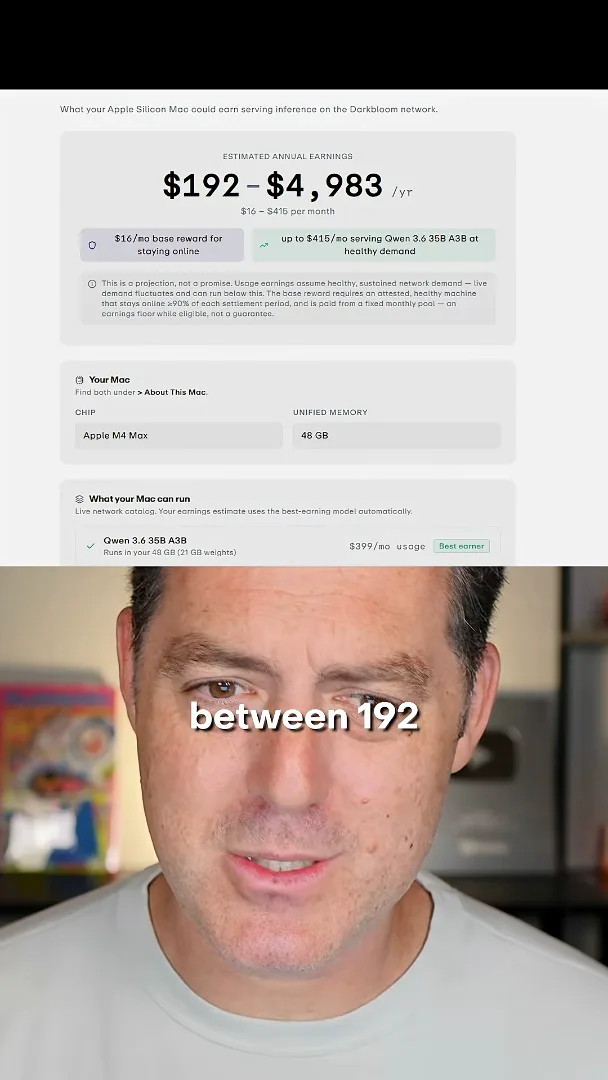
If you have a Mac sitting around, you may be able to earn money by providing AI compute to other people. The Darkbloom calculator shown in the video estimates $192 to $4,983 per year for an example Apple Silicon Mac. That is a projection, not a promise: the display says usage earnings assume sustained demand and the base reward requires an eligible machine to stay online. Hardware, demand, electricity and other costs affect the actual outcome.
Install Darkbloom on a compatible Mac and its network can route AI model inference requests to the machine. I find the idea more interesting than the income alone: it could be the beginning of a private data-center movement, where individual home computers serve as nodes in a distributed system instead of leaving all compute to large data centers.
A distributed data center idea
He imagines individual computers serving AI requests from home. He suggests possible cost and security advantages without comparing measured results.
In that vision, people can serve AI to the world from their homes. I think it's interesting and could be more secure and less expensive. Those are my expectations, not conclusions demonstrated by a controlled comparison in this video; privacy, security and costs depend on the implementation and operating conditions.
Mehr aus diesem Kanal
 34:21EN
 Matthew Berman· 27. Okt. 2026Matthew Berman Examines Anthropic’s IPO Filing, AI Growth and GovernanceMatthew Berman, Sam Altman · Forward FutureThe presenter reviews the S-1’s financial metrics, compute strategy and voting structure while questioning the tension between rapid AI development and safety.
 0:36ENMatthew Berman· 25. Okt. 2026Kimi K3.1 and a Rubik’s Cube Solver DemonstrationMatthew Berman · Forward FutureMatthew Berman shows a scrambled virtual cube being solved and gives the Kimi K3.1 test a favorable assessment.
 25:50ENMatthew Berman· 24. Okt. 2026Kimi K3.1 Pro Tested: Strong 3D Demos, Uneven Results and Competitive PricingMatthew Berman · Forward FutureMatthew Berman tests the open-weight model on coding, 3D rendering and visual explanations, then compares benchmark results and prices.
 32:20ENMatthew Berman· 23. Okt. 2026Who Is Local AI For? The Costs, Trade-offs and a Hybrid FutureMatthew Berman · Forward FutureMatthew Berman weighs data control and independence against hardware cost, setup complexity and inference speed.
 1:03:37ENMatthew Berman· 23. Okt. 2026Matthew Berman’s Team Tests Kimi K3.1 on Animation, Games, and ChartsMatthew Berman, Alex, Brian · Forward FutureA live team AMA turns into an informal test of Kimi K3.1, from personal-agent workflows to motion graphics, a browser game, and a benchmark chart.
 0:53ENMatthew Berman· 22. Okt. 2026Sam Altman on AI and the Discovery of New KnowledgeSam Altman · OpenAIAltman expects progress in mathematical discovery to extend to biology, materials and energy.