In 30 Sekunden
Matthew Berman shows how he used Midjourney in Discord to generate imagined childhood portraits of public figures and himself. He varies composition and clothing, then finds that the output based on his own photo does not look much like him. These images are generated interpretations, not reconstructions of real childhood appearances; the interface and steps are historical to March 2023.
- 1Build a portrait promptBerman combines a public figure’s name and childhood description with studio lighting, a 50 mm lens and a 2:3 aspect ratio.
- 2Compare variationsHe likes some generated celebrity portraits more than others, illustrating inconsistent resemblance.
- 3Change the compositionA full-body prompt adds a suit and tie to an imagined childhood portrait.
- 4Use a reference imageHe uploads a personal photo to Discord, copies its link and includes it in a Midjourney prompt.
- 5Mixed personal resultsBerman says the images do not resemble him as a child; he speculates that additional images might help, without testing that claim.
Das Wichtigste
- A prompt can combine a person’s name with an age, composition, lighting, lens and aspect ratio.
- The generated celebrity portraits vary in resemblance and are fictional images, not historical photographs.
- Berman uploads his own photo and adds its link to the prompt, but dislikes the resulting likeness.
- Supplying an image as a prompt reference is not evidence that the model was retrained on it.
- Midjourney’s interface and features may have changed since the 2023 Discord demonstration.
Den bearbeiteten Text nach Kapiteln lesen
Prompting childhood portraits
Berman introduces a technique credited to Linus Ekenstam and constructs a portrait prompt. He compares several generated examples.
I found a Midjourney technique in Linus Ekenstam’s newsletter for creating imagined childhood portraits of celebrities, political figures or yourself. These are generated interpretations, not verified pictures of what a person actually looked like as a child. The workflow shown uses Midjourney through Discord in March 2023 and may differ from current interfaces.
I start with the `/imagine` command and describe Bill Clinton as a child in a close-up studio portrait. The prompt adds smiling, realistic style, volumetric lighting, a 50 mm lens and 4K, with a 2:3 portrait aspect ratio. These terms guide the desired appearance; they do not guarantee photographic accuracy or a particular output resolution.
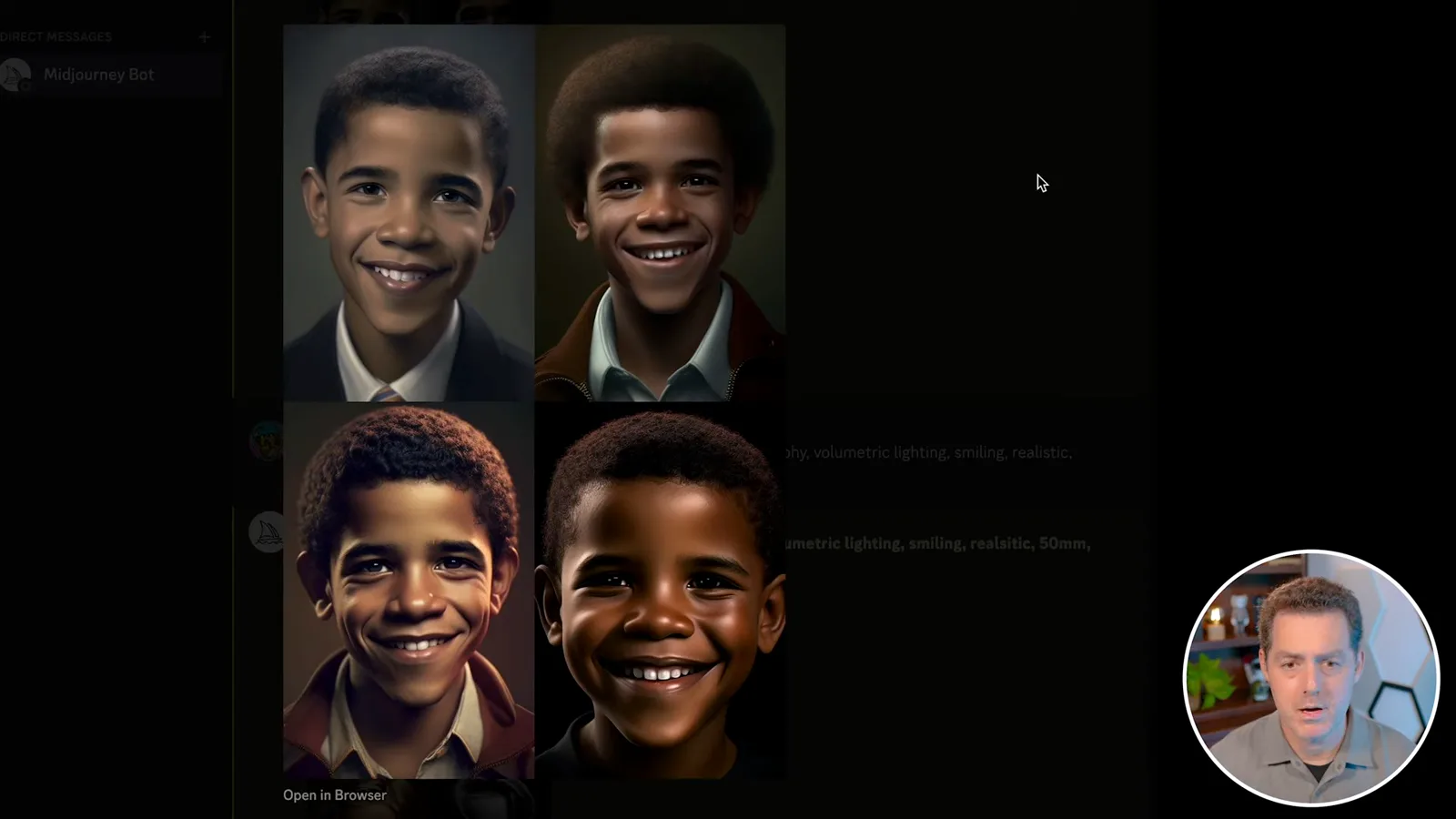
While that generates, I review earlier examples of Barack Obama, Brad Pitt, Dwayne Johnson, Beyoncé and Will Smith. Some variations resemble their subjects to me more than others; I find some unconvincing. The generated images are subjective likenesses, and apparent resemblance does not validate them as childhood records.
I also show a full-body Elon Musk example and images based on my own photo. The latter do not look much like me as a child. In the Bill Clinton set, some outputs still have gray hair or wrinkles, which shows the model does not always follow the requested age consistently.
Different poses and personal photos
He requests a full-body portrait and uploads a personal reference image. The resulting images do not match his own recollection.
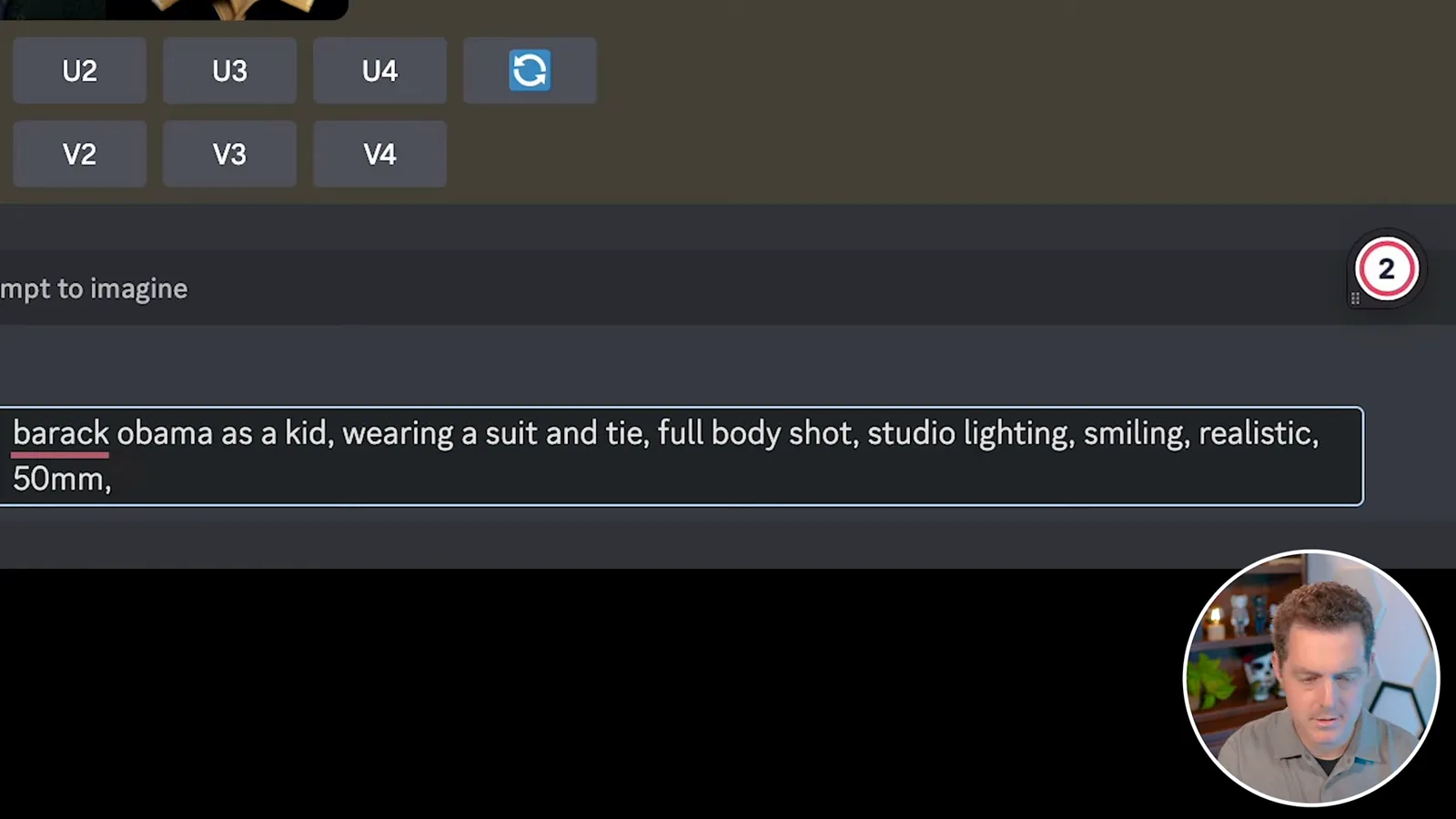
To try another pose, I prompt for Barack Obama as a child wearing a suit and tie, with a full-body composition, studio lighting, a smile, a 50 mm lens and a 2:3 aspect ratio. I like the result; this is still an imagined portrait rather than a historical image.
For a personal version, I upload a photo of myself to Discord, copy its image link, and place the link after `/imagine`. I add a description of a child in a suit, a big smile and straight blond hair, plus photographic style terms. The same kind of reference workflow could be tried with a group photo.
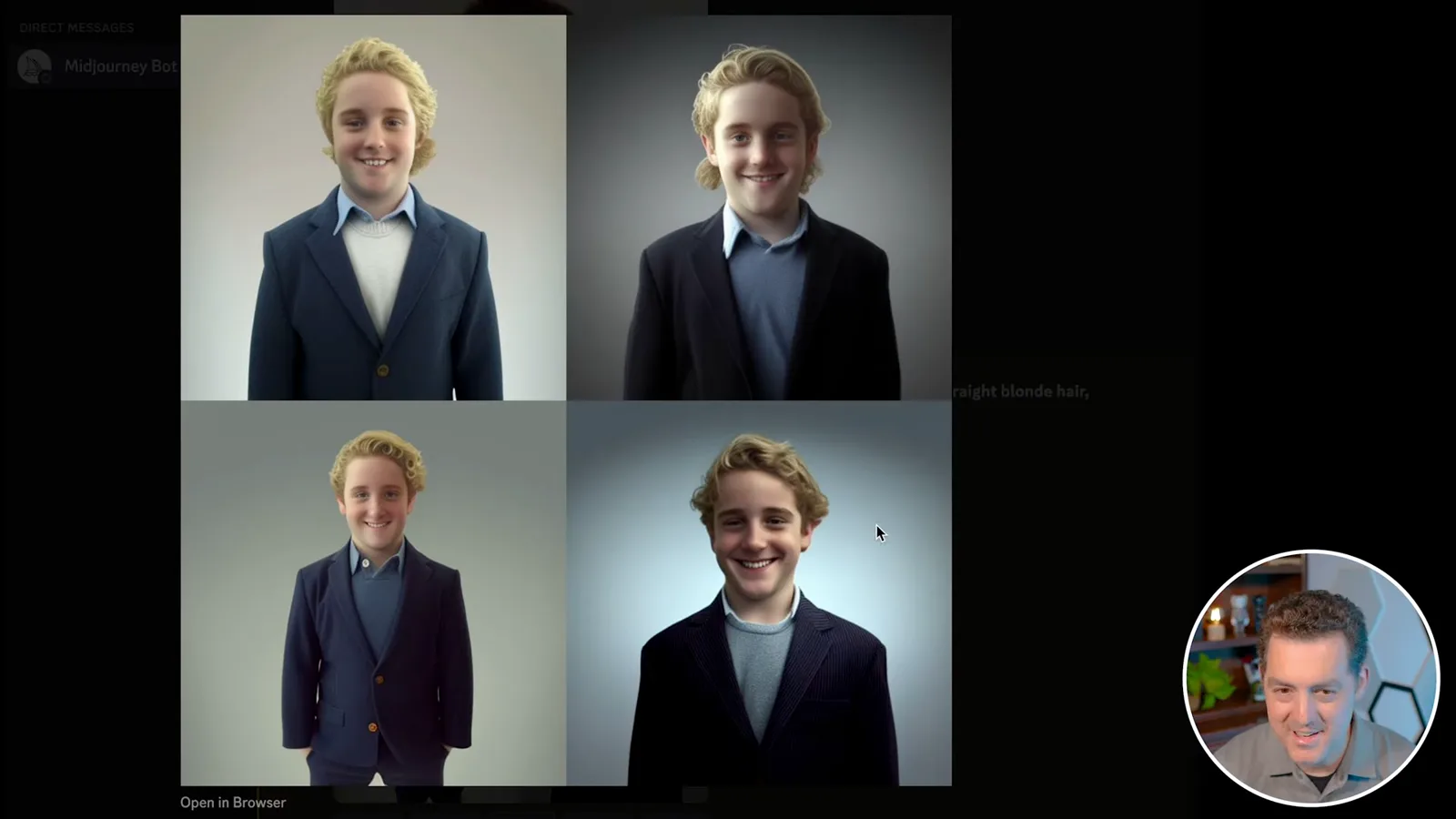
The resulting images do not resemble my childhood appearance, so I am disappointed. I speculate that trying more images could improve the likeness, but I do not test that here. An image included as a prompt reference conditions a generation; this demonstration does not show that uploading it retrains the model.
Mehr aus diesem Kanal
 34:21EN
 Matthew Berman· 27. Okt. 2026Matthew Berman Examines Anthropic’s IPO Filing, AI Growth and GovernanceMatthew Berman, Sam Altman · Forward FutureThe presenter reviews the S-1’s financial metrics, compute strategy and voting structure while questioning the tension between rapid AI development and safety.
 0:26ENMatthew Berman· 25. Okt. 2026Sam Altman on Human Values and Problem-Solving in an AI WorldSam Altman · OpenAIIn a short interview excerpt, Altman considers the enjoyment of solving hard problems and the human role in interpreting results.
 0:36ENMatthew Berman· 25. Okt. 2026Kimi K3.1 and a Rubik’s Cube Solver DemonstrationMatthew Berman · Forward FutureMatthew Berman shows a scrambled virtual cube being solved and gives the Kimi K3.1 test a favorable assessment.
 0:21ENMatthew Berman· 24. Okt. 2026An AI-Generated Kimi Benchmark Chart Used Invented ScoresMatthew Berman · Forward FutureMatthew Berman asks for a graph of Kimi K3.1 Pro benchmarks, then discovers that the displayed figures are illustrative placeholders.
 25:50ENMatthew Berman· 24. Okt. 2026Kimi K3.1 Pro Tested: Strong 3D Demos, Uneven Results and Competitive PricingMatthew Berman · Forward FutureMatthew Berman tests the open-weight model on coding, 3D rendering and visual explanations, then compares benchmark results and prices.
 32:20ENMatthew Berman· 23. Okt. 2026Who Is Local AI For? The Costs, Trade-offs and a Hybrid FutureMatthew Berman · Forward FutureMatthew Berman weighs data control and independence against hardware cost, setup complexity and inference speed.