In 30 Sekunden
Matthew Berman reviews the January 2025 response to DeepSeek V3 and R1, arguing that efficient models could increase adoption and demand for compute rather than end investment in hardware. He surveys researchers, investors and policy commentators, disclosing his small investment in Groq. The article distinguishes V3’s reported training-compute estimate from total R1 development costs, and R1-Zero’s training setup from R1’s multistage process. Stock predictions, geopolitical interpretations and unverified claims about GPU holdings or trading remain opinions or allegations rather than established facts.
- 1A V3 cost comparisonKarpathy compares reported GPU-hours; the V3 estimate covers specified training runs, not the complete cost of research and development.
- 2Reinforcement learningR1-Zero uses reinforcement learning without initial supervised fine-tuning, while R1 adds cold-start and supervised stages.
- 3Test-time computeBerman and Groq’s Jonathan Ross discuss compute used while a model produces an answer. Berman discloses a small Groq investment.
- 4Jevons paradoxLower per-task cost may encourage enough additional usage to raise total compute consumption, but the outcome depends on demand.
- 5Hosting and privacyModel weights can be run locally or by third parties, which differs from using DeepSeek’s own hosted service.
- 6Unverified speculationClaims about chip holdings and a hypothetical short trade are discussed without evidence sufficient to establish them.
Das Wichtigste
- DeepSeek’s V3 estimate of $5.576 million covers specified GPU-hours at an assumed rental rate, not all research or R1 development costs.
- R1-Zero and R1 have different training pipelines; R1 includes cold-start data and supervised fine-tuning.
- Cheaper AI may increase usage, but a rebound in total compute demand is not guaranteed.
- Reasoning at inference time can itself require compute even when training becomes more efficient.
- Open weights allow local or third-party deployment, while privacy depends on the chosen deployment.
- Claims about undisclosed GPU inventories and a possible short trade are not established in the video.
- Berman’s market and AGI predictions are views about an uncertain future.
Den bearbeiteten Text nach Kapiteln lesen
V3, R1 and training efficiency
Berman reviews Karpathy’s reactions to DeepSeek and the market response. The V3 cost estimate has a narrower scope than total development costs.
DeepSeek’s releases have provoked a wide range of reactions: enthusiasm about accessible model weights, concern about competition with China, and questions about training costs and chips. In late January 2025, AI-related stocks fell sharply. I want to examine the arguments, including why I do not think lower model costs necessarily imply lower demand for compute.
Andrej Karpathy had already highlighted DeepSeek-V3 in December. He compared the reported roughly 2.8 million GPU-hours for V3 with the roughly 30.8 million GPU-hours reported for Llama 3 405B, while cautioning that this did not make large clusters irrelevant. The comparison is informative but does not control for differences in hardware, training processes, or the full cost of development.
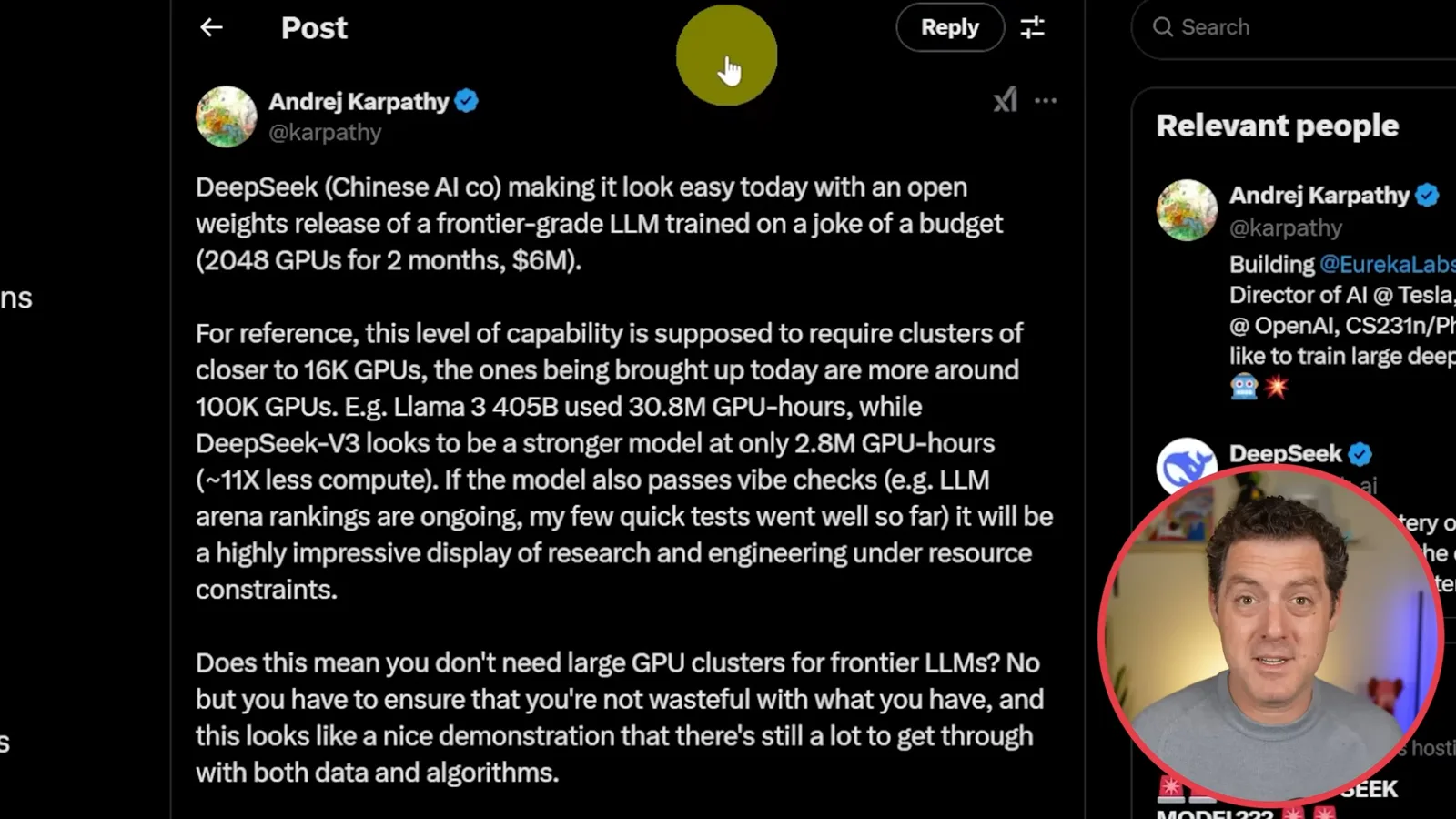
The often-repeated roughly $6 million figure requires a careful boundary. DeepSeek’s V3 report estimates $5.576 million for 2.788 million H800 GPU-hours at an assumed $2 per hour, including its listed pretraining, context extension, and post-training runs. It excludes prior experiments and other development expenses, and is not a total cost for developing R1 or the company.
Karpathy’s later argument is that deep learning can continue to absorb substantial compute, including through reinforcement learning. A useful reward signal can guide models toward desired answers, but reward design and evaluation remain difficult. More generated training data is not automatically unlimited useful data, and compute by itself does not guarantee better intelligence.
I describe R1 as not using human feedback, but the distinction matters: the [R1 paper](https://arxiv.org/abs/2501.12948) describes R1-Zero as starting reinforcement learning without a preliminary supervised fine-tuning stage, whereas R1 uses cold-start data and a multistage process including supervised fine-tuning. That is different from saying the entire R1 pipeline involved no human-generated data or supervision.
The market response raised questions about spending on chips and data centers. I disagree with the idea that this one release makes compute unimportant. A report I discuss argues that DeepSeek’s work shows efficiency under constraints rather than the end of scaling. The report also mentions claims about a much larger GPU stockpile, but the exact inventory and how it was used are not established here.
I think restrictions on access to advanced chips may have encouraged efficiency. I also think DeepSeek’s technical report makes its work worth taking seriously, though publication of a method does not independently verify every claimed resource figure. I mention investor Gary Tan’s post about buying Nvidia after the decline; this is his stated action, not a recommendation or proof about future returns.
Inference and the rebound argument
He discusses test-time compute and Jevons paradox. He predicts greater demand but acknowledges that the outcome is uncertain.
Groq CEO Jonathan Ross suggests a shift in attention from pretraining to test-time compute. I disclose that I am a small investor in Groq. Reasoning models may use additional computation while producing an answer, so cheaper training or a more efficient model does not automatically eliminate demand for inference hardware.
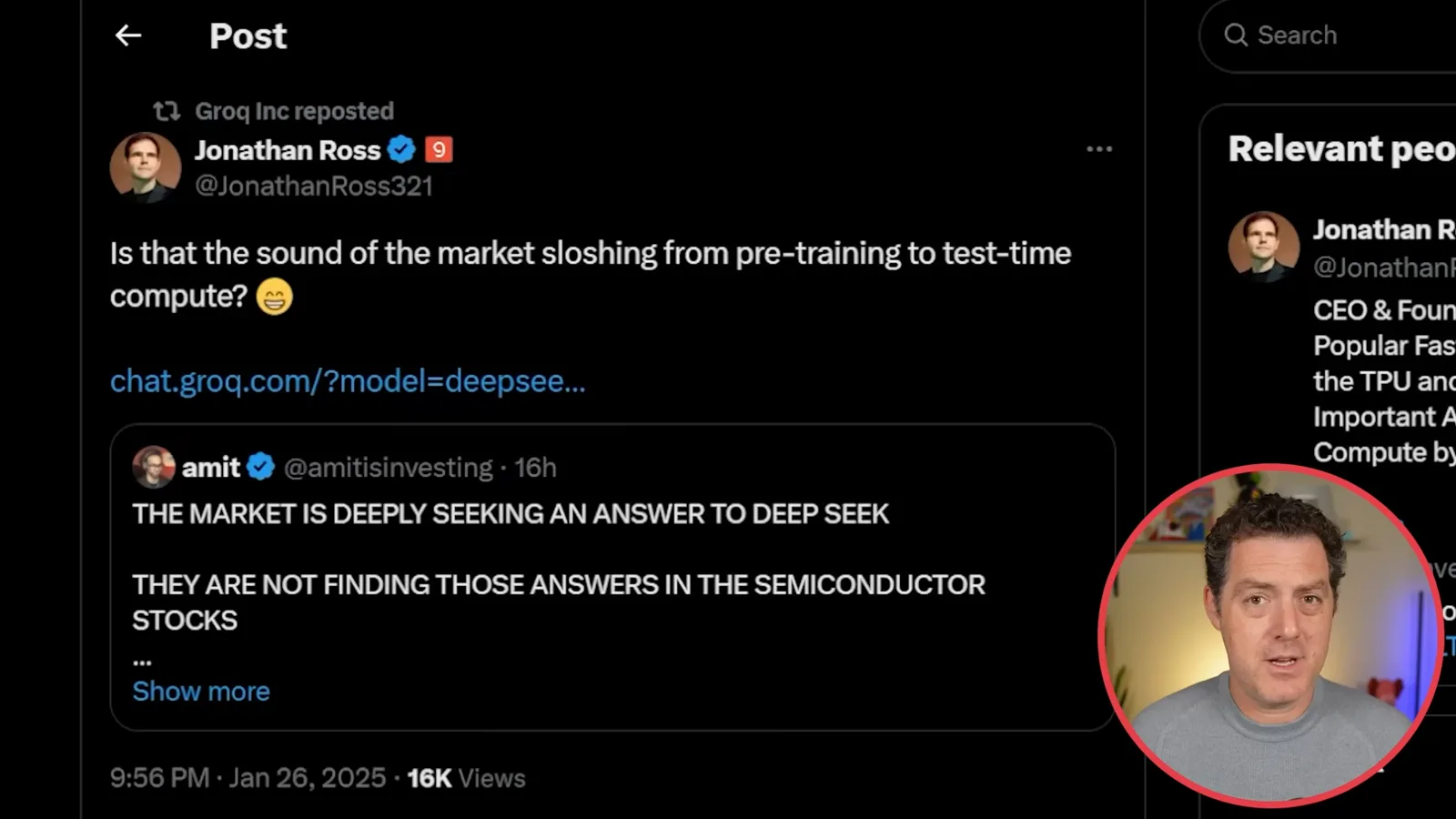
I use Jevons paradox to explain a possible rebound: if a service becomes cheaper or more efficient, people may use it for more tasks. In some circumstances the increase in activity can outweigh per-task savings and raise total resource consumption. That outcome depends on demand and other constraints; it is not guaranteed, and a rise in usage does not necessarily mean total spending or any particular stock must rise.
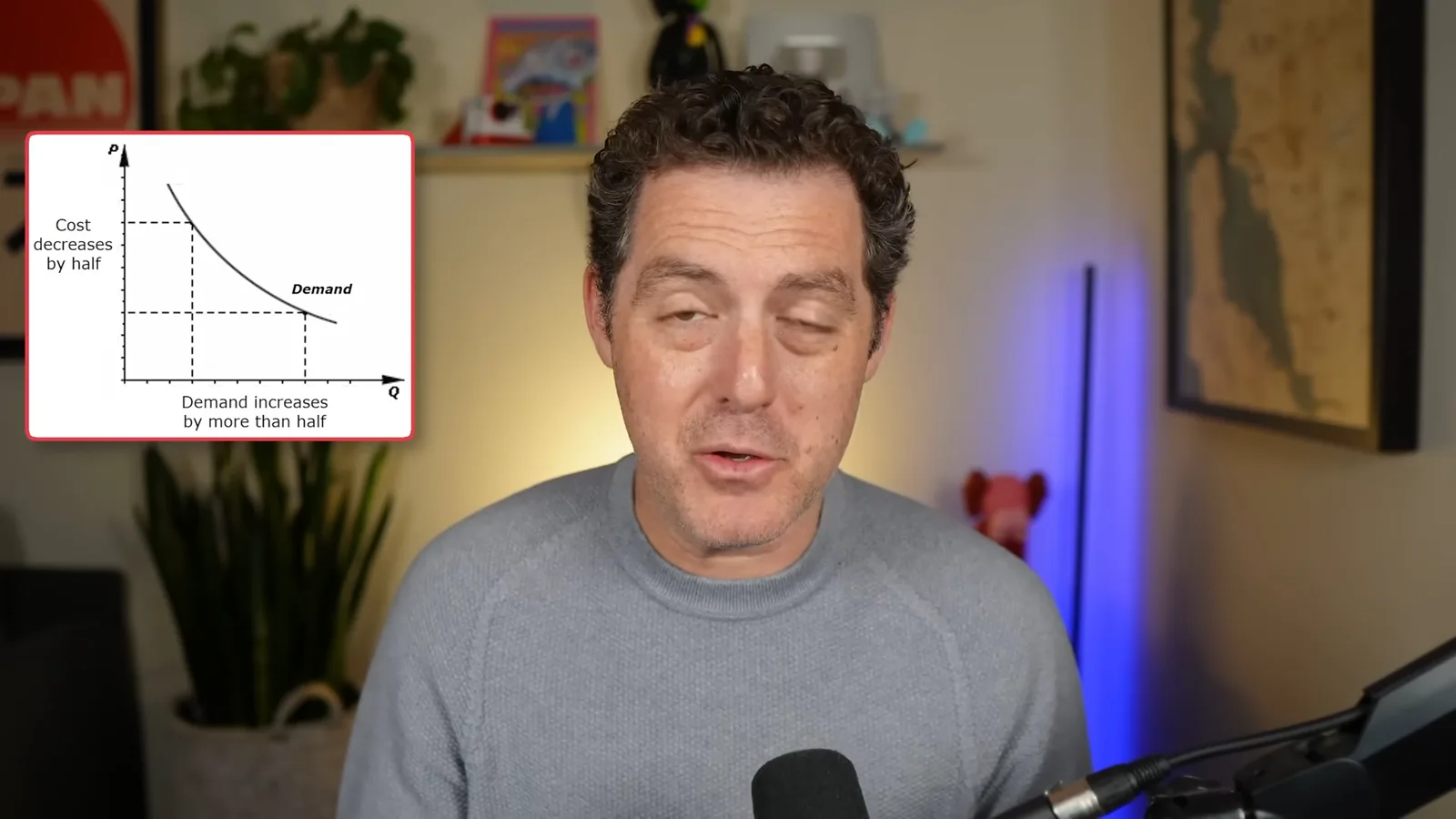
I expect lower AI costs to expand adoption and accelerate progress, and I am optimistic about compute demand. Those are predictions, not established consequences of DeepSeek’s release. The paths and timing to artificial general intelligence or superintelligence are also uncertain.
Open models, competition and privacy
Researchers and investors react to open weights while Berman considers geopolitical competition and privacy. He distinguishes hosted use from local deployment.
NVIDIA researcher Jim Fan celebrates the release of model weights as an opportunity for developers to study and build on reasoning models. I agree that wider access can enlarge the research community. At the same time, I worry about geopolitical competition and disagree with treating every aspect of the US–China relationship as automatically cooperative.
I test a distilled 70B Llama-based R1 model hosted by Groq and report around 250 tokens per second in my session. Perplexity also announces access to R1 in its research service. These examples show how third parties can distribute versions of the model, but a single speed measurement does not predict every workload or hardware configuration.
Venture capitalist Bill Gurley argues that an openly available foreign model can benefit innovation, competition, and other public interests compared with a proprietary alternative. I share his enthusiasm for wider access, though open weights alone do not settle every safety, security, or geopolitical question.
David Sacks and Aaron Levie argue that the release demonstrates the risks of excessive AI regulation in a competitive international environment. I favor faster research and worry about restrictive rules. These are policy arguments, not proof that a particular regulation caused the US or Europe to fall behind.
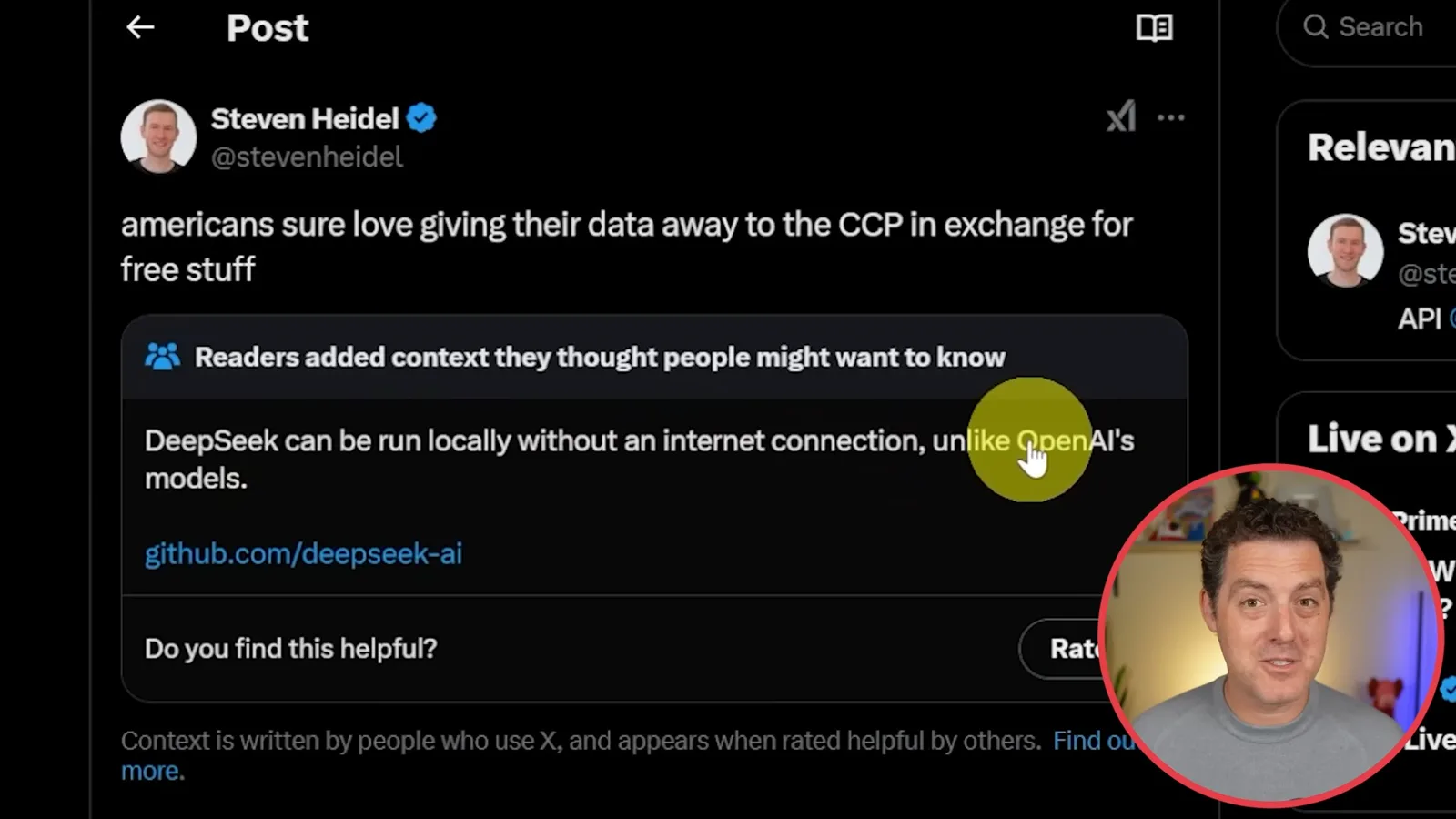
A social-media post raises concerns about sending data to DeepSeek’s hosted service. A community note observes that released weights can also be run locally; that distinction is important. I personally choose not to use the company’s hosted app because of privacy concerns, but the video does not establish that every user’s data is sent to the Chinese government. Third-party hosting and local operation have their own privacy and security considerations.
Prices, speculation and market reactions
Berman reviews predictions about inference costs and unverified claims about chips and trading. He closes with a meme about future GPU demand.
Stability AI founder Emad Mostaque describes high demand for GPU capacity after Stable Diffusion’s release, and Microsoft’s Satya Nadella invokes Jevons paradox in discussing AI efficiency. These are examples of the rebound argument, not a measurement proving how the entire future AI market will behave.
Some observers predict that inference prices and margins will fall, benefiting applications built on top of models. I agree that lower costs can open new uses and may increase total demand. Still, the magnitude, timing, and effects on particular firms remain uncertain.
Chris Camillo speculates that High-Flyer, the hedge fund associated with DeepSeek, might have shorted Nvidia around the release. No evidence of such a trade is presented in this video, so it remains an unsupported question, not an established event. I also discuss competing claims about chip holdings, including an estimate attributed to Alexandr Wang and skepticism from Elon Musk; those claims are not independently verified here.
A published research recipe can enable others to test ideas, but it does not by itself reveal every resource used or prove an exact replication. I expect more work from the community to clarify what can be reproduced. The video also shows jokes about the market reaction and AI competition.
The final meme contrasts the idea that efficiency will reduce GPU demand with the opposite prediction: cheaper AI could increase adoption and demand. I favor the latter view, but the actual outcome depends on prices, supply, adoption, and competition.
Mehr aus diesem Kanal
 34:21EN
 Matthew Berman· 27. Okt. 2026Matthew Berman Examines Anthropic’s IPO Filing, AI Growth and GovernanceMatthew Berman, Sam Altman · Forward FutureThe presenter reviews the S-1’s financial metrics, compute strategy and voting structure while questioning the tension between rapid AI development and safety.
 0:26ENMatthew Berman· 25. Okt. 2026Sam Altman on Human Values and Problem-Solving in an AI WorldSam Altman · OpenAIIn a short interview excerpt, Altman considers the enjoyment of solving hard problems and the human role in interpreting results.
 0:36ENMatthew Berman· 25. Okt. 2026Kimi K3.1 and a Rubik’s Cube Solver DemonstrationMatthew Berman · Forward FutureMatthew Berman shows a scrambled virtual cube being solved and gives the Kimi K3.1 test a favorable assessment.
 0:21ENMatthew Berman· 24. Okt. 2026An AI-Generated Kimi Benchmark Chart Used Invented ScoresMatthew Berman · Forward FutureMatthew Berman asks for a graph of Kimi K3.1 Pro benchmarks, then discovers that the displayed figures are illustrative placeholders.
 25:50ENMatthew Berman· 24. Okt. 2026Kimi K3.1 Pro Tested: Strong 3D Demos, Uneven Results and Competitive PricingMatthew Berman · Forward FutureMatthew Berman tests the open-weight model on coding, 3D rendering and visual explanations, then compares benchmark results and prices.
 32:20ENMatthew Berman· 23. Okt. 2026Who Is Local AI For? The Costs, Trade-offs and a Hybrid FutureMatthew Berman · Forward FutureMatthew Berman weighs data control and independence against hardware cost, setup complexity and inference speed.