In 30 Sekunden
Gemini 4 Neon led Claire Vo’s 25-task comparison of AI models, doing especially well at creative work and app prototypes while costing relatively little. Ordinary coding tasks produced much smaller differences, with GPT-6.2 Astra narrowly ahead. Yet the best output did not make the best interactive experience: Vo found Neon slow and rated Claude Opus 5.5 poorly when blind, but used Opus most because it was fast and pleasant. She also analyzed her own agent-session messages to measure friction, finding more frustration with GPT-6.2 Sol.
- 1Gemini 4 Neon won the overall comparisonNeon topped Vo’s combined blind and model-judge scores and was among the least expensive usable models in her comparison.
- 2Opus 5.5 was pleasant to use despite weak blind scoresVo rated its outputs poorly without knowing their source, yet it caused her the least frustration and became her most-used model.
- 3Routine coding produced only a narrow gapGPT-6.2 Astra led her coding tasks by about 0.1 over Opus 5.5. She suggests choosing an inexpensive model that passes the particular tests a team needs.
- 4Independent design made the storybook test harderOnce Astra demonstrated how to animate a page, the other models could follow its instructions. Their own versions exposed more meaningful differences in creative execution.
- 5A strong background result can still be slow to work withNeon’s benchmark jobs ran without intervention, but Vo found its interactive use in Antigravity frustratingly slow. Opus was quicker and easier for her to use.
- 6Session messages can reveal friction that output scores missVo classified her own agent exchanges for frustration, returned work and requests to keep going. Sol scored 12.8 combined annoyance moments per 100 messages in her analysis.
Das Wichtigste
- Test models on your own tasks: Vo’s creative-heavy benchmark may not reflect every job.
- For routine coding, compare the cheapest models that meet your requirements; Astra’s lead was narrow in this test.
- Evaluate speed and interaction separately from output quality, especially for work done in real time.
- Analyze agent-session messages for returned work, frustration and repeated requests to continue.
- Use background execution for slow, high-quality work when immediate interaction is unnecessary.
Den bearbeiteten Text nach Kapiteln lesen
A surprise winner across 25 practical tasks
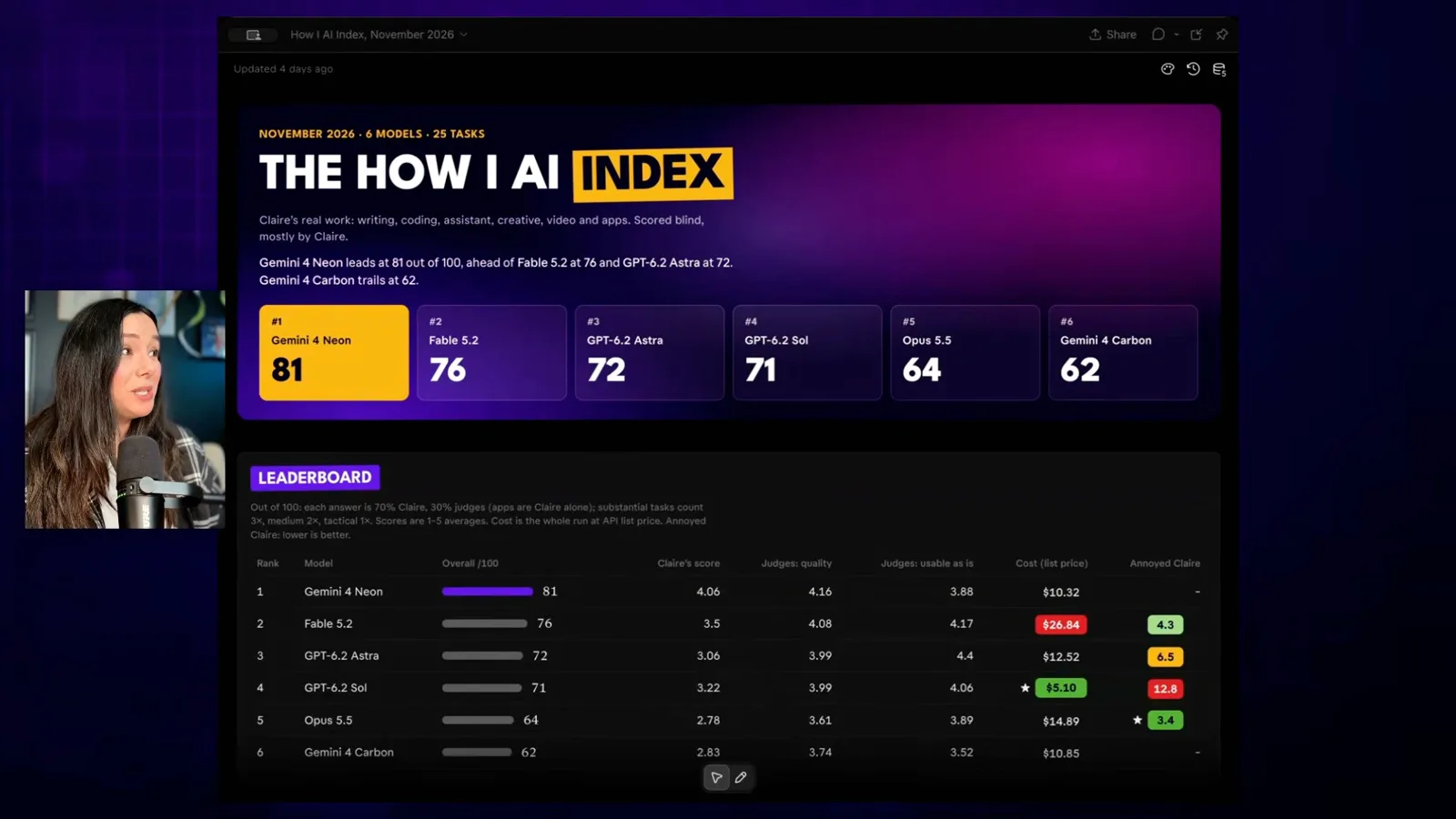
Gemini 4 Neon led Claire Vo’s comparison after a week of model releases. Her benchmark combines practical work with creative tests that help distinguish otherwise capable models.
In the past week, OpenAI and Google have released a wave of models. Instead of offering a first-day reaction, I spent the week putting models from OpenAI, Google and Anthropic through practical coding, creative and personal-assistant work. The results surprised me, including a clear favorite I had not expected.
My overall winner is Gemini 4 Neon. It arrived late in the week, went through the benchmark and came out on top. I have long loved GPT models and Codex, so I was surprised to see OpenAI fall back and Gemini take the lead; Claude's Fable also performed well.
How blind ratings and two model judges are combined
Vo scores outputs without seeing the model names and blends her scores with judgments from Claude and GPT. Creative tasks expose differences but are less representative of many people’s daily work.
My How I AI benchmark has grown from roughly eight tasks to 25, covering writing, coding, personal assistance, creative work, video and prototyping. I run each model in its own working environment when I can. These models are all capable, so finding tasks difficult enough to distinguish their outputs has become a challenge.
I added creative and video tasks partly because those still produce visible differences. That has a drawback: many founders, engineers, product managers and business owners are not spending their days on animation, video editing or 3D rendering. The tasks help separate models, but are not necessarily representative of everyone's work.
I compare the outputs blind, giving my own scores before I know which model produced each one. For example, I might compare different redesigns of the ChatPRD homepage. I also use a Claude model and a GPT model as judges to assess qualities such as technical feasibility and completeness, then blend their scores with mine.
Output quality and working experience diverge
Fable stood out before Neon arrived, while Opus 5.5 scored low blind yet was pleasant to use. The GPT-6.2 models were frustrating in her workflow, though she cannot separate model behavior from its environment.
The GPT-6.2 models did not top my leaderboard. After a week testing them in the Codex environment, I still found them comparatively hard to work with, although I cannot tell whether the cause is the model or the combination of model and environment. I have been spending more time in Claude Code and Antigravity and less in Codex.
I added a separate Claire Annoyance Bench to capture the experience of using a model, not just the quality of its output. In day-to-day use, I found GPT-6.2 Sol especially irritating. When most models can do a task, whether people enjoy working with them becomes another meaningful distinction.
Before Neon entered the test, Claude Fable 5.2 led, largely because of its creative and video results. It costs more than twice as much as most of the other models in my comparison, so I am selective about where I use it. It is particularly good for specific demanding jobs.
Claude Opus 5.5 brought me back to Claude, and I like using it as an orchestrator in Claude Projects. Yet I rated its outputs low when I judged them blind, even though it was my least annoying model to work with. That gap illustrates the tension between capability, output quality, working experience and cost.
Gemini 4 Neon did well in both my blind scoring and the model judges’ scores, and it was among the least expensive models I tested. The displayed leaderboard puts the full benchmark run at $10.32 for Neon and $5.10 for Sol, compared with $26.84 for Fable. Carbon ranked last overall.
Everyday coding is close; creative work separates models
Astra led the coding tests narrowly, while Sol did well on writing. Neon led creative and prototype work, and Fable remained strong at video.
For ordinary software engineering, I found all the models good. Advanced engineering, math and security tests can still reveal differences, and teams should evaluate their particular front-end, back-end and security needs. For routine company software, I would pick the cheapest model that does the job well.
GPT-6.2 Astra scored best on my coding tasks, but only by about 0.1 over Opus 5.5. GPT-6.2 Sol did very well on writing: I tend to like the less reasoning-heavy GPT models for being succinct and clear. For the voice of an assistant talking to me while it works, I preferred Neon and Fable.
Creative work was more discriminating. Astra did impressive image and animation work, while the Claude models struggled with some pixel-based work without an image-generation model. Neon did even better on my creative tasks. Fable had been my favorite for cutting and editing video, but Neon also performed strongly there.
Neon also led my app-design and prototyping tests. Opus 5.5 ranked lower than I expected, perhaps because I like its design work more when it has an existing design system than when it has to design something from scratch. A recognizable generic style can make its output easy to spot.
Newspapers and animated characters reveal design differences
Vo compares illustrations, layout and animations, including new characters for an existing design system. Neon stood out on layout and motion, while different models struggled with different examples.
One recurring creative task is to design a family newspaper that we print for our children each morning. A Grok bot generates and prints it; in the benchmark I compare the models' vector illustrations and page layouts. Astra and Sol made some attractive illustrations, while several Claude illustrations were difficult to recognize.
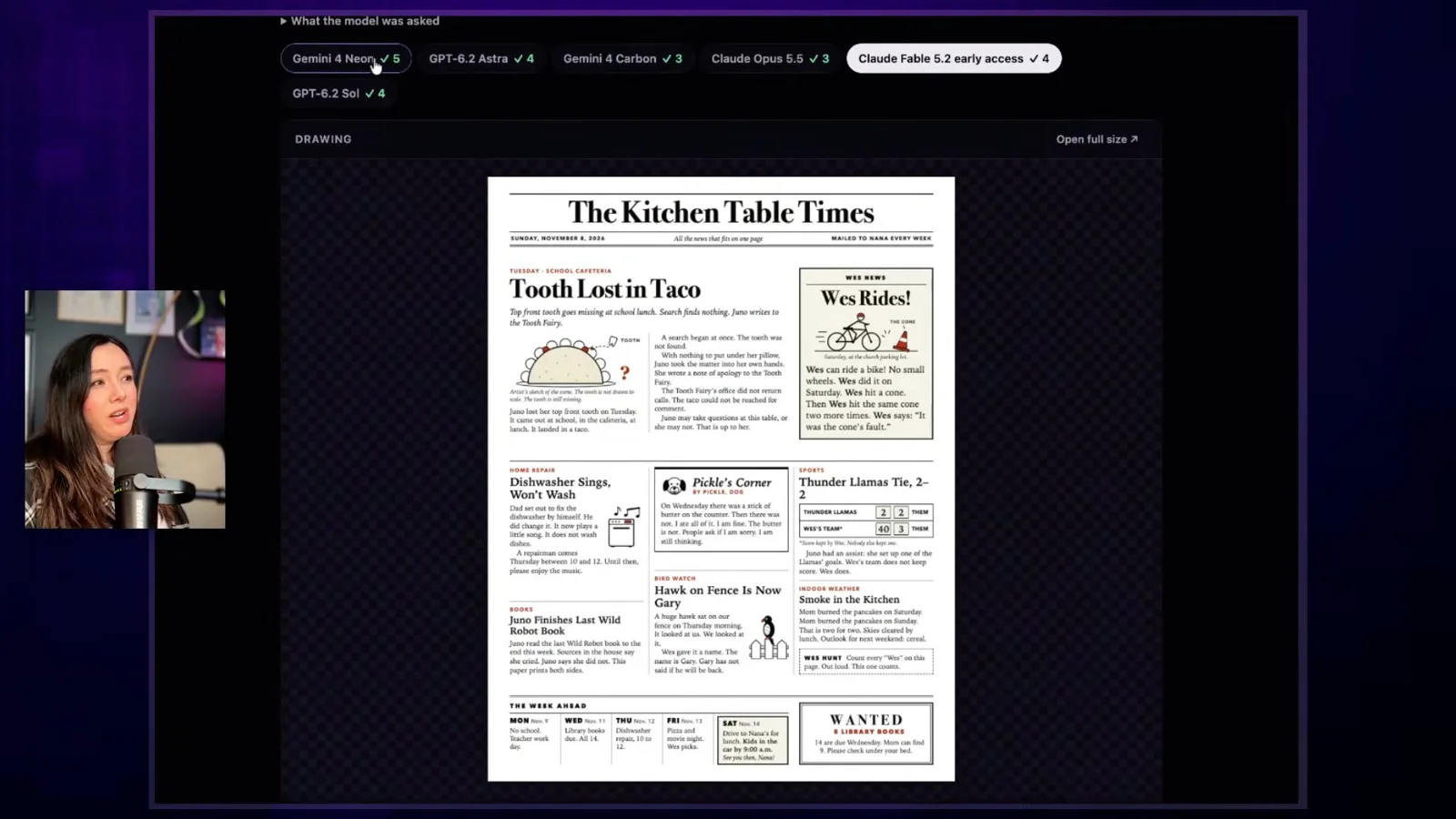
Neon's family newspaper stood out to me not just for individual drawings but for its dense layout and overall design. I also asked the models to create thumbnail concepts for How I AI. Fable did poorly on that design task in my judgment, even though I would use it for video or heavy coding work.
For a new test, I supplied three little character designs from our CXO.dev design system and asked each model for additional characters representing a designer, a finance lead and an on-call engineer. Carbon failed; I liked the new characters from Neon and Opus, while some of Sol's were harder to read.
I then asked the models to animate the characters. Sol's movement was slow and oddly timed. Fable gave them clearer turns, expressions and better timing, while Neon produced my favorite: its character had a lively walk, and the mouths and movements matched the interaction. Animation is becoming a useful way to see differences.
A storybook becomes a harder test when each model designs it
Astra built interactive effects by programmatically altering pixels in an image. Once the technique was shared, all models could reproduce it, so Vo instead compared their independently designed versions.
Astra first impressed me with an interactive storybook. I generated one image, and Astra programmatically changed its pixels to make the other visual states. A ghost could float across the page, the girl's eyes followed it, the window reflected it, and the ghost could blow out a candle.
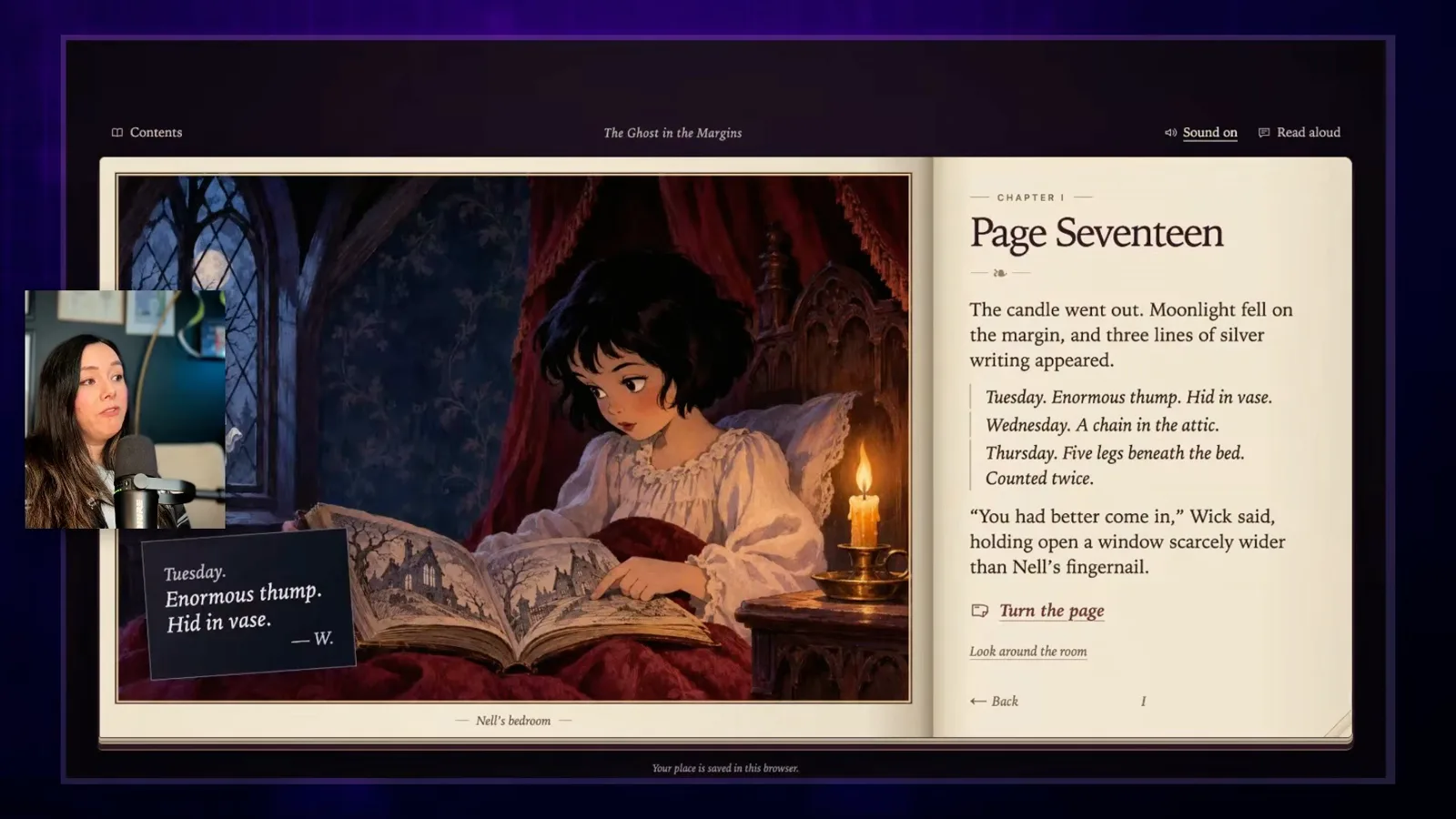
Other details included moving chains, a shadow cast by a hand over the storybook and animation with help from ElevenLabs. This was not a set of individually generated pictures. The interaction between the page and the altered pixels produced something I could not previously have built myself.
Once Astra had figured out the approach, it could instruct the other models, and all were able to make the animated page. The more discriminating task was asking each model to make its own version from instructions, rather than measuring whether it could follow an approach another model had already found.
Opus 5.5 made a cute scene, but its transition as the ghost blew out the candle was abrupt. With the same prompt and similar access to tools, Fable added touches such as candle smoke and a camera move as the ghost went to bed. Neon also made an excellent version, with a hat, changing light and a floating ghost.
Across my creative work, Neon was the strongest overall. Fable had been best for video over time, with Neon a strong late entrant. For interactive animations like the storybook, I would reach for Fable or Neon rather than Opus.
Prototypes and speed change the choice of model
Neon led across five subjective app prototypes but felt slow to use interactively. Opus 5.5 was faster and became her most-used model despite its weaker blind output scores.
I run about five prototyping tasks: a ChatPRD homepage redesign, a course portal for CXO.dev, a family home screen on a smart frame, a dense benchmark-running developer tool and a podcast production app. Neon consistently ranked highest, with Opus also doing well on some tasks. Fable produced a nice animated example.
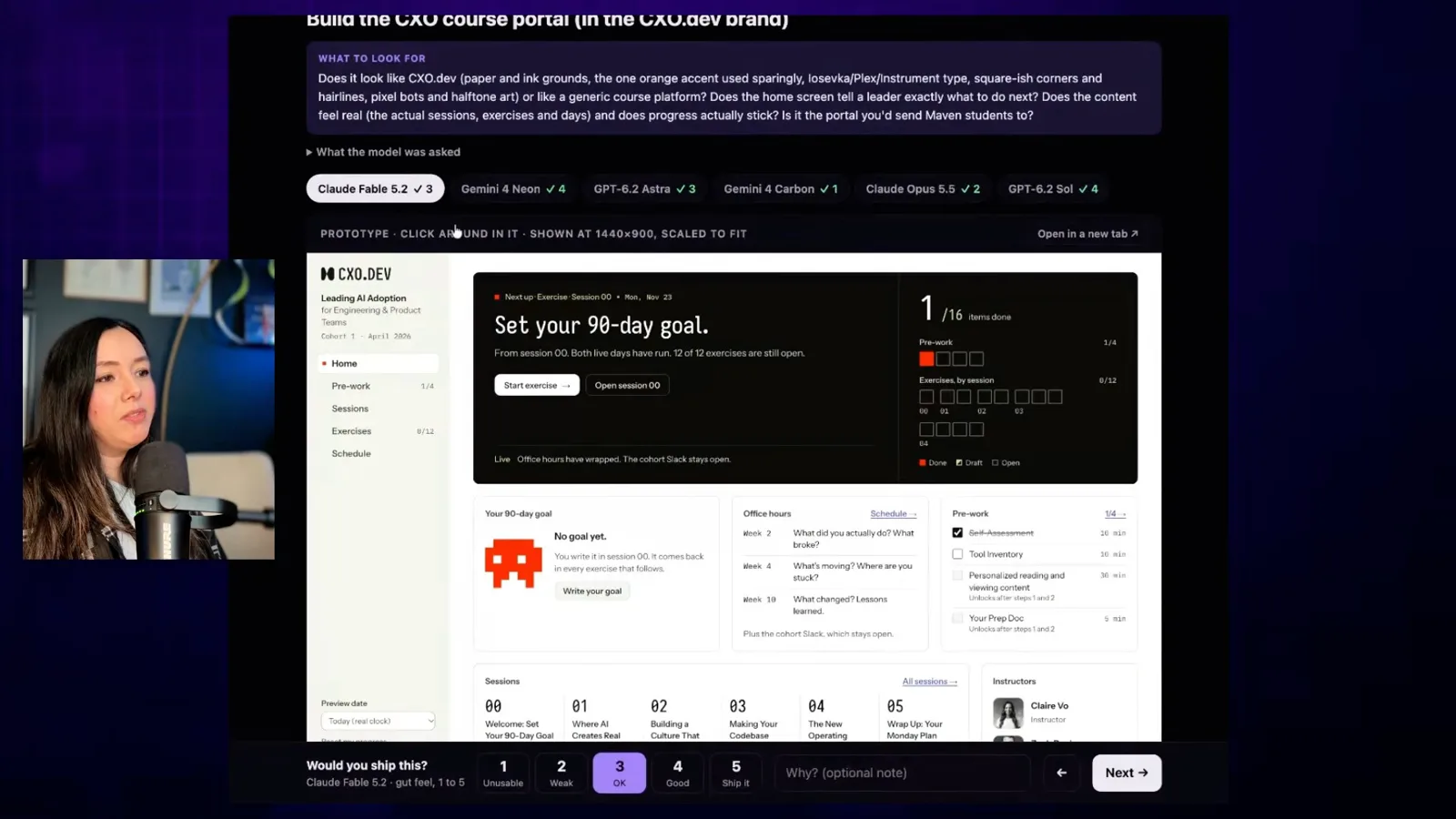
Neon seems particularly good at dense interfaces and layout, although some of its visual styling still has a generic AI look. Strip that away and I like the underlying layout. App preferences are subjective, so several models win individual tasks even though Neon leads consistently in my scores.
A model's speed changes how useful those scores feel. The benchmark runs in the background without my steering, whereas using Neon synchronously in Antigravity has felt frustratingly slow: I submit a prompt and wait while it goes away to work. The eventual output can be excellent, but waiting is a real cost.
Fable is both slow and expensive, but I generally use it for video work in the background, where the delay bothers me less. Opus 5.5 is fast and easy to work with, so I use it most despite ranking its blind outputs poorly. That is the gap between the benchmark and what I actually choose each day.
Sol is cheap and useful for some browser work but is not my choice for these benchmark tasks. Astra sits around the middle on cost and performance; with Neon and Fable ahead on output and Opus feeling fast and pleasant, I have found less reason to reach for it.
Session histories measure everyday annoyance
Vo uses an agent to classify her own messages for frustration, delegated work returned to her, and requests to continue. Her sessions showed more friction with Sol and little expressed frustration with Opus 5.5.
To build my Annoyance Bench, I had Codex analyze local agent-session histories turn by turn. It categorized my messages according to whether I was handing back work the agent could have done, expressing frustration or telling it to keep going. The analysis turns my own interactions into a measure of friction.
One recurring example with GPT-6.2 Sol was failing to open a pull request when it could have done so, leaving me to say try again or keep going. The displayed analysis gives Sol an annoyance score of 12.8 per 100 messages, combining handbacks, expressed frustration and continuation requests. The evidence covered sessions before and after changes to the Codex environment.
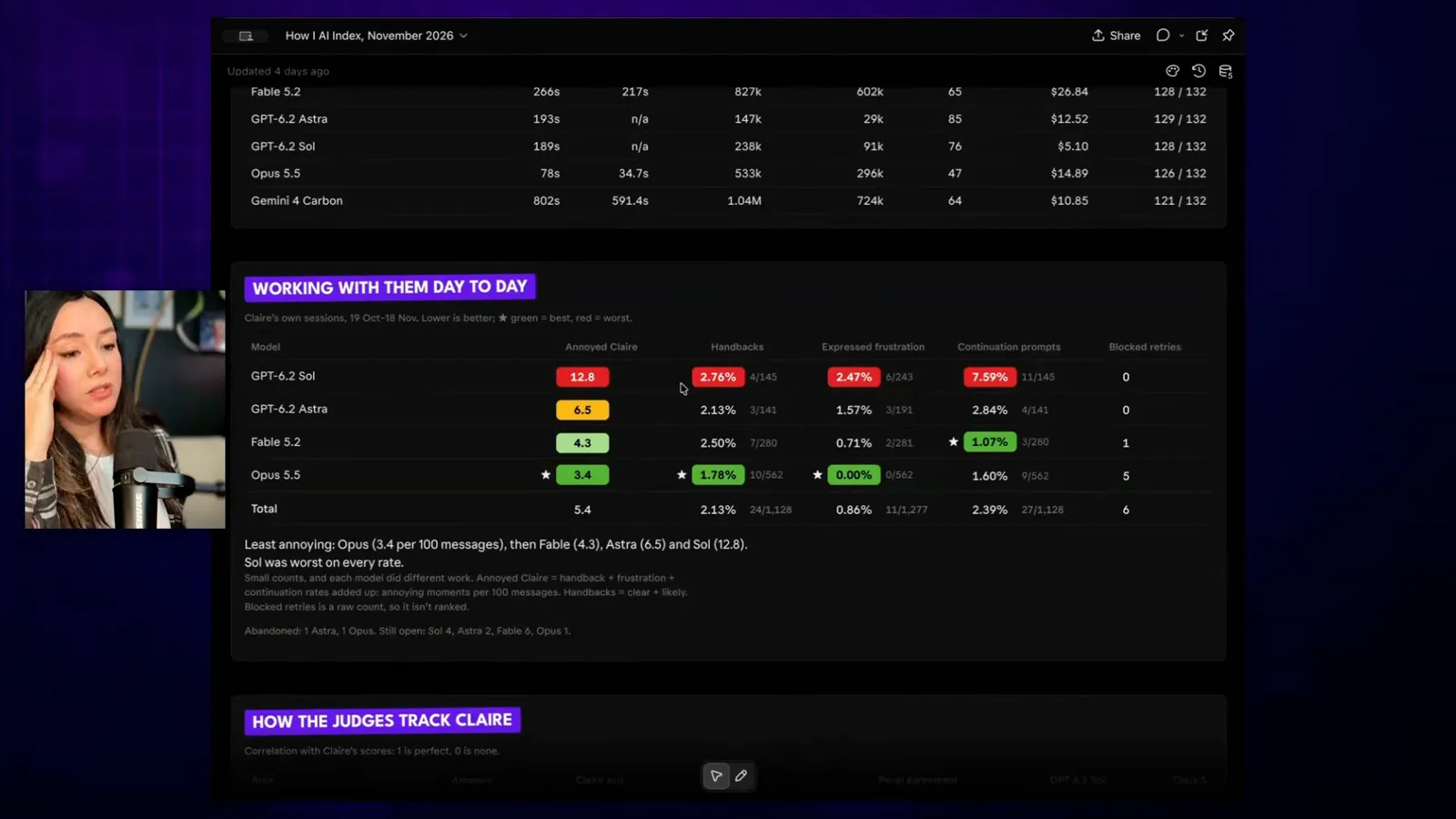
Astra also annoyed me in daily use. Opus 5.5, by contrast, was the most pleasant: I did not express frustration with it in the sessions analyzed. That surprised me because I had not expected to prefer working with Claude, and because I had ranked its blind outputs so much lower.
My late-November comparison puts Gemini 4 Neon first, even though I still have complaints about the speed and experience of Antigravity. I encourage people to try it on their own tasks. I still use Codex for browser work and coding, and I expect to keep revising the benchmark and the annoyance analysis as the models change.
Mehr aus diesem Kanal
 31:24EN
 How I AI· 23. Nov. 2026Podcast · 2 StimmenAnkit Maheshwari built an AI assistant that handles his daily bottlenecksGast: Ankit Maheshwari · Moderation: Claire VoHis OpenClaw assistant checks approvals, orders lunch and calls people, but an unexpected travel approval showed why it needs boundaries.
 39:47ENHow I AI· 16. Nov. 2026PodcastClaire Vo: Token Fraud Forced ChatPRD to End Free TrialsModeration: Claire VoAbusers exploited trials, promo codes and relays to consume model access. Vo explains the controls she added and their cost to legitimate users.
 34:15ENHow I AI· 11. Nov. 2026Podcast · 2 StimmenScott Farrar’s AI household system keeps its memory in filesGast: Scott Farrar · Moderation: Claire VoA shared folder helps a family track repairs, insurance and next steps across AI conversations.
 38:34ENHow I AI· 9. Nov. 2026Podcast · 2 StimmenA founder used Codex to build the Norwegian tutor he wantedGast: William Imoh · Moderation: Claire VoWilliam Imoh describes a voice app built around conversation, then shows how role-based agents support his company.
 24:47ENHow I AI· 9. Nov. 2026PodcastClaire Vo: Fable 5.2 excels at creative builds, but not every designA marketing animation, furniture guide and 3D typewriter impressed Vo; independently generated website designs did not.
 42:30ENHow I AI· 2. Nov. 2026Podcast · 2 StimmenInside Figma’s PM OS: Ezra Mechaber on Skills, Bug Bashes and Automated ExperimentsGast: Ezra Mechaber · Moderation: Claire VoFigma growth PM Ezra Mechaber shows Claire Vo how a shared repository supports product work, browser testing and a human-reviewed experiment loop.