In 30 Sekunden
At Tesla’s 2025 shareholder meeting, Elon Musk presented a vision of sustainable abundance built around humanoid robots, autonomous vehicles and energy storage. He discussed proposed Optimus production lines, Cybercab manufacturing and the AI5 chip, along with forecasts about self-driving. The video was later uploaded with an incorrect 2026 meeting label; production schedules and capability claims are Musk’s projections at the 2025 event.
- 1Musk proposes million-unit robot production linesMusk proposes million-unit robot production lines
- 2He reframes the mission as sustainable abundanceHe reframes the mission as sustainable abundance
- 3Cybercab is designed for autonomous serviceCybercab is designed for autonomous service
- 4Hands, real-world AI and scale remain difficultHands, real-world AI and scale remain difficult
- 5AI5 is intended for Tesla’s own softwareAI5 is intended for Tesla’s own software
- 6Grid storage shifts energy across demand cyclesGrid storage shifts energy across demand cycles
Das Wichtigste
- Musk described sustainable abundance as meeting human needs while preserving nature.
- His proposed Optimus output and cost figures were long-term targets, not reported production.
- Cybercab was presented as a vehicle designed for autonomous service.
- Tesla’s AI5 chip was described as specialized for the company’s own software.
- Musk’s predictions about self-driving do not establish current approval or permit distracted driving.
Den bearbeiteten Text nach Kapiteln lesen
Optimus and the case for abundance
Optimus and the case for abundance
Elon Musk begins among dancing Optimus robots and thanks Tesla shareholders and its board. He says the company is entering a new chapter centered on artificial intelligence and robotics.
Musk predicts Optimus could become Tesla’s largest product. He imagines both personal assistants and industrial robots, with several industrial machines for every personal robot.
He speculates about tens of billions of robots and says safety will matter as the technology spreads. These are long-term projections, not deployments or results reported at the meeting.
Musk outlines ambitions for a million-unit production line in Fremont and a ten-million-unit annual line in Texas. He then speculates about even larger future volumes.
He argues that inexpensive humanoid labor could expand access to goods and services. He also predicts robots could someday provide highly precise medical care, a claim about a possible future rather than an existing medical capability.
Musk offers a speculative example involving a robot preventing a person from committing a crime, then recommends Iain M. Banks’s Culture novels as a rough picture of the future he imagines.
He suggests that AI and robots could expand the economy many times over and wonders whether energy might one day become a useful measure of value. He encourages the audience to hold Tesla stock.
A new mission and self-driving software
A new mission and self-driving software
Musk revisits Tesla’s original mission of accelerating sustainable energy. He proposes “sustainable abundance”: meeting human needs while preserving nature.
Turning to vehicles, he describes Tesla cars as machines designed for autonomy. He says many customers have not tried the company’s Full Self-Driving software and describes efforts to demonstrate it in stores and service centers.
Musk predicts future software versions might allow drivers to divert their attention. That was his prediction at the 2025 meeting; it should not be treated as permission to drive distracted or as a description of current system approval.
He asks customers to support regulatory approval in Europe and describes a hoped-for expansion in China. He presents Tesla’s safety data as part of his argument for approval.
Cybercab and manufacturing
Cybercab and manufacturing
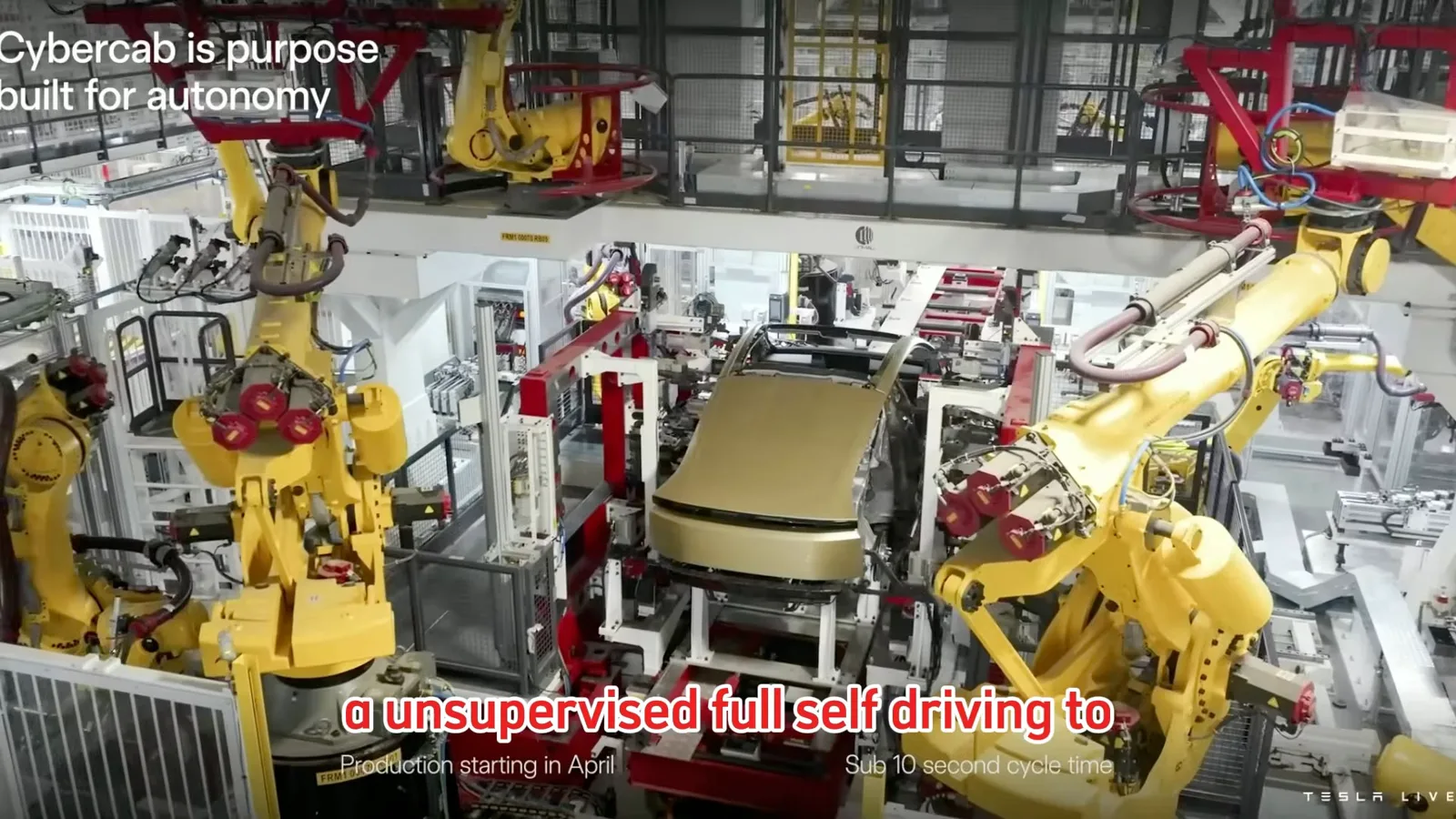
Musk introduces Cybercab as a vehicle designed for an autonomous service without a steering wheel or pedals. He says production was planned for the following April, a schedule announced at the 2025 meeting.
He compares the proposed manufacturing system to high-volume consumer electronics and describes a target cycle time below ten seconds, with five seconds as a theoretical longer-term possibility.
Building humanoid robots at scale
Building humanoid robots at scale
Musk says Tesla’s vehicles and robots share components: batteries, power electronics, motors, connectivity, cameras, AI hardware and software. In his framing, the car is a robot on wheels.
He identifies three difficult problems for a humanoid robot: a dexterous hand and forearm, real-world AI and manufacturing at scale. He argues that Tesla is positioned to combine all three.
A prototype production line is shown. Musk distinguishes it from a future high-volume line, which he expects to be much more automated.
At sustained output of about a million units a year, Musk estimates production cost could approach $20,000 per robot in that year’s dollars. This is his estimate for a proposed scale, not an observed retail price.
He lays out an intended sequence of Optimus versions: version 3 the following year, version 4 hopefully in 2027, and version 5 in 2028. He imagines an annual release cycle with greater production at each step.
Musk cites Tesla’s own driving statistics and predicts large safety benefits from future autonomous driving. He discusses software versions 14.2 and 14.3 as upcoming improvements; his statements do not establish that drivers can safely sleep.
AI chips and proposed capacity
AI chips and proposed capacity
He turns to the AI5 chip, saying Tesla wants high performance with low power use and cost. He compares projected performance with Nvidia Blackwell, while explaining that Tesla’s chip is specialized for its own software.
Musk argues that specialization simplifies the chip and says much of Tesla’s inference uses integer operations. He presents this as a design tradeoff against the broader compatibility required of a general-purpose platform.
He names TSMC and Samsung as manufacturing partners, discusses a prospective AI6 successor, and says supplier capacity might still be insufficient for Tesla’s ambitions.
Musk floats the idea of a much larger “Terafab” chip factory. At the meeting he presents it as something Tesla may need, not as a completed facility.
Solar, batteries and supply chains
Solar, batteries and supply chains
The energy section returns to solar power, batteries and electrification. Musk argues that the sun’s output makes solar a central long-term energy source and speculates about solar-powered AI satellites.
He points to Tesla’s existing vehicle range and discusses the Cybertruck and Tesla Semi. He says volume Semi production was planned for the Nevada factory in 2026.
Musk argues that grid batteries can shift energy across periods of high and low demand and improve use of generating capacity. His claim that storage alone could double US output is an assertion made in the speech, not an established forecast.
He describes Megablock and Megapack as ways to simplify large battery installations. He hopes future versions can integrate more power electronics and connect more directly to utility infrastructure.
Musk highlights the Supercharger network and says other automakers had adopted it in North America. He also discusses factory safety and Tesla’s effort to secure battery-material supply.
He mentions a lithium refinery in Texas, a cathode factory and 4680 cells. The stated purpose is to make the supply chain more resilient while continuing to buy cells and chips from outside suppliers.
Musk ends by returning to the goal of sustainable abundance. Throughout the address, his long-term output, capability and cost figures are plans or predictions made at the 2025 meeting.