In 30 Sekunden
Sid Pednekar uses two hypothetical asset-management firms to explain why AI access alone does not guarantee value. He argues that leaders focus their judgment on important problems, redesign workflows, share capabilities and preserve evidence from successes and failures.
- 1Judgment becomes scarceAbundant AI-generated answers make deciding what matters and weighing tradeoffs more important.
- 2Start with the bottleneckThe hypothetical firms compare faster summaries with a redesign aimed at timely material signals.
- 3Share the coreReusable datasets, definitions and lessons help successive teams build on prior work.
- 4Make learning compoundFeed corrections and their evidence back into shared tools, context and processes.
Das Wichtigste
- Define the business problem and bottleneck before selecting an AI tool.
- Focus investment on valuable workflows rather than counting disconnected pilots.
- Standardize reusable infrastructure and knowledge while adapting workflows to local needs.
- Capture evidence from corrections and successes so organizational learning compounds.
Den bearbeiteten Text nach Kapiteln lesen
Why judgment matters
Pednekar introduces the gap between AI adoption and value and presents three pillars.
I am Sid Pednekar, an AI, technology and data executive in asset management. I want to explain what organizations that lead in AI adoption do differently, using two hypothetical firms and their research workflows as a running example.
AI access is widespread but outcomes are uneven. I cite surveys reporting that some companies see productivity improvements while fewer report measurable cost reductions or revenue gains. These figures depend on the surveys and their definitions; the broader point is that deployment does not automatically create business value.
I organize the discussion around three pillars: design the right problem, build shared capabilities, and compound the advantage. They apply to individuals and teams across functions, not only to one industry.
As AI makes many forms of analysis and answers more abundant, more output does not necessarily mean more value. The scarce resource is judgment: choosing what matters, recognizing quality in context, and weighing tradeoffs when there is no single obvious answer.
Judgment is exercised throughout an organization, from executives and engineers to portfolio managers and data scientists. Because it is limited, the useful question is where our best judgment is worth spending.
Choose and redesign the right problem
Two hypothetical firms illustrate bottlenecks, focused investment and workflow redesign.
The first pillar is choosing the right problem. It is tempting to start with a new model or copilot and ask where it can be inserted. I suggest starting instead with the business bottleneck and what would improve the decision.
In my hypothetical firm B, analysts summarize earnings transcripts faster with an AI tool. That may save time, but summarization can also discard context. Firm A asks why important signals reach analysts too late and reexamines the entire workflow around that bottleneck.
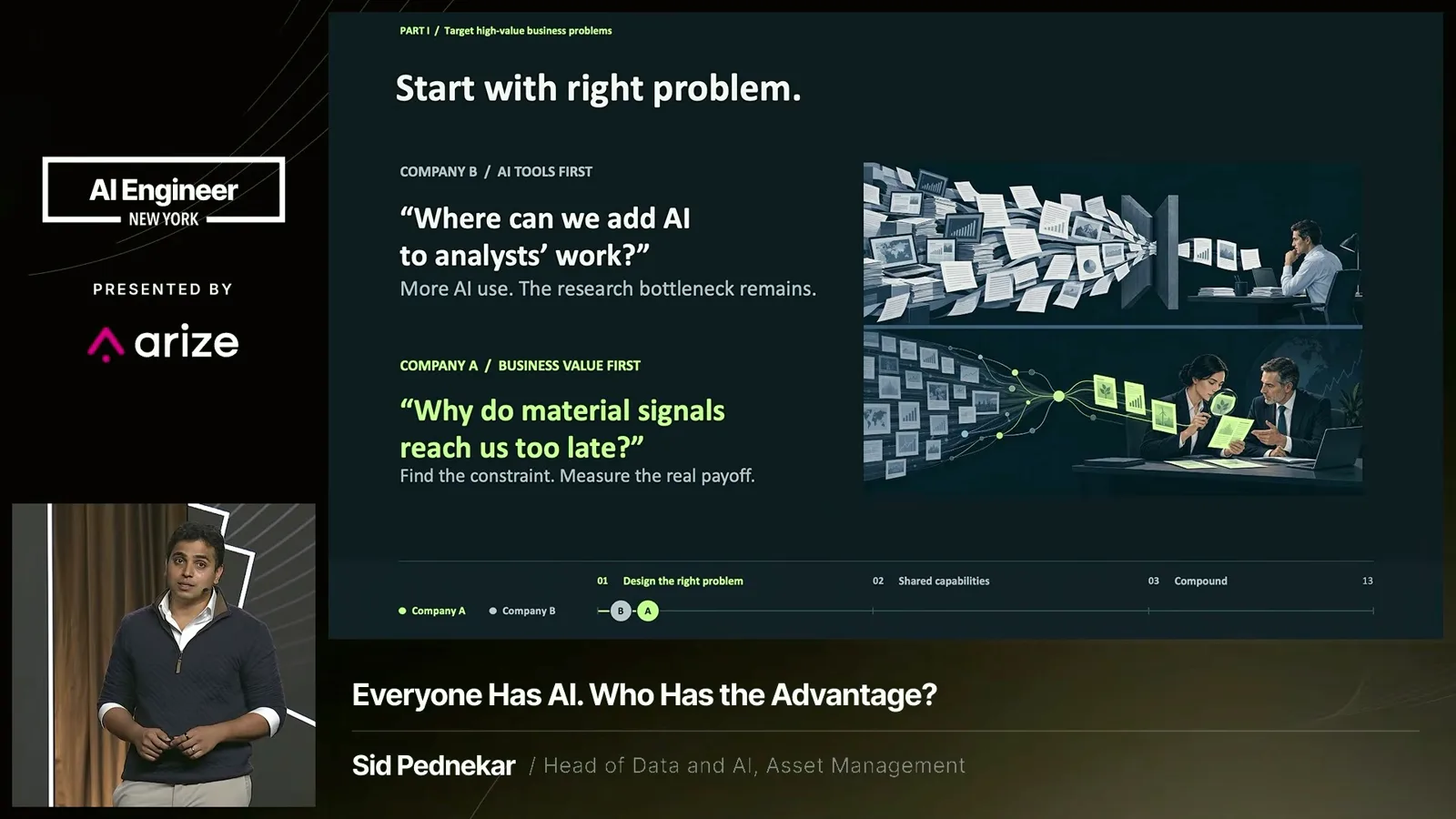
The relevant bottleneck could be research capacity, decision speed, data quality, latency or reliability. Leaders, in my account, are selective about which decisions deserve attention rather than treating every possible AI feature as equally valuable.
Experimentation is useful, but it is different from innovation theater or productivity theater. A firm with disconnected summary, copilot and retrieval pilots can appear active without improving an important outcome. I advocate concentrating engineering, analytics and human judgment on a small number of valuable workflows.
Redesigning work also means changing roles. Rather than merely accelerating a report, an analyst could define an investment thesis, monitor evidence for and against it, investigate exceptions and spend time on the cases most likely to affect a decision. The distinction is between speeding up a task and reconsidering the system around it.
Build shared capabilities
Technology and business teams share infrastructure, data and institutional knowledge.
Once the problem is selected, the second pillar is shared capability. Technology and business roles are converging: engineers move closer to business outcomes, while business specialists build tools and automation. Bringing the right people together requires crossing organizational silos.
I call this standardizing the core and personalizing the edges. Shared infrastructure and modules are familiar ideas, but AI changes what can be shared across analysts, clients, engineers and data scientists while still allowing each group to adapt its own workflow.
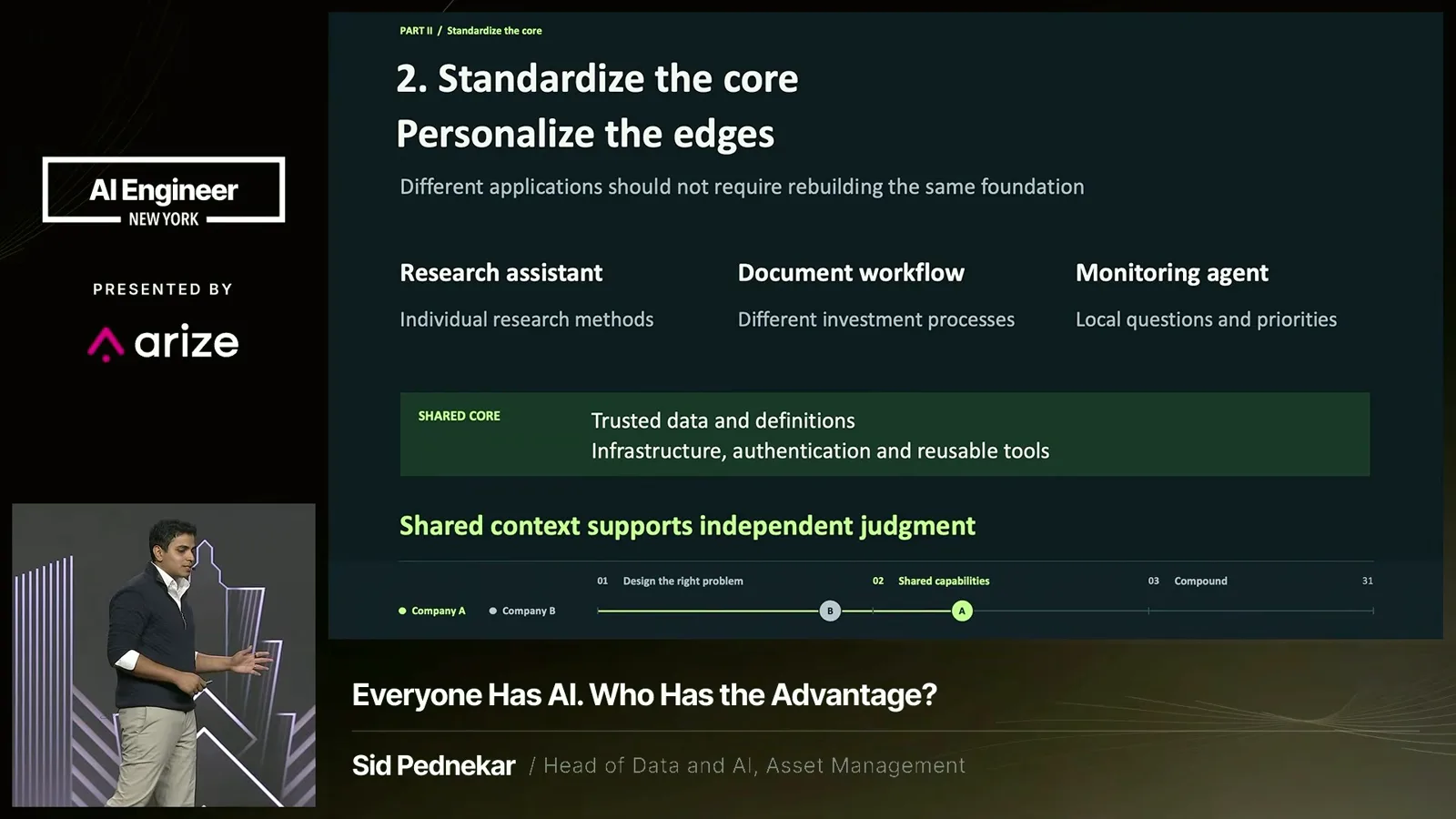
For data scientists, a shared core might include datasets, semantic definitions and a record of what worked, what failed and where the gaps are. The next person should be able to build on that work instead of rebuilding it from scratch. Ask what a successor should not have to reconstruct.
Enterprises were largely designed around people using individual applications. Agents can move across applications and workflows, so leaders need to understand where infrastructure and data quality must change. Reusable data is a common challenge.
Reusable knowledge can support different kinds of team agents: subject-matter specialists, workflow agents that coordinate tasks, or agents that track organizational state. Their value depends on the shared knowledge and processes available to them.
Compound the advantage
Organizations preserve evidence from successes and failures and direct freed capacity to valuable work.
The final pillar is compounding. When an initiative fails, what can the organization learn? When it succeeds, how does that become part of the system? An individual may learn from a correction, but the organization benefits only if useful evidence and learning are fed back into tools, context or process.
AI can free capacity, but leaders still have to decide where that capacity goes. Redesign the system around important measures, monitor the results and build a feedback loop. My closing question is the same one I started with: when everyone has AI, who has the advantage?
Mehr aus diesem Kanal
 23:05ZH
 AI Engineer· 6. Nov. 2026Ryo Lu:当我们什么都能做,还知道自己想做什么吗?Ryo Lu从 AI 生成的日记工具到爵士乐团,Ryo Lu 讨论如何在更强大的工具旁保有判断、生活和与他人合作的空间。
 14:58ENAI Engineer· 6. Nov. 2026Sparsh Jain on Building Experiential Memory for AI AgentsSparsh Jain · CentralAgent AIAn agent-memory lifecycle forms, updates and retrieves lessons while evaluation loops manage changing context.
 17:27ENAI Engineer· 6. Nov. 2026Philipp Schmid: Seven Things an AI Coworker NeedsPhilipp Schmid · Google DeepMindA walkthrough of managed agents, skills, credentials and controls, culminating in a scheduled portfolio-audit demo.
 14:04ENAI Engineer· 6. Nov. 2026Frank Long on Building AI Investment Workflows Around QualityFrank Long · CoatueCoatue’s Frank Long breaks investing into information, analysis and decision steps, and argues for choosing the right combination of code, models and people.
 17:52ENAI Engineer· 5. Nov. 2026Cameron Wolfe on Evaluating AI When Answers Are SubjectiveCameron Wolfe · NetflixNetflix’s Cameron Wolfe outlines human review, calibrated model judges and production monitoring as a repeatable evaluation loop.
 20:45ENAI Engineer· 5. Nov. 2026John Stecher and Scott Worland on Building AI Systems That Can ChangeScott Worland, John Stecher · Norm AIThe Blackstone and Norm AI CTOs discuss data strategy, evaluations, production controls and when to wait for a better model.