In 30 Sekunden
Matthew Berman watches OpenAI’s December 2024 Canvas presentation and discusses the company’s move into creative and developer tools. The presenters show a side-by-side writing workspace, inline comments, Python execution and editing inside custom GPTs. A debugging demo fixes a Matplotlib error and renders a chart; a later Sankey example needs further refinement. Berman also considers the platform risk for developers building on an AI provider.
- 1Three Canvas changesOpenAI announces broader availability, Python execution and custom GPT support in its December 2024 presentation.
- 2A document beside the chatA story appears in an editable Canvas, separate from the conversation. Both the user and ChatGPT can make changes.
- 3A debugging loopThe console reports a Matplotlib error, ChatGPT suggests a correction, and the presenters rerun the code to produce a chart.
- 4An imperfect diagramGenerated Sankey code initially fails on color handling; after a correction it renders a graphic that still needs refinement.
- 5Custom GPTs and CanvasA letter-drafting GPT uses an image and added context to produce an editable first draft.
Das Wichtigste
- The 2024 announcement expanded Canvas access, added Python execution and brought Canvas to custom GPTs.
- A side-by-side document and chat let people edit directly while asking the model for changes or comments.
- Python execution exposes errors to ChatGPT and supports a run, diagnose, edit and retry loop.
- The Sankey example produces an error and an imperfect chart, illustrating why outputs still need inspection.
- Berman sees both an opportunity in integrated AI tools and platform risk for developers building on a provider.
Den bearbeiteten Text nach Kapiteln lesen
The Canvas announcements
OpenAI announces broader availability, Python execution and support in custom GPTs. Berman reacts to the December 2024 launch.
On day four of OpenAI’s December 2024 launch series, the focus is Canvas, a separate surface for collaborating with ChatGPT on writing and code. Earlier announcements included o1 Pro and Sora. We will watch the presentation and examine how the new Canvas features work.
OpenAI product lead Kevin says demand for Sora has been unusually high and the team is working to expand access. I noticed the service improving after launch, including the ability to see progress on a video generation. The rest of the presentation turns to Canvas, which had previously been in beta for Plus users.
Kevin announces three changes: Canvas is being made available to everyone and integrated into the main model, Python code can be run inside a canvas, and Canvas is coming to custom GPTs. I am especially excited about running code and iterating on the output inside the same environment. These announcements describe the product at the time of the video.
Writing side by side
The presenters create and edit a story with chat and document in separate panes. Berman discusses the implications of OpenAI building creative tools.
OpenAI engineers Lee and Alexi begin with a Christmas story. The 2024 composer has a tools button from which Lee selects Canvas. I speculate that OpenAI might eventually let outside developers build tools for that menu, but I have no information confirming such a plan.
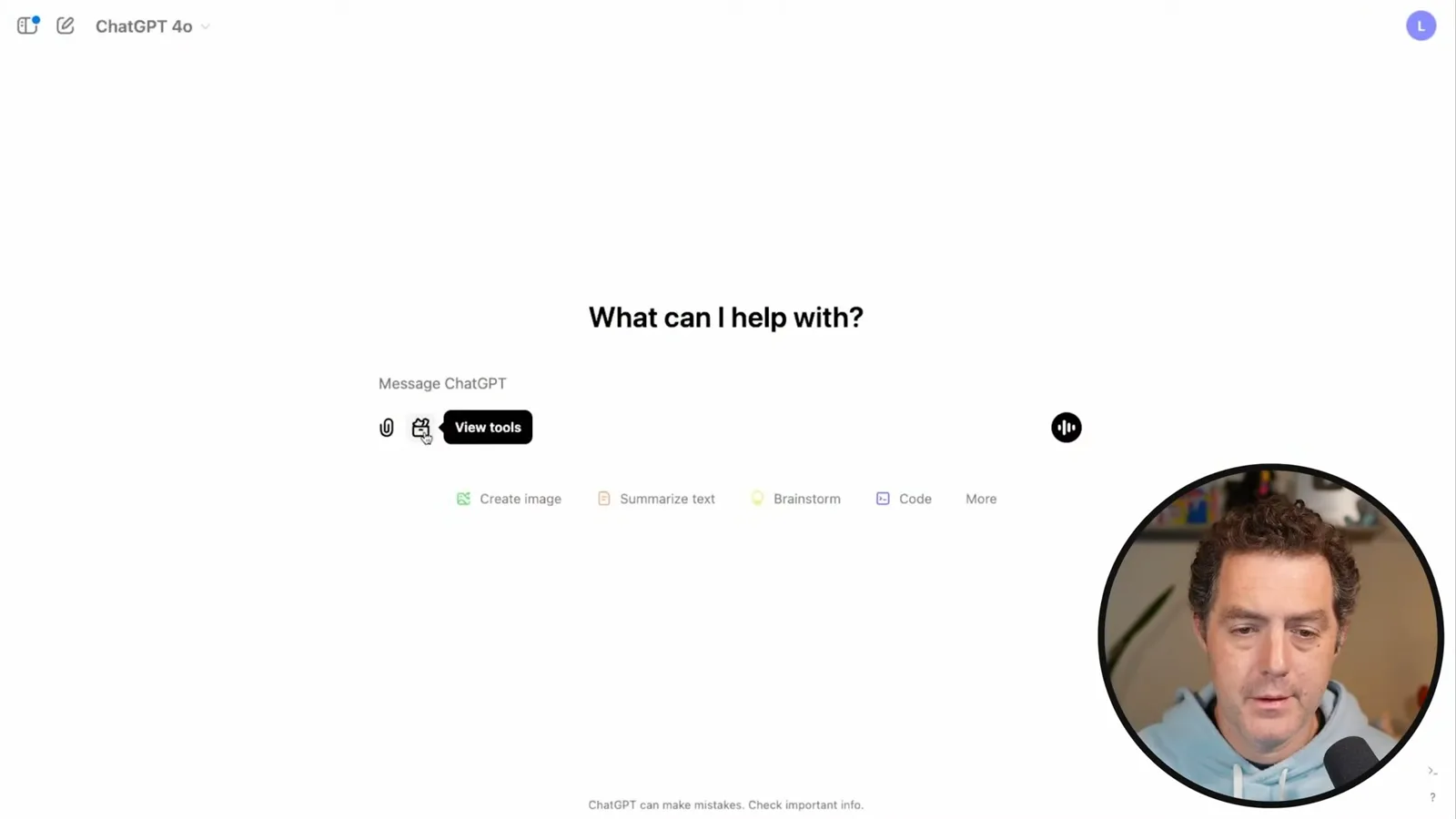
Lee asks ChatGPT for a children’s story about silly elves. Chat appears on the left and the document on the right, keeping the actual story separate from the conversation and its preamble. The separation makes it easier to locate the document and edit it instead of losing revisions in a long chat.
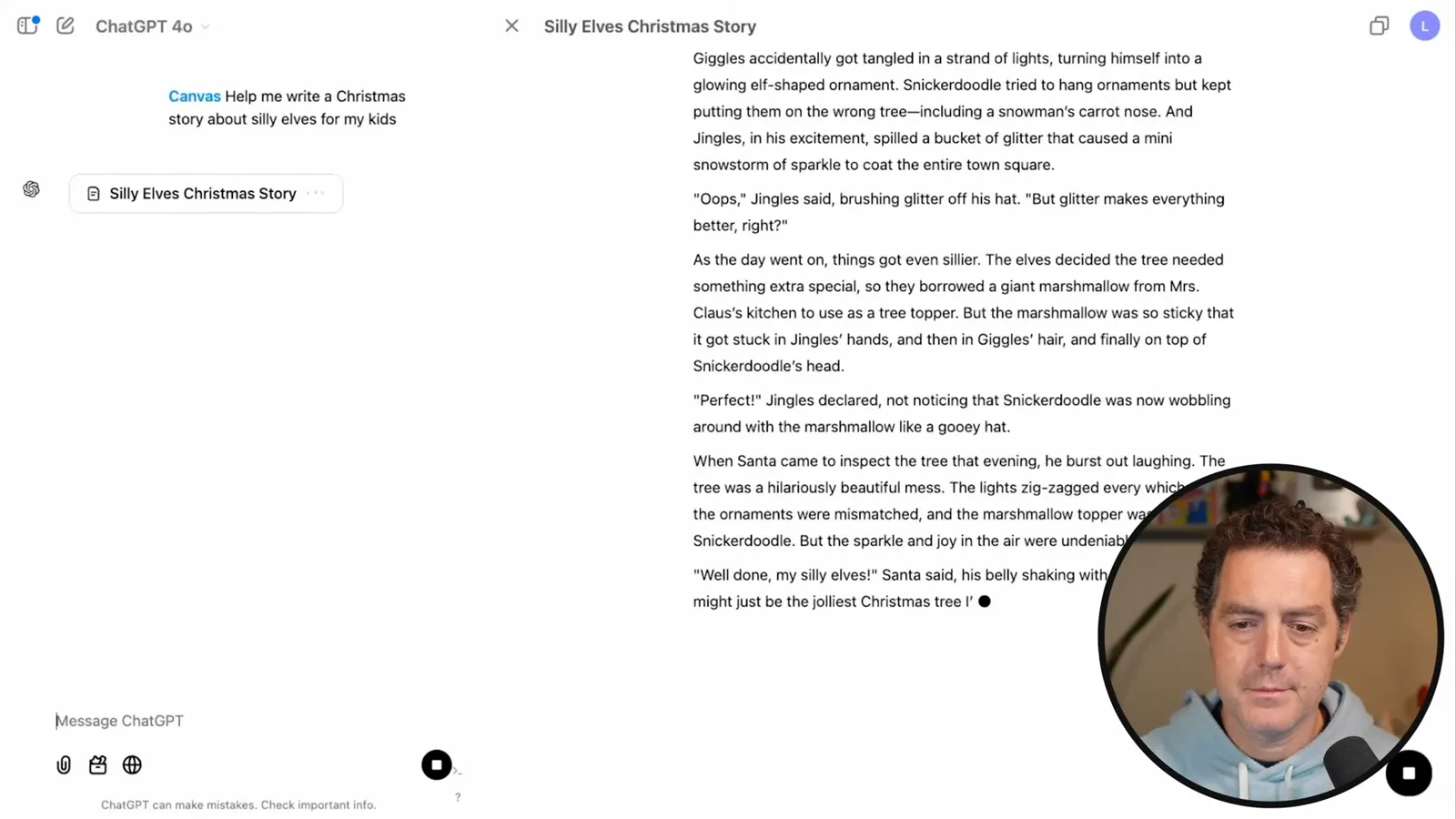
Both the person and ChatGPT can edit the canvas. Lee shortens the story’s title directly, while requests sent in chat can ask the model to make changes. I think this side-by-side arrangement makes creative writing and coding easier to work with than a single stream of messages.
This also reveals how I think OpenAI is positioning itself: not only as a model provider but as a provider of creative tools. As models become more commoditized, tools and infrastructure become important. For developers building on OpenAI, however, platform risk is worth considering: the platform might eventually build a competing product.
The presenters show ordinary editor capabilities such as adding and bolding text, plus shortcuts for asking ChatGPT to suggest edits. Some of these features were already available. The useful distinction is that a person can edit the document directly while asking the model for feedback or changes in context.
Feedback on an existing document
Pasted text can be opened in Canvas and edited before sending. The model leaves comments linked to specific parts of an essay.
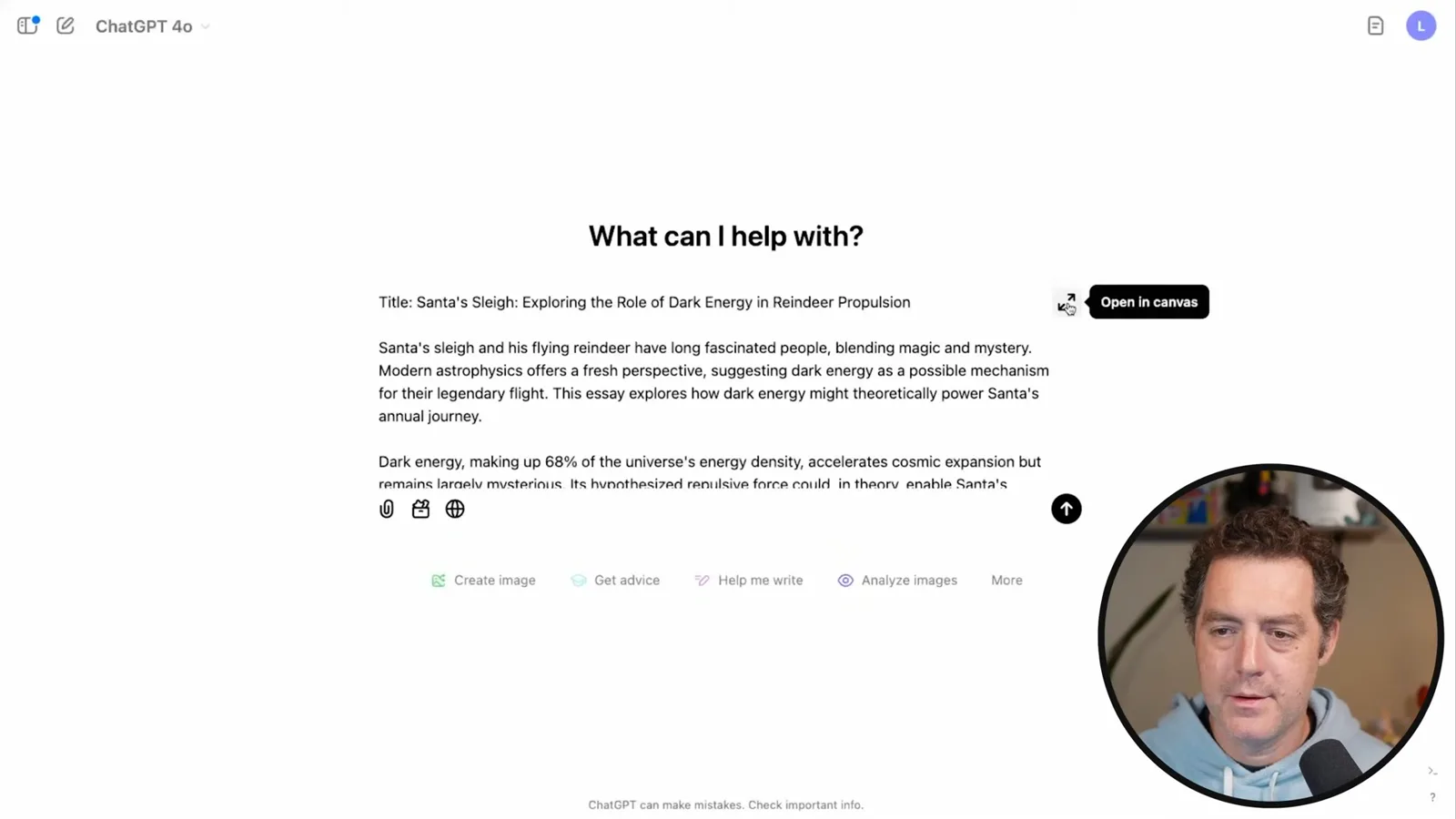
Alexi pastes an essay about the fictional physics of Santa’s sleigh into the composer. A new “open in canvas” button appears for the substantial text, allowing it to be edited as a draft before it is sent. Bolding the title is an ordinary editor action, not an AI operation; ChatGPT has not seen the draft until a message is sent.
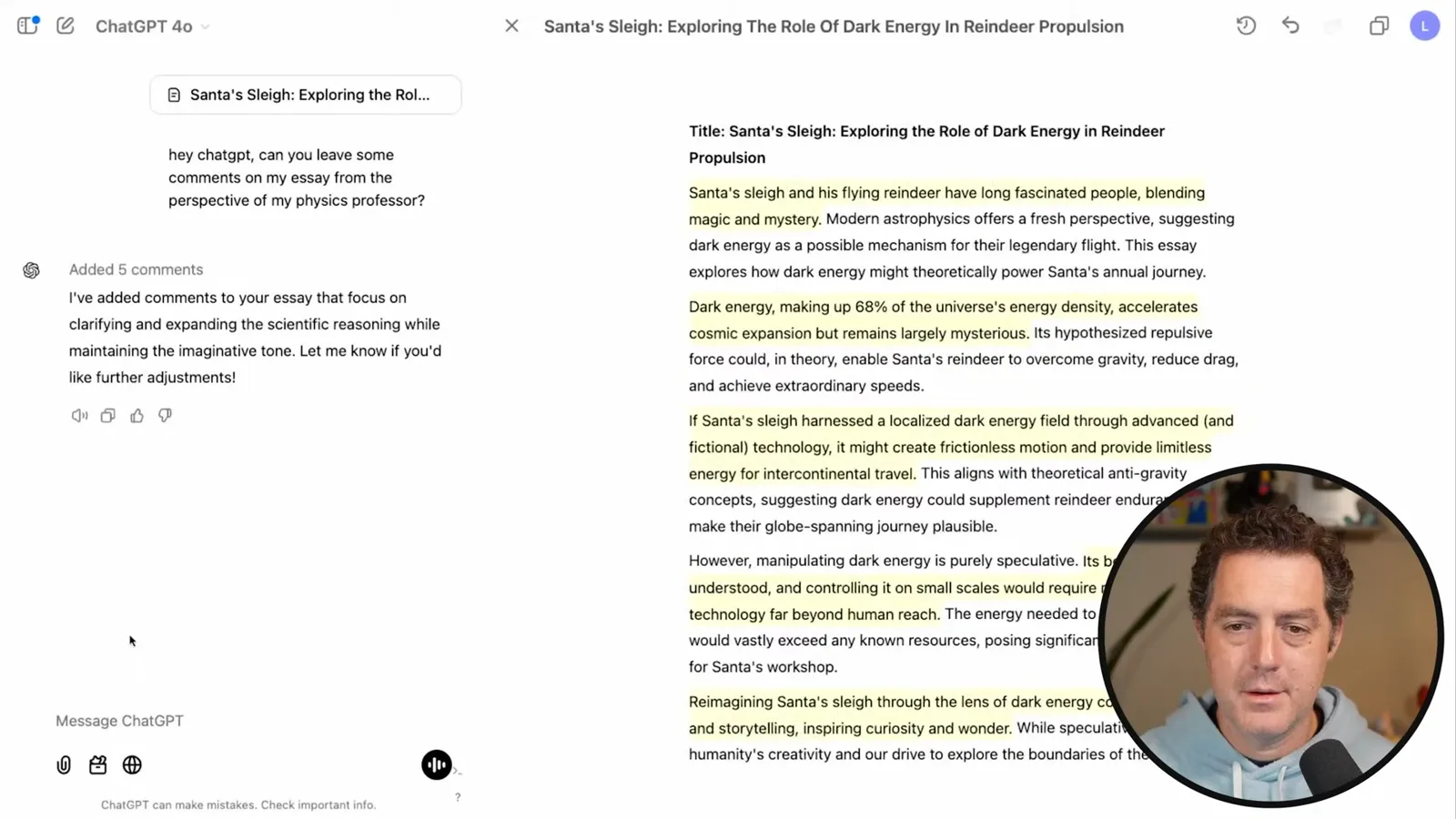
Alexi asks for comments from the perspective of a physics professor. ChatGPT selects portions of the essay and leaves inline comments, which can be applied or rejected. I think inline comments may already have existed, but the interaction is appealing because the feedback is attached to the relevant text, much like a collaborative document editor.
Run, debug and revise Python
The presenters run a broken script, inspect an exception, apply a fix and review changes. A second diagram example shows a further error and an imperfect result.
The next demonstration switches to programming. Alexi copies a broken Python example from a local IDE into ChatGPT and opens it in Canvas. The code editor recognizes Python and supplies syntax highlighting and basic autocomplete, with a Run button at the top.
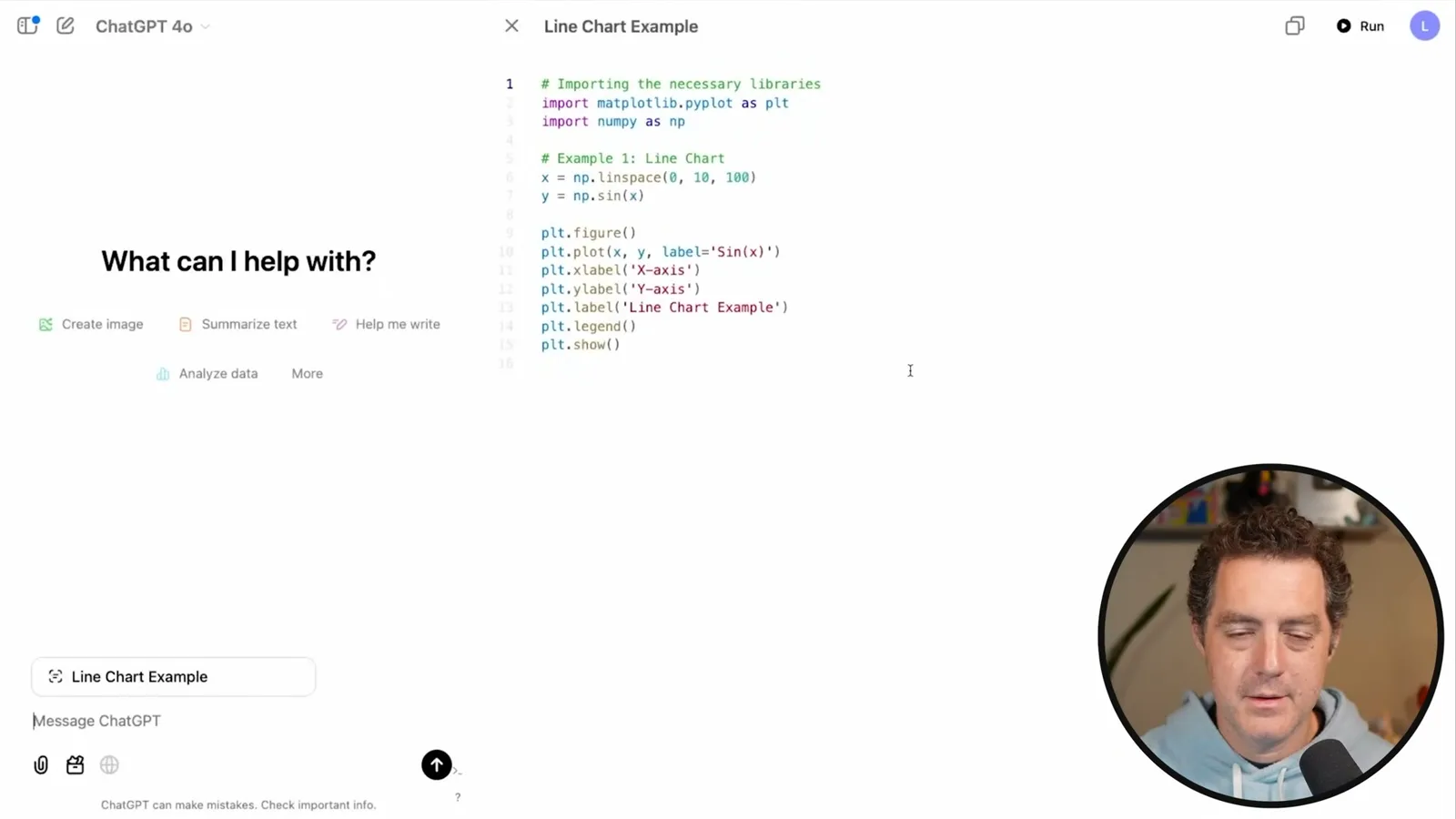
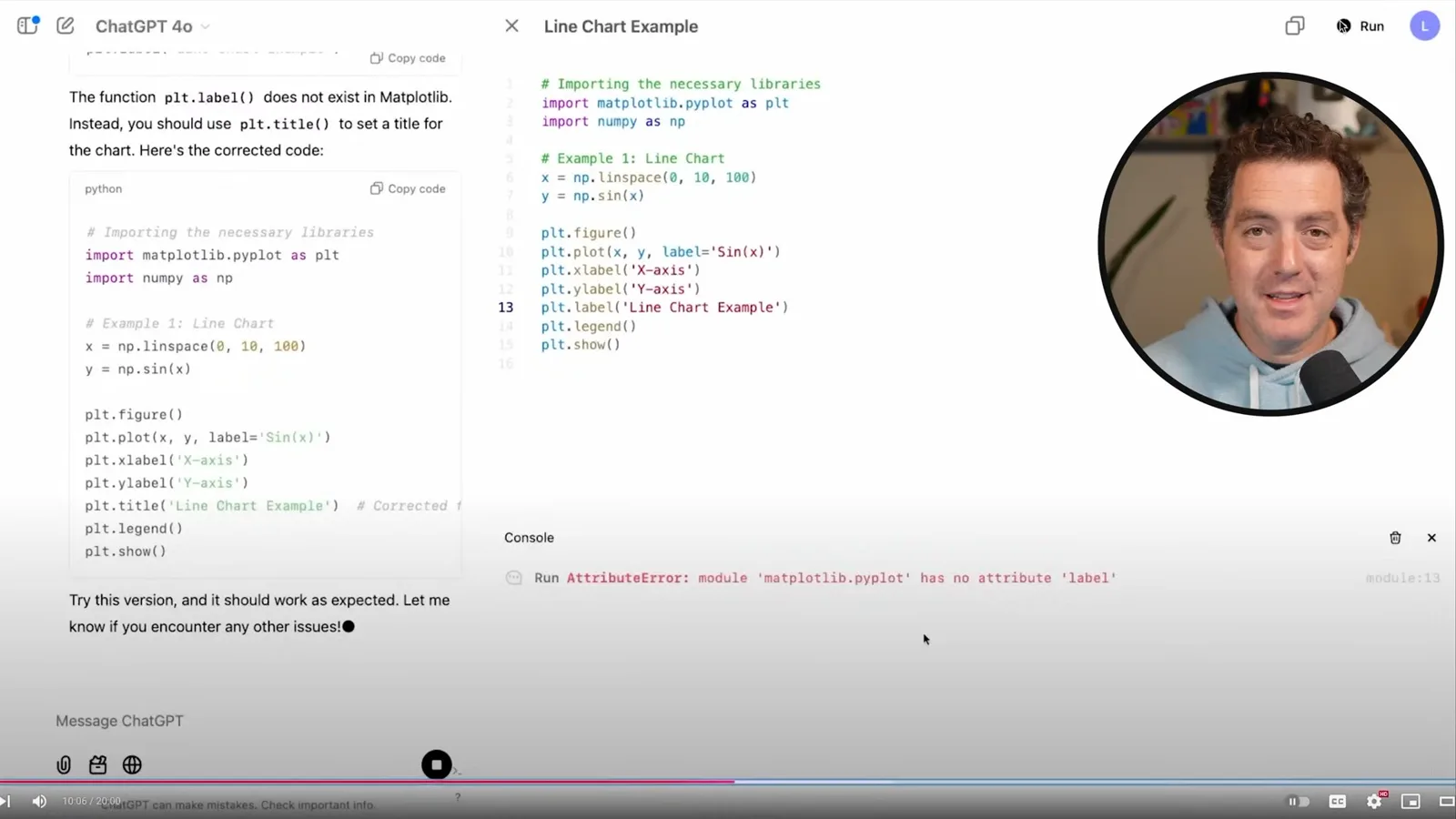
I see this as a move toward bringing more developer tooling into ChatGPT, although the editor shown is still basic. Alexi asks the model to debug the script. ChatGPT identifies an invalid Matplotlib call, plt.label, and suggests using plt.title instead.
The presenters run the original code. A console opens and displays the exception, which ChatGPT can also see; it leaves a comment explaining the problem. Clicking Fix bug sends the code and error back to ChatGPT, which changes the canvas. This makes execution, feedback and editing part of one loop.
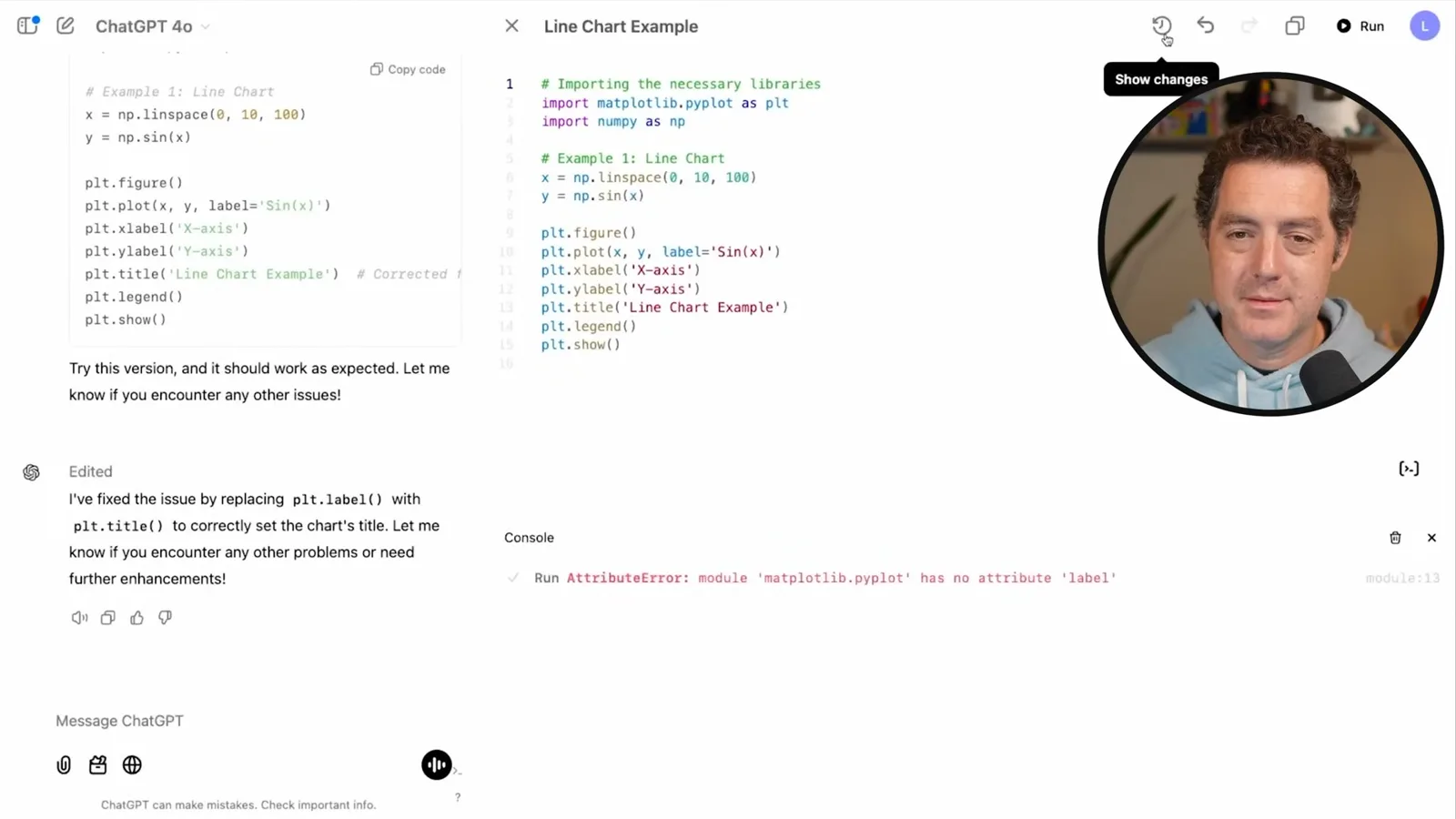
A Show changes control reveals an inline diff, and the presenters say the same feature works for documents. After the correction they run the script again and a line chart renders. The successful retry supports this particular fix, not a guarantee that generated fixes will always be correct.
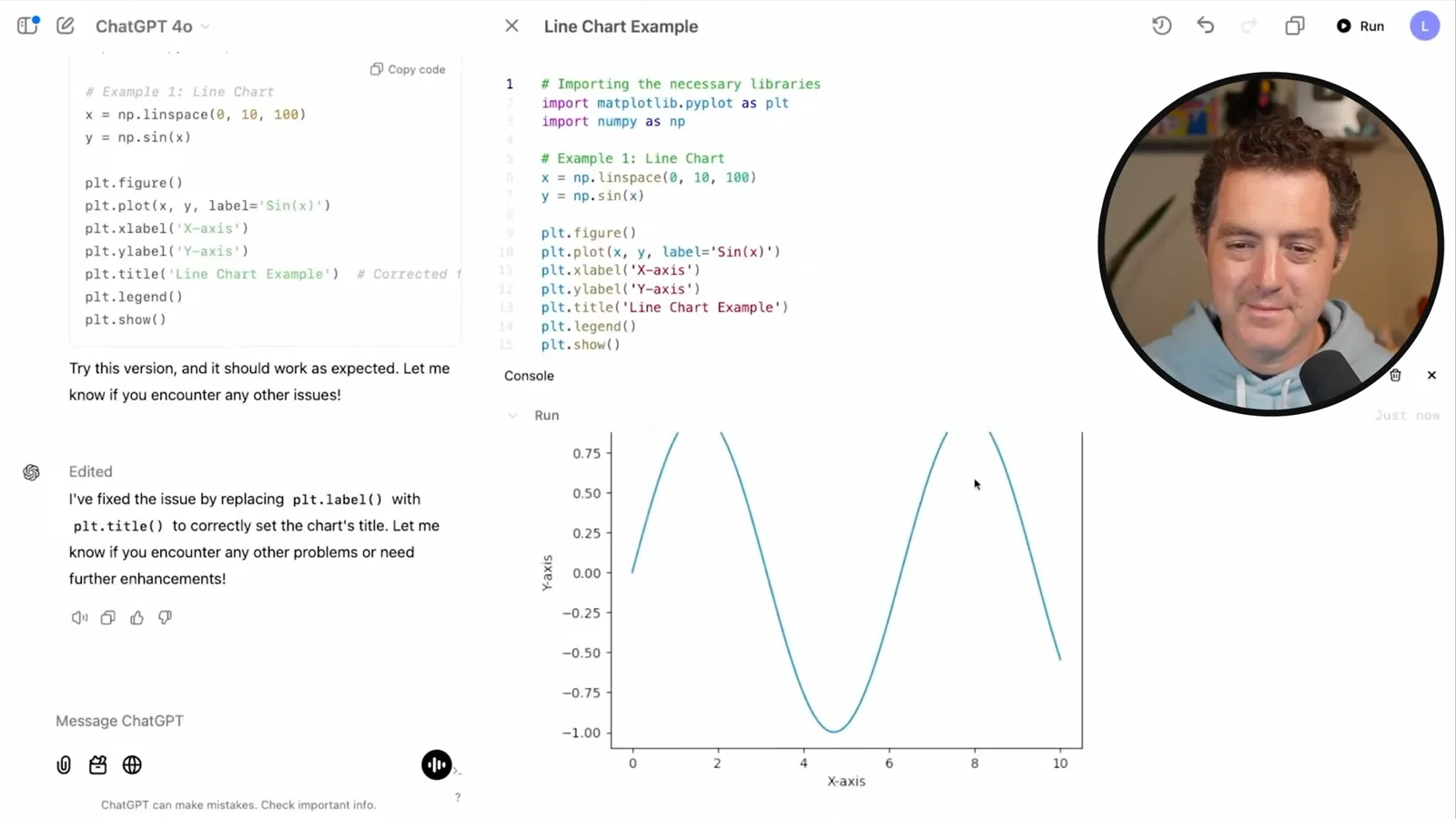
The presenters explain that Canvas uses a WebAssembly Python emulator to run code and load libraries with fast feedback, including graphics. At the time I understand the feature to support Python, and I speculate that other languages could eventually be supported; that is not an announcement.
For a second programming example, Alexi asks ChatGPT to add a Sankey diagram showing the flow of Santa’s toys and to use appropriate colors. The model adds code and data, but the first run produces a color error. It then proposes a correction using a single color per flow.
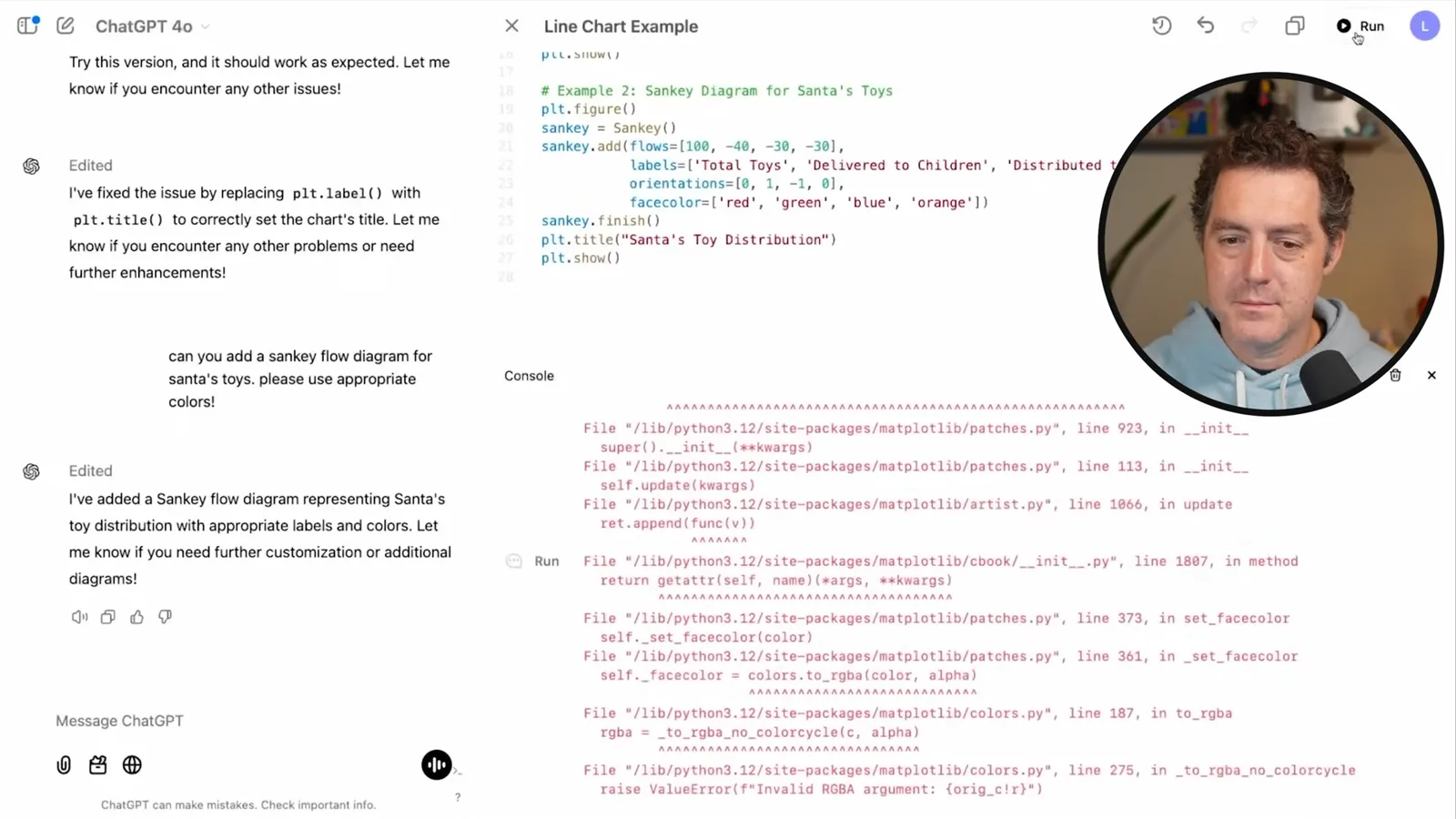
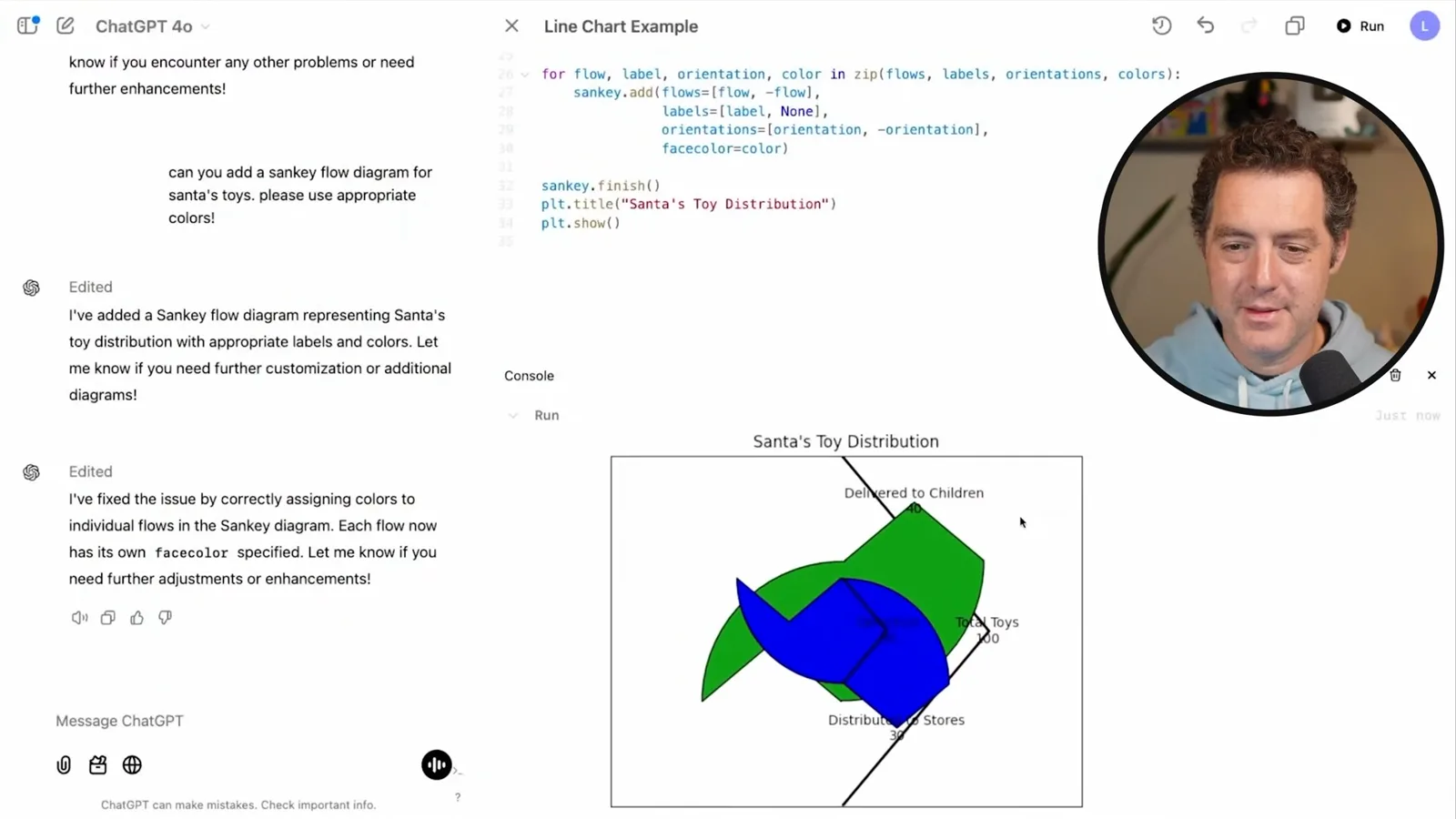
The next run produces a graphic, although the presenters observe that the Sankey layout still has problems. They suggest continuing to refine it and even dragging the image into the prompt so ChatGPT can see the result. The example shows both the benefit of the feedback loop and the need to inspect the output.
Canvas in a custom GPT
A Santa letter-drafting GPT uses a photographed letter and context to create an editable response. Berman closes with his assessment of the updates.
The last announcement brings Canvas to custom GPTs, which can be given instructions and context for specific tasks and shared with others. Lee builds a Santa letter drafter as an example. I use a few custom GPTs myself and am interested in how others use them.
The presenters provide a photograph of Alexi’s letter, which asks for a bike, a GPU and dark matter, and add the context that Alexi has been nice. The custom GPT drafts a response in Canvas. The idea is to give Santa a starting point that can be reviewed and edited rather than sending an untouched response automatically.
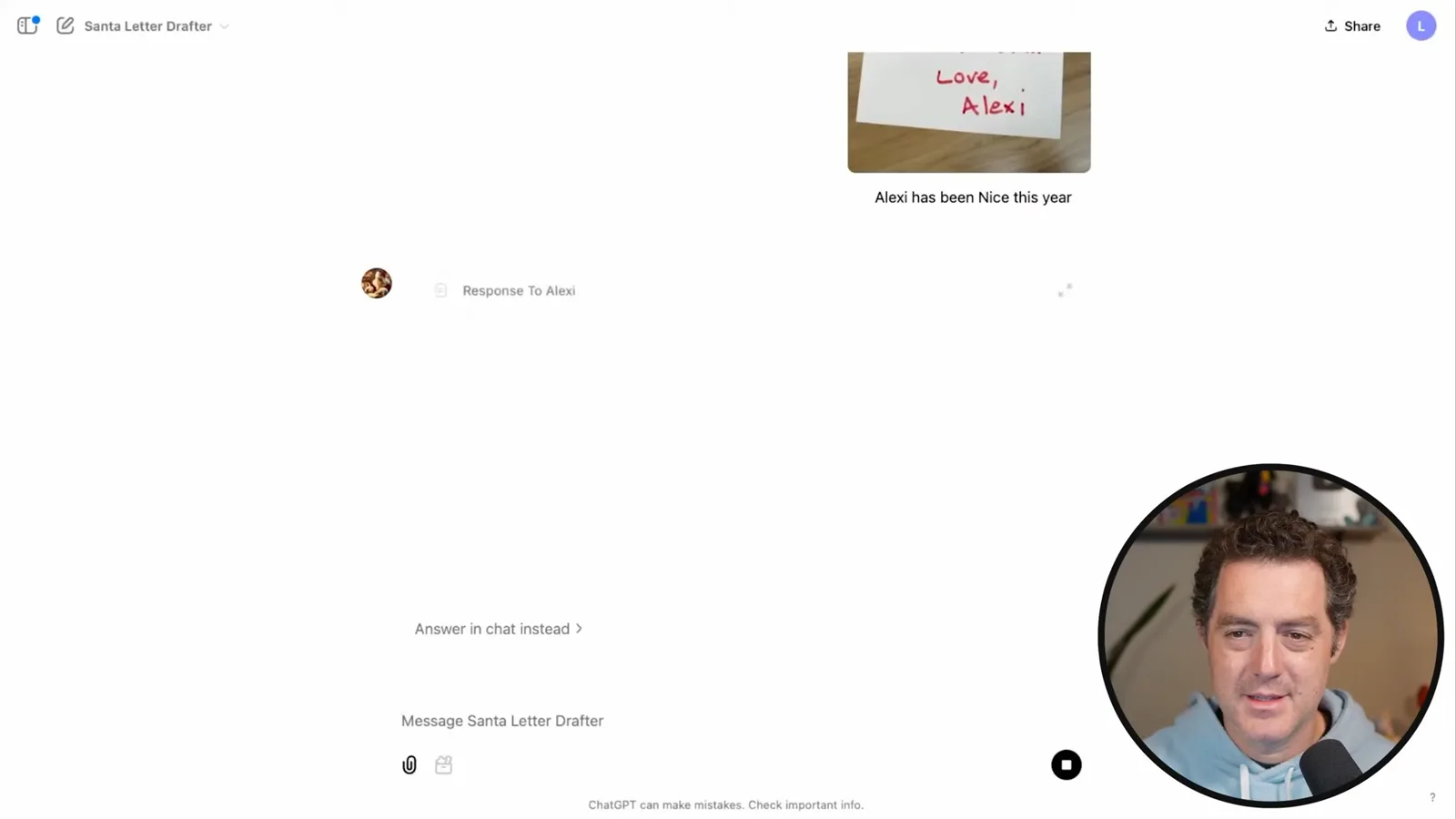
The draft responds to the requested bike and H100 GPU while treating dark matter as beyond the toy factory’s capability. A person can revise it in Canvas. These are quality-of-life updates rather than an announcement on the scale of o1 or Sora, but I find the integrated writing and code workflow useful.
Mehr aus diesem Kanal
 34:21EN
 Matthew Berman· 27. Okt. 2026Matthew Berman Examines Anthropic’s IPO Filing, AI Growth and GovernanceMatthew Berman, Sam Altman · Forward FutureThe presenter reviews the S-1’s financial metrics, compute strategy and voting structure while questioning the tension between rapid AI development and safety.
 25:50ENMatthew Berman· 24. Okt. 2026Kimi K3.1 Pro Tested: Strong 3D Demos, Uneven Results and Competitive PricingMatthew Berman · Forward FutureMatthew Berman tests the open-weight model on coding, 3D rendering and visual explanations, then compares benchmark results and prices.
 32:20ENMatthew Berman· 23. Okt. 2026Who Is Local AI For? The Costs, Trade-offs and a Hybrid FutureMatthew Berman · Forward FutureMatthew Berman weighs data control and independence against hardware cost, setup complexity and inference speed.
 1:03:37ENMatthew Berman· 23. Okt. 2026Matthew Berman’s Team Tests Kimi K3.1 on Animation, Games, and ChartsMatthew Berman, Alex, Brian · Forward FutureA live team AMA turns into an informal test of Kimi K3.1, from personal-agent workflows to motion graphics, a browser game, and a benchmark chart.
 0:53ENMatthew Berman· 22. Okt. 2026Sam Altman on AI and the Discovery of New KnowledgeSam Altman · OpenAIAltman expects progress in mathematical discovery to extend to biology, materials and energy.
 0:22ENMatthew Berman· 21. Okt. 2026A Robot Bodyguard Video Shows Dramatic Rescue ScenariosMatthew Berman · Forward FutureMatthew Berman reacts to a short robot demonstration depicting fighting and vehicle-rescue scenarios.