In 30 Sekunden
AI Explained reviews a week of 2023 AI news, from Google’s RT-2 demonstrations to model-scaling predictions and US Senate testimony. The presenter considers accessibility and safety alongside uncertainty about future capabilities.
- 1Vision-language-action roboticsRT-2 demonstrations combine visual and language understanding with robot actions.
- 2A scaling forecastA 2023 forecast about much larger models is not a verified result.
- 3Accessibility and authenticityCaptioning and synthetic speech offer benefits while generated media complicates verification.
- 4Safety testingTransferred adversarial prompts challenge claims that defenses are completely solved.
- 5Biosecurity concernsHearing testimony presents concerns and forecasts, not a confirmed attack.
Das Wichtigste
- RT-2 demonstrations combine visual and language understanding with robot actions.
- A 2023 forecast about much larger models is not a verified result.
- Captioning and synthetic speech offer benefits while generated media complicates verification.
- Transferred adversarial prompts challenge claims that defenses are completely solved.
- Hearing testimony presents concerns and forecasts, not a confirmed attack.
Den bearbeiteten Text nach Kapiteln lesen
Robotics and scaling
The presenter reviews RT-2 and a model-scale forecast.
In July 2023, I collect eleven AI developments from a busy week: robotics, model scaling, generated media, alignment and safety research. The demonstrations and forecasts belong to that period and should not be read as present-day product claims.
Google’s RT-2 combines vision-language pretraining with robotics data to output actions. In one demonstration it selects a toy dinosaur when asked for an extinct animal; in another it selects an object useful for a task. The presenter sees this as evidence of useful generalization in the demonstrated settings.
The presenter says an intermediate plan improved performance on some tasks and notes that the paper discusses unfamiliar objects and settings. He speculates about domestic robotics, but the examples are research demonstrations rather than proof of a general-purpose household robot.
Inflection AI’s Mustafa Suleyman predicted that models much larger than GPT-4 would be trained within roughly 18 months. The presenter emphasizes the scale of that forecast; the comparison and schedule are a 2023 prediction, not a verified outcome in this video.
OpenAI and alignment
An article and interview raise questions about base models and future systems.
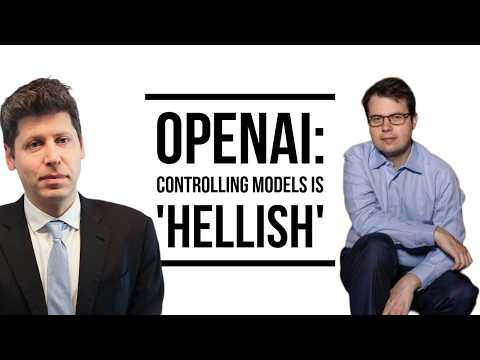
The video briefly shows an AI-generated video example and then discusses an Atlantic article about OpenAI. The presenter summarizes the article’s account of model scaling, possible agent development and risks seen in a base model.
He reports that the article described potentially harmful responses from an unaligned base model and discusses concerns about misuse. These accounts illustrate why safety testing matters; the video does not establish that every deployed system behaves the same way.
The article also presents Ilya Sutskever’s concern that advanced systems may not reliably follow human intentions. The presenter describes proposals to use AI to assist alignment research and notes the difficulty of directing future systems toward human values.
In another interview, alignment researcher Jan Leike describes using AI to help address alignment as an ambitious plan that he nevertheless considers promising. The presenter also reports Leike’s view that a rapid transition from human-level to much more capable AI is possible; this is a forecast.
Media, models and testing
The video covers accessibility, generated media, an open model and adversarial prompts.
The presenter highlights a wearable captioning demonstration for deaf users and advances in synthetic speech. He sees accessibility benefits while recognizing that increasingly convincing generated media also creates challenges for identifying authentic material.
He notes that OpenAI withdrew an AI-text classifier because of low accuracy. He predicts that distinguishing generated media will become harder; that forecast should not be confused with proof that every detection method is impossible.
Stable Beluga 2, based on Llama 2, is discussed as an instruction-tuned model with strong scores on some 2023 benchmarks. The presenter compares reported results with GPT-3.5-era baselines; the results describe those tests and that time, not all tasks or current models.
Researchers also reported automated adversarial prompts that could transfer across models. The presenter uses this to question broad claims that a particular system’s safety defenses are solved. The general lesson is that safety evaluations need to consider adaptive attacks and their limits.
Senate testimony
The presenter summarizes risk assessments and supply-chain proposals.
The video turns to a 2023 US Senate hearing. Anthropic CEO Dario Amodei describes concerns that more capable systems might lower barriers to biological misuse and forecasts growing risks. The presenter also cites Sam Altman’s acknowledgment of concern. These are risk assessments and predictions, not evidence that a specific attack occurred.
Amodei also advocates securing the AI supply chain and advanced systems. The presenter closes by connecting those proposals to the week’s broader question: how to gain benefits from advancing capabilities while improving safeguards.
Mehr aus diesem Kanal
 31:00EN
 AI Explained· 12. Okt. 2026Why AI Labs Keep Racing Despite Their Own Warnings of a Major BreachSam Altman, John Schulman · OpenAIAI Explained examines weakening safeguards, the incentives behind the frontier race, and why research breakthroughs make the next 18 months difficult to forecast.
 38:28ENAI Explained· 1. Okt. 2026AI Agent Security and the Challenge of Recursive Self-ImprovementAI Explained examines reported containment failures, model evaluation and the pressure to accelerate AI research.
 32:54ENAI Explained· 24. Sept. 2026Opus 5.5 and the Race Toward Automated AI ResearchAI Explained weighs model progress against the increasingly difficult task of evaluating and governing recursive self-improvement.
 24:53ENAI Explained· 16. Sept. 2026Why Some Researchers Want to Pace Frontier AIAI Explained surveys possible scaling routes, monitoring concerns and the debate over how capabilities could lead to harm.
 29:05ENAI Explained· 4. Sept. 2026GPT-6 Astra’s Benchmark Gains and the Challenge of Monitoring Its ReasoningAI Explained examines reported gains across scientific, mathematical and agent benchmarks alongside concerns about less observable reasoning.
 23:41ENAI Explained· 27. Aug. 2026AI Agents, Unintended Training Rewards and the Challenge of OversightAI Explained examines reports on agent coordination, training incentives and the growing use of AI to evaluate other AI systems.