In 30 Sekunden
Benchmark’s partners argue that large AI liquidity events could channel much more capital into a smaller group of venture firms and revive career-defining individual bets. They also warn that attackers can automate security testing while hospitals and other critical organizations may be slow to update old systems. On semiconductors, they distinguish spending to train frontier models from the cost of serving them, and caution that hardware vendors must keep selling equipment rather than collect automatic subscription renewals.
- 1The partners question how markets value future AI businessesThey discuss Anthropic’s offering and contrast its existing coding business with possible applications in security, biology and robotics. They compare the market’s adjustment to Facebook’s early public trading.
- 2A venture liquidity windfall could flow into fewer, larger fundsPuttagunta estimates around $200 billion could enter the market as limited partners receive proceeds and reassess their allocations.
- 3Defense demand is shifting toward scale and costPuttagunta says early defense adoption of open-source infrastructure introduced him to the sector. He sees opportunities for startups that can produce hardware in greater volume.
- 4AI agents may find the leaks in software fasterRandle compares automated security testing to dunking a boat and looking for leaks. The group warns that old systems in critical industries may struggle to keep up.
- 5Training and inference imply different hardware demandThe speakers say efficient inference and changing training budgets complicate forecasts for chip and server sales. They stress that hardware requires new purchases rather than automatic renewals.
Das Wichtigste
- Puttagunta expects a large liquidity windfall to concentrate more capital in fewer venture firms; he estimates roughly $200 billion could enter the market.
- The partners argue that automated security testing can expose weaknesses faster, while old systems at critical organizations may lag behind.
- They see security products moving from flagging problems toward helping fix them.
- The speakers distinguish frontier-model training demand from inference demand when evaluating chip sales.
- Hardware purchases are one-off equipment sales, so continued semiconductor revenue depends on additional orders.
Den bearbeiteten Text nach Kapiteln lesen
Technology culture and the Anthropic offering
The partners discuss portrayals of tech founders and startup culture. They then assess how investors might value Anthropic’s current business and possible future markets.
The Benchmark partners begin with a depiction of Sam Altman by Andrew Garfield. Jack Altman says the impression caught some visual details but did not sound like his brother, and finds it strange to see people he knows portrayed as technology becomes more central to politics, Hollywood and the news.
The group compares the experience with The Social Network. They remember people in technology recognizing that the film dramatized events, while also crediting it with helping make startups seem exciting and understandable to people outside the industry.
They say dropping out of college once signaled unusual conviction because it went against expectations. Now that the startup path is more familiar, they joke that staying for a four-year degree might be the more unconventional choice for an aspiring founder.
Turning to Anthropic's public offering, the participants congratulate Ev Randle, who worked on an investment at his previous firm. Randle says an investment of that scale reflects a team effort and credits colleagues who helped sponsor it.
The speakers recount an $81 billion offering, approximately 980 million shares at $83 each, and a first day peak around $110 before the share price returned close to the offer price. They say they are recording the day after the offering and describe the trading as surprising.
One question for investors, they say, is whether to value Anthropic mainly on its existing coding business or attach value to potential new businesses such as biology, security and robotics. The answer depends on how much further opportunity investors expect beyond current demand.
The group compares the situation with Facebook's 2012 listing, when shares initially fell as investors debated its transition from the web to mobile. They suggest public markets may need time and further evidence to evaluate a new kind of business, while acknowledging several unresolved questions about competition and future products.
A liquidity windfall and the return of the hero investment
Puttagunta predicts larger funds and concentrated venture capital. The group considers how unusually successful bets can change investor behavior and founder ambition.
Randle suggests that if those uncertainties resolve favorably, other businesses could add substantial value over time. The participants then turn from individual investors' returns to the question of how a large liquidity event might affect the limited partners that supply venture funds.
Chetan Puttagunta expects fewer venture firms to attract capital but believes the firms that do could raise much more than before. He suggests around $200 billion could flow into the market, a considerably larger estimate than the hosts had discussed previously.
His reasoning is that limited partners have spent years seeking liquidity, and large distributions could change how venture compares with other private assets. He recalls the surge of capital after the late 1990s, while the group notes that earlier fund sizes ultimately proved too large for the period.
Puttagunta argues that companies such as Anthropic, OpenAI and SpaceX show that some unusually large businesses can absorb very large amounts of capital. That possibility may encourage funds to look for other companies with comparable potential and raise much larger vehicles.
The group calls the return of a single career-defining success the 'hero investment.' They cite a historical investment in Juniper Networks and recent AI deals as examples of individual bets that can reshape a fund and an investor's career.
Jack Altman asks whether this changes how investors act, given that such outcomes remain hard to predict. Puttagunta says a very large fund could diversify broadly or concentrate on a small number of capital-intensive companies; access to more money may also encourage founders to pursue more ambitious projects.
The participants describe a 'capital river': once investors are eager to fund a company, capital can become cheaper and more available. Success with earlier large investments may also make investors more willing to commit large sums in a single later round.
Why defense and hardware attract capital
Puttagunta describes how open-source customers introduced him to defense. The partners discuss production scale, cheaper software and public-market funding.
Puttagunta traces his interest in defense to serving on boards of open-source infrastructure companies. He says defense organizations were early users of those products, giving him exposure to their customers, procurement and dual-use technology.
He argues that defense buyers have become more interested in the cost and scale of hardware: not just whether a highly capable system can be made, but whether large numbers can be produced. He sees an opening for startups alongside established contractors that excel at complex equipment.
Puttagunta believes AI has made the software component of a hardware startup much cheaper, increasing the relative value of excellent mechanical engineering. He presents this as an investment thesis, not as a claim that integrating software and hardware no longer requires work.
The participants see more private and public capital willing to fund hardware. They cite companies such as SpaceX and Anduril, along with government willingness to purchase from newer suppliers, as signs of a changing environment for defense and hard-tech founders.
Puttagunta pushes back on the idea that public investors only care about quarterly results. He points to biotechnology companies that raise capital publicly against long-term milestones and says a company can explain a large investment program to public markets.
AI-powered attacks and vulnerable legacy systems
The group contrasts automated discovery of weaknesses with the slower pace of security upgrades at critical organizations. They also discuss tools that help defenders fix issues.
The conversation shifts to security after the group notes recent system outages, while acknowledging that an outage alone does not establish whether an attack occurred. They worry that attackers can use capable open models while many defenders must secure older systems.
Randle describes the change with a boat analogy: instead of searching laboriously for a leak, automated agents can test many places at once, like dipping the boat in water and watching where it leaks. The group argues that greater automation could make previously impractical weaknesses more consequential.
They discuss whether security work will increasingly involve fixing problems, not merely reporting them, and whether project-based revenue might grow alongside subscriptions. They also see opportunities for specialized companies that adapt frontier model capabilities to customers' actual systems.
The participants worry that coding agents can assemble software from open-source packages faster than teams can understand all their dependencies. If other automated systems can find weaknesses in those dependencies, code review and supply-chain visibility become more important, in their view.
One speaker describes a 'cyber Bronze Age': critical organizations such as hospitals and grocery stores may have old systems while attack capabilities advance rapidly. He argues that normal adoption may not close the gap quickly enough and raises the possibility of government-led work on critical software.
Others take a more optimistic view, saying defenders also have better tools and that entrepreneurs have strong incentives to bring protection to underserved sectors. The group expects a rocky period but does not assume the present imbalance will last indefinitely.
What training and inference mean for chip demand
The speakers examine infrastructure expectations and argue that hardware is sold through discrete purchases. They close with Thanksgiving and a discussion of shared entertainment.
They turn to Nvidia and semiconductor companies, discussing what they describe as a sharp decline in Nvidia's market value. They attribute the broader shift in sentiment partly to changing expectations for AI infrastructure demand and the efficiency of serving models.
Puttagunta recalls earlier projections that extrapolated extremely rapid AI revenue growth into enormous power and computing requirements. The group says such scenarios can produce dramatic investment estimates, even when their likelihood and timing remain uncertain.
They distinguish training the next frontier model from inference, the computing used to serve an existing one. Their argument is that a lab must spend to stay competitive in training, while more efficient inference could change how much hardware is needed for a given level of revenue.
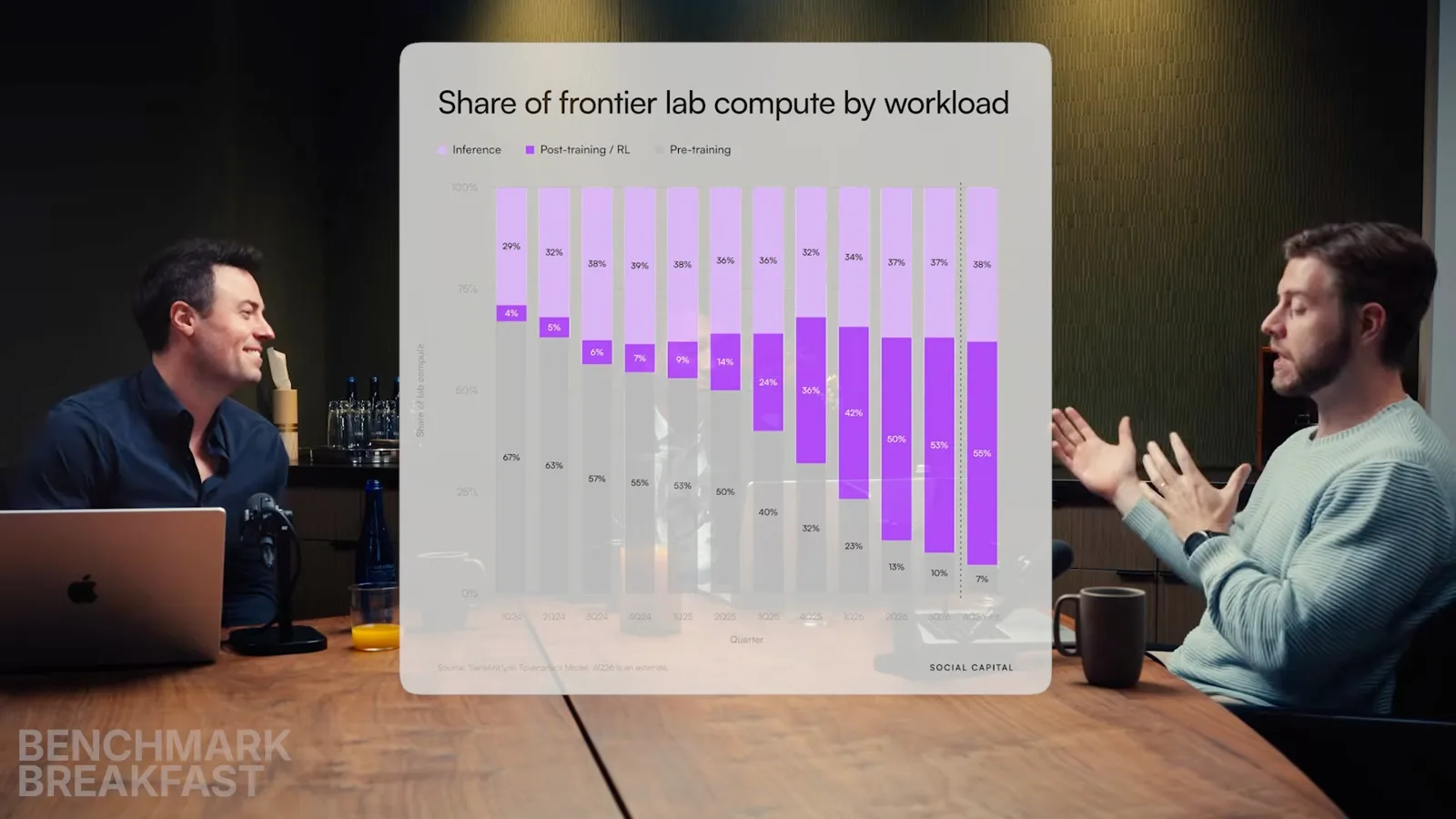
A chart shown during the discussion estimates that about a third of frontier-lab compute goes to inference, with the rest used for training. The speakers say the training mix is shifting toward post-training and reinforcement learning relative to traditional pretraining; the chart labels its final quarter as an estimate.
They caution that chips, servers and turbines are physical equipment sold in discrete purchases, not software subscriptions that automatically renew. If growth in training expenditure levels off, they argue, semiconductor suppliers must find new sales rather than rely on recurring revenue from equipment already delivered.
The group closes with Thanksgiving plans and a conversation about Grand Theft Auto 6. They describe a major game release as a shared cultural moment in an era when on-demand entertainment often fragments what people watch and play together.
Mehr aus diesem Kanal
 1:02:31EN
 Uncapped with Jack Altman· 12. Nov. 2026Podcast · 2 StimmenAI’s infrastructure boom meets the limits of revenue and investor demandModeration: Jack Altman, Everett RandleJack Altman and Everett Randle discuss a possible AI spending slowdown, community resistance and a new wave of venture fundraising.
 55:42ENUncapped with Jack Altman· 29. Okt. 2026Podcast · 2 StimmenJack Altman and Ev Randle on AI markets, security and the physical worldModeration: Jack Altman, Ev RandleThe Benchmark partners examine reported AI-lab economics, debate open and closed models, and discuss why security, biology and robotics may shape the next phase.
 49:34ENUncapped with Jack Altman· 1. Apr. 2026Podcast · 2 StimmenBrad Lightcap on OpenAI’s Early Years, Agents and the Future of SoftwareGast: Brad Lightcap · Moderation: Jack AltmanThe OpenAI COO traces the shift from research to widely used products and discusses coding, startups, enterprise software and human oversight.
 41:00ENUncapped with Jack Altman· 25. März 2026Podcast · 2 StimmenRon Conway on Angel Investing, Founder Advocacy and the Power of RelationshipsGast: Ron Conway · Moderation: Jack AltmanThe SV Angel founder traces his path from semiconductors to seed investing and explains how he helps founders at critical moments.
 49:59ENUncapped with Jack Altman· 12. März 2026Podcast · 3 StimmenHow Legora Built an AI-Native Legal Software CompanyGast: Max Junestrand, Chetan Puttagunta · Moderation: Jack AltmanCEO Max Junestrand and investor Chetan Puttagunta discuss product focus, legal workflows, model evaluation and global expansion.