In 30 Sekunden
At the 2015 Model X launch, Elon Musk presents the SUV as Tesla’s next step beyond a sports car and sedan. He emphasizes crash protection and air filtration, then demonstrates falcon-wing doors, third-row access, a narrow parking space and towing. The presentation’s injury probabilities and filtration comparisons are Tesla’s launch claims or expectations, not independent results established by the event.
- 1Tesla moves from sports cars and sedans into SUVsMusk frames Model X as a way to show another vehicle category can go electric.
- 2The battery and motor layout shape the crash structureHe describes the front crumple zone, side structure and low center of mass, alongside Tesla’s safety expectations.
- 3Tesla presents a large cabin air filterMusk compares the filtration system with a typical car filter and makes performance claims at the launch.
- 4Falcon-wing doors are intended to improve third-row accessMusk explains the design in terms of getting past child seats and placing children in the second row.
- 5The doors open in a tight parking demonstrationA two-hinge mechanism and sensors are presented as ways to adapt the opening to nearby cars or a low ceiling.
- 6The SUV is shown carrying passengers and towingMusk states a 5,000-pound towing capacity and demonstrates luggage space and an accessories hitch.
Das Wichtigste
- Musk says Model X extends Tesla’s electric-vehicle mission into the SUV category.
- He argues that the vehicle’s architecture improves crash protection, presenting Tesla’s expected injury and rollover figures.
- The falcon-wing doors use two hinges and sensors to adjust their opening in confined spaces.
- The demonstration emphasizes access to the third row, room for seven and a claimed 5,000-pound towing capacity.
- Air-filter and safety comparisons at the event are manufacturer claims and should be understood in their test context.
Den bearbeiteten Text nach Kapiteln lesen
Mission and crash protection
Musk introduces the electric SUV and describes Tesla’s safety goals and vehicle architecture.
Elon Musk opens the 2015 Model X launch by describing Tesla’s mission as accelerating sustainable transport. After the Roadster and Model S, he says the company wants to show that an SUV can also be electric.
Musk starts with safety, arguing that protecting occupants is the most important requirement for a family vehicle. He presents Tesla’s expected injury probability and describes it in relation to star ratings; the number is a launch expectation, not an independent result demonstrated onstage.
For a frontal crash, he says the electric motor’s position allows a larger crumple zone than a conventional engine compartment. He argues that the longer distance helps absorb energy before it reaches occupants.
Musk also shows a side-pole comparison and cites a vehicle intrusion figure. He attributes rollover resistance in part to the low-mounted battery pack, which he says lowers the center of mass and helps stiffen the structure.
He describes active safety features including automatic emergency braking and side-collision avoidance using cameras, radar and ultrasonic sensors. These are assistance features, and his remarks describe the planned system at launch.
Cabin air and access
He presents the filtration system, automatic front door and falcon-wing doors.
Musk turns to cabin air and presents a large HEPA filter and additional activated-carbon layers. He displays the Model X filters alongside a typical car filter and makes comparisons for particles, bacteria, allergens and gases.
He calls the maximum filtration setting “bioweapon defense mode” and makes strong claims about the air inside the car. Those statements are launch-event claims; the talk does not provide the methods or conditions needed to establish the comparative figures.
A demonstration begins with the front door. Musk says the car can detect a person approaching and present the door automatically, then describes the panoramic windshield and a phone holder intended to make docking easier.
He says the falcon-wing rear doors were designed partly to make the third row accessible even when child seats occupy the second row. The larger opening, he argues, also makes it easier for a parent to place a child in a seat without leaning outward.
To show how the doors work in tight spaces, Tesla positions the Model X between other vehicles. Musk says the two-hinge mechanism lets the door move upward and over rather than following the single arc of a conventional gull-wing door.
Doors, seats and carrying capacity
Demonstrations cover narrow parking spaces, a low garage, second-row seats and towing.
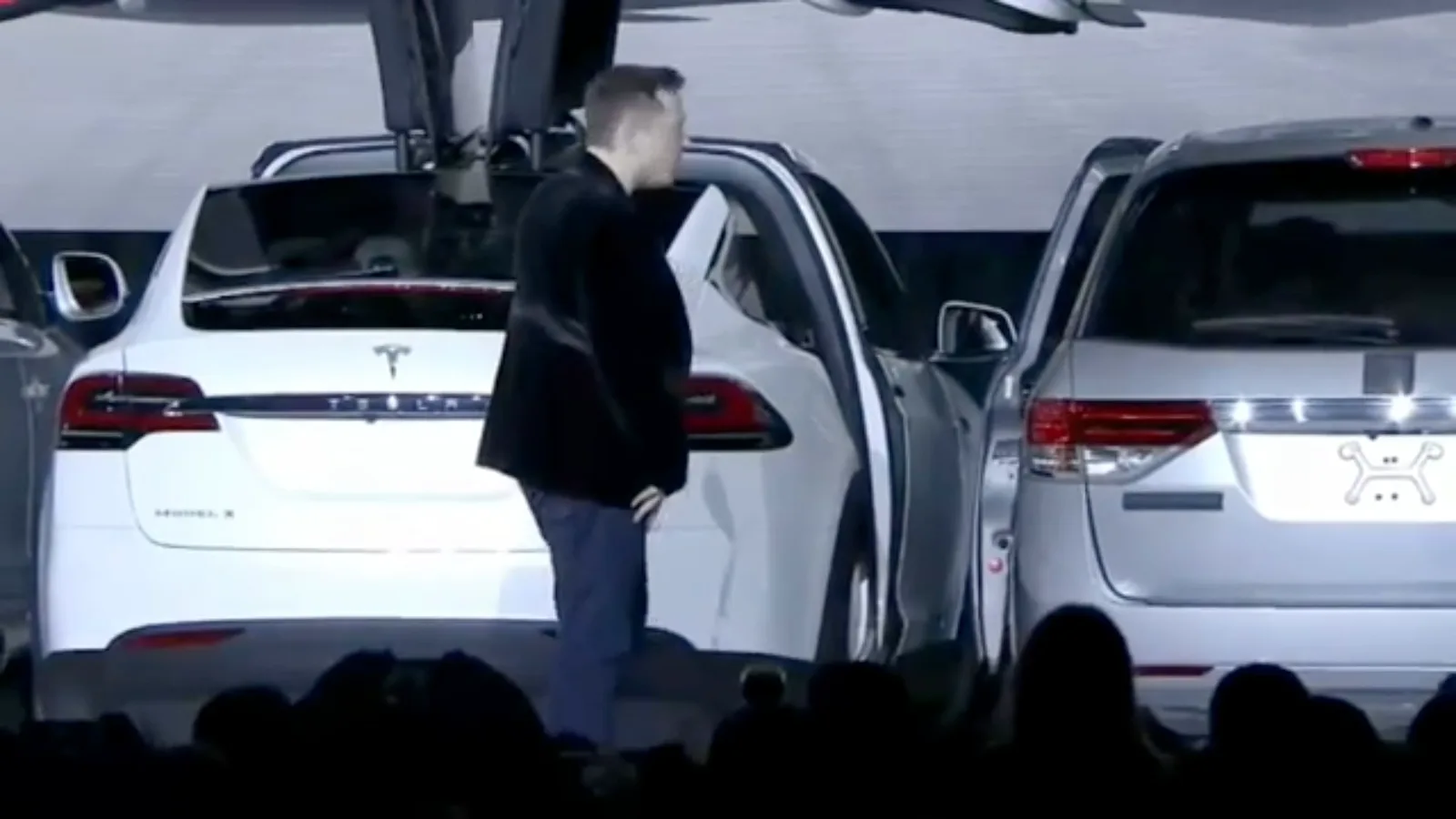
He compares the opening with a minivan’s sliding door in the same arrangement, then discusses a low-garage scenario. He says ultrasonic sensors detect the ceiling and nearby obstacles so the door can adjust its opening path.
Musk shows the second-row seats and says the flat floor leaves storage space underneath for items such as bags or laptops. He presents the design as both functional and aesthetic.
The presentation moves to carrying capacity. Musk says Model X can tow 5,000 pounds while carrying seven people and luggage, and the team demonstrates luggage and stroller storage.
He also demonstrates an accessories hitch intended for bikes or skis, saying it can be attached quickly while preserving access to the rear hatch.
Performance and first deliveries
Musk gives range and acceleration figures and hands over production cars.
Musk gives launch figures for the 90D and P90D versions, including range, all-wheel drive and acceleration. He says the performance version can reach 60 mph in 3.2 seconds; these are the specifications presented at the event.
The presentation closes with the handover of production cars. Musk thanks the Tesla team and invites guests to inspect the vehicle and take test drives.
Mehr aus diesem Kanal
 13:40EN
 Elon Musk best videos· 11. Dez. 2015Elon Musk’s 2014 plan for affordable Teslas and a city on MarsGast: Elon MuskMusk said costly early cars would fund a cheaper Tesla, while Mars settlement would require a dramatic fall in travel costs.
 28:23ENElon Musk best videos· 8. Dez. 2015Elon Musk in 2011: Reusable Rockets, NASA and SpaceX’s First Crew PlansGast: Elon MuskDuring a visit to SpaceX’s Hawthorne factory, Musk discusses the cost of spaceflight, Dragon’s design and his long-term ambition for Mars.
 1:10:16ENElon Musk best videos· 6. Dez. 2015Tesla’s 2010 bet on Model S: rising spending before mass productionModeration: Ricardo ReyesOn the third-quarter call, Musk and CFO Deepak Ahuja laid out the sedan’s milestones, finances and automaker partnerships.
 23:36ENElon Musk best videos· 6. Dez. 2015Musk’s 2010 plan for Model S, an SUV and a cheaper TeslaGast: Elon MuskBefore Model S production, Musk outlined development milestones, charging choices and the next vehicles on Tesla’s roadmap.
 24:50ENElon Musk best videos· 4. Dez. 2015Elon Musk on Leaving PayPal and Preparing SpaceX’s Fourth LaunchGast: Elon MuskBefore Falcon 1’s fourth flight, Musk explains the PayPal dispute, Tesla’s Roadster decisions and SpaceX’s early launch failures.
 31:15ENElon Musk best videos· 27. Nov. 2015Elon Musk in 2010: Tesla’s Early Strategy, Funding and Entrepreneurial AdviceGast: Elon Musk · Moderation: Bambi FranciscoIn a Vator interview, Musk explains the Roadster-to-Model S strategy, early financing and the questions he believes founders should ask themselves.