In 30 Sekunden
Theo Browne challenges claims about Fable 5’s coding performance, discusses Anthropic’s safety-screening research and a temporary subscription announcement, and describes his model-routing workflow. His experience is positive, but he acknowledges limited evidence about the contested benchmark and his business explanations are speculative.
- 1Fallback experienceTheo reports few issues in ordinary work but some refusals or rerouting on other tasks.
- 2Classifier researchHe discusses a two-stage screening design; the paper’s reported results have a specific experimental scope.
- 3Benchmark uncertaintyHe questions a dramatic performance chart but has not independently established the full methodology or ruled out regression.
- 4Historical subscription windowThe announcement shown described a temporary weekly allowance and usage credits after July 7.
- 5Estimated costTheo estimates the API-equivalent cost of a long multi-model session; he used subscriptions.
Das Wichtigste
- A fallback announcement and individual refusals do not establish how often all users are rerouted.
- The discussed classifier research reports results for a particular experimental setup.
- The subscription terms in the video were time-limited and should not be treated as current.
- Theo’s explanation of the provider’s motives is speculation.
- Reasoning effort and model routing affect usage, but costs and quality vary by task.
- A disputed benchmark requires transparent, reproducible methods; anecdotes alone cannot settle it.
Den bearbeiteten Text nach Kapiteln lesen
Claims and fallback behavior
Theo introduces the disputed claims and his experience with coding and refusals. He distinguishes ordinary work from tasks that did trigger restrictions.
I keep seeing claims that Fable 5 cannot code, has been weakened, or is unusably expensive. My opening repeats those claims sarcastically; I do not agree with them. After using the model, I want to separate what has been announced, what I observed and what remains uncertain.
The questions are fallback behavior, subscription availability and cost. Anthropic’s announcement said some routine coding and debugging could fall back to Opus 4.8. I think that wording caused confusion, but my experience alone cannot establish exactly how often routing happens for everyone.
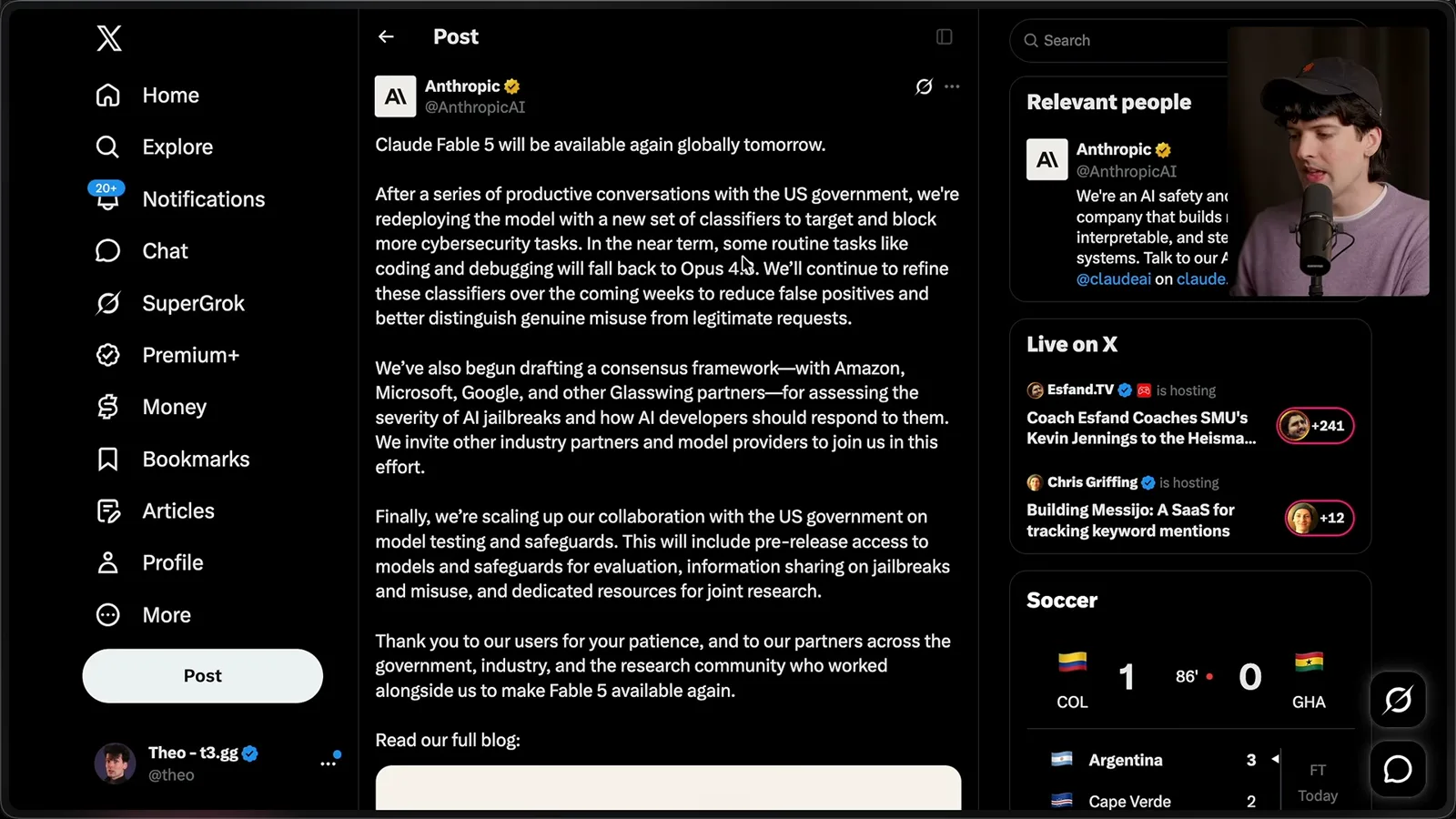
During my first day and a half of ordinary work I did not notice a fallback. I have encountered refusals or rerouting on some cryptography-related puzzles and while configuring a development phone. Those examples show that false positives or restrictions can affect legitimate tasks, even though my ordinary work mostly continued.
I discuss safety screening as more than a simple keyword match: systems can examine both the request and the response. My interpretation of why a particular puzzle triggered a fallback is speculation; I cannot see the classifier’s internal decision for that request.
Safety classifiers and benchmark claims
He discusses screening research and a controversial before-and-after chart. The evidence has limits and does not establish a universal result.
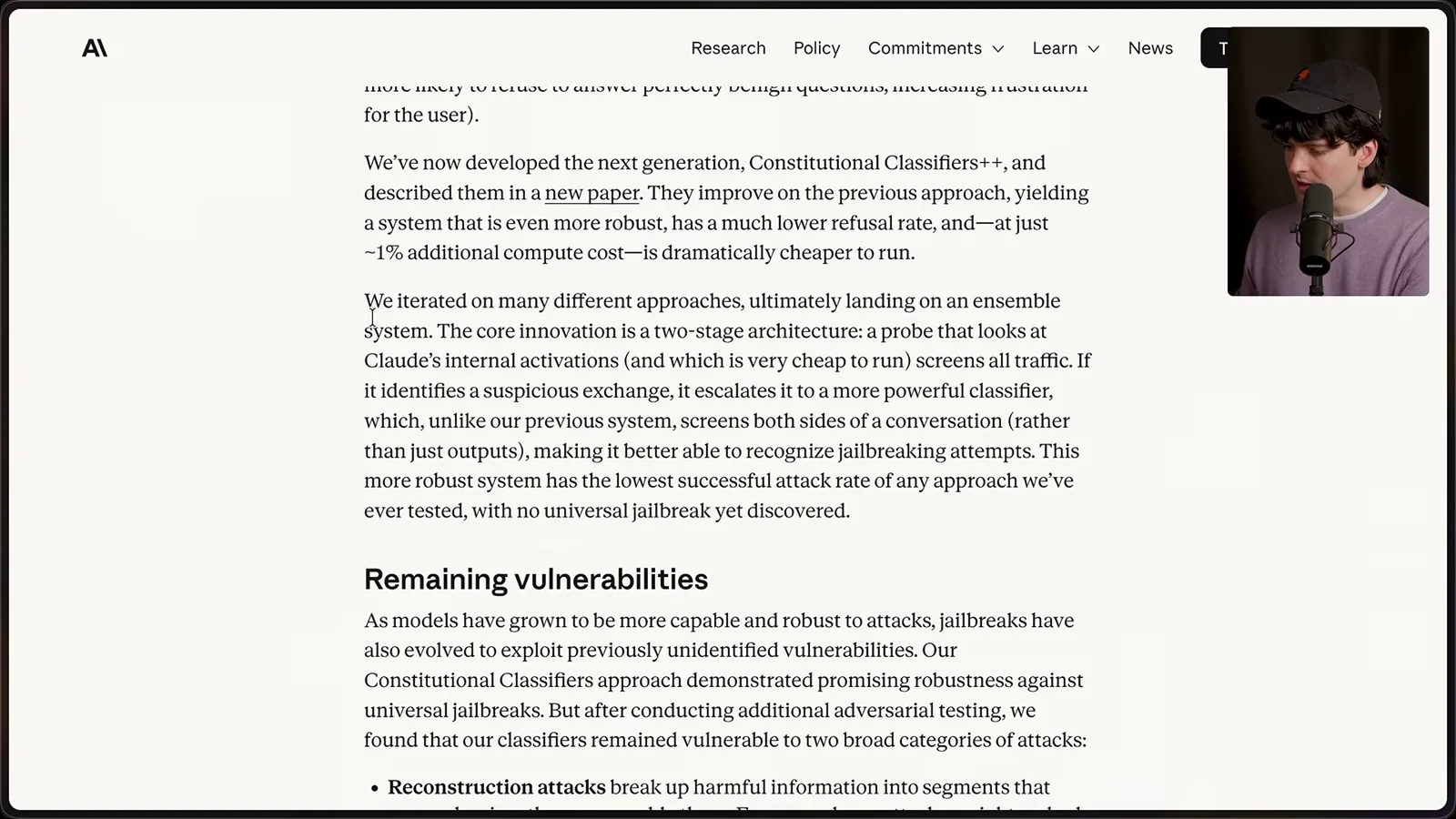
Anthropic has described research into a two-stage classifier: a lightweight probe screens interactions and can escalate suspicious cases to a more expensive classifier. The paper’s reported costs and error rates apply to its stated experimental setup. The video does not establish that every detail of that research is identical to Fable’s deployed routing.
The research claims fewer successful jailbreak attempts and lower overhead for the cascade compared with a more expensive screening approach. Those figures are test-specific, not a guarantee that harmful requests are always blocked or benign requests never refused. Improving protection and reducing false positives are both important.
I think Anthropic’s communication was poor, but in my own day-to-day use the restrictions were much less disruptive than some reactions suggested. Other people’s work can encounter different triggers, so they should test their actual tasks and report incorrect refusals rather than infer a universal result from mine.
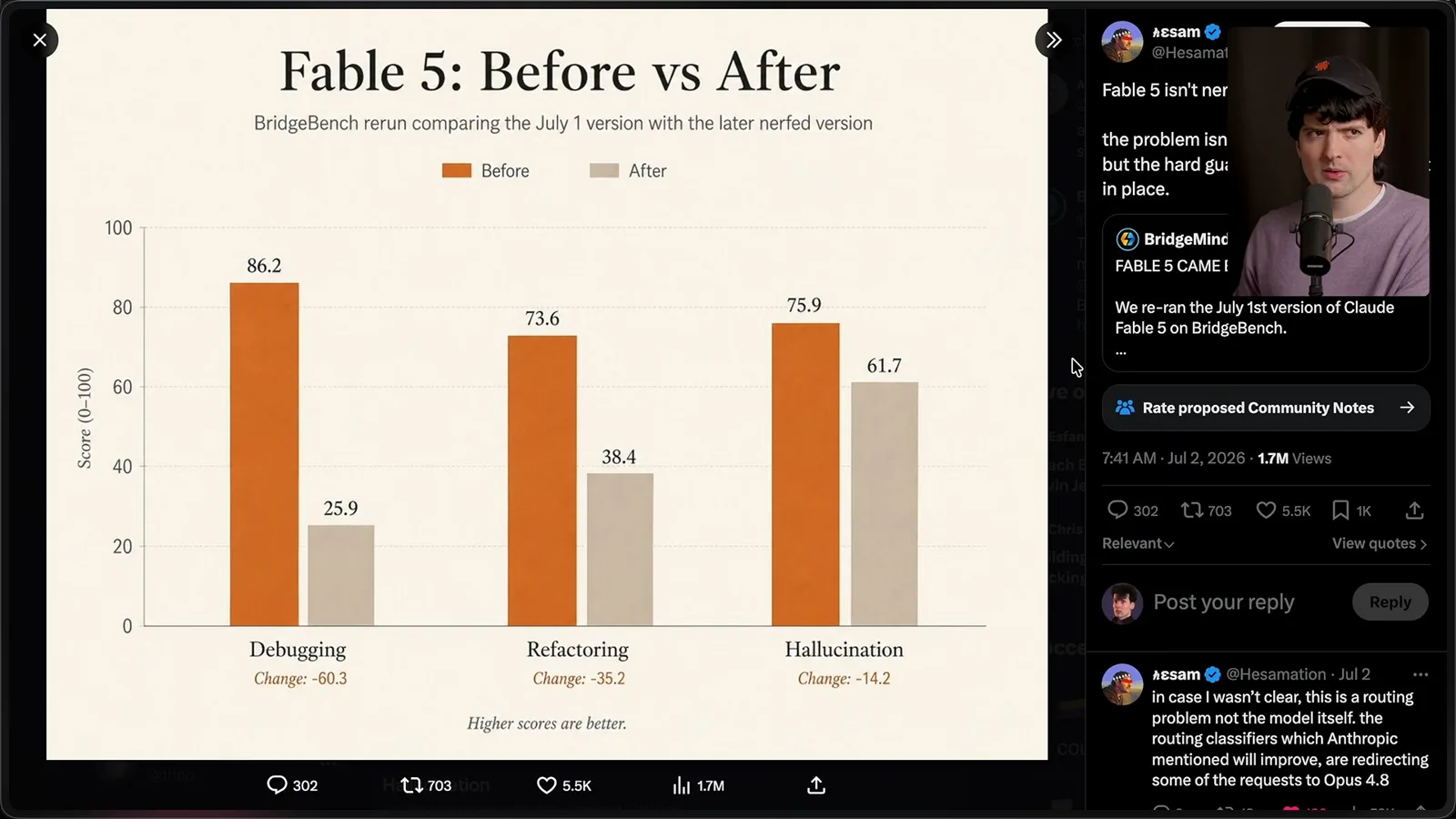
A widely shared chart appeared to show a severe before-and-after performance drop. I question the benchmark’s reliability and say I had not personally investigated its full methodology. My skepticism and anecdotes do not independently prove that no regression occurred; the comparison needs transparent methods and reproducible evidence.
I looked at other results from the same benchmark and found rankings that conflicted with my experience. That is a reason to inspect the tasks, settings and methodology more closely, not by itself a scientific refutation. In my use the model still felt very capable.
Subscription availability
Theo explains the temporary terms shown in the announcement. His further account of business incentives is an interpretation.
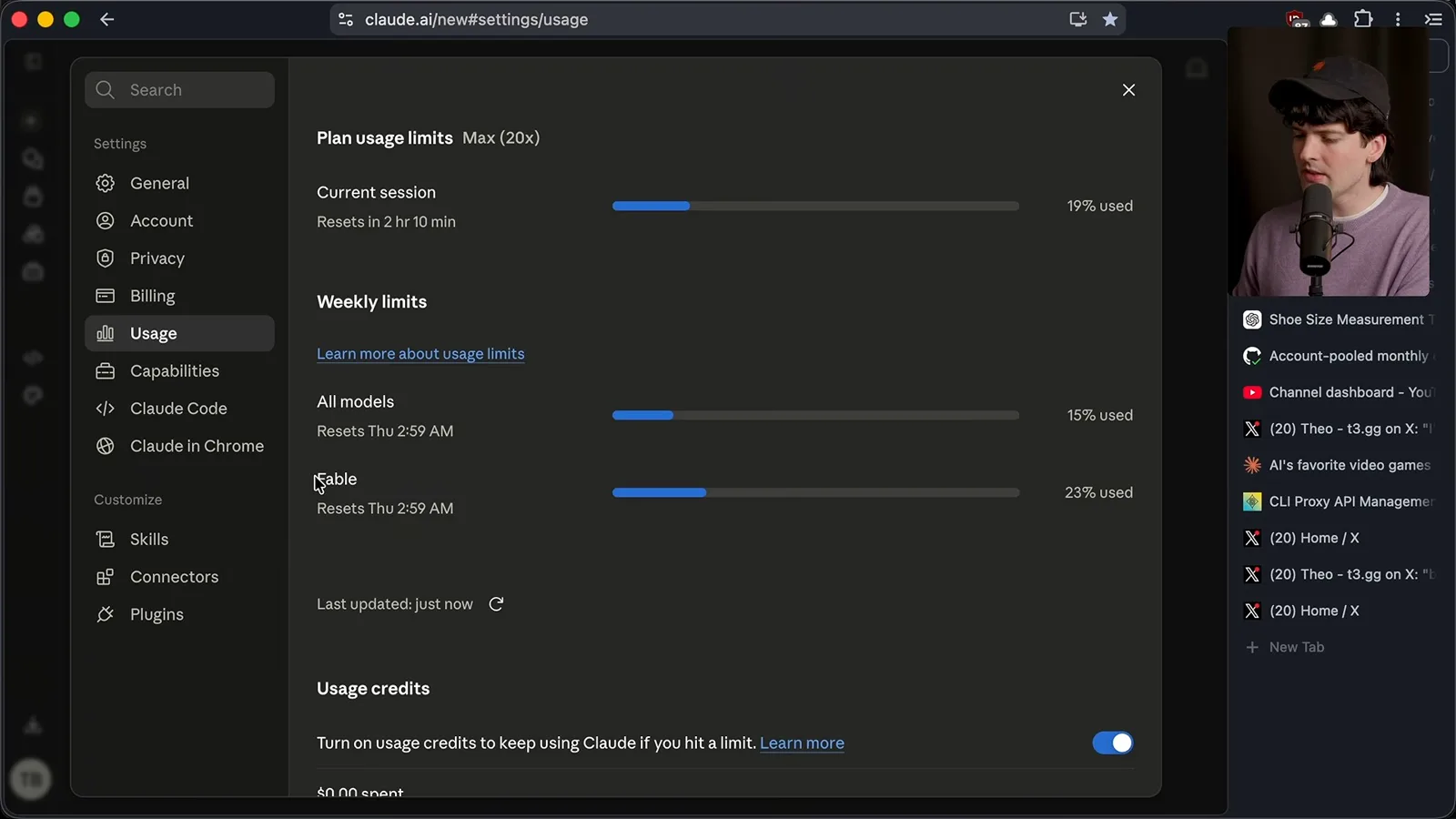
Subscription access was a separate, real concern. At the time of the video, Anthropic said Fable would count for up to half of eligible plans’ weekly usage through July 7 and then be available through usage credits. That was a time-limited announcement, not a statement of current availability.
My usage screen had a separate Fable weekly meter. I had used about 23% at that moment, while acknowledging that I was using more than one plan. Limits, resets, workload and account arrangements differ, so my meter should not be interpreted as a typical allowance.
I suspect limited compute capacity and enterprise demand help explain the temporary restriction. I also speculate about pricing, marketing and the economics of serving a large model. Those are my interpretations of incentives, not confirmed details of Anthropic’s internal planning or margins.
One possible reason for a short access window is to observe how heavy users consume capacity across a week. I find that plausible, but it remains a hypothesis. A company’s announcement about capacity does not by itself prove every part of that explanation.
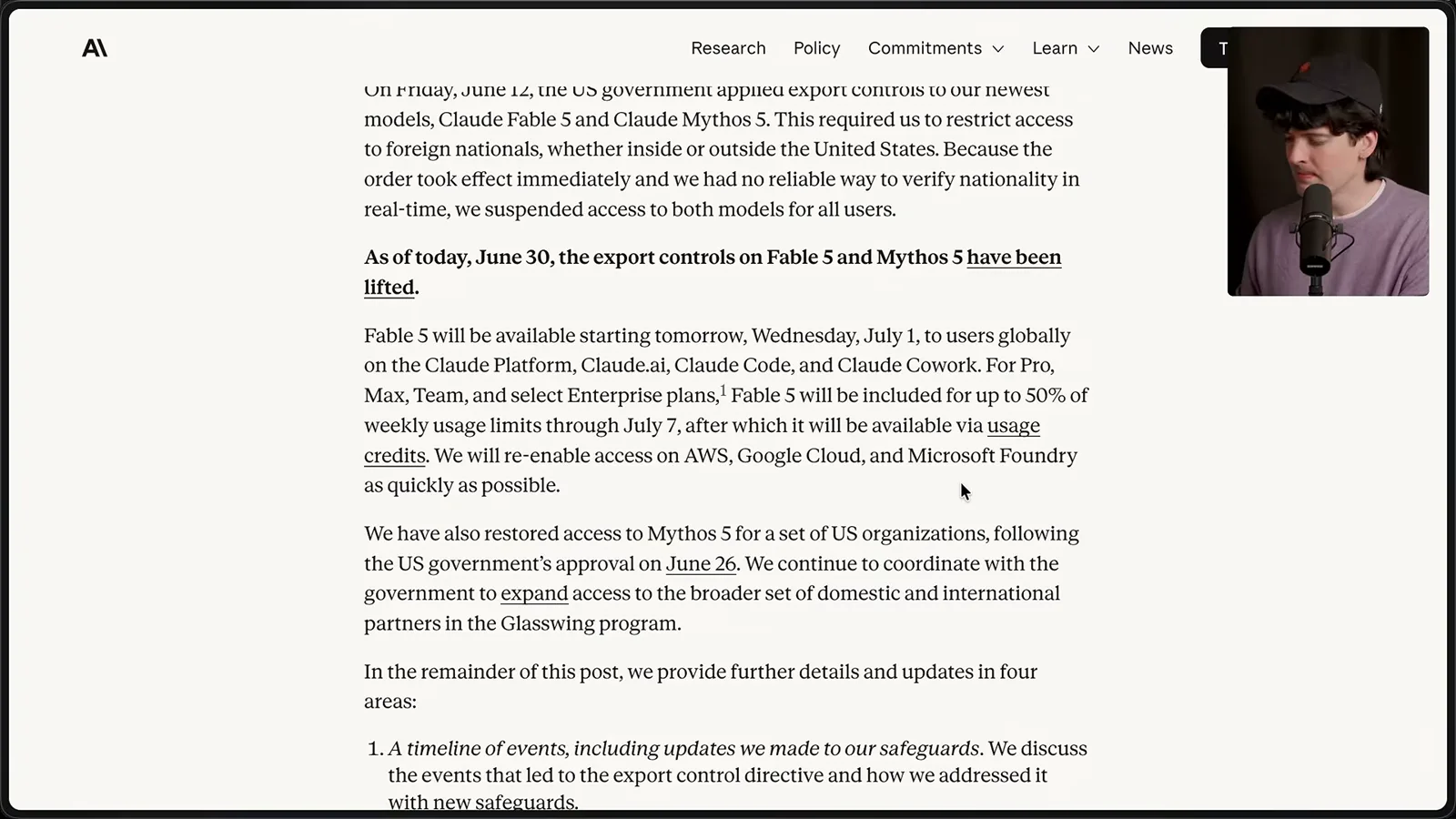
The statement I show says Anthropic aimed to restore Fable as a standard subscription offering when capacity allowed. It expresses an intention at that time, not a guaranteed date or current entitlement. Anyone making a purchase decision should check the provider’s present terms.
Managing usage
He shares his preferred reasoning settings and delegates some work to other models. His cost estimates depend on the session and subscription context.
Cost can still be significant, whether billed directly or reflected in an allowance. My first practical suggestion is to compare reasoning settings. In my experience high worked well, while xhigh and max could use much more without a meaningful improvement for the tasks I tried.
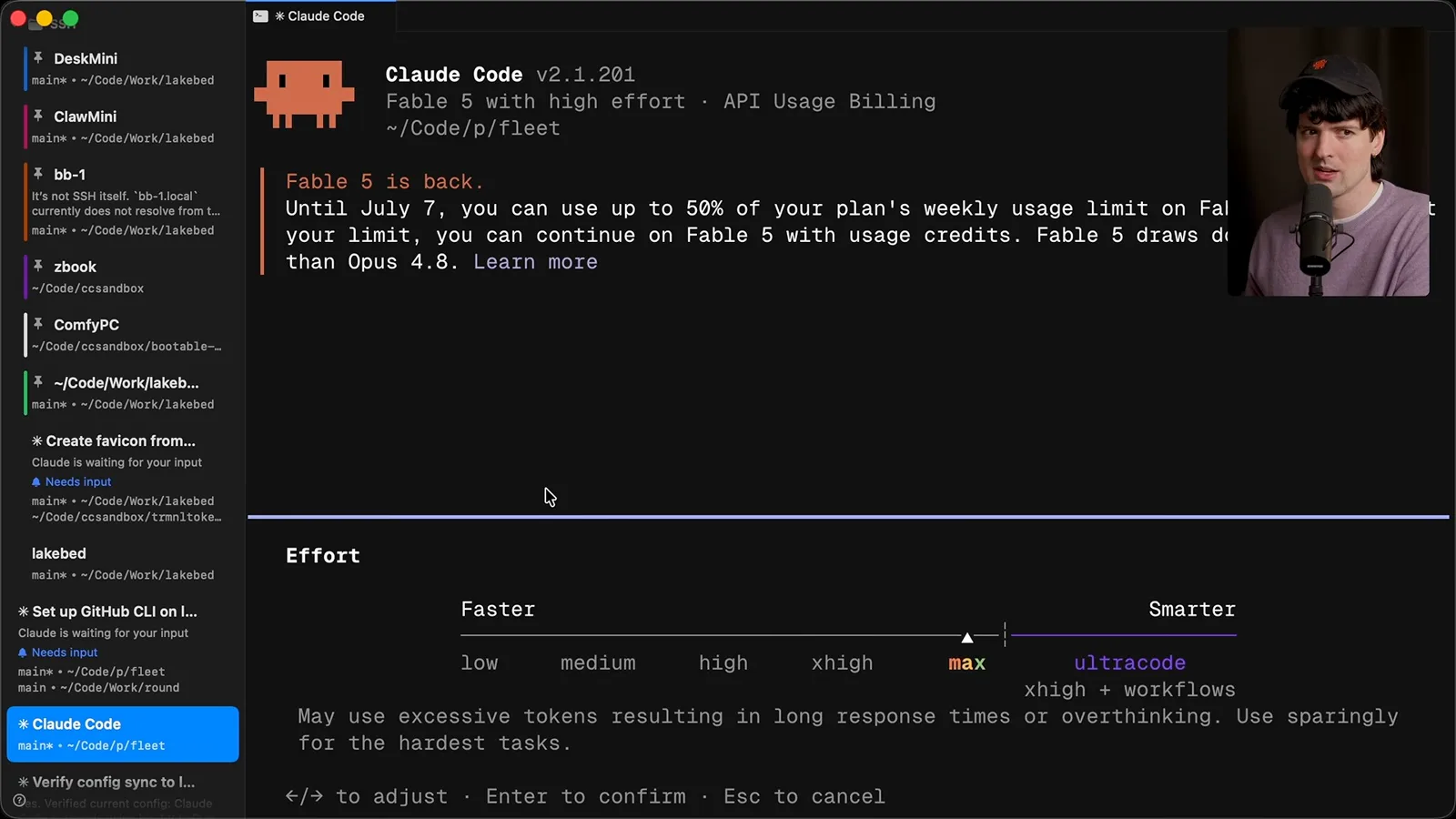
I would start with high, low or medium and measure results rather than assume the most expensive setting is always best. My claim about large cost increases is based on my own runs; the best setting depends on the task, model version and quality requirement.
In one long session I triaged a backlog, closing, rewriting and merging PRs. I estimate the combined usage across Fable and delegated models at roughly $150–$200 at full token rates. I used subscriptions, so this is an estimated equivalent rather than a bill for that exact amount.
My other tactic is to have the coordinating model delegate work to other models when appropriate. I taught Claude Code to use Codex for some implementation and computer-use tasks. Routing can reduce the load on the expensive model, but only if the delegated output is actually good enough and reviewed.
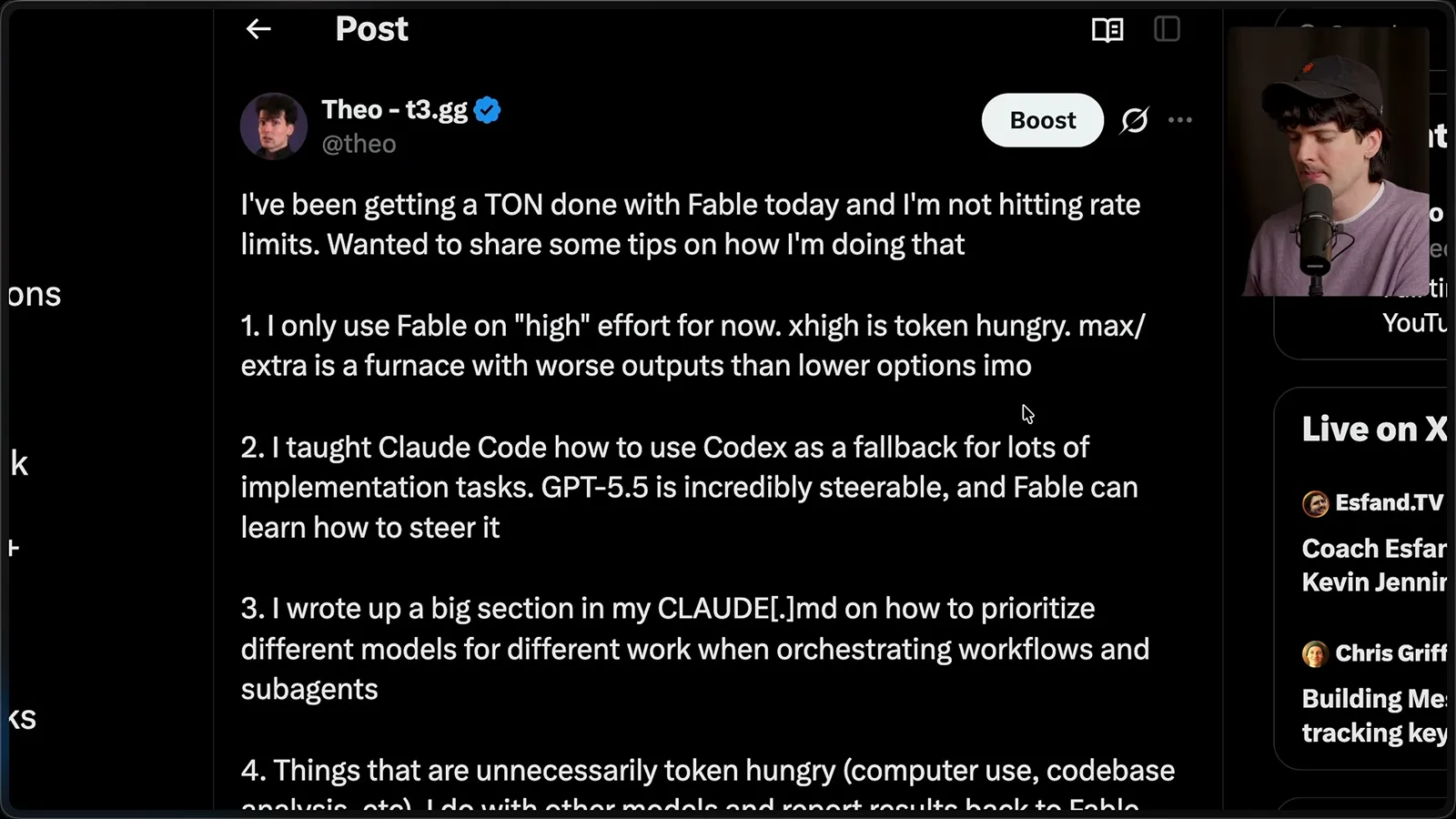
Large document analysis, codebase scans and long computer-use sessions can consume many input tokens, especially when screenshots are involved. I use another model for some of these steps and return the findings to Fable for coordination. That reflects my available tools and subscription economics.
I report merging more than 15 PRs and closing others in this workflow. The equivalent usage estimate includes multiple models, and the subscription percentages I show depend on my reset timing. A count of merged PRs is not a direct measure of correctness or value.
The workflow does not need an elaborate collection of custom tools to begin. The important parts for me are giving the agent suitable instructions, delegating work with clear boundaries and reviewing what comes back. More detail about my configuration is in the follow-up demonstration.
My conclusions are provisional: try lower reasoning effort and route tasks where it makes sense; read the actual subscription terms; and evaluate fallback and performance claims with more than a viral chart or one person’s anecdotes. I remain enthusiastic about the model based on my own work.
Mehr aus diesem Kanal
 38:47EN
 Theo - t3․gg· 28. Okt. 2026Theo’s Long-Running Agent Experiments: Verification, Compute and CostTheo Browne · Ping LabsA skateboard game and two compiler projects show how repeated checks and flexible compute can sustain agent work—and how expensive those loops can become.
 36:07ENTheo - t3․gg· 27. Okt. 2026Theo on Token Costs, Coding Agents, and the Price of AI CapabilityTheo Browne · Ping LabsA viral estimate of Lauren's AI spending prompts a closer look at cache pricing, benchmarks, and the changing work of coding agents.
 30:37ENTheo - t3․gg· 26. Okt. 2026Theo’s Three Skills for Reviewing and Shipping with Coding AgentsTheo Browne · Ping LabsHow sol-loop, full-send and full-stop encode review, verification and different levels of merge authority.
 0:43ENTheo - t3․gg· 23. Okt. 2026Theo Distinguishes Security Vulnerabilities from Active AttacksTheo Browne · Ping LabsA short explanation of why disclosed software flaws and reported attacks are different kinds of security news.
 29:22ENTheo - t3․gg· 22. Okt. 2026Theo on Security Vulnerabilities, Stolen API Keys and AITheo Browne · Ping LabsA look at the gap between vulnerability disclosure and patching, and a speculative account of why stolen inference keys may be valuable.
 31:13ENTheo - t3․gg· 20. Okt. 2026Theo on Why Smarter Models Help More Than DevelopersTheo Browne · Ping LabsFrom game modifications to compiler experiments, Theo revisits his assumptions about who benefits from more capable AI.