In 30 Sekunden
In a 2024 AWS-partnered video, Berman describes automated reasoning and tests an employee-leave policy in Amazon Bedrock Guardrails. The demonstration shows rule extraction, test results and an unstated assumption; formal guarantees depend on the correctness and scope of the encoded policy.
- 1Proof depends on the policyFormal validity does not ensure that extracted rules perfectly reflect the original document.
- 2Extracting rulesThe demonstration turns a leave policy into candidate rules and variables.
- 3Testing a proposed answerThe check flags a contractor answer and exposes relevant assumptions.
Das Wichtigste
- Formal reasoning checks conclusions against explicit rules and assumptions.
- Generated policy rules need expert review against the source document.
- The leave-policy demonstration exposes an unstated assumption about employee level.
- Retrieval and formal checks address different aspects of answer reliability.
- The video was sponsored by AWS and showed a preview feature.
Den bearbeiteten Text nach Kapiteln lesen
Why formal reasoning matters
Berman introduces the difficulty of modeling complex policies and the limitations of language models.
Automated reasoning uses formal logic to analyze statements, and implementing complicated policies can require extensive specialist work. In this AWS-partnered 2024 video, I examine a preview feature intended to help make that work more accessible.
Language models can assist with code and natural language but can also hallucinate. I ask whether formal checks can help assess their responses against explicit rules, particularly in situations where mistakes matter.
As a simple illustration, if rain implies wet ground and wet ground implies less tire grip, the implications can be chained. Real policy systems contain many more conditions, exceptions and interactions.
An airline refund policy may have many pages of eligibility rules. Access-control policies also have many services and permissions; errors in modeling or implementation can have serious consequences.
I recount Amazon’s description of building reasoning around IAM permissions: it involved logicians, engineers, years of work and significant expense. This is an account of that particular effort, not a measurement of all formal verification projects.
The challenge is to use a probabilistic model to help construct rules while relying on formal logic for a check. A mathematical proof establishes a conclusion relative to its formal rules and assumptions; it does not by itself prove that a translated policy perfectly matches the original document.
Bedrock policy creation
The preview extracts candidate rules and variables from a leave policy.
AWS announced Automated Reasoning checks in Amazon Bedrock Guardrails as a preview at re:Invent. I describe how a natural-language policy can be used to propose variables and logical rules for later testing.
My example is a paid leave policy with eligibility conditions such as employment status, level and tenure. Although the demonstration document is short, real policies can contain interacting constraints and exceptions.
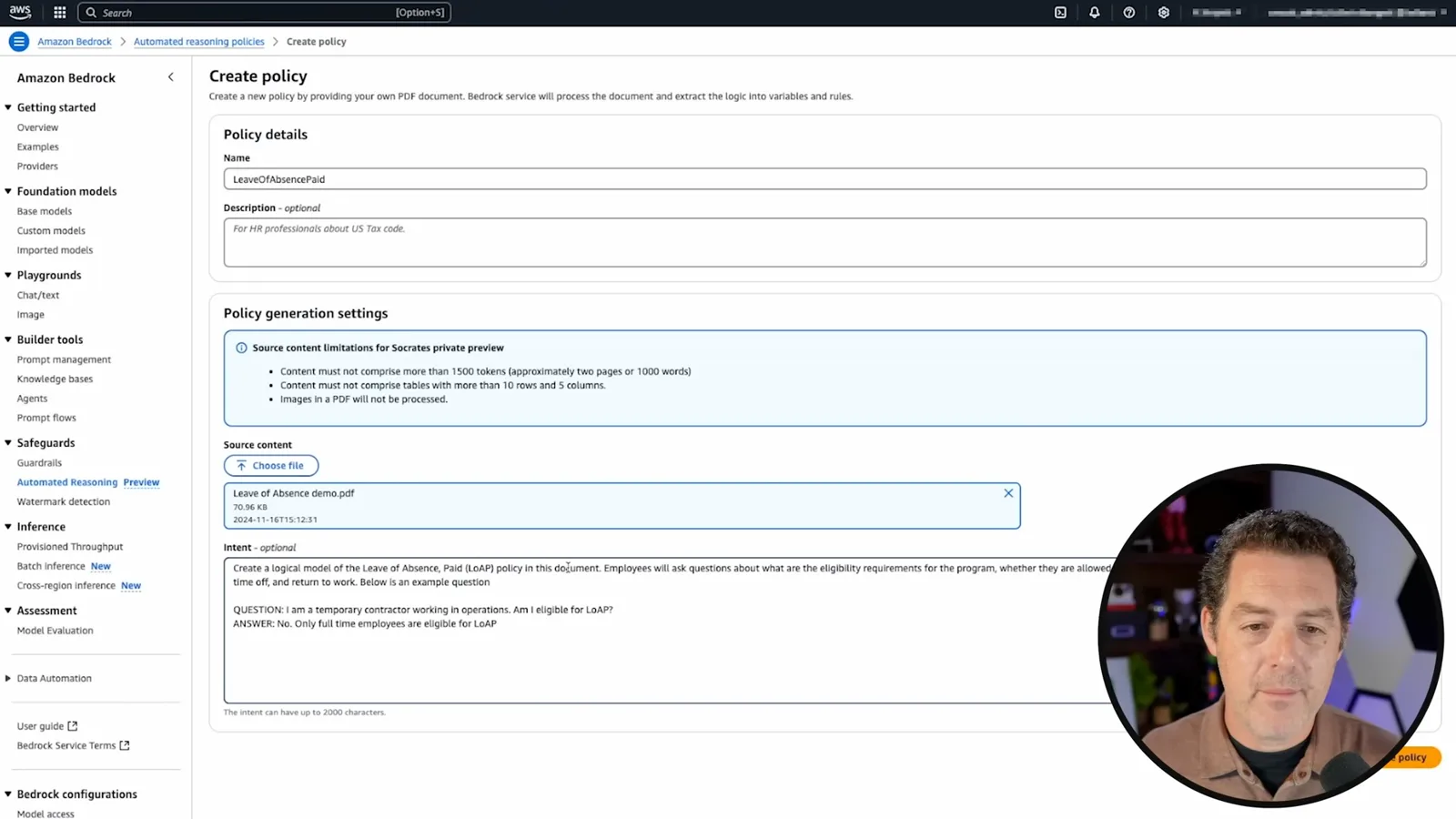
I upload the policy document and describe the intended use: answering employee questions about eligibility. The demonstration shows a policy-creation interface that extracts candidate rules and variables from the source.
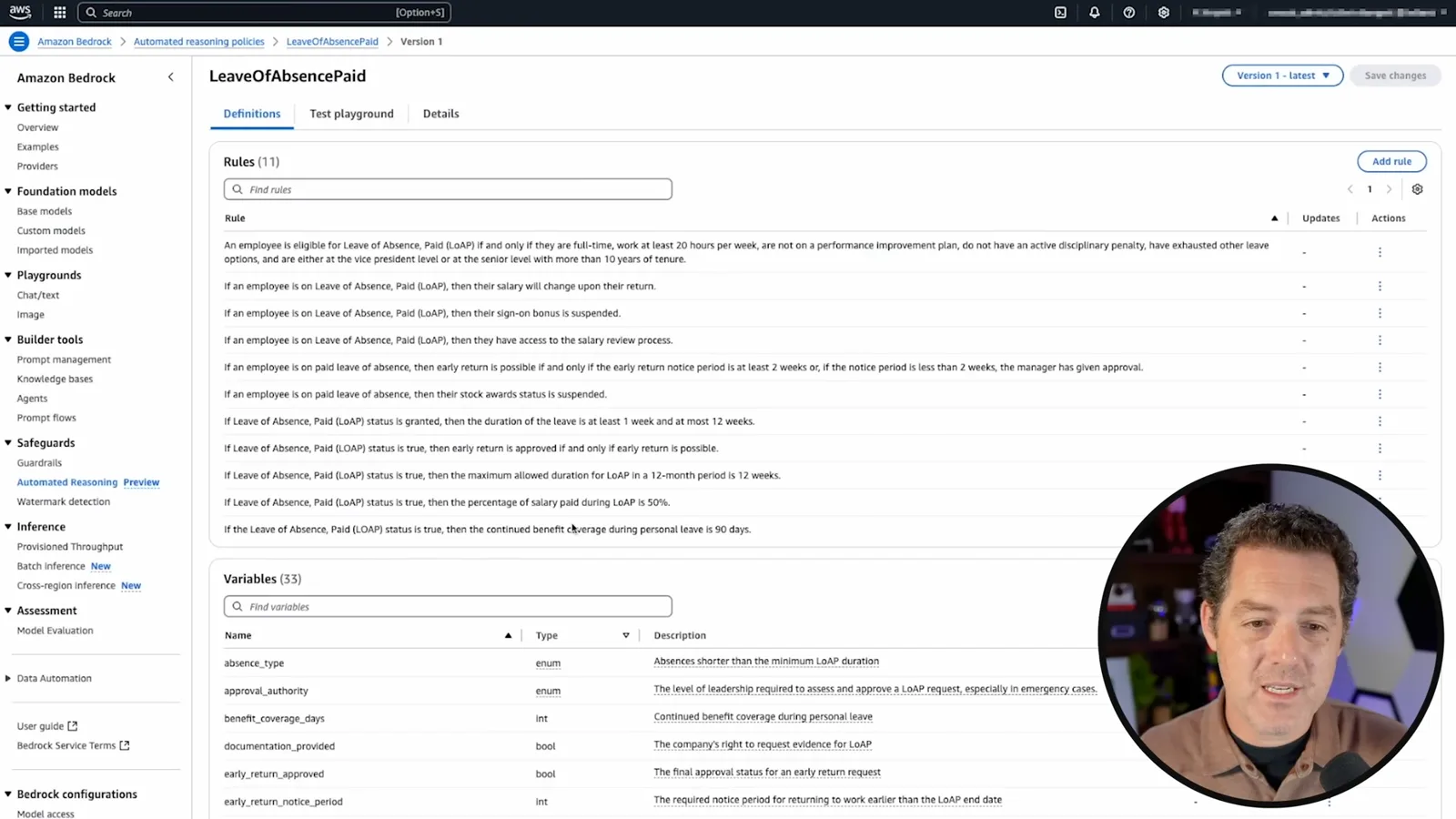
The resulting policy lists rules and typed variables. Reviewing those extracted rules is essential: if a condition is omitted or translated incorrectly, a logically valid conclusion about the formal policy may still misrepresent the source.
Testing and correcting assumptions
A contractor example reveals the need to examine and refine assumptions.
I test a proposed answer saying a temporary contractor is eligible. The tool flags the answer as invalid and shows relevant conditions and variables, making the reasoning available for inspection.
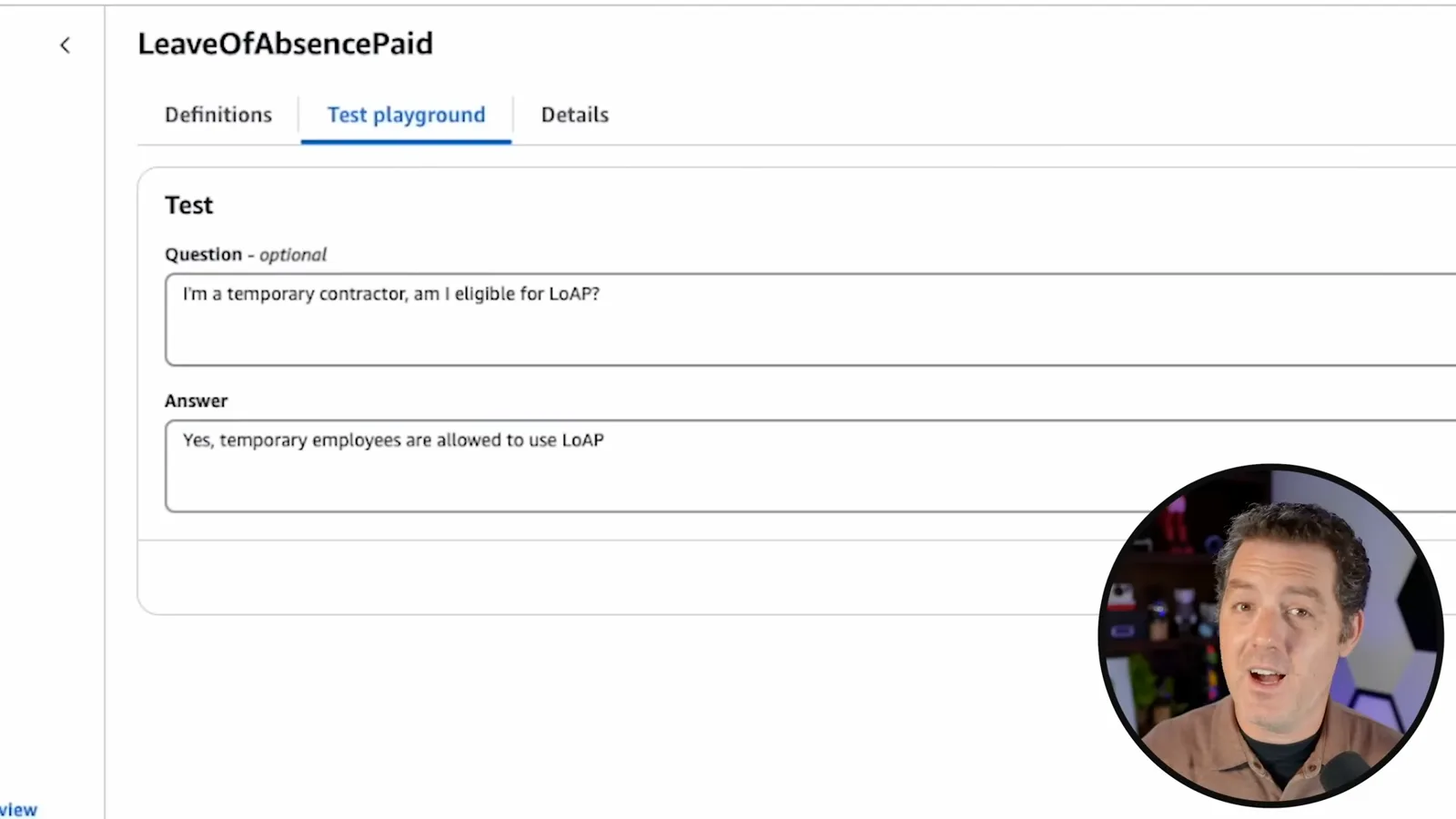
The explanation also assumes an employee level that the question did not state. I edit the variable description to request an explicit level rather than making that assumption, then run another test.
A part-time contractor example is flagged against the full-time requirement, and I also show a positive test. These examples illustrate how policy tests and human review can reveal assumptions or deficiencies in a formulation.
Scope and comparison
Berman compares formal checks with contextual grounding and discusses the potential impact.
I am optimistic that natural-language assistance can reduce the effort required to build formal rules. The video’s broader claims of near-perfect truth should be read cautiously: accuracy depends on the policy, translation, inputs and the scope of the check.
I contrast the approach with contextual grounding or retrieval, which can supply source material but does not itself prove a conclusion from formal rules. The methods serve different purposes and each can fail if its inputs or interpretation are wrong.
I close by pointing viewers to the AWS announcement and thanking AWS for the partnership. The feature shown was a preview at the time; the demonstration should not be taken as a guarantee that all hallucinations are eliminated.
Mehr aus diesem Kanal
 25:50EN
 32:20EN
 0:22EN
 45:08EN
 0:32EN
 1:02EN