In 30 Sekunden
In an October 2025 video, Matthew Berman uses a four-panel script to compare Qwen Image Edit Plus, Nano Banana, Seedream 4 and GPT Image 1 on many visual prompts. His picks vary by task and depend on single generated examples and subjective judgment; the video includes a Dell sponsorship.
- 1Compositing depends on the sceneBerman favors Qwen for the desert SUV and office examples, but chooses other models for the waterfall and beach.
- 2Precise instructions remain difficultThe watch, laptop reflection and single-iris tests show errors in anatomy, physics and localized changes.
- 3Removing objectsAll four remove a coffee table plausibly; Berman favors Nano Banana for preserving the surrounding scene.
- 4Style and textThe models differ in painterly style, blueprint labels and text placement; visual plausibility is not measurement accuracy.
- 5An informal comparisonThe results are based on single samples and subjective preferences rather than a controlled benchmark.
Das Wichtigste
- No model wins every example in this informal comparison; prompt adherence and visual quality vary by task.
- Compositing requires consistent placement, scale, lighting and preservation of source details.
- Precise geometry, localized edits and reconstructing unseen layouts reveal limitations.
- A good-looking image or blueprint does not establish accurate physics or measurements.
- Readers can use the shared four-panel script to compare results on their own prompts.
Den bearbeiteten Text nach Kapiteln lesen
Four models and compositing
Berman compares portraits, vehicles, animals and products placed in new settings. The video includes a Dell sponsorship.
I compare Qwen Image Edit Plus, Nano Banana, Seedream 4 and GPT Image 1 on a series of image-editing prompts. The results are single examples judged by my visual preferences, not a controlled or reproducible ranking. The video includes a Dell sponsorship.
For a portrait composited into a waterfall, I prefer GPT Image 1’s lighting and stylistic consistency. Qwen looks reasonably good, Nano Banana places the subject awkwardly in the water, and Seedream uses mist that conceals some difficult transitions.
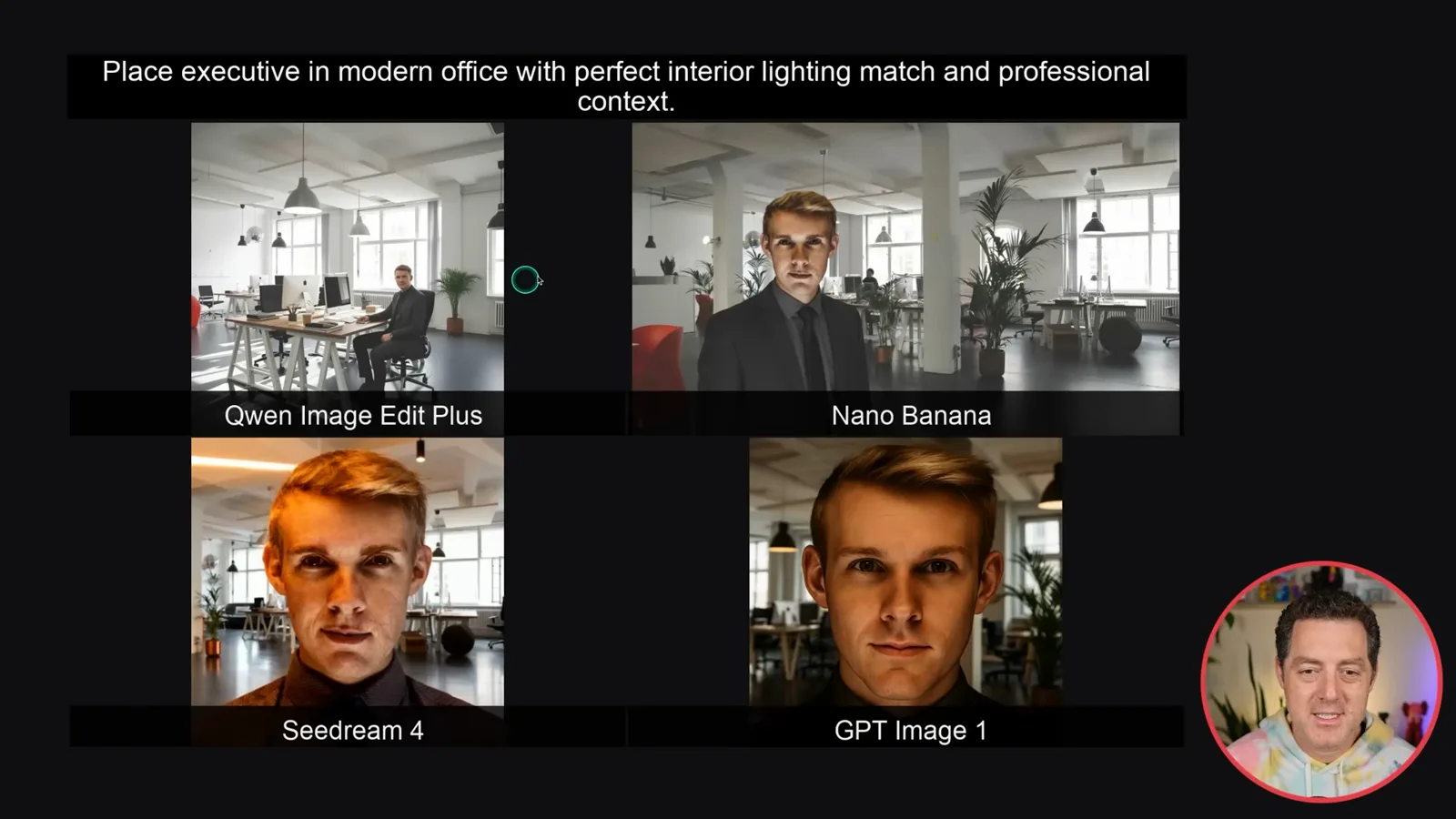
Moving an SUV into a desert, Qwen’s bright lighting and displaced sand appeal to me more than the other examples. For a headshot placed in an office, Qwen also produces my preferred result: the subject appears seated in the setting instead of simply overlaid.
Two puppies moved onto a beach look best to me with Seedream 4, which combines believable animals, water and lighting. I note that Qwen’s lighting works well even though its puppies appear less realistic.
A team member made a script that sends prompts and images to four models for side-by-side comparisons. In a cat-on-furniture prompt, all four are passable to me, although most omit the Christmas tree shown in one of the source images and the prompt did not explicitly require it.
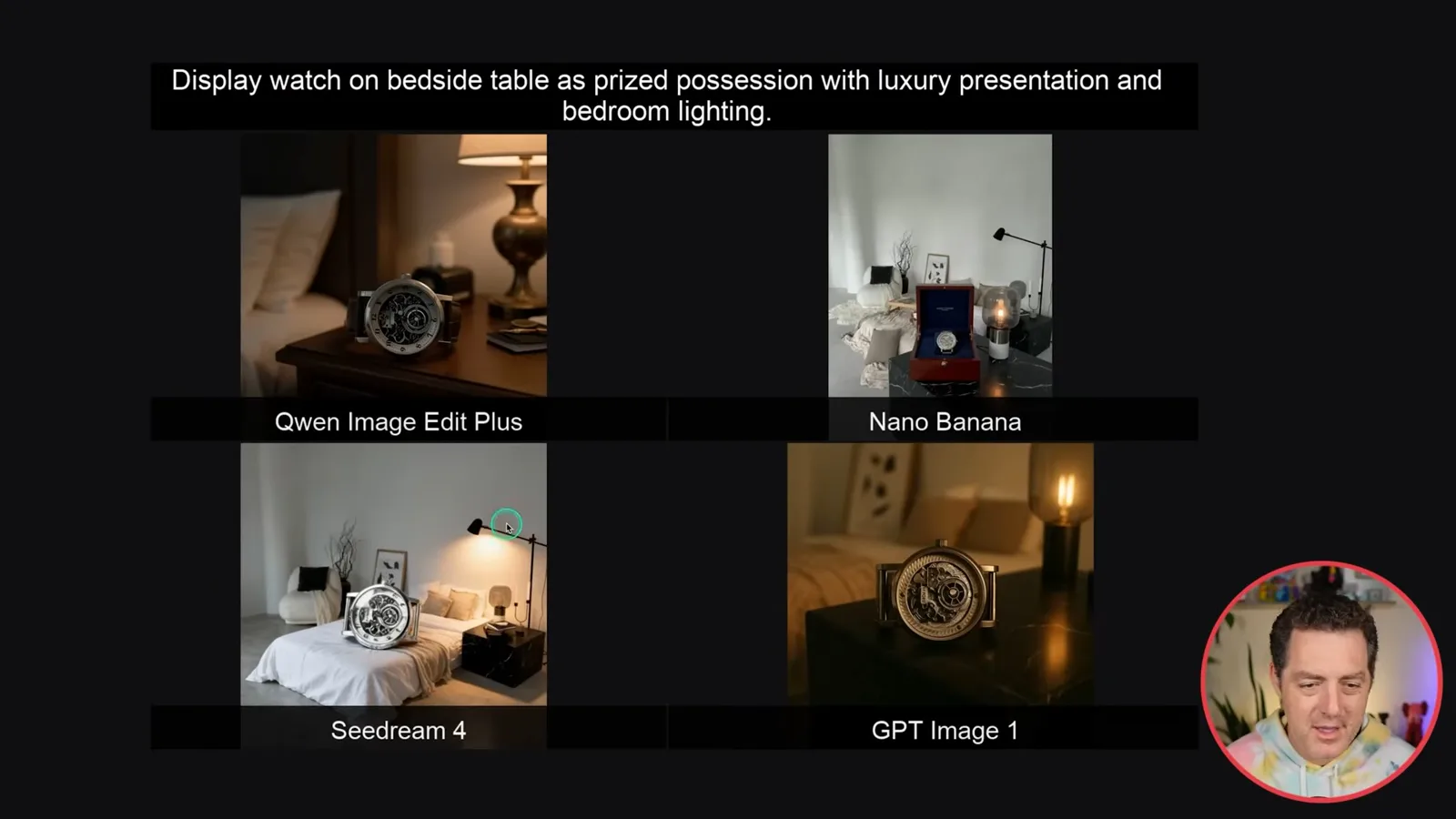
For a watch displayed in a bedroom, GPT Image 1 best preserves the supplied room in my judgment. Qwen makes a convincing image but changes the room; Seedream makes the watch implausibly large, and Nano Banana’s presentation differs from the request.
For a delivery truck in a city, I prefer Qwen’s lighting and fit with the background, though GPT Image 1 and Seedream also look good. Nano Banana’s truck appears oversaturated relative to the street.
Precision and localized edits
Challenging prompts test anatomy, reflections, eye color, recoloring and materials. Several outputs miss parts of the request.
The next tests push precise constraints. A watch placed at a specified distance above a wrist produces anatomical and placement problems across models; I prefer GPT Image 1’s plausible pose, though the exact distance is not verified.
A laptop-and-coffee prompt requests an exact angle and a steam reflection. I cannot measure the angle and find problems with all four results, including incomplete hardware and physically inconsistent reflections. I pick Nano Banana only as the most visually realistic of these imperfect examples.
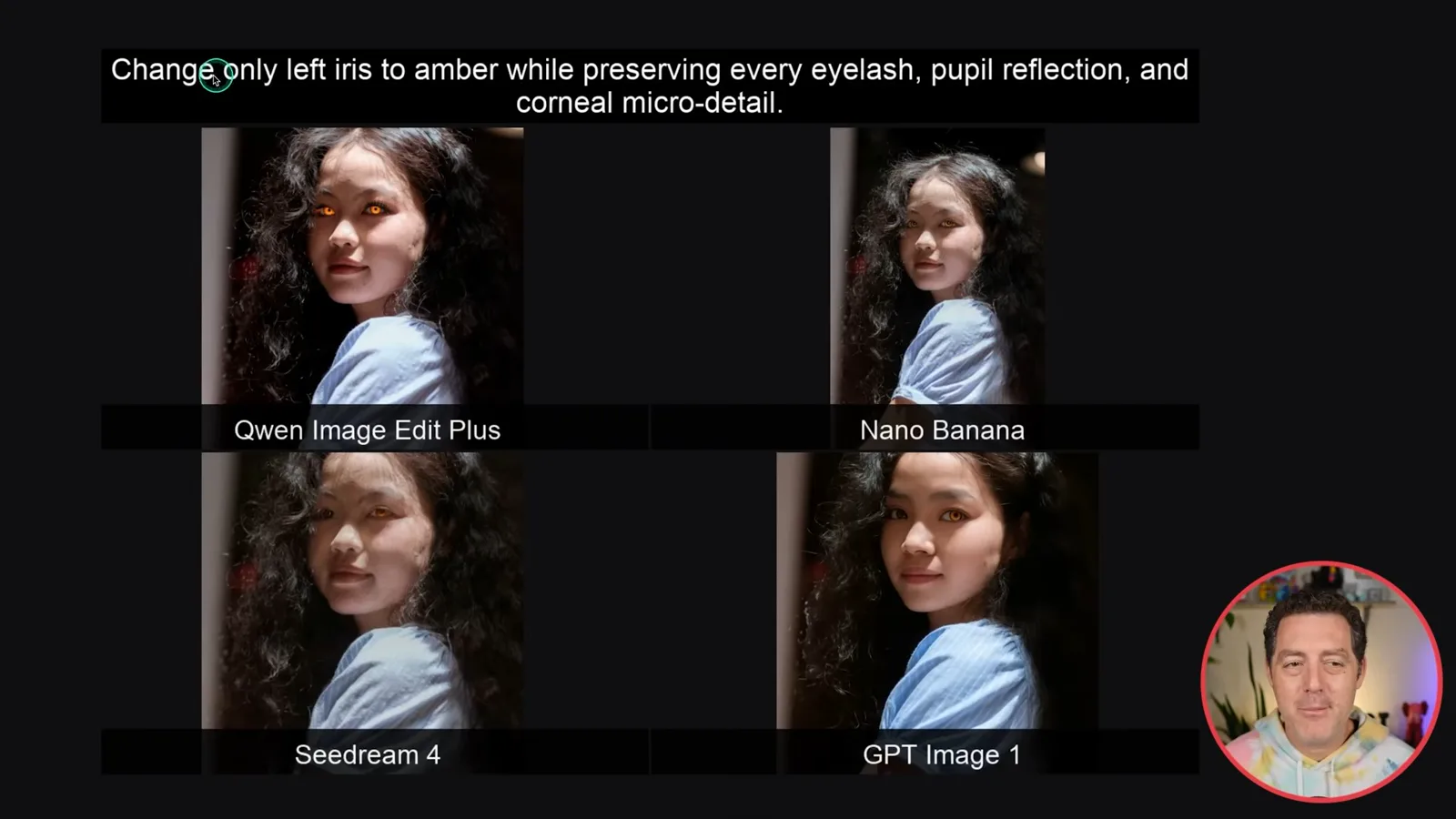
Changing only one iris tests localized editing. Qwen and Nano Banana change both eyes in the examples; GPT Image 1 and Seedream change one. I prefer Seedream because it retains more of the original skin texture.
A prompt asks for two identities in one image without blending them. The results are awkward in different ways; I favor Nano Banana’s interpretation. A contradictory water-flow prompt also produces mixed results, and I prefer Seedream’s appearance over Qwen’s and the other examples.
For recoloring a red Mustang to metallic blue, Nano Banana preserves the original most convincingly to me, with Qwen close. Recoloring kitchen cabinets while preserving grain also favors Nano Banana in my judgment, although the other results have useful qualities.
Turning a ceramic cappuccino cup into clear glass illustrates the need to retain contents as well as change material. Seedream’s empty-looking cup misses that expectation; the other examples look plausible, and I prefer Nano Banana’s rendering.
Portraits, lighting and motion
The comparison moves through face edits, lighting, silhouettes and motion. Berman emphasizes visual consistency.
For a hair-color edit, Qwen adds unexpected dotted markers, while I prefer Seedream’s natural-looking result. An age-up prompt favors GPT Image 1 in this single comparison; an age-down prompt favors Nano Banana for preserving the person while changing hair and wrinkles.
For an anime-style portrait, I like GPT Image 1’s interpretation, although most examples work. Adding battle scars produces imperfect results; I choose GPT Image 1 as the best of the four shown, not as a claim of medical realism.
A golden-hour interior lighting edit gives several appealing colors but apparent stair distortions, so I do not consider any result fully successful. Later I notice that the source itself may already contain distorted stairs, making attribution to the edit uncertain.
For warm evening lighting and candles, Qwen is my preferred example; the others are either too bright or too dark for my taste. In a cat silhouette, GPT Image 1 balances rim lighting with visible facial features better in my view.
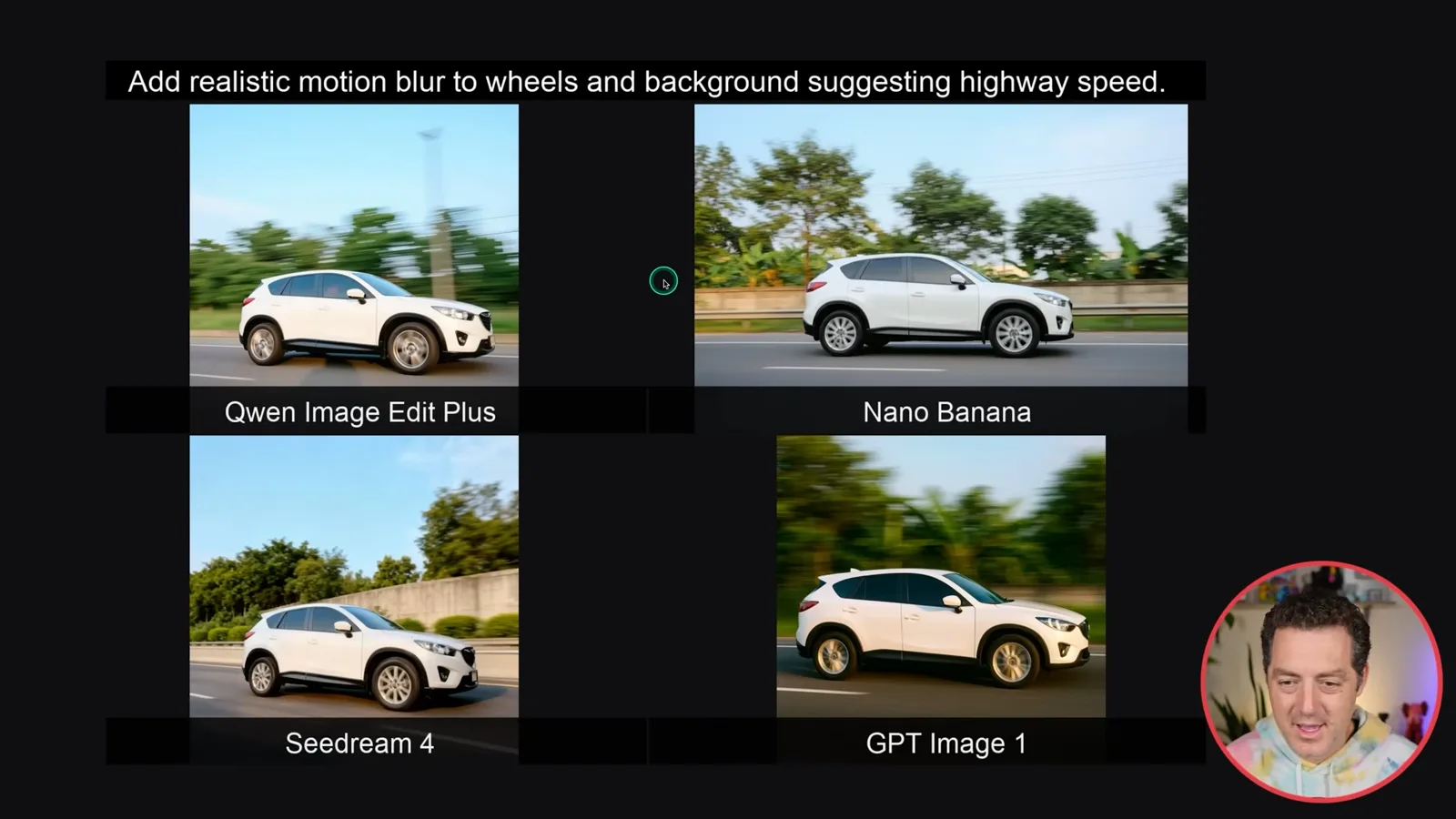
For motion blur on a moving car, all four results are usable to me, with Qwen’s background blur the most convincing. For puppies in mid-leap, I choose Nano Banana because the animals resemble the original and the pose looks convincing.
In a bird takeoff prompt, Seedream’s blurred wings and pose are my favorite. These selections are visual judgments from one set of outputs, and a different seed or prompt could change the result.
Objects, removal and scale
The models add and remove objects and attempt changes in perspective and scale. Some results change unintended parts of the image.
Object addition exposes another failure mode: a fireplace may look convincing while appearing to scorch the wall or changing the room. I prefer Qwen’s example visually but would still want to correct the apparent fire hazard in the image.
When adding racing stripes and sponsor decals to a Mustang, all four examples look good; I favor Qwen for consistency. For string lights in a bedroom, I choose GPT Image 1 because its changes most clearly match the requested atmosphere.
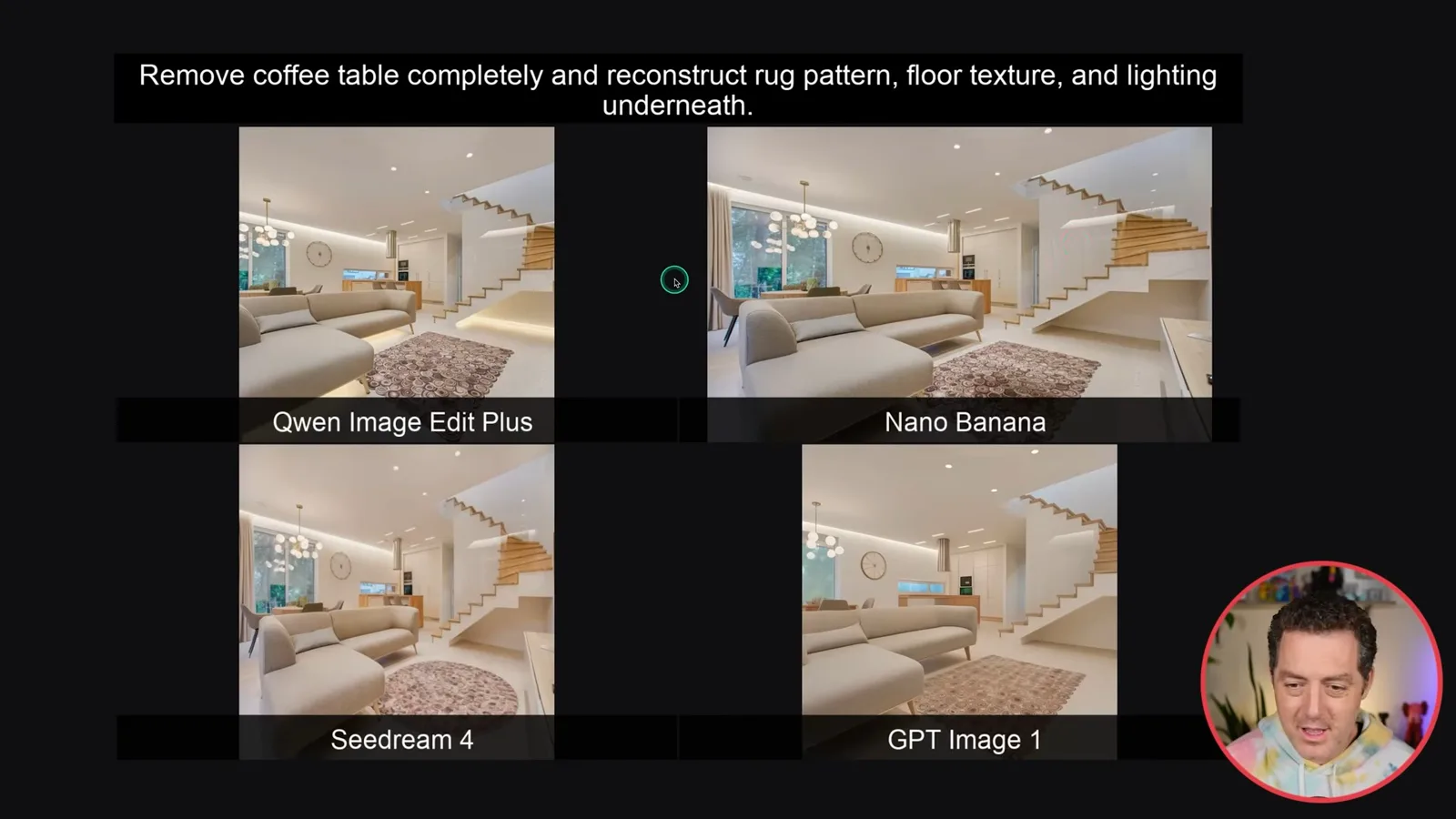
Removing a coffee table works well in all four examples. Nano Banana is my preference for preserving the scene, while Qwen introduces extra light. For removing a bedside lamp and table, I again favor Nano Banana; one alternative changes the wall substantially.
A zoom-out portrait test favors Nano Banana because it preserves the subject’s expression better in the examples. In a top-down kitchen view, I find that none of the models reliably reconstructs the layout and fixtures.
For a giant cat in a miniature house and an office rendered as an architectural miniature, I prefer Seedream’s examples. The comparison considers apparent scale and style, not measured physical accuracy.
Style, text and weather
Berman compares painting, blueprint, lettering and weather effects. He closes with a qualified overall impression.
In the oil-painting test, several results show visible brush strokes; I ultimately prefer GPT Image 1, while Nano Banana looks less painterly. For watercolor, I choose Qwen over other strong examples, and Nano Banana changes the source less.
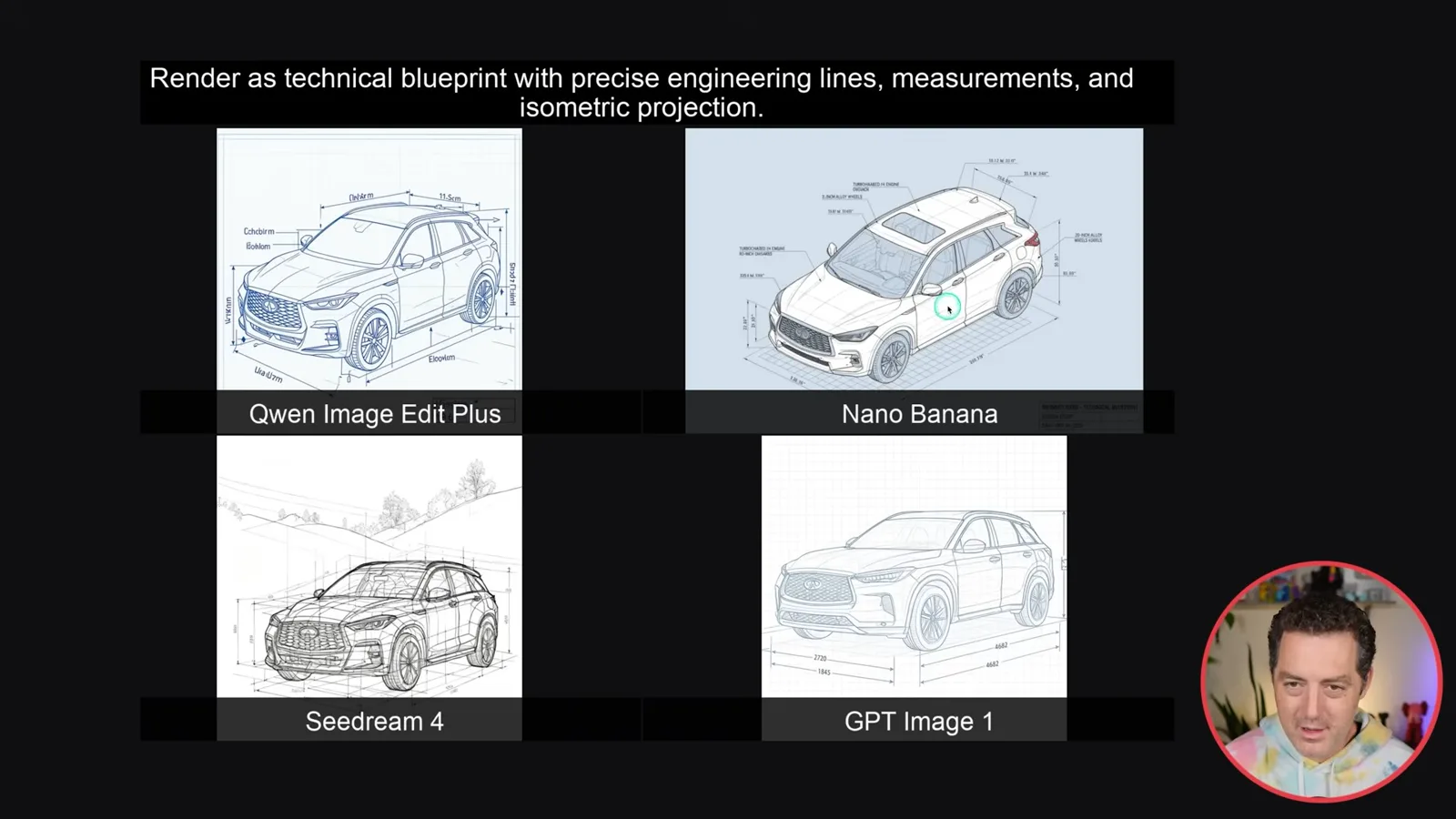
For a technical blueprint, Nano Banana provides the most convincing arrangement of lines and labels in my view. The other examples struggle with text or omit it; a visually convincing blueprint still needs its measurements independently checked.
All four produce usable anime-style images, and I prefer Qwen’s. For a pop-art prompt referencing Roy Lichtenstein, Qwen most closely matches the requested visual style in this comparison.
A movie-poster prompt asks for specific text and perspective; I pick Nano Banana’s example. For blue graffiti on brick, Seedream best integrates the letters and brick texture in my opinion.
For sale lettering on a shop window, GPT Image 1 is the only result that clearly conveys the requested glass transparency to me. Other images handle reflection, dimensionality or transparency less convincingly.
Adding snowfall to a portrait, Qwen balances visible accumulation and consistency with the original. Seedream’s example looks less natural to me, while GPT Image 1 renders snow well but changes the source more.
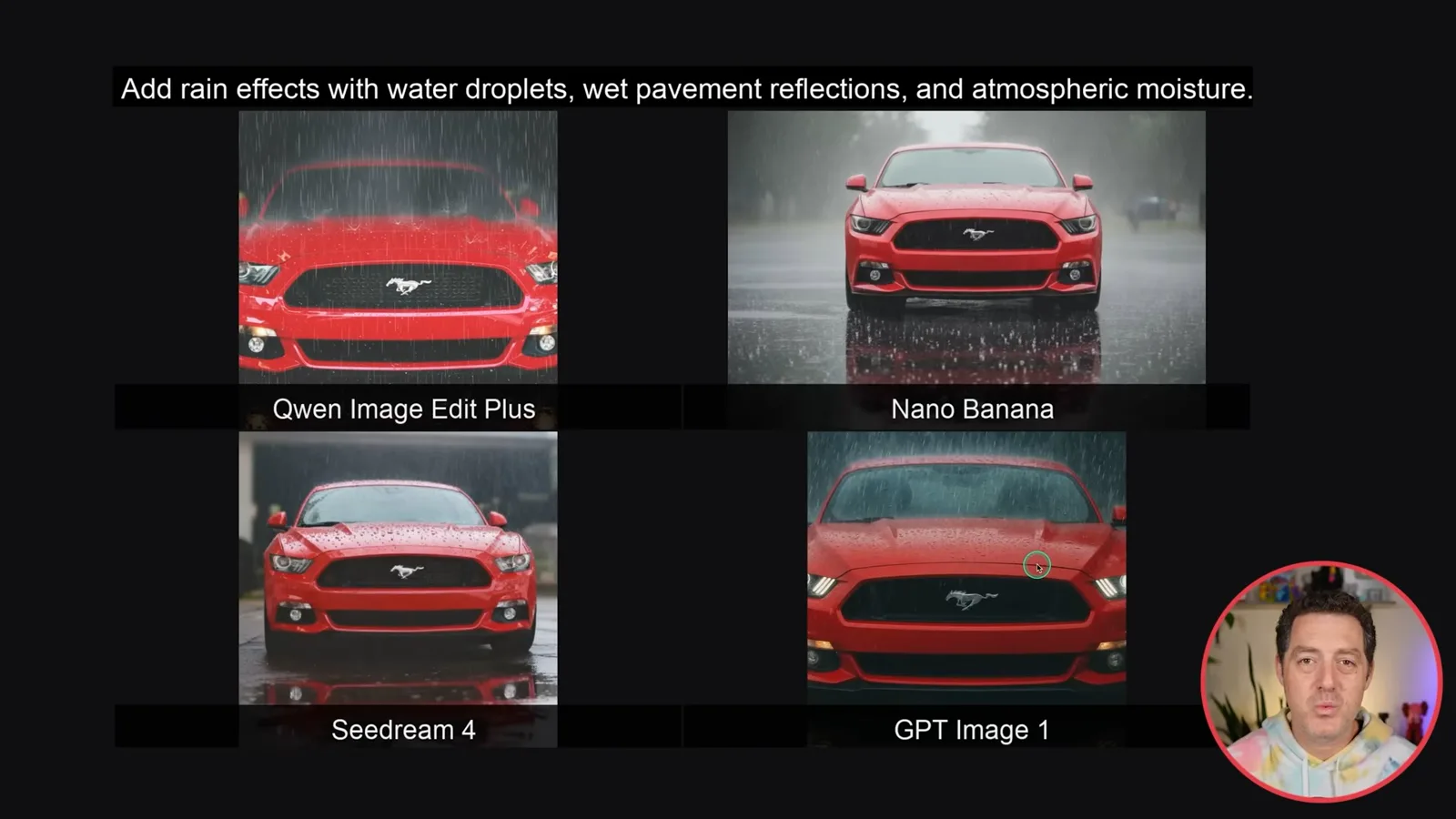
For rain on a car, I prefer GPT Image 1 because droplets visibly interact with the hood. In the final winter dog prompt, all four show visible breath, but I choose GPT Image 1 for its realistic fur, snow and background, with Seedream close behind.
My overall impression is that all four models can be useful, although I think Seedream performed worst across this particular selection. The task-specific results vary considerably, and the published comparison script lets readers try their own prompts; these 2025 results do not establish a lasting overall winner.
Mehr aus diesem Kanal
 25:50EN
 32:20EN
 0:22EN
 45:08EN
 0:32EN
 12:14EN