In 30 Sekunden
In this early-2025 video, Matthew Berman discusses Sam Altman’s claim that OpenAI knows how to build AGI and is turning its attention to superintelligence. Berman explores possible takeoff scenarios and AI research automation; his timeline, simulation hypothesis and assessment of o3 are speculative.
- 1A cryptic postAltman’s post about the singularity prompted discussion; he later offered simulation and uncertainty about takeoff as possible interpretations.
- 2Takeoff speedAn earlier OpenAI essay distinguished how soon AGI might arrive from how quickly more capable systems might follow.
- 3A claim about AGIAltman said OpenAI was confident it knew how to build AGI. Berman’s characterization of o3 as AGI is his own assessment.
- 4Agents in the workplaceAltman predicted AI agents might materially change company output in 2025; Berman agreed. This was a forecast made at the time.
- 5AI research feedbackBerman discusses a proposed intelligence-explosion scenario and early automated research, without evidence that recursive superintelligence has occurred.
Das Wichtigste
- Altman said OpenAI was confident it knew how to build AGI and was beginning to aim beyond it.
- Berman interprets a post about the singularity alongside Altman’s clarification that it had multiple possible meanings.
- Berman’s view that o3 was AGI is an opinion, and benchmark performance alone does not settle that question.
- AI-driven research and rapid self-improvement are scenarios, not established outcomes.
- Both the benefits and risks of increasingly capable systems require attention.
Den bearbeiteten Text nach Kapiteln lesen
The singularity and simulation hypothesis
Berman interprets Altman’s post and explains the proposed singularity. He discusses the simulation hypothesis as a speculative idea.
Sam Altman has written that OpenAI is confident it knows how to build AGI and is beginning to turn its attention toward superintelligence. In this early-2025 video, I want to unpack the claim, his recent post about the singularity and what an AI takeoff might mean.
Altman posted a short story about being near the singularity without knowing which side. I see the singularity as a hypothetical point at which technological change accelerates so much that the consequences become hard to predict. Ray Kurzweil has discussed 2045 as a possible date; I think it might arrive earlier, though neither date is established.
A rapid feedback loop in which AI contributes to its own research could produce an intelligence explosion, but it is a proposed scenario. Today’s models remain difficult to interpret fully, although interpretability research is progressing. I think the alignment problem would become especially important if systems exceeded our ability to understand them.
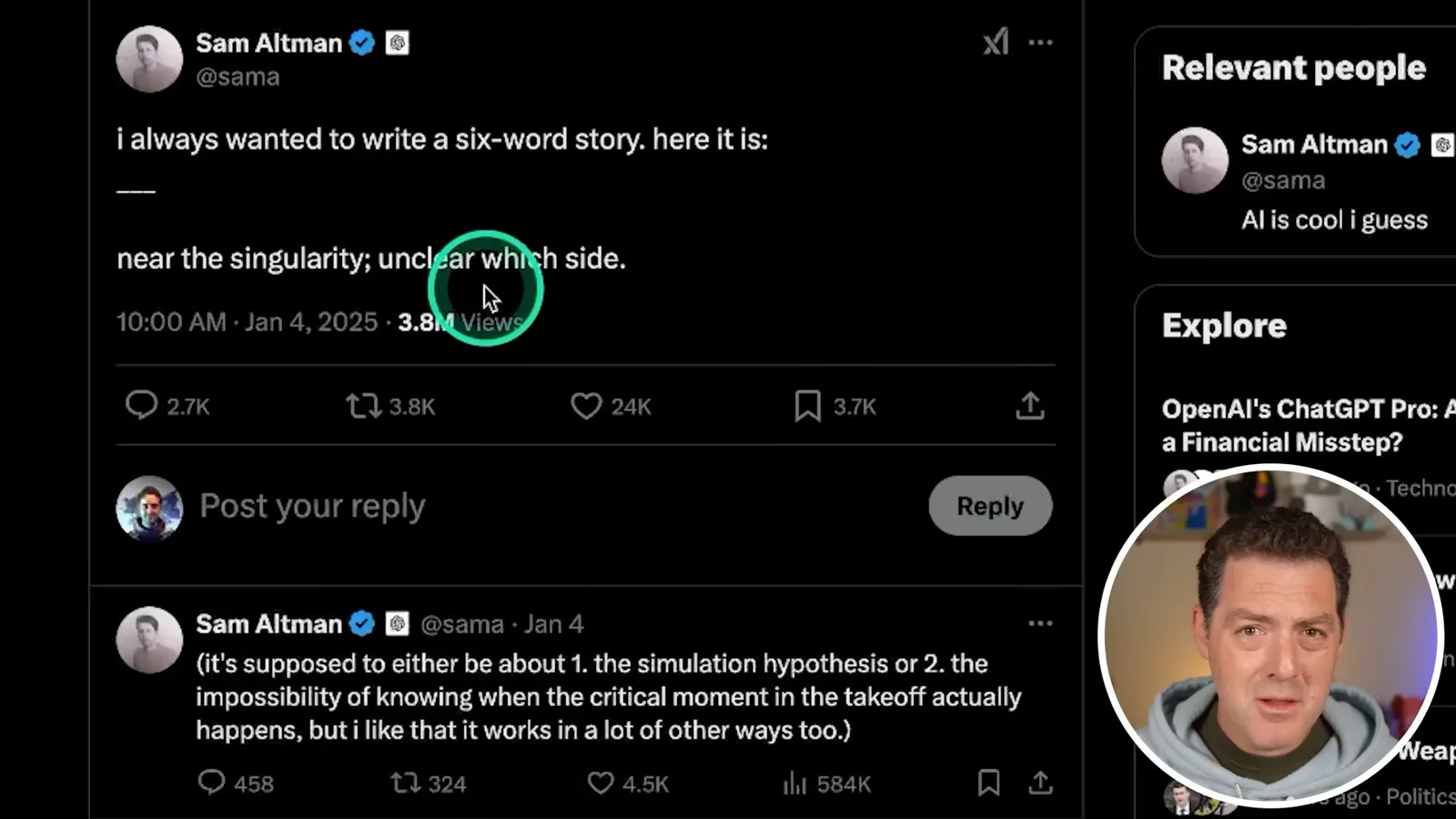
Altman later said his post could refer either to the simulation hypothesis or to the difficulty of identifying the critical moment of takeoff. The simulation hypothesis asks whether our world is artificially simulated. I personally find the idea plausible, but it remains speculative and the argument that simulations might be possible does not prove we inhabit one.
Takeoff and OpenAI’s earlier essay
He reviews the distinction between AGI timelines and the speed of subsequent progress, and discusses safety and coordination.
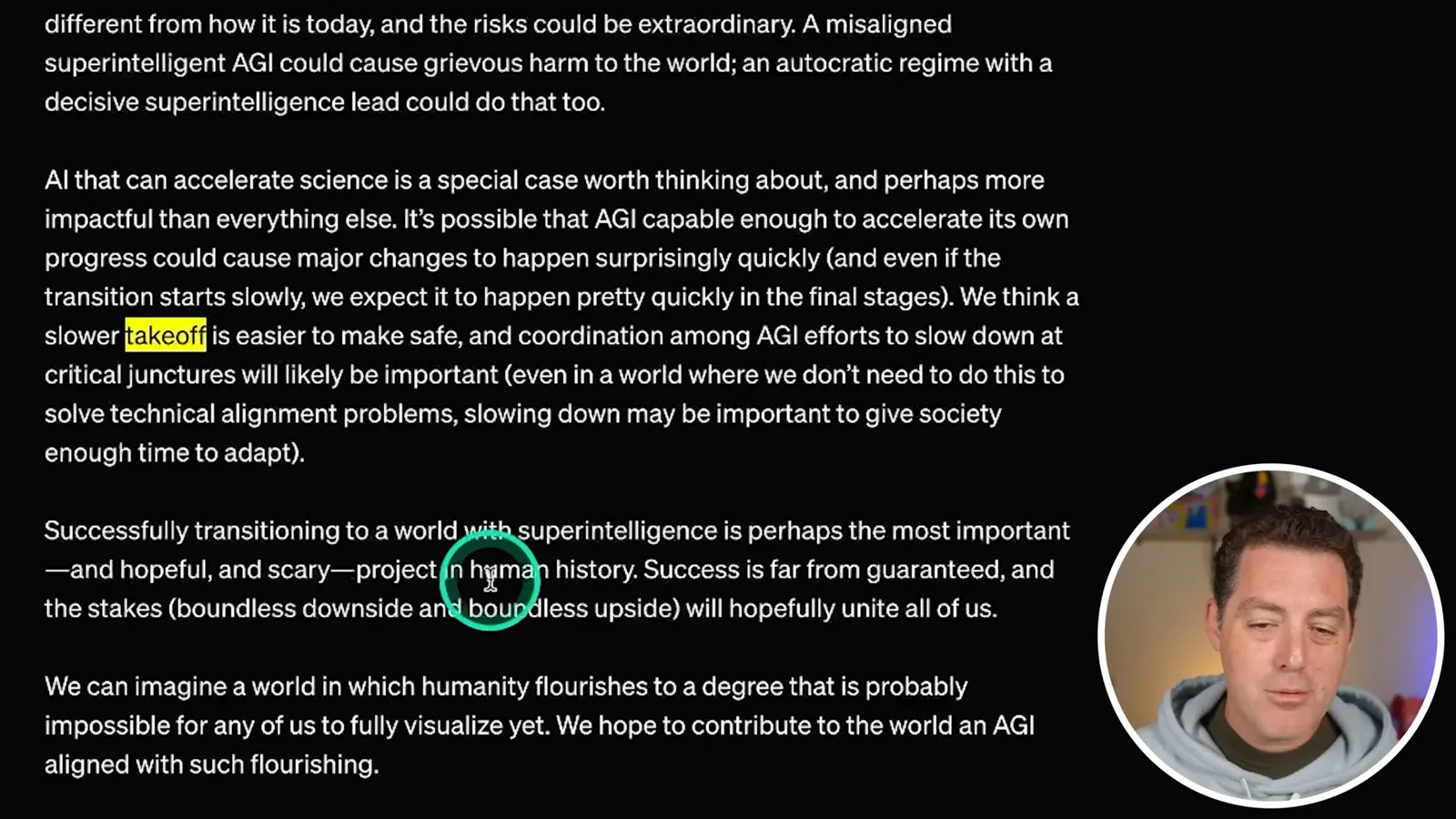
I revisit OpenAI’s 2023 discussion of planning for AGI. It suggested that a slower takeoff might be easier to make safe and that coordination at critical points could give society time to adapt. The time until AGI and the speed of change after it are separate uncertainties; a short timeline does not by itself determine takeoff speed.
Altman’s reflections on AGI
Berman reads Altman’s reflections on ChatGPT, AGI, AI agents and superintelligence. He offers his own assessment of o3.
Altman’s later reflection traces OpenAI’s path through the November 2022 launch of ChatGPT. I also point to models such as o1 and o3 that use additional inference-time computation for difficult problems. I see these developments as a new reasoning paradigm, though future progress is uncertain.
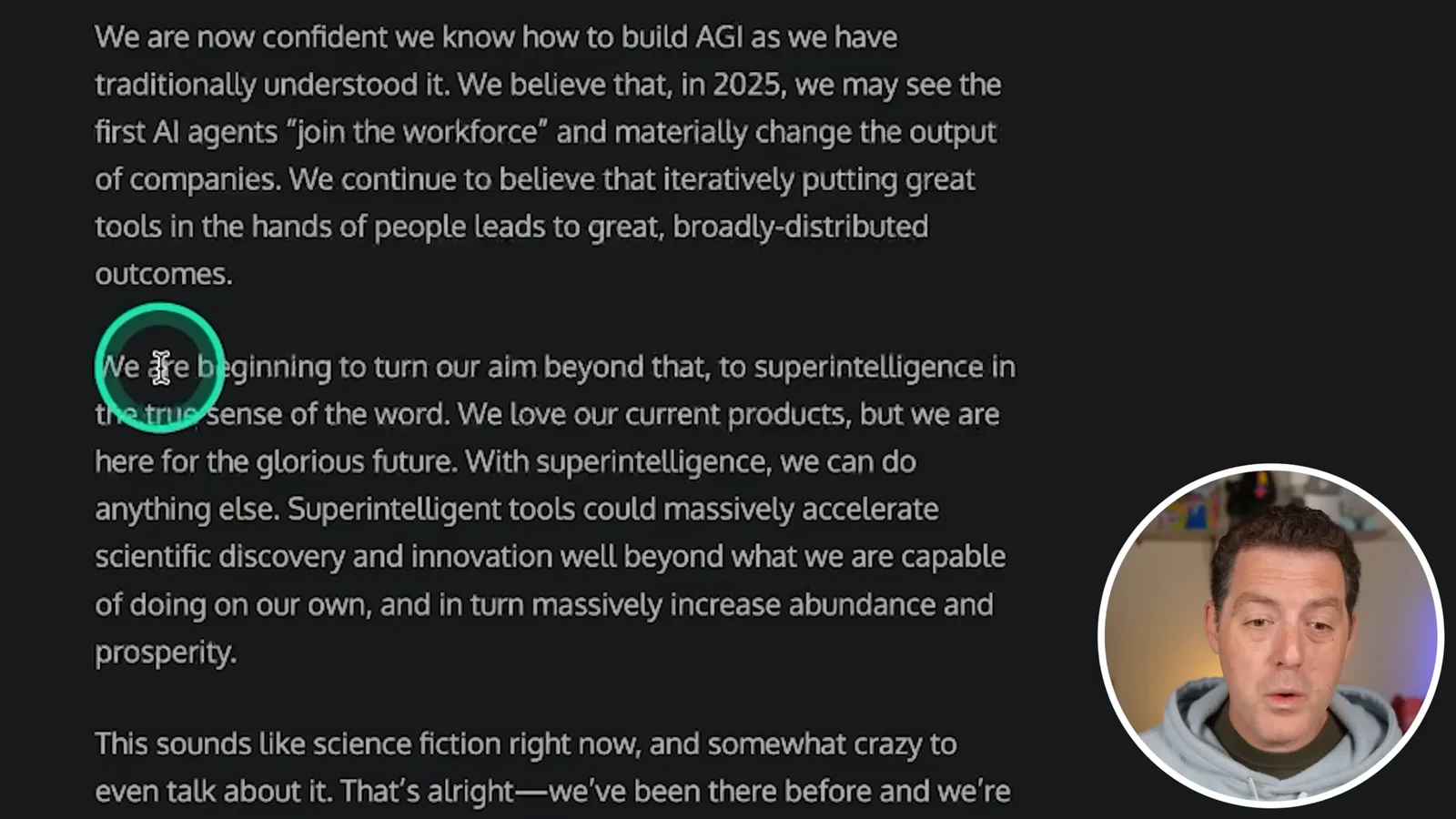
Altman says OpenAI is confident it knows how to build AGI as traditionally understood. I believe o3 is already AGI based on its benchmark results, while acknowledging OpenAI did not call it that. This is my interpretation: benchmark scores alone do not resolve the contested definition or establish general intelligence.
Altman predicted that AI agents might begin to join the workforce in 2025 and materially change company output. I shared that expectation, anticipating initially specialized applications. He also describes superintelligence as a longer-term goal that could accelerate science and increase prosperity. These were forecasts and ambitions, not demonstrated outcomes.
Automated research and risks
He explores hypothetical feedback from AI research, references early research systems and discusses possible social consequences.
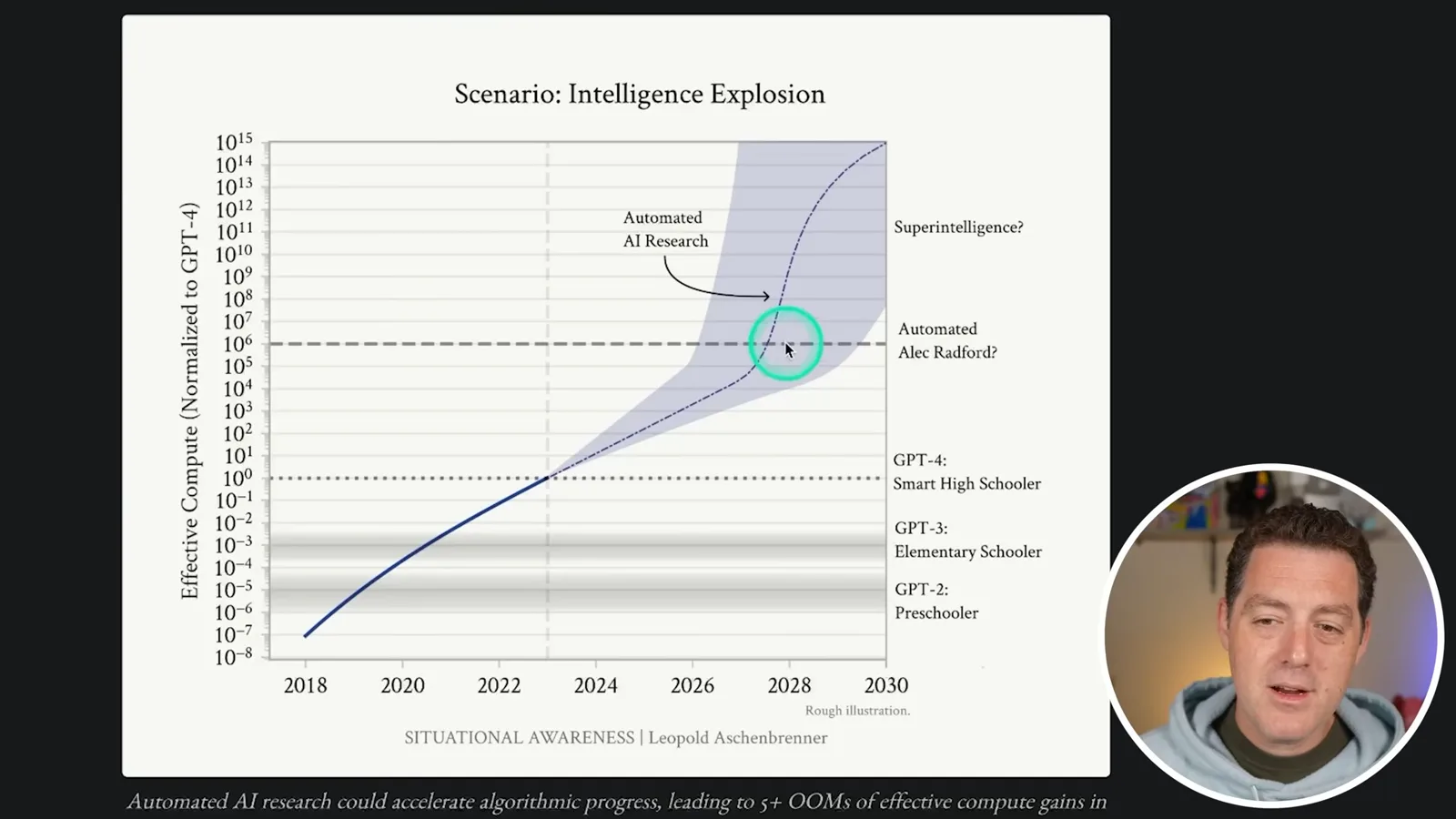
I return to an intelligence-explosion scenario in which AI helps automate AI research, accelerating further improvements. I discuss compute and inference costs and mention Sakana AI’s early AI Scientist work as an example of research automation. Such early systems have limitations and do not establish that autonomous recursive superintelligence is imminent.
I close with concerns raised by an OpenAI alignment researcher about possible consequences for politics, social relationships, markets and everyday life. My view is that the potential effects deserve serious discussion. Whether and how these changes occur remains uncertain, and both benefits and harms matter.
Mehr aus diesem Kanal
 25:50EN
 32:20EN
 45:08EN
 12:14EN
 10:36EN
 17:37EN