In 30 Sekunden
3Blue1Brown introduces a hexagonal tiling puzzle: rotate any three rhombuses that form a smaller hexagon, then ask whether repeated rotations can connect every valid tiling. The short poses the question and points to a longer video; it does not give the solution.
- 1Build the tilingTile a hexagon with equal rhombuses whose angles are 60° and 120°.
- 2Rotate a local hexagonThree rhombuses forming a smaller hexagon can be rotated by 60°.
- 3Ask about reachabilityCan a sequence of these moves transform any tiling into any other?
Das Wichtigste
- The large hexagon is tiled with congruent 60°–120° rhombuses.
- Three tiles that form a small hexagon can be rotated by 60° to create a new tiling.
- The puzzle asks whether those local moves connect every possible tiling; the short leaves the answer open.
Den bearbeiteten Text nach Kapiteln lesen
The tiles and the move
A large hexagon is tiled with rhombuses. Three tiles forming a small hexagon can be rotated together.
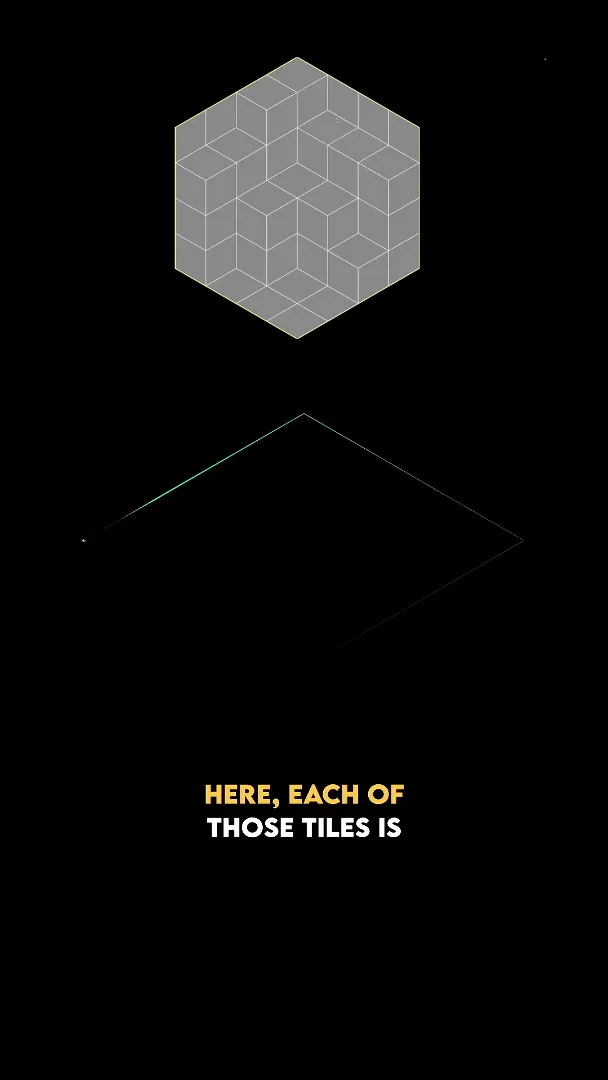
Here is a tiling puzzle. Start with a hexagon whose side length is a whole-number multiple of the side of a small tile. Fill it with congruent rhombuses, each with angles of 60° and 120°.
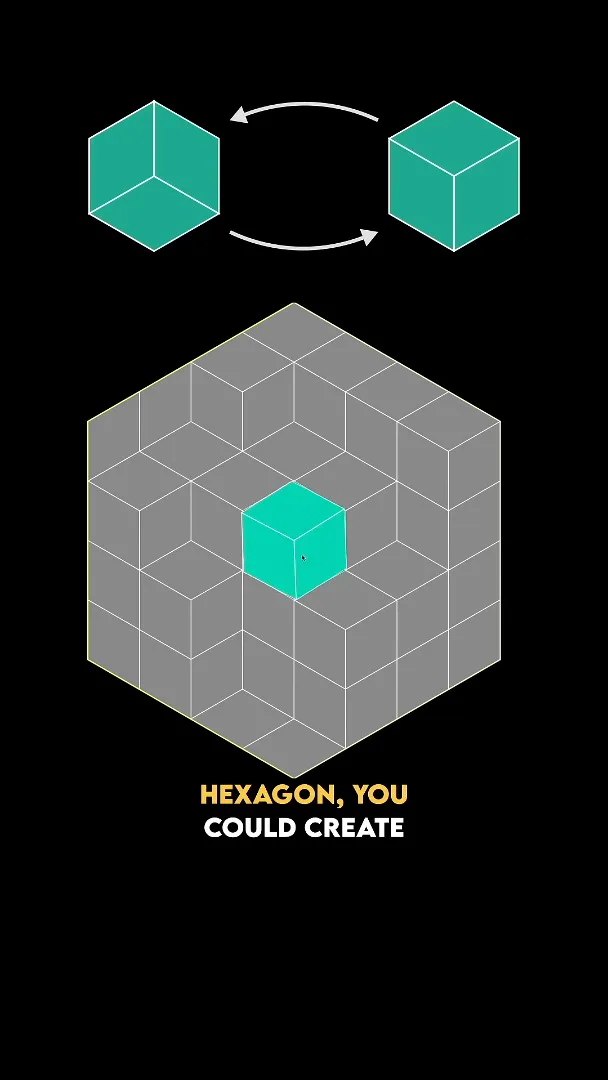
Whenever three rhombuses form a smaller hexagon, rotate that little hexagon by 60°. The move creates a different local tiling and can reveal other small hexagons that were not present before, making further rotations possible.
The question
The puzzle asks whether every tiling is reachable from every other. The short directs viewers to a longer video for the underlying insight.
Using only these moves, can you always get from any tiling of the large hexagon to any other? The short leaves the question for the viewer and points to a longer video with several puzzles and unexpected solutions. The presenter suggests that seeing the picture in the right way reveals the key insight.
Mehr aus diesem Kanal
 40:44EN
 3Blue1Brown· 16. Okt. 2026Grant Sanderson: There's never been a better time to go into mathGrant Sanderson, Constantin Kogler · 3Blue1BrownStudents fear AI has solved mathematics. Grant Sanderson argues the opposite: even if machines prove theorems better than we do, the institution of math stays valuable—and this is a rare moment when newcomers can reshape it.
 51:55EN3Blue1Brown· 18. Sept. 2026The last IMO problem AI could not solveGrant Sanderson · 3Blue1BrownGrant Sanderson walks through IMO 2025 Problem 6 — a tiling puzzle that frontier models missed — and the visual patience it takes to prove a construction is optimal.
 0:55EN3Blue1Brown· 24. Juli 2026The 64 Sugar Cubes Puzzle: Six Equal DistancesA 4×4×4 block has three colors; prove that six same-colored pairs share a distance.
 33:51EN3Blue1Brown· 16. Juli 2026What Cross-Entropy Connects: Compression, Language Models and KL DivergenceGrant Sanderson · 3Blue1BrownGrant Sanderson builds cross-entropy from code lengths and uses it to explain next-token training and distillation.
 2:25EN3Blue1Brown· 12. Juni 2026How Shannon Measured the Entropy of EnglishA guessing game helped Claude Shannon estimate how much information English text contains, and why prediction is central to compression.
 1:02EN3Blue1Brown· 10. Juni 2026A Robot Walk and the Puzzle of Optimal Binary EncodingHow few bits does it take to send directions that occur with unequal frequencies?