






Ergebnisse
94 ArtikelSortieren
 56:01EN
 AI Engineer· 26. Okt. 2026Xander Song on Evaluating Agents with Harbor and PhoenixXander Song · Arize AIArize AI engineer Xander Song explains how Harbor runs realistic agent tasks in isolated sandboxes, and how his team uses Phoenix to compare prompt changes, inspect trajectories, and test a SQL tool.
 19:43ENAI Engineer· 26. Okt. 2026Jack Wotherspoon on Building a Team of Managed AgentsJack Wotherspoon · Google DeepMindGoogle DeepMind’s Jack Wotherspoon introduces Gemini Managed Agents: cloud sandboxes that let teams run coding and research agents with a single API call. He explains how persistent environments, reusable skills, proxy-injected credentials, schedules, and specialized agents fit together.
 20:55ENAI Engineer· 26. Okt. 2026Jesse Hall: Build Voice Agents for Conversations, Not LeaderboardsJesse Hall · LiveKitLiveKit’s Jesse Hall explains how to evaluate voice agents as real-time systems: understand callers, handle interruptions, keep talking while tools run, and measure the delay people actually hear.
 18:27ENAI Engineer· 26. Okt. 2026Daksh Gupta on Building a Better AI Code Review AgentDaksh Gupta · GreptileGreptile co-founder Daksh Gupta explains why a webhook plus a coding agent is not enough for reliable pull-request review—and how targeted prompts, incident data, model inversion, codebase context, browser testing, and task-specific model routing can help.
 35:19ENAI Engineer· 25. Okt. 2026SallyAnn DeLucia: How to Write Your First AI EvalSallyAnn DeLucia · Arize AITurn an agent’s real traces into concrete pass/fail criteria, then build an LLM judge you can test, align with people, and run in production.
 20:58ENAI Engineer· 25. Okt. 2026Vinoo Ganesh on Making Financial AI Cite Every NumberVinoo Ganesh · KeplerKepler CEO Vinoo Ganesh explains why financial AI should retrieve and cite figures while deterministic software handles the math. His design makes traceability, retrieval quality, and tenant security part of the answer itself.
 15:27ENAI Engineer· 25. Okt. 2026What AI Engineers Do Now: Build the Loop Around AgentsAparna Dhinakaran · Arize AIAparna Dhinakaran argues that AI engineers are moving from shipping individual features to building systems that let agent teams improve them. At Arize, that means tracing agent behavior, evaluating its work against human judgment, and feeding those signals back into an always-on agent.
 17:42ENAI Engineer· 21. Okt. 2026Is a Faster Model Actually Faster? Measure the Finished Job, Not the TokensMorgan Suo · MiniMaxMiniMax's Morgan Suo takes the engineering changes inside M3.1 Flash one by one and asks the question that matters to users: does the job an analyst needs actually get done sooner, cheaper and correctly?
 1:20:57EN
Matt Godbolt: Inside Skylake’s Out-of-Order PipelineMatt GodboltA guided tour of instruction decoding, register renaming, execution and memory ordering, grounded in reverse engineering and careful measurements.
 52:05EN
Corwin de Zahr: Exploring OCaml Runtime Safety Through a CTF ChallengeCorwin de Zahr · Jane StreetA deliberately restricted OCaml sandbox becomes a way to examine type safety, callbacks, memory representation and binary debugging.
 3:13EN
How Jane Street’s Strategy and Product Team Works Across the FirmTeam members describe rotations, cross-functional projects and the skills they use to tackle ambiguous problems.
 47:08EN
Chris Casinghino on Making OCaml Safe for Performance EngineeringChris Casinghino · Jane StreetJane Street’s OCaml extensions use layouts and modes to offer more control over memory and parallelism while preserving safety and familiar programming patterns.
 12:43EN
How OCaml Represents Values in MemoryA practical tour of immediate integers, heap blocks, runtime tags and variant constructors, illustrated with OCaml's Obj module.
 1:03:21EN
Horace He on Building ML Systems for Trillion-Trillion OperationsHorace He · MetaHow GPU bottlenecks, compiler design and distributed parallelism shape the systems behind large-scale model training.
 27:16EN
Tudor Brindus on Finding and Reducing System JitterTudor Brindus · Jane StreetA memory ping-pong benchmark reveals how virtualization, interrupts, CPU frequency changes and speculation can disrupt low-latency systems.
 2:50EN
Inside Jane Street’s 2024 Internship ProgramInterns and staff describe an 11-week program built around learning, collaboration and hands-on projects across several disciplines.
 9:25EN
Richard Eisenberg: Using OCaml’s Coercion OperatorRichard Eisenberg · Jane StreetA practical tour of subtyping, polymorphic variants and private type abbreviations, with no runtime conversion cost.
 8:06EN
How OCaml's Proposed Include Functor Syntax Reduces RepetitionA reverse-array example shows how to derive common module functions from a minimal implementation without an extra wrapper module.
 3:18EN
Rory on Production Engineering and Incident Support at Jane StreetRory · Jane StreetA production engineer describes monitoring order engines, responding to outages and building a supportive team.
 3:16EN
JP on Machine Learning and Trading at Jane StreetJP · Jane StreetA Hong Kong equities trader describes his changing workday, the growth of research infrastructure, and the distinctive challenges of machine learning in finance.
 2:46EN
Matt on Machine Learning and Trading at Jane StreetMatt · Jane StreetA Hong Kong equities trader describes the challenges of financial data, the firm’s ML roles and its collaborative culture.
 14:36EN
Programming with OCaml's Local ModeAn example shows how a local list can contain global values, why a non-escaping annotation alone does not ensure stack allocation, and where the experimental feature remains awkward.
 11:28EN
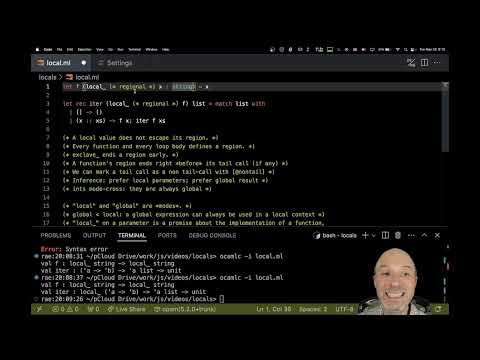
OCaml Local Types: Regional Parameters and Loop RegionsA demonstration explains why some local parameters can cross a function boundary and how loop regions reclaim allocations.
 3:11EN
Alok on Quantitative Research at Jane StreetAlok · Jane StreetA researcher describes projects, useful mathematical background and how candidates can prepare for interviews.
Mehr laden24 von 94 angezeigt