







Ergebnisse
158 ArtikelSortieren
 1:06:51EN
Marius Eriksen: Reflow for Incremental Cloud Data ProcessingMarius Eriksen · GRAILA functional language and runtime turn data workflows into typed programs, reuse prior results and provision cloud resources on demand.
 1:14:23EN
Cristina Rosu: Building Dynamic OCaml Web Apps with Incr_domCristina Rosu · Jane StreetA practical introduction to the Elm architecture, virtual DOM and incremental computation, followed by a live counter-app demonstration.
 1:02:34EN
Andy Ray on Designing and Running OCaml on FPGAsAndy Ray · Jane StreetHardCaml turns OCaml into a hardware design language. Andy Ray explains FPGA fundamentals, simulation and verification, then demonstrates an OCaml software stack running on a soft CPU.
 1:14:37EN
Adding an Effect System to OCamlA prototype brings algebraic effects into OCaml’s type system and explores how to track exceptions, I/O and locally mutable state.
 1:08:43EN
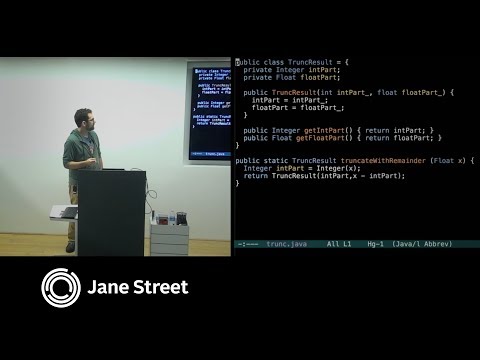
Ron Minsky on Types and Why They Matter in SoftwareYaron Minsky · Jane StreetType systems can make programs faster, catch mistakes and guide large refactorings, but their value depends on the language and the work. Ron Minsky explains the trade-offs through practical examples.
 1:10:18EN
Shriram Krishnamurthi on Designing Computing Curricula for Real ClassroomsShriram Krishnamurthi · Brown UniversityThe Bootstrap project treats curriculum design as an engineering problem: start with goals and constraints, then support teachers and measure learning.
 1:06:49EN
Bryan Cantrill on Finding the Butterfly Behind a Performance HurricaneBryan Cantrill · JoyentSmall defects can produce vast performance failures across layers of abstraction. Bryan Cantrill explains how to investigate them with questions, instrumentation and visualization.
 56:12EN
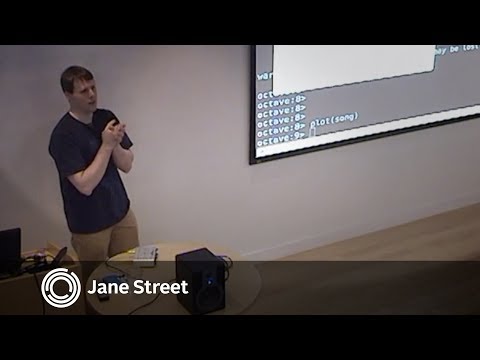
Echoes of Fourier: From Sound Waves to Fast ConvolutionChristopher HardinA practical introduction to Fourier transforms, convolution, and the mathematics of placing a recording in real or imagined acoustic spaces.
 56:06EN
How Jane Street Reviews Code with IronJane Street's internal review tool tracks what each reviewer has actually read, keeps feedback in the code, and enforces review obligations before release.
 1:13:25EN
Nate Foster: Verifying Programmable Network Data PlanesNate Foster, Ron · Cornell UniversityHow p4v applies program verification to packet-processing code, and why its conclusions depend on control-plane assumptions.
 52:51EN
Caveat Configurator: When Configuration Becomes CodeDominick LoBraico · Jane StreetDominick LoBraico explains why flexible OCaml plugins created production problems at Jane Street, and how configuration generation and disciplined plugin management address them.
 59:14EN
Arjun Guha on Verifying System ConfigurationsArjun Guha · UMass AmherstPuppet manifests can be declarative yet nondeterministic or non-idempotent. A verification tool models resource interactions to find those problems.
 38:17EN
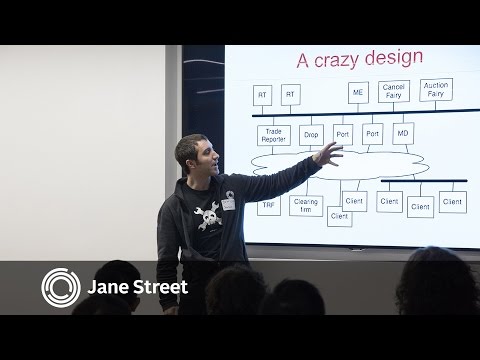
How to Build a Reliable Exchange with Deterministic ReplayA matching engine, multicast and state-machine replication can turn a high-throughput exchange into a recoverable system. This talk explains the design and its tradeoffs.
 25:44EN
Why Functional Programming Matters at Jane StreetA Jane Street developer revisits John Hughes’s classic argument and explains why expressive static types rank highest for trading systems.
 28:31EN
Incremental: Self-Adjusting Computations in OCamlSebastian Funk · Jane StreetSebastian explains Jane Street’s dynamic dependency graph library and the algorithms behind efficient updates.
 1:09:24EN
Yaron Minsky on Effective ML: Writing OCaml for Code ReadersYaron Minsky · Jane StreetPractical lessons from Jane Street on using types, interfaces and abstraction to keep a large OCaml codebase understandable and correct.
 1:06:39EN
Why Jane Street Uses OCamlA Jane Street talk explains how functional programming and static types support reliable trading software, and examines the costs of choosing a less common language.
 23:58EN
Effective ML: Errors, Abstraction and Managing ComplexityA Jane Street engineer discusses explicit failure, boilerplate, type-system restraint and the practical role of side effects.
 1:04:56EN
Yaron Minsky on Incremental: From Research Idea to Production LibraryYaron Minsky · Jane StreetA history of the algorithms, memory problems and performance tradeoffs behind Jane Street’s OCaml library for self-adjusting computations.
 1:12:41EN
Ron Minsky on Trading, Correctness and Jane Street’s Shift to OCamlYaron Minsky · Jane StreetA Jane Street technologist explains the market-making business and why readability, types and predictable performance shaped the firm’s choice of OCaml.
 51:35EN
Yaron Minsky on Effective ML: Interfaces, Invariants and Code ReadersYaron Minsky · Jane StreetIn the first part of a 2011 Harvard lecture, Jane Street’s Yaron Minsky shows how OCaml interfaces and types can make long-lived code easier to understand and change.
 10:20EN
 Lex FridmanPodcast · 2 StimmenHow C++ Is Standardized: Votes, Consensus and the Move to a Three-Year Release CycleGast: Bjarne Stroustrup · Moderation: Lex FridmanBjarne Stroustrup explains how the ISO committee works, why C++0x slipped to C++11, and how shorter cycles made C++14, C++17 and C++20 arrive on time.
 1:19:25EN
 Lenny's PodcastPodcastInside Mercado Libre: How 18,000 Engineers Ship 30,000 Changes a Day Without an Army of PMsModeration: Lenny RachitskySebastian Barrios, formerly head of product and engineering at Mercado Libre and now SVP of Engineering at Roblox, explains how a Latin American giant runs engineering and product as one team.
 1:23:15ENLenny's PodcastPodcast · 2 StimmenCamille Fournier on Rewrites, One-on-Ones and Building Platform TeamsGast: Camille Fournier · Moderation: Lenny RachitskyThe author of The Manager's Path explains what annoys engineers about PMs, why rewrites are a trap, how to move into management, and what makes platform teams work.
Mehr laden24 von 158 angezeigt