









筛选结果
34 篇排序
 1:25:56EN
 Cognitive Revolution "How AI Changes Everything"· 2026年10月17日播客Claude Changed the Password. The Steering Wheel Was Already Optional主持 Nathan LabenzNathan Labenz and Prakash Narayanan spend a week on agents that can lock you out, models that dodge a feeling they deny having, and formal proofs that found Linux bugs.
 2:00:51ENCognitive Revolution "How AI Changes Everything"· 2026年10月10日播客Resample Every Token and You Can Watch the Model Decide主持 Nathan LabenzGoodfire's Eric Bigelow on forking paths, in-context learning, and why chain-of-thought monitoring is getting harder to trust.
 2:13:09ENCognitive Revolution "How AI Changes Everything"· 2026年8月26日播客One Chain of Thought, 100 Million Tokens: RL Is a Hell of a Drug主持 Nathan LabenzApollo Research's Bronson Schoen on reward-seeking models, invented slang, and why chain-of-thought monitoring will not save us.
 1:56:40ENCognitive Revolution "How AI Changes Everything"· 2026年8月8日播客The Periodic Table Was Already in the Weights主持 Nathan LabenzGoodfire CTO Dan Balsam tells Nathan Labenz how concept manifolds, predictive data debugging, and a $1,000-a-month research agent are turning interpretability into a product.
 2:06:41ENCognitive Revolution "How AI Changes Everything"· 2026年7月9日播客Zero the J-Space and a Model's Hidden Goal Lights Up on Token One主持 Nathan LabenzA weekly Cognitive Revolution cut of Anthropic's global-workspace paper, AI superforecasters, open video world models, and a chip that treats inference as data movement.
 1:57:46EN → 简体中文Cognitive Revolution "How AI Changes Everything"· 2026年6月27日播客意识 30%、蜜蜂 47%、人员更替 80%:用数字衡量 AI 正在变成什么主持 Nathan Labenz《The Cognitive Revolution》的周度精选,先从 Cameron Berg 谈模型内部开始,再拉远到“逐步剥夺人类权力”(gradual disempowerment)、欧洲的两难处境,以及围绕智能体(Agent)重新搭建业务的公司。
 1:22:36ENCognitive Revolution "How AI Changes Everything"· 2026年6月6日播客A Thousand Researchers, a Million AIs: Frontier Labs Start Talking About the Brakes主持 Nathan LabenzThe first week of AI in the AM follows OpenAI's timeline for an ML-intern model this year and a human-level AI researcher by early 2028 — and the closed-door meeting where labs admitted they might one day need to slow down together.
 3:36:29EN → 简体中文Cognitive Revolution "How AI Changes Everything"· 2026年4月23日播客Claude 给自己的福利打了 4.49 分:首个越过中性线的版本主持 Nathan LabenzCameron Berg 再次做客《The Cognitive Revolution》,梳理六个月来在内省、功能性情绪和模型福利(model welfare)方面的研究,并介绍一项尚未发表的案例:学习与感受也许是同一种现象。
 1:44:15ENCognitive Revolution "How AI Changes Everything"· 2026年4月1日播客Nathan Labenz's p(doom) Is 10 to 90 Percent. He Is More Optimistic Anyway主持 Nathan LabenzFive years ago, expecting AGI by 2035 made you an extremist. On The Intelligence Horizon, the Cognitive Revolution host explains why the same forecast now sounds bearish, and why he still thinks a defense-in-depth strategy might keep society on the rails.
 1:49:53ENCognitive Revolution "How AI Changes Everything"· 2026年3月5日播客Don't Fight Backprop: Goodfire's Bet on Designing What Models Learn主持 Nathan LabenzDan Balsam and Tom McGrath return to The Cognitive Revolution with a $150 million Series B, a new research pillar called intentional design, and a rule for anyone who wants to steer training: stop trying to out-muscle gradient descent.
 2:27:18ENCognitive Revolution "How AI Changes Everything"· 2025年11月5日播客Turn Down AI's Deception Knob, and It Starts Reporting Experience主持 Nathan LabenzCameron Berg of AE Studio tells Nathan Labenz how suppressing deception features in Llama 3.3 70B pushed self-reports of subjective experience toward 100 percent.
 1:28:17ENCognitive Revolution "How AI Changes Everything"· 2025年9月20日播客Adam Gleave's Three Capability Tiers: Attack Agents in 5–7 Years, Fully AI Companies Around Year 14主持 Nathan LabenzFAR.AI and the UK AI Security Institute stacked adversarial attacks on frontier safeguard pipelines and found many breakthroughs were engineering failures, not a verdict against defense in depth.
 3:14:49EN → 简体中文Cognitive Revolution "How AI Changes Everything"· 2025年9月6日播客今年夏天,什么都没有突破曲线:Zvi 为什么拉长了 AGI 时间表主持 Nathan Labenz这是 Zvi Mowshowitz 第十次做客《The Cognitive Revolution》播客。他认为 GPT-5 和国际数学奥林匹克(IMO)金牌都在既有趋势之内,而芯片政策、能源问题和强化学习让他的末日概率(p(doom))微微上调。
 2:02:17ENCognitive Revolution "How AI Changes Everything"· 2025年8月27日播客SAEs Find the Nouns. Parameter Decomposition Looks for the Verbs主持 Nathan LabenzGoodfire's Lee Sharkey argues that sparse autoencoders recover a network's variables, not the algorithms those variables run, and shows how stochastic parameter decomposition tries to recover the computations themselves.
 1:37:05EN → 简体中文Cognitive Revolution "How AI Changes Everything"· 2025年6月19日播客一位代数几何学家辞去终身教职,因为碗形的损失曲线图是假的主持 Nathan LabenzTimaeus 的 Jesse Hoogland 和 Daniel Murfet 认为,真正决定神经网络如何学习、如何泛化、又如何出错的,是损失景观中的奇点,而不是每份幻灯片里那些平滑的山谷。
 1:54:08ENCognitive Revolution "How AI Changes Everything"· 2025年5月29日播客Why Anthropic's first check went to a company building microscopes for neural nets主持 Nathan LabenzGoodfire's Dan Balsam and Tom McGrath argue that mechanistic interpretability now has a proto-paradigm, two stubborn gaps, and three products worth shipping today.
 1:19:10ENCognitive Revolution "How AI Changes Everything"· 2025年5月11日播客A Robot-Arm Shot That Took Months Now Lives in a Prompt主持 Nathan LabenzLuma Labs’ Amit Jain and Jiaming Song on Ray 2, few-shot camera concepts, and why they think video models sit on the path to multimodal AGI.
 2:33:39EN → 简体中文Cognitive Revolution "How AI Changes Everything"· 2025年2月27日播客攻击者后出手:Nicholas Carlini 为什么总能攻破 AI 防御主持 Nathan Labenz谷歌 DeepMind 安全研究员谈简单的损失函数、70% 的稳健准确率,以及为什么修复必须落在系统层面,单靠模型本身不够。
 2:09:55ENCognitive Revolution "How AI Changes Everything"· 2025年1月18日播客The Attacker Won All 70 Rounds Against Mind-Reading Defenses主持 Nathan LabenzLuke Bailey, Erik Jenner, and Scott Emmons walk through a 50-page paper showing that probes, out-of-distribution detectors, and sparse autoencoders can be bypassed while the model still does the harm.
 1:01:53ENCognitive Revolution "How AI Changes Everything"· 2024年12月18日播客Humans Wrote 1.3 Percent of the Tokens. The AI Lab Still Designed Working Nanobodies.主持 Nathan LabenzStanford's James Zou describes a GPT-4o research group that invented a protein-design pipeline for under $100 — and a sparse autoencoder that pulled an undocumented motif out of ESM-2.
 2:37:47ENCognitive Revolution "How AI Changes Everything"· 2024年10月19日播客The intern who wrote GELU now wants humanity's last exam主持 Nathan LabenzDan Hendrycks on activation functions, five-year benchmarks, jailbreaks that do not yield to scale, and stacking defenses because no single layer is trustworthy.
 1:52:00ENCognitive Revolution "How AI Changes Everything"· 2024年8月17日播客4,096 Numbers Have to Carry Every Concept. Goodfire Wants the Knobs主持 Nathan LabenzDan Balsam and Tom McGrath explain how sparse autoencoders unpack a language model's residual stream — and why a public-benefit startup is trying to make that a product.
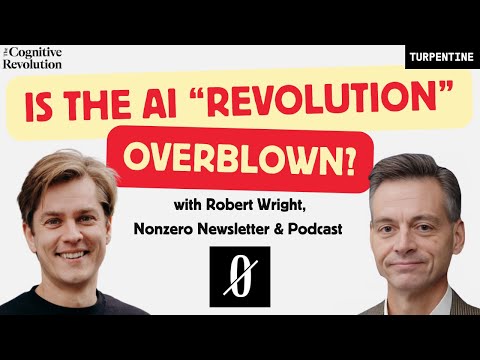 2:04:15ENCognitive Revolution "How AI Changes Everything"· 2024年8月14日播客A parrot cannot paraphrase — and Claude cannot be talked into harm主持 Nathan LabenzRobert Wright of the Nonzero podcast interviews Nathan Labenz on whether large language models understand anything, what Anthropic’s 10 million features actually show, and why open weights collide with U.S.–China policy.
 46:20ENCognitive Revolution "How AI Changes Everything"· 2024年5月15日播客One Vector Made the Assistant Plot to Take Over the World主持 Nathan LabenzNathan Labenz and Robert Wright pick apart AI doom, mechanistic interpretability, and why today's alignment tricks are not expected to work.
加载更多已显示 24 篇,共 34 篇