








筛选结果
104 篇排序
 23:54EN
 No Priors: AI, Machine Learning, Tech, & Startups播客 · 2 人对谈Beyond GPT-7: The Customization Toolkit, Meta's Open Source Bet and the Return of Consumer AI主持 Sarah Guo, Elad GilIn a host-only episode, the No Priors hosts map the six levers for 10x to 100x better AI, explain fine-tuning, RAG and AI feedback, and ask why consumer social is suddenly interesting again.
 1:03:25EN
 Lex Fridman播客Theano in an Hour: Symbolic Graphs, Automatic Gradients and a Compiler That Rewrites Your Math主持 Lex FridmanPascal Lamblin of MILA walks through how Theano builds, differentiates, optimizes and runs computation graphs, then trains logistic regression, a convnet and an LSTM.
 50:23EN
 Unsupervised Learning: With Jacob Effron播客OpenAI’s Platform Bet: Where AI Value Accrues, Why Open Source Trails, and When Superintelligence Arrives主持 Jacob EffronPeter Welinder explains OpenAI’s platform strategy, the case for proprietary frontier models over open source, the enterprise hallucination problem, and his speculative timeline for AGI and superintelligence.
 1:34:27EN → 简体中文
 Lenny's Podcast播客 · 2 人对谈开源是这一代人的自由问题:Matt Mullenweg 谈 Llama、WP Engine 和 fort 的权利嘉宾 Matt Mullenweg · 主持 Lenny RachitskyWordPress 联合创始人、Automattic 首席执行官 Matt Mullenweg 向 Lenny Rachitsky 讲述开源哲学、与 WP Engine 的冲突,以及他如何看待 AI、社区和收购。
 1:02:06ENLex Fridman播客Learning TensorFlow Hands-On: From a Mystery Line to Handwritten Digits主持 Lex FridmanGoogle Brain's Sherry Moore walks a Deep Learning School audience through how TensorFlow works and two core labs, linear regression and MNIST digit recognition.
 33:31ENNo Priors: AI, Machine Learning, Tech, & Startups播客 · 2 人对谈Open Source Catches Up, Regulation Can Wait: Sarah Guo and Elad Gil Answer Listener Questions主持 Sarah Guo, Elad GilTwo AI investors cover open-source models, autonomous agents, whether to regulate AI, where startups can win, and why healthcare innovation is so hard.
 1:47:58EN → 简体中文Lenny's Podcast播客 · 3 人对谈让意见不合的人达成共识:Community Notes 怎样做出可信的事实核查嘉宾 Keith Coleman, Jay Baxter · 主持 Lenny RachitskyCommunity Notes 产品负责人 Keith Coleman 和创始机器学习工程师 Jay Baxter 讲述这套算法如何运转、一支极小的团队如何把它做出来,以及它为何能在 Twitter 和 X 的四任领导者手里活下来。
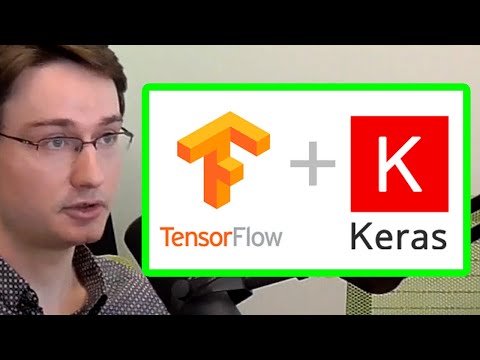 11:59ENLex Fridman播客 · 2 人对谈From a Side Project to TensorFlow's Core: François Chollet on How Keras Came to Be嘉宾 François Chollet · 主持 Lex FridmanThe creator of Keras recalls why he built it in 2015 around recurrent networks, how it moved onto TensorFlow, and what TensorFlow 2.0 means for its design.