









필터 결과
23개정렬
 1:57:29EN
 Cognitive Revolution "How AI Changes Everything"· 2026년 4월 4일팟캐스트Frontier vision models score 12.5%: Joseph Nelson on the real waterline of computer vision진행자 Nathan LabenzThe Roboflow CEO tells Nathan Labenz why vision still lags language, how to distill SAM 3 into an edge model for Wimbledon, and why the United States has almost never led open-source vision.
 3:53:49ENCognitive Revolution "How AI Changes Everything"· 2025년 1월 3일팟캐스트With One-Twelfth the Data, an Open-Source Vision Model Beat GPT-4o진행자 Nathan LabenzWill Hardman of Veratai walks Nathan Labenz through two years of vision-language models, from ViT and CLIP to InternVL, BLINK, and Transfusion.
 54:45ENCognitive Revolution "How AI Changes Everything"· 2024년 10월 9일팟캐스트A Few Megabytes of Doom and a Few Gigabytes of Model: Why Runway Bets on Generalization진행자 Nathan LabenzCTO Anastasis Germanidis tells The Cognitive Revolution why video is a fuller record of the world than text, why physics shows up without being programmed in, and how a small lab competes with unlimited compute.
 46:47ENCognitive Revolution "How AI Changes Everything"· 2024년 8월 3일팟캐스트Editing Video Like a Document: How Descript Puts AI in the Copilot Seat진행자 Nathan LabenzDescript CEO Andrew Mason on Underlord, why the timeline had to die, and what a ten-times-more-expensive editor would look like.
 1:03:22ENCognitive Revolution "How AI Changes Everything"· 2024년 8월 2일팟캐스트A 40-person team at $35 million ARR: HeyGen made AI avatars a business, not a demo진행자 Nathan LabenzJoshua Xu and Benchmark’s Victor Lazarte tell Nathan Labenz how a camera-replacement product grew past 40,000 business customers — and why half the faces on this episode are fake.
 1:21:28ENCognitive Revolution "How AI Changes Everything"· 2024년 1월 26일팟캐스트The Prompt Is a Bug: Suhail Doshi’s Bet on Control Over Pixels진행자 Nathan LabenzThe Mixpanel founder tells Nathan Labenz how a cloud browser, a canceled tweet, and a Thursday weight drop shaped Playground AI’s bet on images.
 1:36:39ENCognitive Revolution "How AI Changes Everything"· 2023년 11월 9일팟캐스트OpenAI’s $5 Million Bet: A 60-Person Team Wants GPT-4V to Give Cars Common Sense진행자 Nathan LabenzGhost Autonomy cofounder John Hayes tells Cognitive Revolution why a multimodal model on the driving path could reset self-driving after two decades of DARPA-era stacks.
 1:30:21ENCognitive Revolution "How AI Changes Everything"· 2023년 9월 14일팟캐스트A Million DALL-E Images, Distilled into Twelve Minutes of Film진행자 Nathan LabenzWaymark’s Stephen Parker and Josh Rubin walk through how they turned stills from DALL-E 2 into The Frost, a narrative short, and what the next generation of video models changes.
 1:18:18ENCognitive Revolution "How AI Changes Everything"· 2023년 6월 20일팟캐스트Fifteen Thousand Brain Numbers Were Enough to Reconstruct What Someone Saw진행자 Nathan LabenzTanishq Mathew Abraham walks through MindEye, the fMRI-to-image system that maps a handful of voxel values onto CLIP and diffusion models.
 1:01:17ENCognitive Revolution "How AI Changes Everything"· 2023년 5월 9일팟캐스트The $300 million Gates refused, and the $10 billion that went to OpenAI진행자 Nathan LabenzRobert Scoble and Ben Tossell talk with Nathan Labenz about AI scouting, Apple's still-sleeping neural engines, and whether incumbents or AI-first startups will win.
 1:21:20ENCognitive Revolution "How AI Changes Everything"· 2023년 3월 9일팟캐스트Freeze the eyes and the brain. Train only the optic nerve.진행자 Nathan LabenzJunnan Li and Dongxu Li tell Nathan Labenz how BLIP cleaned noisy web captions, and how BLIP-2 connected a frozen vision model to a frozen language model in under ten days on one A100.
 9:59EN
 Lex Fridman팟캐스트Is Language or Vision Harder? Ilya Sutskever on the Unity of Machine Learning진행자 Lex FridmanIn a short clip from his 2020 conversation with Lex Fridman, Ilya Sutskever explains why vision, language and reinforcement learning share the same few principles, and why asking which problem is harder is the wrong question.
 58:46ENLex Fridman팟캐스트Caging the Neural Network: How Aptiv Thinks About Safe Self-Driving진행자 Lex FridmanAptiv Autonomous Mobility's Karl Iagnemma and Oscar Beijbom explain why end-to-end learning is hard to trust in cars, and show how PointPillars and nuScenes push lidar perception forward.
 1:23:18ENCognitive Revolution "How AI Changes Everything"팟캐스트From GPT-2 to GPT-3 Moments in Robotics: Six DeepMind Papers on Bridging Robots and the Internet진행자 Nathan LabenzKeerthana Gopalakrishnan and Ted Xiao walk through RT-2, RT-X, RT-Trajectory, AutoRT, Learning to Learn Faster and PIVOT, and say what is still missing for general-purpose robots.
 1:03:24EN
 Unsupervised Learning: With Jacob Effron팟캐스트Why Sora Bet on People, Not Just Pixels진행자 Jacob EffronThe Sora team explains how a video model became a social creation network, what cameos revealed about human creativity, and why the next frontier is world simulation.
 1:11:50ENLex Fridman팟캐스트Data Is Everything: Teaching Self-Driving Cars to Understand the Human Behind the Wheel진행자 Lex FridmanIn an MIT lecture, Lex Fridman shows how deep learning can sense pedestrians, driver posture, gaze, emotion and cognitive load, and why that matters for human-centered autonomy.
 58:19ENUnsupervised Learning: With Jacob Effron팟캐스트Runway's Chris Valenzuela on Why Taste Beats Tools in Generative Media진행자 Jacob EffronChris Valenzuela, CEO of Runway, explains why generative media is still early, how taste and iteration shape the work, and what has to change before AI media becomes a new art form.
 1:19:52ENLex Fridman팟캐스트From Pixels to Steering Wheels: Convolutional Networks and End-to-End Driving진행자 Lex FridmanLex Fridman's MIT 6.S094 lecture explains how convolutional neural networks work, where deep learning helps a self-driving car, and how to train a network to steer from video.
 1:19:34EN
 Lenny's Podcast팟캐스트Fei-Fei Li on ImageNet, World Models and Why Everyone Has a Role in AI진행자 Lenny RachitskyThe scientist often called the godmother of AI traces how big data sparked deep learning, explains why spatial intelligence is the next frontier, and shows what World Labs' first product, Marble, can do.
 53:13ENLex Fridman팟캐스트How Machines Learn to See: From Pixel Differences to Convolutions, ResNets and Scene Segmentation진행자 Lex FridmanLex Fridman's MIT 6.S094 lecture walks from the basics of image classification through landmark network architectures to pixel-level segmentation, optical flow and the SegFuse competition.
 34:33ENLex Fridman팟캐스트Teaching Cars to Watch the Driver: Deep Learning for Semi-Autonomous Vehicles진행자 Lex FridmanLex Fridman's MIT 6.S094 lecture on using driver-facing cameras and neural networks to understand body pose, gaze, emotion and cognitive load.
 11:29ENLex Fridman팟캐스트Why Tesla AI Day Was the Most Impressive Real-World AI Effort Lex Fridman Has Seen진행자 Lex FridmanLex Fridman walks through the neural network, data annotation, Dojo and Tesla Bot announcements and what they say about solving real-world robotics.
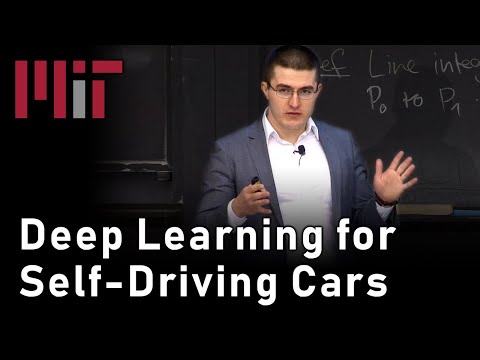 1:31:29ENLex Fridman팟캐스트Is Driving More Like Chess or Conversation? Lex Fridman's Opening Lecture on Deep Learning for Self-Driving Cars진행자 Lex FridmanThe first lecture of MIT 6.S094 introduces neural networks, reinforcement learning and computer vision through the question of how hard driving really is.