









필터 결과
23개정렬
 1:47:38EN
 Cognitive Revolution "How AI Changes Everything"· 2026년 7월 4일팟캐스트19 Neurons Can Drive a Car. Liquid AI Wants Foundation Models on Every Chip진행자 Nathan LabenzRamin Hasani traces liquid neural networks from a worm's 300-cell brain to a 600-megabyte model that will talk from inside a Mercedes, and explains why architecture search now beats architecture avengers.
 1:13:33EN
 Unsupervised Learning: With Jacob Effron· 2026년 6월 3일팟캐스트A Trillion Tokens Later, the Concept Finally Lands: Łukasz Kaiser on What Transformers Still Miss진행자 Jacob EffronThe Attention Is All You Need co-author tells Unsupervised Learning that transformers will probably keep winning — and that they still do not learn the way people do.
 4:25:13EN
 Lex Fridman· 2026년 1월 31일팟캐스트The Architecture Barely Changed. Data, Cost, and Open Weights Did.진행자 Lex FridmanNathan Lambert and Sebastian Raschka walk Lex Fridman through a year in which training methods and datasets moved more than model design, and 2026 looks like a fight over inference cost, agents, and who owns truly open models.
 1:03:00ENUnsupervised Learning: With Jacob Effron· 2026년 1월 29일팟캐스트A Model That Solves New Math Problems Every Week Still Isn't AGI진행자 Jacob EffronFormer OpenAI research VP Jerry Tworek on why scaling still works, why models go hopeless when they fail, and why he left to chase continual learning.
 1:18:05ENUnsupervised Learning: With Jacob Effron· 2025년 12월 18일팟캐스트The Real Bottleneck in AI Research Is Compute, Not Ideas진행자 Jacob EffronAfter NeurIPS, Ari Morcos and Rob Toews sit down with Jacob Effron to argue about plateauing models, SSI’s secrecy, OpenAI’s cash burn, and a set of spicy 2026 bets.
 1:39:05ENCognitive Revolution "How AI Changes Everything"· 2025년 10월 29일팟캐스트The Summer GPT-5 Disappointed Does Not Mean AI Progress Has Stalled진행자 Nathan LabenzNathan Labenz tells Erik Torenberg why the GPT-5 backlash mixed up product mishaps, naming chaos, and a real jump in capabilities.
 1:02:05ENUnsupervised Learning: With Jacob Effron· 2025년 9월 24일팟캐스트$100 Million Researchers and a $200 Billion xAI: An AI Roundtable Does the Math진행자 Jacob EffronDatology’s Ari Morcos and Radical Ventures’ Rob Toews argue over whether models are plateauing, whether RL-environment startups will last, and why Google is the lab they would pick.
 51:08ENUnsupervised Learning: With Jacob Effron· 2025년 4월 15일팟캐스트The Transformer Co-Author Who Says Scaling Hit a Wall진행자 Jacob EffronCohere CEO Aidan Gomez tells Redpoint that a $100 million model is still an amnesiac genius, and that enterprise AI money is concentrating in support, research, and the back office.
 1:10:23ENUnsupervised Learning: With Jacob Effron· 2025년 3월 17일팟캐스트A Million Tokens per Dollar: Why Noam Shazeer Thinks Inference Compute Is Still Untapped진행자 Jacob EffronThe Transformer co-inventor and Gemini researcher Jack Rae walk through test-time compute, Ilya Sutskever's AGI critique, and a four-year-old who now lectures his teacher about lizards.
 48:18ENUnsupervised Learning: With Jacob Effron· 2024년 12월 6일팟캐스트Noam Brown: There's No Hard Wall—Just Eight Orders of Magnitude of Headroom진행자 Jacob EffronA ChatGPT query costs about a penny. The problems society cares about most, he says, are worth a million dollars.
 2:40:58ENCognitive Revolution "How AI Changes Everything"· 2024년 11월 16일팟캐스트Zvi Mowshowitz Still Puts P(doom) at 60%—and Says Not Updating Is Self-Deception진행자 Nathan LabenzA six-month recap with the Don't Worry About the Vase author covering Ilya’s SSI, OpenAI’s o1, Claude’s computer use, the SB 1047 veto, and Trump’s return.
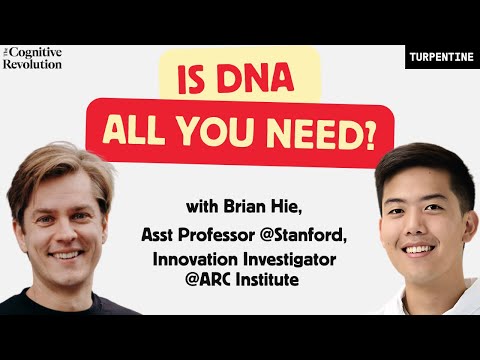 1:18:32ENCognitive Revolution "How AI Changes Everything"· 2024년 9월 20일팟캐스트A DNA Model That Can Tell Which Genes You Cannot Touch진행자 Nathan LabenzStanford's Brian Hie walks through hybrid architectures, a genome-scale language model trained only on DNA, and an antibody that binds 25 times tighter than nature.
 1:23:57ENCognitive Revolution "How AI Changes Everything"· 2024년 9월 4일팟캐스트A Training Run Is a Particle Collider—and the China Contest Is a Fifty-Year Race진행자 Nathan LabenzSamo Burja tells Nathan Labenz why ChatGPT's virality may have slowed AI science, and why Washington should treat Beijing as an economic rival rather than a military one.
 1:01:55ENCognitive Revolution "How AI Changes Everything"· 2024년 6월 1일팟캐스트A $9 AI nurse, an 86 on the medical boards, and a 10% extinction line진행자 Nathan LabenzNathan Labenz’s solo scouting report walks from medical state of the art through how models actually learn, then to live players, scaling trends, and a control plan that still does not exist.
 1:01:39ENCognitive Revolution "How AI Changes Everything"· 2024년 4월 13일팟캐스트GPT-5 Wants 100 Trillion Tokens. Does Earth Have Enough?진행자 Nathan LabenzTraining GPT-3 took about a trillion tokens; GPT-4 took about ten trillion. The next jump is a data question as much as a compute one.
 1:19:52ENCognitive Revolution "How AI Changes Everything"· 2023년 10월 18일팟캐스트1,000 H100s Take 115 Days; 22,000 Take Five진행자 Nathan LabenzNathan Labenz and Trey Kollmer walk through cluster math that turns GPT-4-scale training into a weekly experiment, then four papers on search-augmented models, recursive code improvers, spatial maps inside Llama 2, and what networks do when they have no idea.
 1:33:56ENCognitive Revolution "How AI Changes Everything"· 2023년 7월 6일팟캐스트The AI Scouting Report: 90 Minutes From GPT-4's Exam Scores to Whether Models Understand진행자 Nathan LabenzNathan Labenz spends a solo episode walking through what general-purpose models can do, how they are trained, how capabilities unlock, and whether they understand anything at all.
 1:32:22ENCognitive Revolution "How AI Changes Everything"· 2023년 6월 29일팟캐스트A Million Bytes and 256 Symbols: Meta's MEGABYTE Wants to Throw the Tokenizer Away진행자 Nathan LabenzLili Yu of Meta AI explains a multiscale transformer that predicts million-byte sequences, skips tokenization, and aims to model any file as raw bytes.
 26:02ENLex Fridman· 2020년 2월 9일팟캐스트Moore’s Law Is Not Dead—It Is a Cascade of S-Curves진행자 Lex FridmanJim Keller explains why transistor scaling keeps outrunning its obituary, and how exponential hardware changes the mathematics AI can attempt.
 1:10:19ENUnsupervised Learning: With Jacob Effron팟캐스트The Robot That Folded the Laundry: Physical Intelligence’s Three Frontiers진행자 Jacob EffronKarol Hausman and Danny Driess explain how robot foundation models moved from coded primitives to web-scale pretraining, and why performance is now the hard gate.
 1:14:59EN
 Lenny's Podcast팟캐스트Why Anthropic's Ben Mann Thinks the Exponential Hasn't Slowed, and Why He Still Worries About Safety진행자 Lenny RachitskyThe Anthropic co-founder on the AI talent war, scaling laws, the economic Turing test, jobs, leaving OpenAI, constitutional AI and how he forecasts the risk of superintelligence.
 1:19:48ENLex Fridman팟캐스트Bigger Models, Cleaner Splits and Human Baselines: Andrew Ng's Practical Recipe for Applied Deep Learning진행자 Lex FridmanIn a 2016 Deep Learning School talk, Andrew Ng distills lessons from leading Baidu's AI team into a workflow for diagnosing models, handling data and building a career.
 1:13:40ENUnsupervised Learning: With Jacob Effron팟캐스트The Long Tail, the World Model, and the 1995 Problem: Inside Waymo's Scaling Phase and Robotics' Missing Moment진행자 Jacob EffronVincent, a distinguished engineer at Waymo, explains how foundation models became teachers for self-driving, why the long tail and causality are the real frontier, and where robotics still lacks its generalist proof point.