









필터 결과
15개정렬
 2:59:44EN
 Cognitive Revolution "How AI Changes Everything"· 2026년 6월 3일팟캐스트Two Endangered Languages Broke Transformers. Nested Learning Gave Models a Sleep Button.진행자 Nathan LabenzGoogle researcher Ali Behrouz tells Nathan Labenz how stacking update frequencies — not just layers — and an offline sleep phase could give language models genuine continual learning.
 1:13:23ENCognitive Revolution "How AI Changes Everything"· 2024년 10월 12일팟캐스트An AI Found a GABA-Cancer Link. The Next Step Is Talking to the Cells.진행자 Nathan LabenzMichael Levin and Leo Pio Lopez on a multilayer embedding that predicted melanoma, a cancer with no mutations, and why biology's real interface is cognitive.
 1:59:47ENCognitive Revolution "How AI Changes Everything"· 2024년 10월 5일팟캐스트BCI Would Take 30 Years. This Studio Pivoted to Alignment Instead진행자 Nathan LabenzJudd Rosenblatt and Mike Vaiana of AE Studio describe two biologically inspired results that do not need interpretability breakthroughs to work.
 1:29:14ENCognitive Revolution "How AI Changes Everything"· 2024년 4월 29일팟캐스트55% of People Have Had a Lucid Dream. Prophetic AI Wants the Rest to Have One Every Night진행자 Nathan LabenzProphetic AI co-founders Eric Wollberg and Wesley Berry tell Ate-a-Pi how a headband of EEG and focused ultrasound, steered by a neural transformer, is meant to light up the prefrontal cortex during REM.
 2:09:50ENCognitive Revolution "How AI Changes Everything"· 2024년 4월 26일팟캐스트He stayed up all night playing Civilization 6 with his mind진행자 Nathan LabenzDean W. Ball surveys EEG, ultrasound stimulation, and Neuralink with Nathan Labenz, and argues that merging with machines started decades ago.
 1:34:11ENCognitive Revolution "How AI Changes Everything"· 2024년 4월 17일팟캐스트From forty hours in a scanner to one: reconstructing what you see from a shared brain space진행자 Nathan LabenzPaul Scotti explains how MindEye2 maps a new person's fMRI into CLIP with an hour of data, and why a linear layer plus better image generators changed the cost of reading minds.
 1:25:09ENCognitive Revolution "How AI Changes Everything"· 2024년 2월 9일팟캐스트Two-Headed Worms, Regenerated Legs, and a Sort That Learned to Wait진행자 Nathan LabenzTufts biologist Michael Levin tells Cognitive Revolution why anatomy is rewritable software, and why he stopped a paper that might have made AI more alive.
 1:58:43ENCognitive Revolution "How AI Changes Everything"· 2024년 2월 7일팟캐스트A Worm With 302 Neurons Already Makes Trade-offs. AI Is Still on the Same Ladder.진행자 Nathan LabenzMax Bennett maps 600 million years of brain evolution onto five breakthroughs — and asks which rungs today's models have actually reached.
 1:18:18ENCognitive Revolution "How AI Changes Everything"· 2023년 6월 20일팟캐스트Fifteen Thousand Brain Numbers Were Enough to Reconstruct What Someone Saw진행자 Nathan LabenzTanishq Mathew Abraham walks through MindEye, the fMRI-to-image system that maps a handful of voxel values onto CLIP and diffusion models.
 45:31EN
 Lex Fridman· 2020년 7월 1일팟캐스트You Are Your Own Existence Proof: Karl Friston on Free Energy, Life, and Self-Awareness진행자 Lex FridmanKarl Friston explains how the free energy principle reframes existence, life, planning, and self-awareness as inference problems.
 25:06ENLex Fridman팟캐스트Living Inside the Brain's Story: Joscha Bach on Simulation, Self and Consciousness진행자 Lex FridmanIn a clip from his conversation with Lex Fridman, Joscha Bach argues that consciousness, identity and even God are software-like patterns, and that we exist inside a narrative our brain generates.
 11:51ENLex Fridman팟캐스트Building a Brain: Paola Arlotta on the Choreography of Human Brain Development진행자 Lex FridmanA Harvard stem cell biologist walks through how the embryo builds the cerebral cortex, why order and environment matter, and why development continues into our twenties.
 15:41ENLex Fridman팟캐스트Abolishing Involuntary Death: Ben Goertzel on Immortality, Pain and the Meaning of Life진행자 Lex FridmanIn a clip from Lex Fridman's podcast, AI researcher Ben Goertzel argues that death and pain should be optional, and sketches what it would take to fund a serious attack on aging.
 11:26ENLex Fridman팟캐스트The Cookie Your Brain Bakes: Joscha Bach on Happiness, Cells and the Meaning of God진행자 Lex FridmanIn a short clip, Joscha Bach moves from why happiness is not the point to the cell as a cosmic probe and a naturalistic reading of God as civilization.
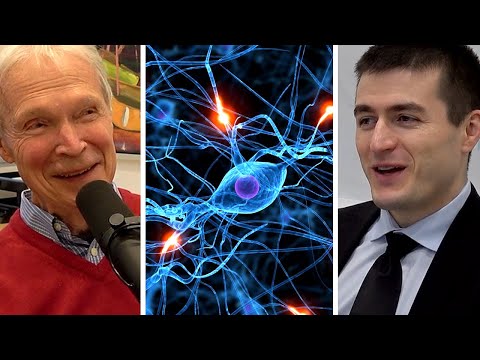 20:50ENLex Fridman팟캐스트Glitches as Features: What John Hopfield Says Artificial Neural Networks Are Missing진행자 Lex FridmanIn a short conversation with Lex Fridman, physicist and neural-network pioneer John Hopfield compares evolved brains with today's artificial networks and explains why he expects AI to borrow from biology generation after generation.