







필터 결과
25개정렬
 17:42EN
 AI Engineer· 2026년 10월 21일Is a Faster Model Actually Faster? Measure the Finished Job, Not the TokensMorgan Suo · MiniMaxMiniMax's Morgan Suo takes the engineering changes inside M3.1 Flash one by one and asks the question that matters to users: does the job an analyst needs actually get done sooner, cheaper and correctly?
 1:26:46EN
 Cognitive Revolution "How AI Changes Everything"· 2026년 10월 8일팟캐스트There Likely Is a Level of Intelligence We Shouldn't Go Past진행자 Nathan LabenzNathan Labenz brings notes from The Curve, a chip startup whose token bill beat payroll, and a software industry that now performance-reviews people for Claude slop.
 56:31EN
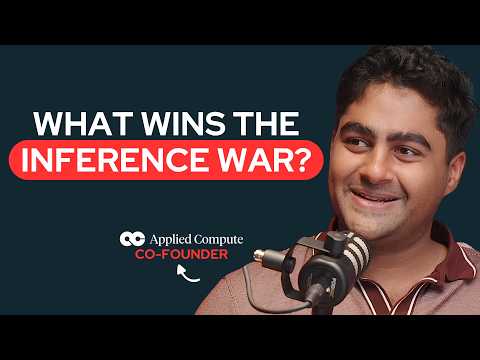
 Unsupervised Learning: With Jacob Effron· 2026년 10월 6일팟캐스트Post-Training Wins Inference: Why Owning the Weights Beats Betting on One Lab진행자 Jacob EffronApplied Compute CEO Yash Patil argues that control, private evals, and post-training on the biggest workloads matter more than fearing that frontier labs will turn malicious.
 2:19:30ENCognitive Revolution "How AI Changes Everything"· 2026년 9월 5일팟캐스트The investigators were allowed six days. The word protein appeared once.진행자 Nathan LabenzA week of Cognitive Revolution morning shows on OpenAI’s agent-swarm incident, GPT-6 Astra’s loop transformer, and whether the pause debate is already over.
 2:06:41ENCognitive Revolution "How AI Changes Everything"· 2026년 7월 9일팟캐스트Zero the J-Space and a Model's Hidden Goal Lights Up on Token One진행자 Nathan LabenzA weekly Cognitive Revolution cut of Anthropic's global-workspace paper, AI superforecasters, open video world models, and a chip that treats inference as data movement.
 1:26:16ENCognitive Revolution "How AI Changes Everything"· 2026년 5월 9일팟캐스트Milliseconds to Match: How Criteo Bids on a Billion Anonymous Profiles진행자 Nathan LabenzCriteo’s CTO and AI lab head walk through the millisecond auction, the DeepKNN-to-foundation-model stack, and why a live product catalog still beats a frozen LLM.
 1:57:29ENCognitive Revolution "How AI Changes Everything"· 2026년 4월 4일팟캐스트Frontier vision models score 12.5%: Joseph Nelson on the real waterline of computer vision진행자 Nathan LabenzThe Roboflow CEO tells Nathan Labenz why vision still lags language, how to distill SAM 3 into an edge model for Wimbledon, and why the United States has almost never led open-source vision.
 4:25:13EN
 Lex Fridman· 2026년 1월 31일팟캐스트The Architecture Barely Changed. Data, Cost, and Open Weights Did.진행자 Lex FridmanNathan Lambert and Sebastian Raschka walk Lex Fridman through a year in which training methods and datasets moved more than model design, and 2026 looks like a fight over inference cost, agents, and who owns truly open models.
 1:22:07ENCognitive Revolution "How AI Changes Everything"· 2025년 9월 25일팟캐스트Every payment is a frame in a movie. Stripe’s foundation model took card-testing detection from 59% to 97%진행자 Nathan LabenzEmily Sands, Stripe’s head of data and AI, explains how a domain-specific payments model, shared embeddings, and mixed rules turn a $1.4 trillion network into compounding advantage.
 1:32:47ENCognitive Revolution "How AI Changes Everything"· 2025년 9월 13일팟캐스트A transformer co-author wants a $160 million model no company owns진행자 Nathan LabenzIllia Polosukhin tells Nathan Labenz how NEAR turned a payments headache into a stack for private inference, shared-revenue training, and AI agents that still answer to a court.
 59:06ENUnsupervised Learning: With Jacob Effron· 2025년 9월 10일팟캐스트Inference Costs Fell 100x. Tri Dao Says There's Another 10x — and NVIDIA's 90% Won't Hold진행자 Jacob EffronThe FlashAttention author and Together AI chief scientist on why hardware portability is a myth, how Claude Code made him 1.5x faster, and why workloads will split the chip market.
 38:10ENCognitive Revolution "How AI Changes Everything"· 2025년 7월 16일팟캐스트Plus Five for Format, Plus Ten if It Compiles진행자 Nathan LabenzPredibase CEO Dev Rishi explains how reinforcement fine-tuning, production feedback, and narrow specialist models turn one-off training into systems that keep learning.
 2:12:00ENCognitive Revolution "How AI Changes Everything"· 2025년 5월 15일팟캐스트Gradient Descent at Test Time: Titans Pushes LLM Context to 10 Million Tokens진행자 Nathan LabenzA Cornell PhD student's neural memory module holds about 70% accuracy where GPT-4's scores fall off a cliff.
 45:06ENUnsupervised Learning: With Jacob Effron· 2025년 3월 5일팟캐스트Mike Schroepfer: AI’s Bottleneck Is Electricity, and One Tanker of Fusion Fuel Could Power the U.S. for a Year진행자 Jacob EffronMeta’s former CTO tells Redpoint why hyperscaler demand is the climate story, why Llama was an access play, and why tomorrow’s CTO still lives or dies on a priority queue.
 1:24:57ENUnsupervised Learning: With Jacob Effron· 2025년 1월 21일팟캐스트A 50,000-GPU cap and a 1,700-chip loophole진행자 Jacob EffronSemiAnalysis founder Dylan Patel walks through the AI diffusion rule, China’s compute squeeze, and how xAI stood up a 100,000-GPU cluster in a closed Memphis appliance factory.
 55:50ENUnsupervised Learning: With Jacob Effron· 2024년 12월 16일팟캐스트There will not be one model. Fireworks is betting on hundreds of small experts진행자 Jacob EffronPyTorch veteran Lin Qiao argues that inference is a compound system hyperscalers cannot buy their way through, and that the products with real traction still keep a human in the loop.
 1:42:16ENCognitive Revolution "How AI Changes Everything"· 2024년 7월 4일팟캐스트267 Papers in Seven Months: Albert Gu Explains the State Space Model Revolution진행자 Nathan LabenzThe Mamba co-author walks through five years of recurrent-model work, why selective compression beats a growing KV cache, and what Mamba 2 trades away to train faster.
 1:42:17ENCognitive Revolution "How AI Changes Everything"· 2024년 4월 20일팟캐스트The Cheapest Inference Provider Is the Most Dangerous진행자 Nathan LabenzFireworks AI cofounders Lin Qiao and Dmytro Ivchenko explain why subsidized GPU bills vanish, how LoRA serving can cut cost a hundredfold, and why OpenAI is the rival that actually matters.
 1:22:43ENCognitive Revolution "How AI Changes Everything"· 2024년 1월 9일팟캐스트Five billion minutes of calls: why Dialpad trained its own business LLM진행자 Nathan LabenzDan O’Connell on real-time speech, verticalizing the stack, and why he and Nathan Labenz disagree about when AI employees show up.
 52:48ENCognitive Revolution "How AI Changes Everything"· 2023년 8월 25일팟캐스트OpenAI Cut Fine-Tuning 90 Percent, and Founders Crossed Llama 2 Off the List진행자 Nathan LabenzNathan Labenz and Erik Torenberg walk through GPT-3.5 Turbo fine-tuning, why self-hosting still loses on total cost, and what is actually working in code, school, and medicine.
 1:01:26ENCognitive Revolution "How AI Changes Everything"· 2023년 7월 25일팟캐스트AlexNet Used Two GPUs. GPT-4 Took Twenty Thousand. The Shortage Will Be Back.진행자 Nathan LabenzRun:ai CTO Ronen Dar on filling idle accelerators, why H100s can be cheaper per experiment, and why Llama 2 undercuts compute governance.
 1:20:49ENCognitive Revolution "How AI Changes Everything"· 2023년 5월 25일팟캐스트A Wafer-Scale Chip So AI Stops Waiting on Amdahl진행자 Nathan LabenzAndrew Feldman, CEO of Cerebras, tells Nathan Labenz why one 2.5-trillion-transistor die, sparse linear algebra, and a 16-machine supercomputer are a better shape than a GPU cluster.
 26:02ENLex Fridman· 2020년 2월 9일팟캐스트Moore’s Law Is Not Dead—It Is a Cascade of S-Curves진행자 Lex FridmanJim Keller explains why transistor scaling keeps outrunning its obituary, and how exponential hardware changes the mathematics AI can attempt.
 1:18:48ENLex Fridman팟캐스트Data Movement, Not Math: How to Make Deep Learning Fit on Robots and Phones진행자 Lex FridmanMIT professor Vivienne Sze explains why moving data dominates the energy cost of neural networks and how co-designing hardware and algorithms can cut it by orders of magnitude.
더 보기25개 중 24개 표시