







필터 결과
149개정렬
 38:17EN
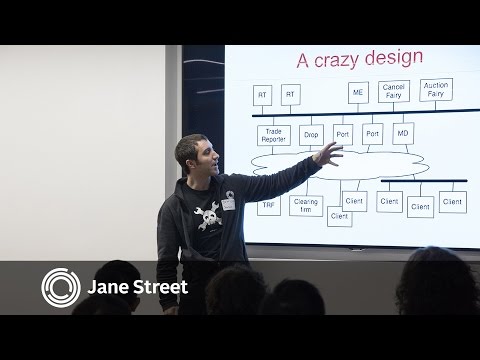
How to Build a Reliable Exchange with Deterministic ReplayA matching engine, multicast and state-machine replication can turn a high-throughput exchange into a recoverable system. This talk explains the design and its tradeoffs.
 25:44EN
Why Functional Programming Matters at Jane StreetA Jane Street developer revisits John Hughes’s classic argument and explains why expressive static types rank highest for trading systems.
 28:31EN
Incremental: Self-Adjusting Computations in OCamlSebastian Funk · Jane StreetSebastian explains Jane Street’s dynamic dependency graph library and the algorithms behind efficient updates.
 1:09:24EN
Yaron Minsky on Effective ML: Writing OCaml for Code ReadersYaron Minsky · Jane StreetPractical lessons from Jane Street on using types, interfaces and abstraction to keep a large OCaml codebase understandable and correct.
 1:06:39EN
Why Jane Street Uses OCamlA Jane Street talk explains how functional programming and static types support reliable trading software, and examines the costs of choosing a less common language.
 23:58EN
Effective ML: Errors, Abstraction and Managing ComplexityA Jane Street engineer discusses explicit failure, boilerplate, type-system restraint and the practical role of side effects.
 1:04:56EN
Yaron Minsky on Incremental: From Research Idea to Production LibraryYaron Minsky · Jane StreetA history of the algorithms, memory problems and performance tradeoffs behind Jane Street’s OCaml library for self-adjusting computations.
 1:12:41EN
Ron Minsky on Trading, Correctness and Jane Street’s Shift to OCamlYaron Minsky · Jane StreetA Jane Street technologist explains the market-making business and why readability, types and predictable performance shaped the firm’s choice of OCaml.
 51:35EN
Yaron Minsky on Effective ML: Interfaces, Invariants and Code ReadersYaron Minsky · Jane StreetIn the first part of a 2011 Harvard lecture, Jane Street’s Yaron Minsky shows how OCaml interfaces and types can make long-lived code easier to understand and change.
 10:20EN
 Lex Fridman팟캐스트 · 2명How C++ Is Standardized: Votes, Consensus and the Move to a Three-Year Release Cycle게스트 Bjarne Stroustrup · 진행자 Lex FridmanBjarne Stroustrup explains how the ISO committee works, why C++0x slipped to C++11, and how shorter cycles made C++14, C++17 and C++20 arrive on time.
 1:19:25EN
 Lenny's Podcast팟캐스트Inside Mercado Libre: How 18,000 Engineers Ship 30,000 Changes a Day Without an Army of PMs진행자 Lenny RachitskySebastian Barrios, formerly head of product and engineering at Mercado Libre and now SVP of Engineering at Roblox, explains how a Latin American giant runs engineering and product as one team.
 1:23:15ENLenny's Podcast팟캐스트 · 2명Camille Fournier on Rewrites, One-on-Ones and Building Platform Teams게스트 Camille Fournier · 진행자 Lenny RachitskyThe author of The Manager's Path explains what annoys engineers about PMs, why rewrites are a trap, how to move into management, and what makes platform teams work.
 1:32:32ENLenny's Podcast팟캐스트 · 2명Devin's Scott Wu on Building an AI Software Engineer and Turning Coders into Architects게스트 Scott Wu · 진행자 Lenny RachitskyThe Cognition co-founder explains how his 15-person team uses fleets of Devins to build Devin, what the product can and can't do, and why he expects more engineers, not fewer.
 40:42EN
 No Priors: AI, Machine Learning, Tech, & Startups팟캐스트 · 2명Don't Mistake a Month of Hype for the End of Software진행자 Sarah Guo, Elad GilSarah Guo and Elad Gil separate the SaaS-apocalypse noise from the real signals: record revenue ramps, collapsing token prices, and the question of when a founder should sell.
 1:16:17ENLenny's Podcast팟캐스트 · 2명Faster, But for What? Nicole Forsgren on Measuring Developer Productivity in the AI Era게스트 Nicole Forsgren · 진행자 Lenny RachitskyThe creator of DORA and SPACE explains why most productivity metrics mislead, how AI changes flow and trust, and how to build a developer experience program that proves its value.
 1:16:53ENLenny's Podcast팟캐스트 · 2명Engineering Leadership After ZIRP: Strategy, Systems and Accountability게스트 Will Larson · 진행자 Lenny RachitskyCarta CTO Will Larson on how engineering management changed after the zero-interest-rate era, and the habits he relies on now: systems models, written strategy, shared incentives and honest values.
 1:41:26EN
 Cognitive Revolution "How AI Changes Everything"팟캐스트The AI Scouting Report, Part 3: What AI Can Already Do, Who Will Win, and Why Nathan Labenz Wants Caution on Scaling진행자 Nathan LabenzNathan Labenz closes his AP-course tour of AI with capabilities, market moats, jobs, law, safety plans and a stance on what to do next.
 1:03:25ENLex Fridman팟캐스트Theano in an Hour: Symbolic Graphs, Automatic Gradients and a Compiler That Rewrites Your Math진행자 Lex FridmanPascal Lamblin of MILA walks through how Theano builds, differentiates, optimizes and runs computation graphs, then trains logistic regression, a convnet and an LSTM.
 10:24ENLex Fridman팟캐스트 · 2명Concepts: How C++ Finally Got Compile-Time Constraints on Templates게스트 Bjarne Stroustrup · 진행자 Lex FridmanBjarne Stroustrup explains what C++ concepts are, why they are real and shippable today, and why it took decades to get them right.
 40:25ENLex Fridman팟캐스트A Language That Knows the World: Stephen Wolfram on Computable Knowledge진행자 Lex FridmanIn this clip from the Lex Fridman Podcast, Stephen Wolfram explains what makes the Wolfram Language different from ordinary programming languages and how it grew into a computable knowledge base, from Wolfram Alpha to computational contracts.
 14:47ENLex Fridman팟캐스트 · 2명Build Your Own Types: What Bjarne Stroustrup Learned from Simula, Fortran and Lisp게스트 Bjarne Stroustrup · 진행자 Lex FridmanThe creator of C++ traces how Simula's user-defined types shaped his language, and why he builds for constrained, long-lived systems.
 1:45:10ENLenny's Podcast팟캐스트 · 2명Shape Up in Real Life: Fixed Time, Variable Scope, and the Shaping Session That Makes It Work게스트 Ryan Singer · 진행자 Lenny RachitskyRyan Singer, author of Shape Up, explains appetites, six-week time boxes and live shaping sessions, and why copying Basecamp's method without its conditions fails.
 1:40:03ENLenny's Podcast팟캐스트 · 2명Do More Per Minute: Shopify's Farhan Thawar on Intensity, Hard Paths and Hiring by Doing게스트 Farhan Thawar · 진행자 Lenny RachitskyShopify's head of engineering explains how pair programming, relentless check-ins, deleted code and job trials keep a 10,000-person company moving fast.
 17:32ENLex Fridman팟캐스트Over-Automating, Googling Doctors and Neural Nets: George Hotz Reviews Programming Memes진행자 Lex FridmanLex Fridman and George Hotz rate printed programming memes, and the jokes turn into candid talk about testing, hiring, social media and the power of neural networks.
더 보기149개 중 24개 표시