









絞り込み結果
198 件並び順
 1:29:30EN
 Cognitive Revolution "How AI Changes Everything"· 2025年10月14日ポッドキャスト2,500 Compounds and a 51 Percent Hit Rate: How a Small Graph Net Found New Antibioticsホスト Nathan LabenzMIT's Jim Collins tells Nathan Labenz how a bootlegged 2018 project, a binary growth-inhibition label, and Chemprop graph networks pulled novel antibiotics out of chemical space that labs could never screen by hand.
 36:58EN
 No Priors: AI, Machine Learning, Tech, & Startups· 2025年10月9日ポッドキャスト · 2 人STaR's Author Wants Models With EQ, Not Just More IQホスト Sarah Guo, Elad GilEric Zelikman, the Stanford and xAI researcher behind STaR and Quiet-STaR, launches humans& on the bet that three years of IQ scaling left models emotionally unintelligent.
 1:01:49ENCognitive Revolution "How AI Changes Everything"· 2025年10月2日ポッドキャストChatGPT's Co-Creator Left to Put Nature in the Reward Loopホスト Nathan LabenzLiam Fedus and Ekin Dogus Cubuk on why language models still fail at physics, why literature data is too noisy to train on, and why Periodic Labs is aiming at a 200K superconductor.
 1:22:07ENCognitive Revolution "How AI Changes Everything"· 2025年9月25日ポッドキャストEvery payment is a frame in a movie. Stripe’s foundation model took card-testing detection from 59% to 97%ホスト Nathan LabenzEmily Sands, Stripe’s head of data and AI, explains how a domain-specific payments model, shared embeddings, and mixed rules turn a $1.4 trillion network into compounding advantage.
 2:02:17ENCognitive Revolution "How AI Changes Everything"· 2025年8月27日ポッドキャストSAEs Find the Nouns. Parameter Decomposition Looks for the Verbsホスト Nathan LabenzGoodfire's Lee Sharkey argues that sparse autoencoders recover a network's variables, not the algorithms those variables run, and shows how stochastic parameter decomposition tries to recover the computations themselves.
 13:30EN
 3Blue1Brown· 2025年8月17日How AlphaGeometry Combines Logical Proof with Creative ConstructionAleph0Aleph0 explains how a symbolic geometry solver gets surprisingly far without AI, and how a language model supplies the auxiliary constructions that take it to Olympiad level.
 57:52EN
 Unsupervised Learning: With Jacob Effron· 2025年8月13日ポッドキャストThey Aimed for 1%. The Lab Hit 20%. Chai Discovery Moved Antibody Design Onto the Computer.ホスト Jacob EffronJoshua Meier on three waves of AI drug discovery, why Chai-2 behaves like Photoshop for molecules, and why a 1% hit rate was supposed to be enough to change the industry.
 30:11EN
 Sequoia Capital· 2025年7月30日ポッドキャストFrom 12 Percent on AIME to IMO Gold in Two MonthsAlex Wei, Sheryl Hsu, and Noam Brown tell Sequoia's Sonya Huang how a three-person OpenAI sprint used general-purpose reinforcement learning, not Lean, to reach gold-level on the 2025 International Mathematical Olympiad.
 23:39ZH
 跟李沐学AI· 2025年7月23日李沐:给文本大模型加入一千万小时语音,开源 Higgs Audio李沐 · Boson AI李沐介绍团队如何在文本大语言模型的训练里加入大量语音数据,做成能听能说的 AudioLLM,并把 Higgs Audio 开源。他讲了架构取舍、token 压缩、数据从哪来,以及怎么在 3090 上跑起来。
 38:10ENCognitive Revolution "How AI Changes Everything"· 2025年7月16日ポッドキャストPlus Five for Format, Plus Ten if It Compilesホスト Nathan LabenzPredibase CEO Dev Rishi explains how reinforcement fine-tuning, production feedback, and narrow specialist models turn one-off training into systems that keep learning.
 1:42:06ENCognitive Revolution "How AI Changes Everything"· 2025年7月8日ポッドキャストEvery Frontier Lab Is Spending a Billion a Year on Data. Here Is Where It Goesホスト Nathan LabenzLabelbox CEO Manu Sharma on the $15 billion Scale deal, RL “gyms,” $250,000 trainers, and why post-training now eats the budget that used to belong to pre-training.
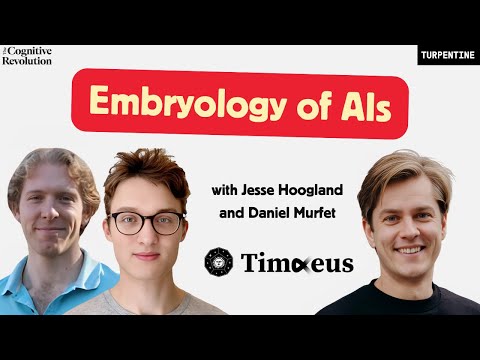 1:37:05ENCognitive Revolution "How AI Changes Everything"· 2025年6月19日ポッドキャストAn Algebraic Geometer Quit Tenure Because the Bowl-Shaped Loss Plot Is a Lieホスト Nathan LabenzJesse Hoogland and Daniel Murfet of Timaeus argue that singularities in the loss landscape — not the smooth valleys in every slide deck — are what actually govern how neural networks learn, generalize, and go wrong.
 48:51ENSequoia Capital· 2025年6月17日ポッドキャストThe Breakthroughs for AGI Are Already Done, Says OpenAI’s Former Research HeadBob McGrew tells Sequoia’s Training Data that 2025 is the year of reasoning, agents will be priced at the cost of compute, and nothing fundamental will be added to the stack by 2035.
 1:54:08ENCognitive Revolution "How AI Changes Everything"· 2025年5月29日ポッドキャストWhy Anthropic's first check went to a company building microscopes for neural netsホスト Nathan LabenzGoodfire's Dan Balsam and Tom McGrath argue that mechanistic interpretability now has a proto-paradigm, two stubborn gaps, and three products worth shipping today.
 2:12:00ENCognitive Revolution "How AI Changes Everything"· 2025年5月15日ポッドキャストGradient Descent at Test Time: Titans Pushes LLM Context to 10 Million Tokensホスト Nathan LabenzA Cornell PhD student's neural memory module holds about 70% accuracy where GPT-4's scores fall off a cliff.
 47:00ENUnsupervised Learning: With Jacob Effron· 2025年5月8日ポッドキャストAn Eval Lasts Three Months — and a Frozen Frontier Would Still Feed Startups for a Decadeホスト Jacob EffronOpenAI’s GPT-4.1 post-training lead Michelle Pokrass tells Unsupervised Learning how the team spent three months on evals before training, why agents fail on wiring more than intelligence, and when to reach for RFT.
 38:10ENNo Priors: AI, Machine Learning, Tech, & Startups· 2025年5月1日ポッドキャスト · 2 人o3 should wait exactly as long as the answer takesホスト Sarah Guo, Elad GilOpenAI researchers Eric Mitchell and Brandon McKinzie tell No Priors why o3's leap is a chain of tools during reasoning — and why you should send the same prompt a hundred times.
 58:11ENSequoia Capital· 2025年4月15日ポッドキャストPatrick Hsu Wants an App Store for Biology, Not Just Better DrugsThe Arc Institute co-founder argues that Evo 2, trained on genomes rather than proteins, should underpin tools for every step of the scientific method.
 1:14:11ENCognitive Revolution "How AI Changes Everything"· 2025年4月5日ポッドキャストThe Reasoning Curve Was Smooth All Along: Gemini 2.5's Jack Rae on Thinking, Memory, and AGIホスト Nathan LabenzDeepMind's thinking-and-inference lead explains why RL-for-reasoning felt sudden, why Gemini shows raw chain of thought, and why a million-token window still is not memory.
 1:43:54ENCognitive Revolution "How AI Changes Everything"· 2025年3月23日ポッドキャストA Year to Grow a Brain Organoid, an Hour to Simulate Itホスト Nathan LabenzStanford postdoc Siyu He tells Nathan Labenz how Squidiff and CORAL move single-cell and spatial experiments into the computer — and where the models still cannot go.
 35:14ENNo Priors: AI, Machine Learning, Tech, & Startups· 2025年3月20日ポッドキャスト · 2 人Robots Have No Wikipedia. Chelsea Finn Is Starting With Three Buildings.ホスト Sarah Guo, Elad GilPhysical Intelligence’s cofounder tells No Priors why a generalist robot model has to be trained across embodiments, why open-sourcing hardware is a bet against the problem going unsolved, and why humanoids are a little overrated.
 1:10:23ENUnsupervised Learning: With Jacob Effron· 2025年3月17日ポッドキャストA Million Tokens per Dollar: Why Noam Shazeer Thinks Inference Compute Is Still Untappedホスト Jacob EffronThe Transformer co-inventor and Gemini researcher Jack Rae walk through test-time compute, Ilya Sutskever's AGI critique, and a four-year-old who now lectures his teacher about lizards.
 1:56:38ENCognitive Revolution "How AI Changes Everything"· 2025年3月8日ポッドキャストo3 took ARC from 20% to 87%. Nathan Labenz sketches early superintelligenceホスト Nathan LabenzOn Consistently Candid, the Cognitive Revolution host argues that math and coding will be superhuman by 2026, and that a reasoning core plus specialist “intuitive physics” may already be enough.
 57:41ENNo Priors: AI, Machine Learning, Tech, & Startups· 2025年2月25日ポッドキャスト · 2 人A Hundred Million Cells, Four People, Three Days: Biology's ImageNet Momentホスト Sarah Guo, Elad GilVevo Therapeutics and the Arc Institute open-sourced Tahoe-100M and a 230-million-cell atlas in the same week — and argued that virtual cells, not just protein folders, are the next language model of biology.
もっと見る198 件中 24 件を表示