







Résultats
24 articlesTrier
 34:11EN
 GOTO Conferences· 23 oct. 2026Anatoliy Bilenko and Alberto Carretero: Making Database Protocols Reliable with Formal Methods and AIAnatoliy Bilenko, Alberto Carretero · CanonicalCanonical’s database engineers connect executable specifications, model-based tests, failure exploration, and reconstructed execution histories—and explain why none of these techniques proves a real system correct on its own.
 1:48:29EN
How AI Is Changing Programming: John Krazit and Ron MinskyRon Minsky, John Krazit · Jane StreetJane Street’s AI tooling lead and the Signals and Threads host examine agent infrastructure, security, code review and the changing experience of writing software.
 1:25:00EN
Eric Mannes on Turning Messy External Data Into Trading ResearchRon, Eric Mannes · Jane StreetFrom commodity futures and an Excel risk system to point-in-time datasets and AI, Eric Mannes explains the domain knowledge behind data engineering at Jane Street.
 1:34:29EN
Jacob Baskin on Building Superstore and Scheduling the HiveYaron Minsky, Jacob Baskin · Jane StreetThe Jane Street engineer traces the design choices behind a distributed analytical database and the challenge of allocating a growing research cluster.
 1:34:36EN
Nate Foster: Treating the Network as a ProgramYaron Minsky, Nate Foster · Jane StreetFrom programmable switches to BGP, a programming-languages researcher explains how higher-level policies and formal models can make networks easier to change.
 1:48:21EN
Will Wilson on Deterministic Simulation and the Hard Problems of Software TestingYaron Minsky, Will Wilson · Jane StreetThe Antithesis co-founder explains how replayable simulations explore complex software, why properties matter and where testing meets its limits.
 1:12:58EN
Chris Lattner on Mojo and the Search for Portable GPU PerformanceYaron Minsky, Chris Lattner · Jane StreetRon Minsky and Chris Lattner discuss the language and compiler design behind Modular’s effort to make accelerator programming both portable and fast.
 1:01:23EN
Will Crichton on Making Rust More UnderstandableWill Crichton · Brown UniversityOwnership visualizations, interactive trait diagnostics and program slicing illustrate an evidence-based approach to developer tools.
 1:27:41EN
Ron Minsky on the Saga of Multicore OCaml at Jane StreetRon Minsky · Jane StreetA production migration exposed garbage-collector regressions, led to a new pacing design, and illustrated the difficulty of turning research into reliable infrastructure.
 53:51EN
Liora Friedberg on Solving Puzzles in ProductionYaron Minsky, Liora Friedberg · Jane StreetProduction engineering combines live incident response with software, process improvements and a culture that helps people learn from mistakes. Liora Friedberg and Ron Minsky explore the work at Jane Street.
 1:03:36EN
Erin Murphy on Designing Tools for Expert UsersRon Minsky, Erin Murphy · Jane StreetFrom NASA scientists to Jane Street engineers, a UX designer explains how observation, drawing and collaboration reveal what complex tools need to do.
 59:38EN
Richard Eisenberg on Dependent Types, OCaml, and AI-Assisted ProgrammingYaron Minsky, Richard Eisenberg · Jane StreetHow type systems can express correctness and performance, and why precise, readable specifications still matter when AI writes code.
 37:24EN
Grace and Nolen's Software Engineering Mock InterviewGrace, Nolen · Jane StreetA unit-conversion graph illustrates how Jane Street interviewers discuss design, code, errors and communication with a candidate.
 1:00:28EN
Ella Ehrlich on Modernizing a Critical Trading SystemRon Minsky, Ella Ehrlich · Jane StreetJane Street’s Gord team rebuilt parts of a legacy data pipeline while preserving availability, and Ehrlich describes the recruiting programs she helped develop.
 1:22:34EN
Stephen Dolan on Memory Management, Garbage Collection, and OCamlRon Minsky, Stephen Dolan · Jane StreetFrom tracing and reference counting to prefetching, local allocation and unboxed types, Dolan explains the tradeoffs behind safe, efficient memory management.
 1:01:11EN
Anil Madhavapeddy on MirageOS and the Evolution of Operating SystemsRon Minsky, Anil Madhavapeddy · Jane StreetFrom Xen and unikernels to OCaml's multicore research, a systems researcher explains how changing abstractions reshape infrastructure.
 1:00:04EN
Ty Overby on Bonsai and Building Functional User InterfacesYaron Minsky, Ty Overby · Jane StreetWhy Jane Street built a composable OCaml UI framework, and what its design reveals about incremental computation, browsers, and visual programming.
 1:00:58EN
James Somers on Technical Writing, Software and RevisionRon Minsky, James Somers · Jane StreetJane Street’s writer-in-residence discusses documentation as shared knowledge, the tools that keep it useful, and the craft of writing for real readers.
 59:33EN
Laurent Mazare on Python, OCaml and Machine LearningRon Minsky, Laurent Mazare · Jane StreetA researcher compares exploratory notebooks with robust production systems, and explains how language interoperability and resource management connect the two.
 1:10:27EN
Greta Yorsh on Compiler Optimization and FeedbackRon Minsky, Greta Yorsh · Jane StreetFrom formal verification and superoptimization to profile-guided code layout, a compiler engineer explains how performance work meets real users.
 59:26EN
Andy Ray on FPGAs, Hardware Design and HardcamlYaron Minsky, Andy Ray · Jane StreetJane Street’s hardware design lead explains why programmable circuits can improve performance and how software tooling makes them easier to build and test.
 47:18EN
Unboxed Types and Memory Layouts for OCamlStephen · Jane StreetStephen explains a proposed type-system extension for controlling data representation while retaining OCaml’s fast separate compilation.
 1:02:34EN
Andy Ray on Designing and Running OCaml on FPGAsAndy Ray · Jane StreetHardCaml turns OCaml into a hardware design language. Andy Ray explains FPGA fundamentals, simulation and verification, then demonstrates an OCaml software stack running on a soft CPU.
 38:17EN
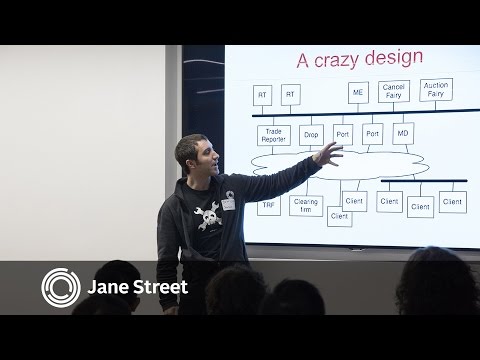
How to Build a Reliable Exchange with Deterministic ReplayA matching engine, multicast and state-machine replication can turn a high-throughput exchange into a recoverable system. This talk explains the design and its tradeoffs.